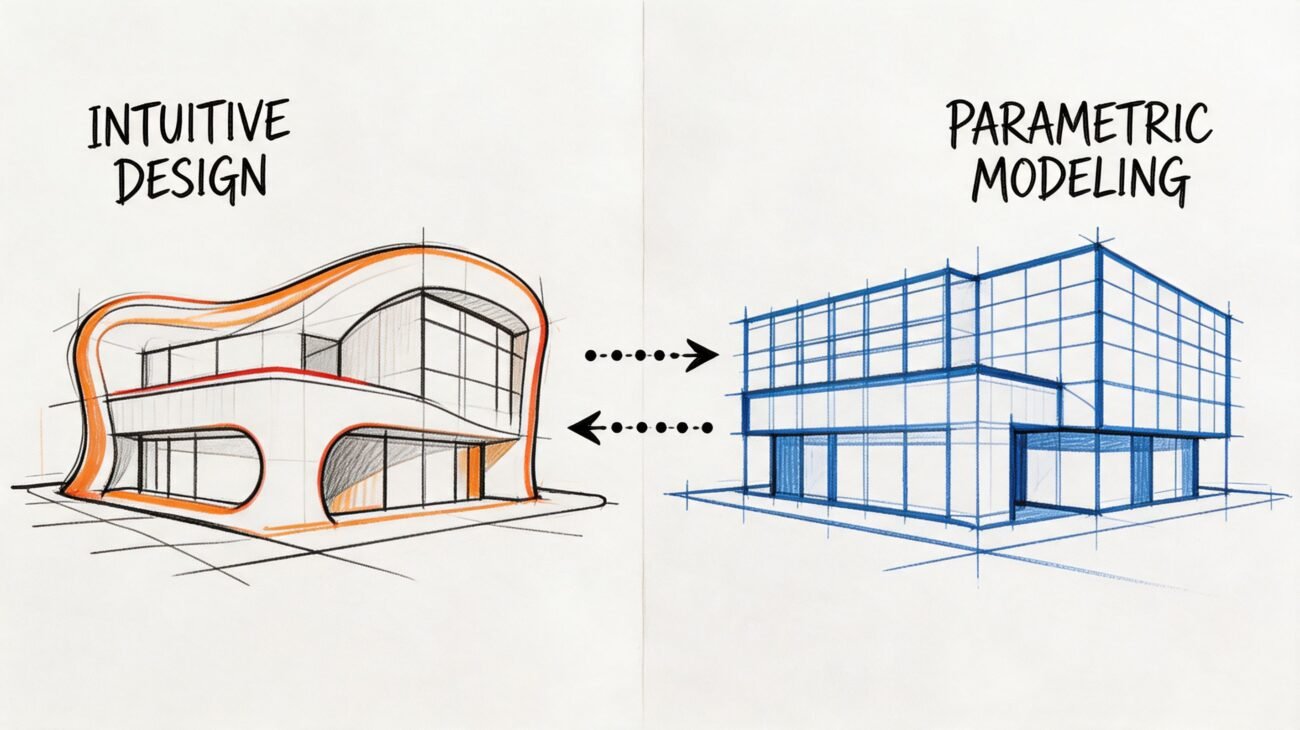
When firm leaders consider outsourced architectural services, the conversation often jumps to the risks—losing control, inconsistent quality, or communication gaps. But we’ve seen that the success of an outsourced project is determined long before you choose a partner. The real variable isn’t who you hire; it’s how you prepare the work.
Most outsourcing failures are caused upstream by unclear scope, inconsistent standards, and undocumented workflows. Outsourcing isn't a handoff of responsibility; it's a capacity and production strategy. The better you prepare a project for collaboration, the more predictable and high-quality the outcome will be.
Why Most Outsourcing Failures Are Set Upstream
Almost every firm has a horror story about outsourcing architectural drafting. The plot is always the same: endless back-and-forth emails, drawings that are technically correct but not usable, and an internal team spending more time fixing outsourced work than they saved. This experience convinces many that the model is broken.
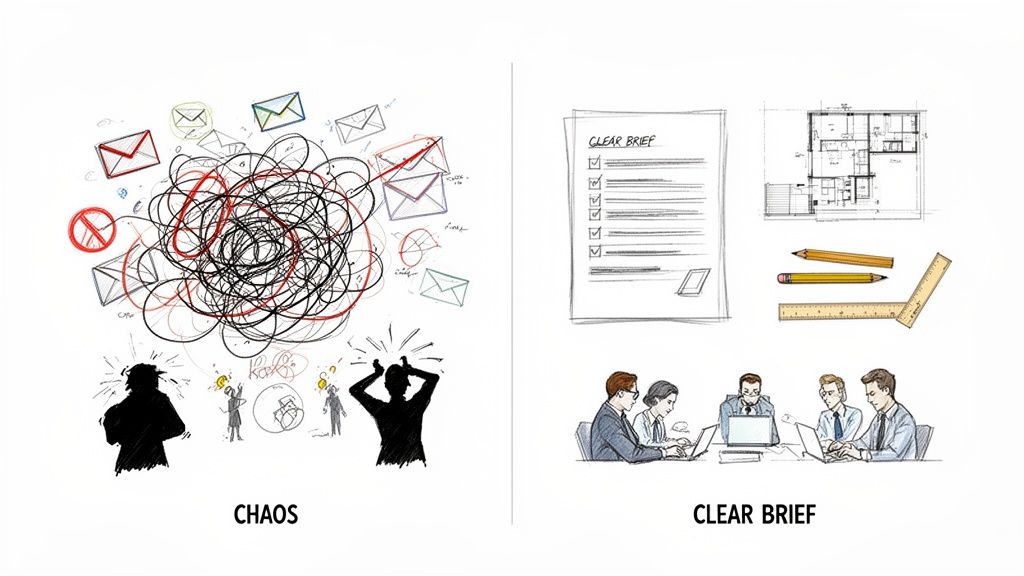
But the problem isn't the model; it’s the lack of preparation. We’ve seen outsourced teams perform at their best when projects arrive with clarity instead of assumptions.
Expecting an external team to guess your firm’s standards, design intent, and QA processes is a recipe for frustration. It erodes your margins and reinforces the idea that outsourcing is a risk. True success comes from treating your partner as a scalable delivery pod that executes on your well-defined systems.
The Upstream Causes of Downstream Pain
The vast majority of outsourcing disasters can be traced back to a few predictable upstream failures. When these fundamentals are missing, the project is guaranteed to suffer from rework, QA overload, and missed deadlines.
Here are the usual suspects:
- Unclear Scope: A vague definition of deliverables and exclusions is a direct path to scope creep and disputes.
- Inconsistent Standards: Without documented CAD templates or BIM standards, your outsourced team is forced to improvise, and their interpretation will rarely match yours.
- Missing Templates: No established title blocks, layer conventions, or family libraries? The output will never align with your firm's professional identity.
- Vague Expectations: Assumptions about the required Level of Development (LOD) or drawing quality are rarely communicated, leading to mismatched deliverables.
These issues are often symptoms of deeper operational challenges that affect firms whether they outsource or not. You can dig deeper into these common hurdles in our article on the 5 mistakes small architecture firms make when growing their teams.
The difference between a smooth partnership and a painful one almost always comes down to the quality of the project handoff.
Prepared vs. Unprepared Outsourcing Outcomes
| Project Aspect | Outcome With Poor Preparation | Outcome With Thorough Preparation |
|---|---|---|
| Onboarding | Weeks of confusing back-and-forth; multiple kickoff calls | Quick, focused onboarding; team is productive from day one |
| First Delivery | Rework required; doesn't match firm standards; creates more work | High-quality first draft; aligns with standards; minimal tweaks needed |
| Communication | Constant clarification emails; project manager is bogged down | Efficient, targeted communication; focuses on progress, not problems |
| Timeline | Significant delays; missed deadlines due to rework cycles | Project stays on schedule; predictable delivery timelines |
| Team Morale | In-house team is frustrated; "outsourcing doesn't work" mentality | In-house team feels supported; sees partner as a valuable extension |
| Final Cost | Budget overruns from extra hours spent fixing errors | Project is completed on or under budget |
Ultimately, architecture outsourcing preparation separates a strategic asset from a costly liability.
Reframe Outsourcing as a Production Strategy
To make outsourcing work, stop thinking of it as a transaction and start treating it as a strategic partnership. Your partner team isn't there to read minds; they are there to execute a well-defined plan using your established production systems. When you provide that plan, the results become predictable, consistent, and scalable.
The core lesson is this: outsourcing works best when projects are prepared for collaboration—not when clarity is expected to emerge later. The quality of your preparation directly determines the quality of the outcome.
Think of it like manufacturing. A factory can’t produce a high-quality car from a confusing blueprint and a pile of mismatched parts. In the same way, an outsourced architectural services team needs clear instructions and the right assets to deliver work that slots perfectly into your projects, protecting your margins and reputation.
Define Your Project Intent and Scope
Success with an outsourced team begins with absolute clarity. Before a single line is drawn, you must define the ‘why’ and the ‘what’ of the project. This isn't just about writing a brief; it's about creating a single source of truth that prevents costly misunderstandings and prevents RFIs.
Move Beyond the Brief to Project Intent
Before listing deliverables, document the project’s core intent. This goes deeper than the building's function; it addresses the business goals driving the project. Why is this project happening, and what does a successful outcome look like for your client and your firm?
Answering these questions upfront empowers your production partner to make intelligent decisions when they encounter gray areas. It provides the context needed to ensure the final output is not just technically accurate but genuinely aligned with your design vision.
Your project intent is the north star for every decision. It should clearly answer: What are the top three priorities for this project (e.g., speed to permit, cost efficiency, design innovation)? What are the absolute non-negotiables?
When this is documented, your internal team and external production pod are pulling in the same direction. It’s your first defense against the endless email chains that drain a project's profitability.
Create an Airtight List of Deliverables and Exclusions
Once the intent is set, create a precise list of deliverables. Vagueness is the enemy. A non-specific list is the number one cause of scope creep and friction.
For example, instead of "Provide construction documents," a better definition would be:
- Deliverables:
- Full set of architectural construction documents in Revit 2023 format.
- Complete sheet set exported to a multi-page PDF.
- Individual sheets exported to DWG format.
Equally important is a list of exclusions. Clearly stating what is not included is one of the best ways to avoid the dreaded "we thought you were handling that" conversation.
- Exclusions:
- Structural, MEP, and fire protection drawings.
- Renderings or visualizations.
- Permit application submission and management.
This level of detail creates clear boundaries, protecting your margins and ensuring predictable outcomes. If you want to understand how clients search for these services, check out the Top 10 Best Architect Keywords for industry insights.
Define Level of Development (LOD) for BIM Projects
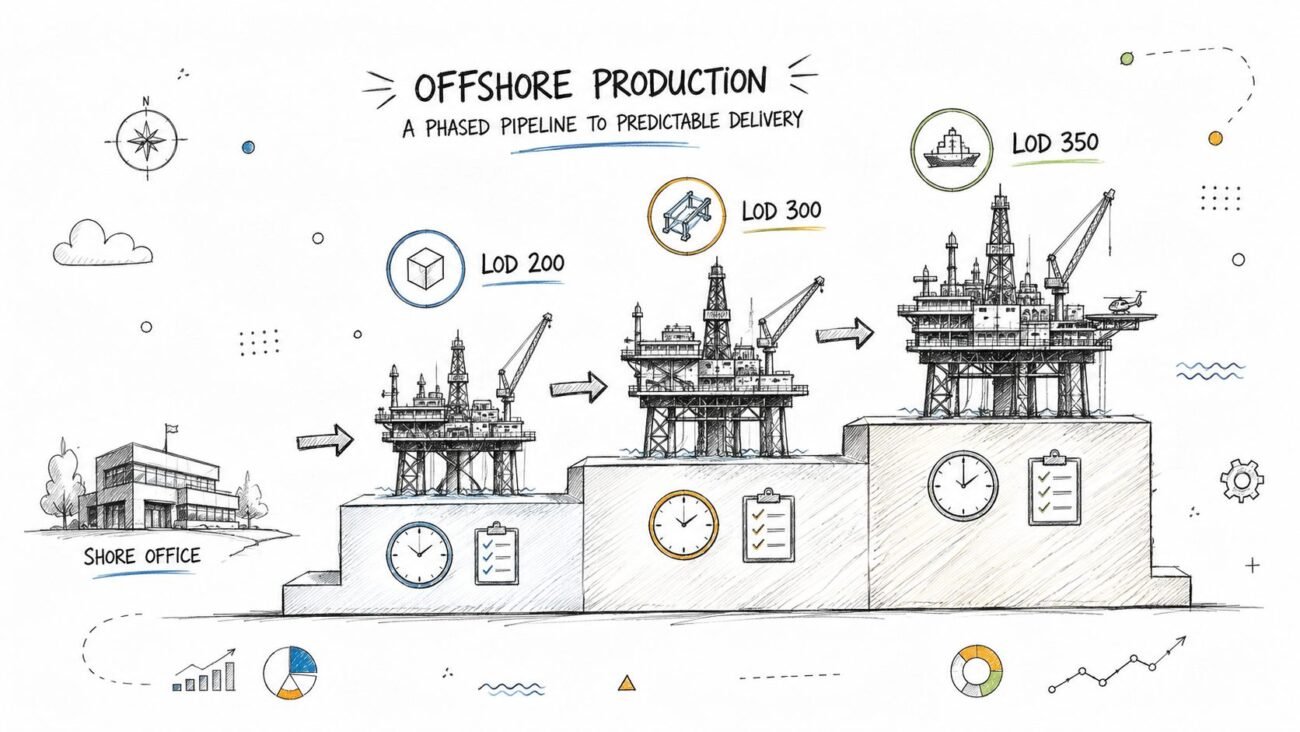
For any project involving a BIM outsourcing workflow, defining the Level of Development (LOD) is non-negotiable. The LOD specifications from the BIMForum outline how much reliable information is embedded in a model element. We've seen projects go off the rails because of mismatched LOD expectations, resulting in models that are too vague or overly detailed for their intended purpose.
Your handoff package must include clear LOD requirements for key milestones:
- Schematic Design (LOD 200): Model contains generic placeholders with approximate quantities, size, shape, and location.
- Design Development (LOD 300): Model contains specific assemblies with precise quantities, size, shape, and location.
- Construction Documents (LOD 350): Model includes details for how elements interface with other building systems.
Documenting LOD expectations eliminates guesswork and ensures the model you receive is fit for purpose at every stage. This single step will save countless hours of rework and QA headaches.
Standardize Your Production Engine for Consistency
Once you’ve defined the scope, the conversation shifts from what to build to how to build it. This is where operational consistency and template discipline become your most valuable assets. A standardized production engine protects your margins and stops the dreaded feedback: "the outsourced work just doesn't look like ours."
Ambiguity is the enemy of efficient production. When an external team has to guess your firm’s standards, they will inevitably guess wrong, kicking off a painful cycle of rework that eats into your budget. The entire point of architecture outsourcing preparation is to eliminate that guesswork. It's about packaging your firm’s production DNA—your templates, standards, and QA processes—into a clear, replicable system.
The Power of Well-Defined Templates and Standards
Your templates are more than just starting points; they are the scaffolding for quality and consistency. A solid handoff package for any outsourced architectural services must include your firm’s established digital assets. This builds a foundation that ensures every deliverable aligns with your quality expectations.
To get this right, focus on building a workflow for scalable growth by providing clear, documented guidance on these key components:
- CAD/BIM Templates: Your primary Revit or AutoCAD template files, pre-loaded with your standard view templates, families, and settings.
- Title Blocks and Sheet Layouts: Your standardized title blocks for all required sheet sizes.
- Layer and Naming Conventions: A document outlining your rules for layers, family names, view names, and sheet numbering.
- Annotation Standards: Specifics on your preferred styles for text, dimensions, tags, and symbols.
Without these assets, you're asking your partner to reverse-engineer your standards, a recipe for inconsistent output and wasted hours on avoidable revisions.
The Sample Set: Your Blueprint for Replicating Quality
While templates provide the rules, a sample set shows what success actually looks like. This is arguably the most valuable asset you can give an outsourcing partner. A sample set is a small, complete project that perfectly embodies your firm’s quality standards in practice.
Think of it as a finished example that answers dozens of questions before they are asked. It visually demonstrates everything from line weights and graphic styles to the level of detail you expect in construction documents.
A sample project removes all subjectivity. It gives your partner a clear, visual target to hit. It’s the ultimate shortcut to getting work back that feels like it came directly from your in-house team.
By providing this reference, you shift the conversation from abstract rules to a concrete example of a high-quality finished product. Building these kinds of production assets is a critical exercise for any firm looking to scale. You can learn more about how to build production systems that survive deadlines and staff turnover.
Standardizing your production engine isn’t about being rigid; it’s about creating clarity. When you remove ambiguity, the outsourcing architectural drafting process becomes a seamless extension of your own studio.
Build a BIM Outsourcing Workflow That Works
Effective collaboration is built on a structured process, not just good intentions. A solid BIM outsourcing workflow is what separates a smooth, predictable project from a chaotic mess of crossed wires and QA overload. It's a framework designed to protect your margins, maintain control, and ensure deliverables meet your standards.
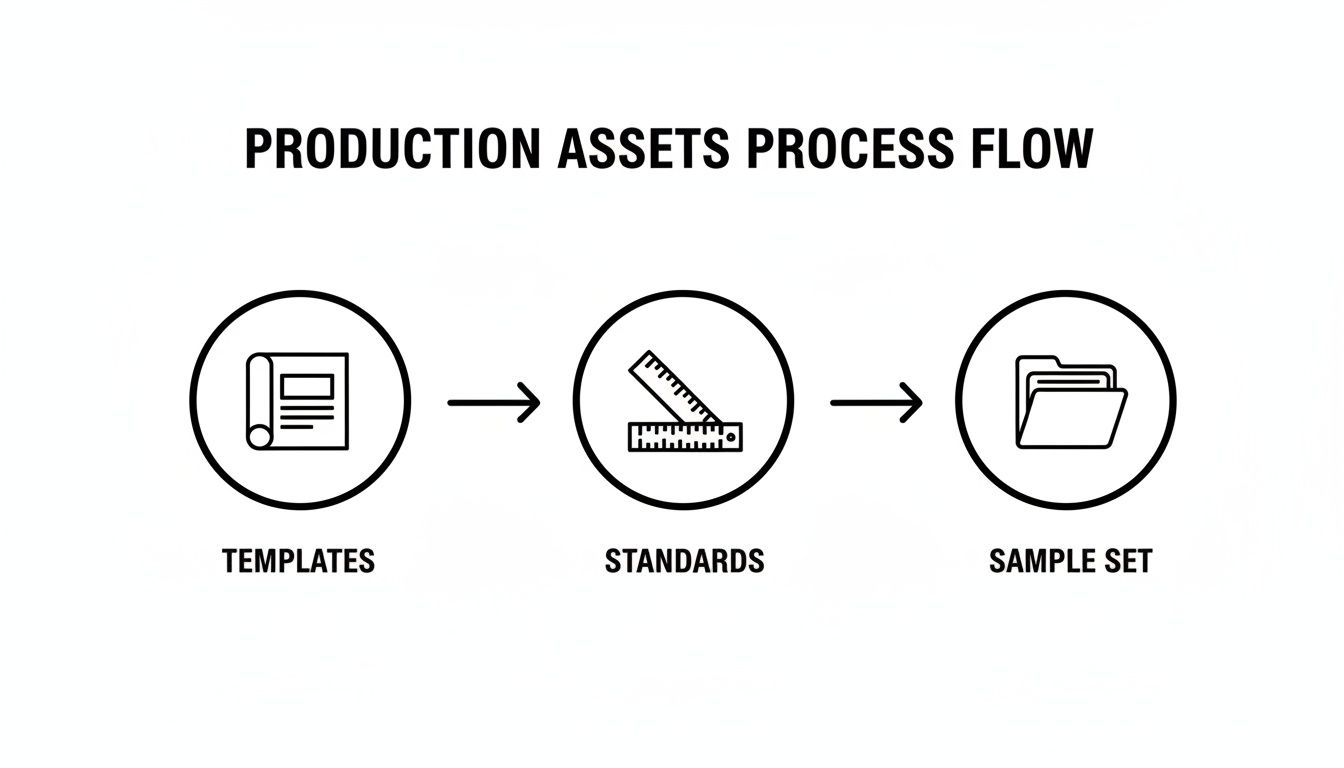
Moving from foundational templates to documented standards and a clear sample set removes the guesswork and establishes a benchmark for quality.
Establish a Single Point of Coordination (SPOC)
Conflicting feedback is one of the fastest ways to derail a project. When an outsourced team gets mixed messages from multiple people at your firm, progress grinds to a halt. The solution is simple and non-negotiable: establish a Single Point of Coordination (SPOC) on both sides.
Your internal SPOC is the one person responsible for gathering, reconciling, and delivering all feedback. Instead of five different people sending five sets of markups, one person consolidates everything into a single, unambiguous set of instructions. This discipline prevents confusion and makes the entire feedback loop more efficient.
Your outsourcing partner should have a dedicated SPOC, too, ensuring you always know who to contact and that your questions are routed correctly.
Implement Milestone-Based QA Checkpoints
Quality assurance shouldn't be a last-minute inspection. A smarter approach is to build it into the process with planned, milestone-based QA checkpoints. These are critical decision checkpoints, not just error-catching sessions.
Structure your checkpoints around key project phases:
- Schematic Design Review: Ensure the model aligns with the project’s core intent and massing.
- Design Development Review: Verify that major systems are coordinated and LOD requirements are on track.
- 50% CD Review: Dig into the details—assemblies, annotations, and sheet setup.
- 95% CD Review: Perform one final coordination and completeness check before issuance for permitting prep.
This cadence catches issues early when they are cheap and easy to fix. It transforms QA from a confrontational "gotcha" moment into a collaborative process of refinement—a core benefit of effective BIM modeling services.
Create Protocols for RFIs and Communication
Requests for Information (RFIs) are a normal part of any project, but they can quickly become a bottleneck if not managed well. A chaotic RFI process—with questions scattered across emails and chat messages—is a recipe for wasted time and increased risk.
Set up a clear RFI protocol from day one. Use a shared RFI log to track every question and its resolution. The outsourcing team should batch questions and submit them at agreed-upon intervals. Your SPOC then coordinates the answers and updates the log. This system prevents constant interruptions and ensures every question gets a clear, definitive answer, effectively preventing downstream issues.
By building a structured workflow, you turn outsourcing from a leap of faith into a predictable, scalable production strategy.
Your Essential Project Handoff Checklist
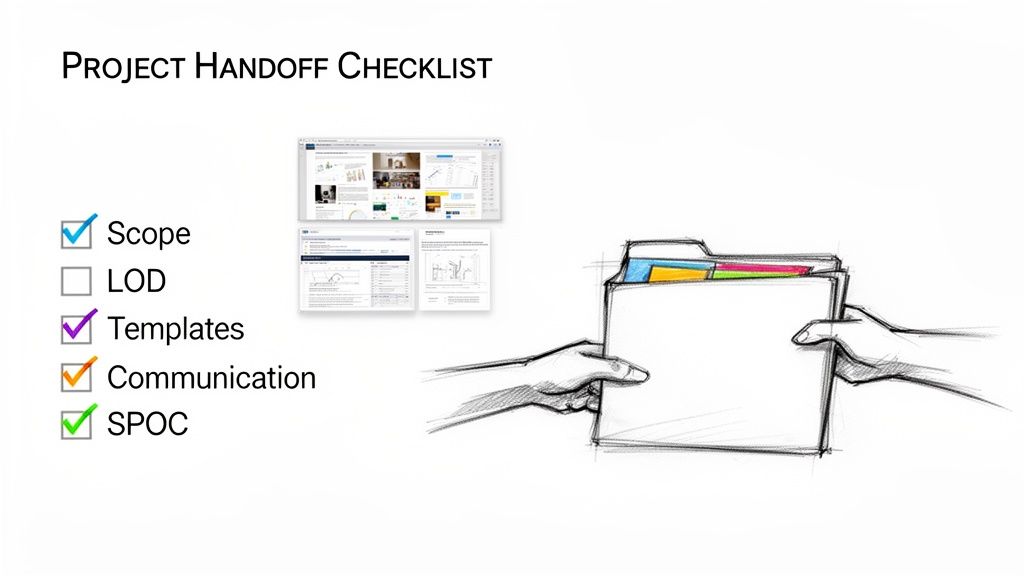
Turning theory into practice separates a successful project from a frustrating one. To ensure your next venture with an outsourced architectural services partner runs smoothly, we've distilled these principles into a practical handoff checklist. This is your framework for clarity.
We’ve seen it time and again: outsourced teams do their best work when a project arrives with clear instructions, not a pile of assumptions. This checklist is your first step toward building that clarity, protecting your margins, and ensuring deliverables meet your firm’s high standards from day one.
Core Handoff Components
Before kicking off, ensure these items are documented, packaged, and ready for your production partner.
Project Intent and Scope Definition
- Priorities: Are the top three project goals clearly stated (e.g., speed to permit, cost efficiency)?
- Deliverables: Is there a specific, itemized list of what the outsourced team will produce?
- Exclusions: Have you explicitly listed all work that is out of scope to prevent confusion?
- LOD Requirements: For BIM projects, is the required Level of Development defined for each project milestone?
Standardized Production Assets
- Templates: Have you provided your firm’s standard CAD or BIM templates, complete with title blocks, view settings, and families?
- Standards Document: Is there a simple guide covering your layer conventions, naming rules, and annotation styles?
- Sample Project: Have you included a small, completed project as a clear visual example of your quality standards?
This package of assets is the single most effective tool for preventing the common "technically correct but not usable" feedback. It replaces guesswork with a clear, replicable system for quality.
Communication and Workflow Protocols
Finally, a successful BIM outsourcing workflow relies on a clear operational structure. Get this right, and the rest falls into place.
- Coordination and QA Framework
- Single Point of Coordination (SPOC): Have you designated one person on your team to consolidate and deliver all feedback?
- QA Checkpoints: Are milestone-based review cycles (e.g., SD, DD, 50% CD) scheduled and agreed upon?
- Communication Protocol: Is there a defined process for handling RFIs, like a shared log and scheduled submission times?
Thorough architecture outsourcing preparation transforms outsourcing from a simple handoff into a true collaboration. By ensuring these elements are in place, you empower your partner to deliver predictable, high-quality results.
To help you get started, we've created a comprehensive Project Readiness Checklist for Architectural Outsourcing. Download it to ensure no detail is missed.
Frequently Asked Questions
Even with the best preparation, a few questions always pop up when firms think about bringing on an outsourced architectural services partner. Here are the answers to the ones we hear most often from firm leaders, architects, and builders.
How Is Intellectual Property Handled?
Your designs are your firm’s lifeblood, so protecting your intellectual property (IP) is non-negotiable. Any reputable outsourcing partner will tackle IP ownership head-on in the service agreement or a dedicated non-disclosure agreement (NDA).
The standard practice is simple: all work product created for your project belongs exclusively to you. The contract should spell out that the partner has zero rights to reuse, share, or claim any ownership of your designs, templates, or project files. Always give this clause a thorough read before you sign anything.
How Do We Manage Communication Across Time Zones?
Good communication in a BIM outsourcing workflow isn't about being online 24/7—it's about being predictable. The most successful partnerships set up a specific "overlap window" of a few hours each day. This is your time for real-time collaboration like video calls or quick-fire discussions.
For everything else, you lean on those structured systems we talked about: a single point of coordination (SPOC) and a shared RFI log. This asynchronous rhythm means your project keeps moving forward overnight while questions are neatly batched for you to review during your workday, keeping disruptions to a minimum.
How Do We Choose the Right Outsourcing Partner?
Look past the flashy software talk. The right partner is the one who’s more interested in your production maturity and QA processes than their toolset. A team that digs deep into your standards, templates, and review cycles during the sales process? That’s a team that gets what it takes to make outsourcing architectural drafting a success.
Ask to see case studies or sample projects that match the complexity of your own work. A partner with a proven track record in your specific sector—whether it’s residential, commercial, or industrial—is going to understand the small details that make a big difference and deliver a much better result.
At BIM Heroes, we know that successful outsourcing is built on clarity and preparation. Our teams are designed to be a seamless extension of yours, executing on well-defined systems to deliver predictable, high-quality architectural production, every time.
To see how ready your next project is for this step, download our Project Readiness Checklist for Architectural Outsourcing.