


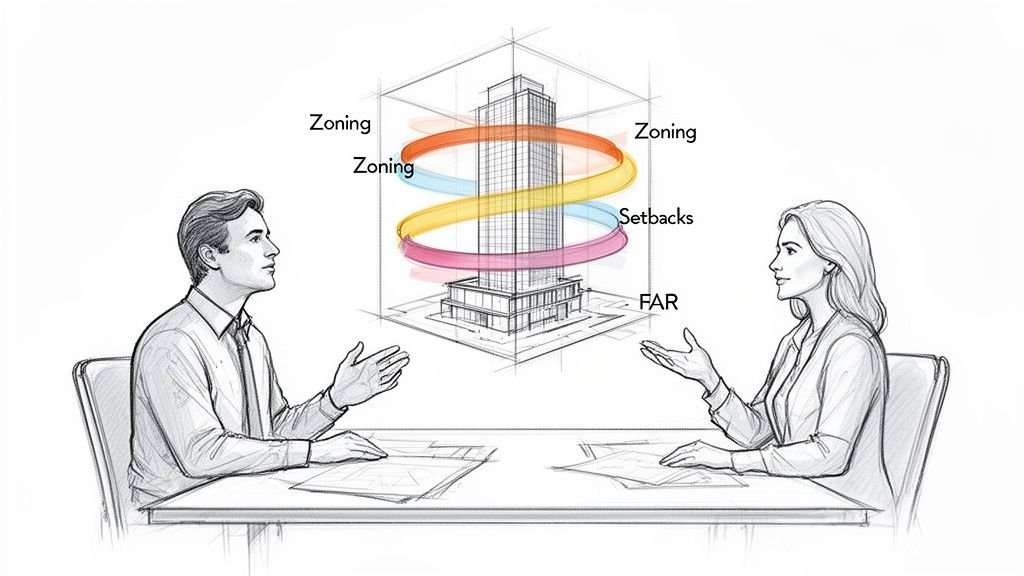
A client buys a site, their vision is crystal clear, and they come to you ready to start designing. But the architect's first job isn't to sketch—it's to find out what the zoning code actually allows. And what it allows is often very different from what the client imagined. Zoning regulations, setback requirements, floor area ratios, height limits, and a dozen other code parameters define the envelope within which any design must fit before a single line gets drawn.
Code research is not a bureaucratic formality that happens before the real work begins—it is the real work at the feasibility stage. Understanding what the regulations allow, how to interpret ambiguous language, and how those parameters translate into buildable square footage is the foundation every good architectural feasibility study is built on.
What Zoning Actually Is and Why It Matters
Zoning is a legal framework established by local municipalities that divides land into districts and defines what can be built in each—what uses are permitted, how tall buildings can be, how much of the lot can be covered, and how structures must be positioned relative to property lines.
Every parcel of land in a US municipality is assigned a zoning designation—residential, commercial, industrial, mixed-use, and many subcategories within each. This designation determines the baseline rules for what can be built, but it's rarely the only regulatory layer that applies.
- Overlay districts, historic preservation zones, flood plain regulations, and specific plan areas can all add requirements on top of base zoning.
- Zoning codes are written by planners and interpreted by zoning administrators—which means the written code and its practical application don't always match.
For architects, zoning research isn't just reading a document; it's understanding a regulatory system and often engaging with local planning departments to confirm interpretations before committing to a design direction. Knowing how a particular municipality interprets its own code is just as important as reading the code itself. This proactive work is a hallmark of production maturity and a key to predictable outcomes.
The Key Zoning Parameters Every Feasibility Study Must Address
Once you know a property's zoning, the real work begins. You must translate dense legal language into a clear set of design constraints that will shape everything from the building's form to its financial viability. These are the core parameters every zoning research feasibility study must nail down.
Permitted Use
The first question: is the intended use permitted in this zone? Uses are typically classified as:
- Permitted by right: The use is allowed as long as it meets all other rules.
- Conditionally permitted: The use requires a conditional use permit—an entitlement process that adds time, cost, and uncertainty.
- Prohibited: The use is not allowed.
Mixed-use projects need to confirm that every use in the program is permitted. Some uses, like drive-throughs or childcare facilities, often trigger additional specific conditions.
Setbacks
Setbacks define the minimum distance a structure must be from property lines—front, rear, and side. They directly determine the buildable footprint of the site.
- Corner lots often have two front setbacks, which can significantly reduce the buildable area.
- Some jurisdictions measure setbacks from the centerline of the adjacent street, not the property line—a critical distinction on narrow lots.
- Accessory structures and certain architectural projections may have different setback rules.
Understanding setbacks is the first step in translating a site plan into a buildable envelope.
Floor Area Ratio (FAR)
Floor Area Ratio (FAR) is the ratio of total building floor area to the area of the lot. A FAR of 2.0 on a 10,000 square foot lot allows 20,000 square feet of building area.
FAR is one of the most important parameters for density; it defines the maximum amount of space that can be built. What counts toward FAR varies by jurisdiction—parking, mechanical spaces, and below-grade areas may or may not be included. Understanding FAR is essential for developers evaluating whether a site can support their program.
Height Limits
Maximum building height is typically defined in feet, number of stories, or both. How height is measured varies—from grade, from average grade, from finished floor—and the method can significantly affect what's achievable on sloped sites.
Lot Coverage
Lot coverage defines the maximum percentage of the lot that can be covered by structures. It works with FAR; a project might have enough FAR for a large building but be constrained by lot coverage to a smaller footprint, requiring more floors to achieve the same area.
Parking Requirements
Minimum parking requirements define how many spaces must be provided based on use and square footage. This can be a major constraint on urban infill sites where structured parking is expensive. Knowing current requirements is essential, as some municipalities have reduced minimums in transit-rich areas. For a closer look at how use and occupancy drive these requirements, our guide on determining occupancy load offers essential context.
How Architects Research Zoning for a Feasibility Study
Proper zoning research for an architectural feasibility study isn't just a Google search—it’s a disciplined professional activity. It’s a core part of what a mature practice offers: reliable systems and predictable outcomes.
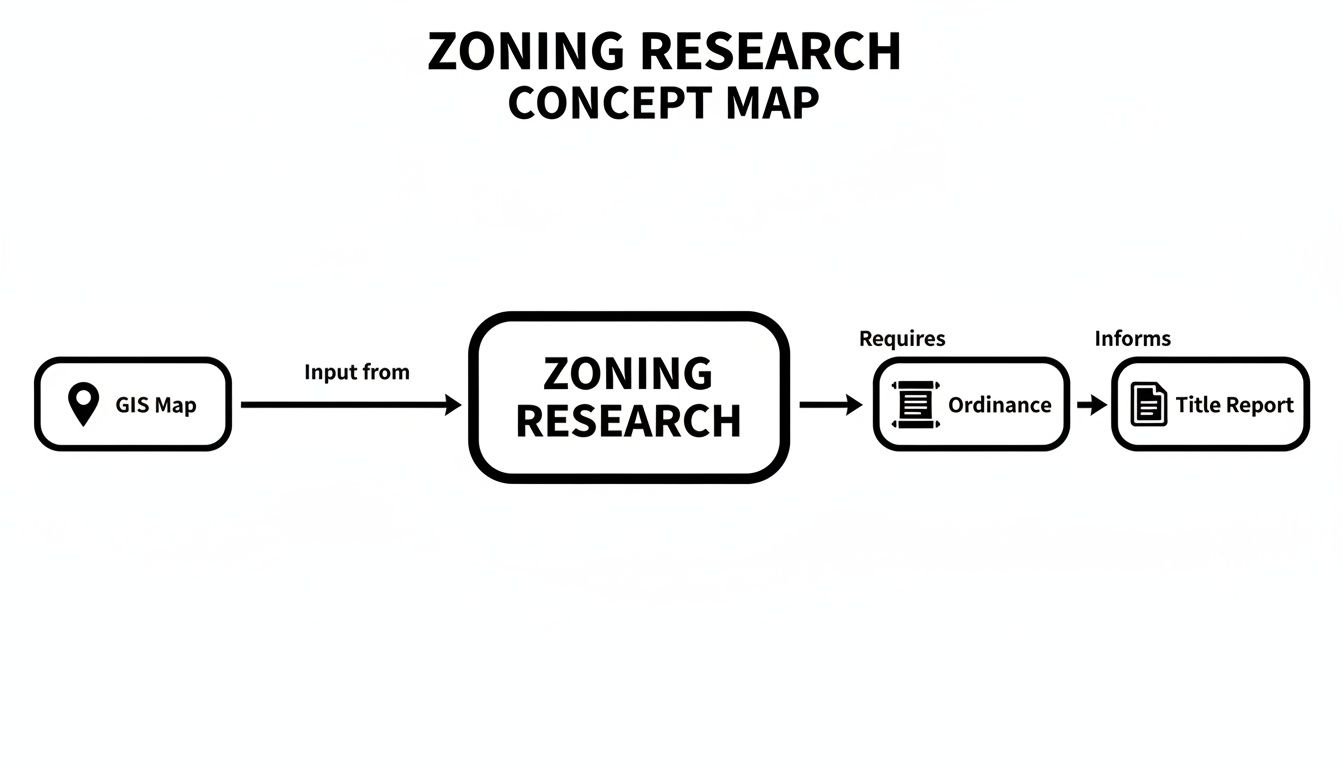
The process starts with the municipality's online zoning map to confirm the parcel's zoning designation. Most US cities and counties have publicly accessible GIS-based maps. Next, pull the zoning ordinance for that designation and read the use table, development standards, and any special conditions.
A thorough process digs deeper:
- Check for overlay districts: Historic, flood, transit, or design review overlays add requirements on top of base zoning.
- Review the parcel's title report: Look for recorded easements, CC&Rs, or deed restrictions that may further limit what can be built. These are not zoning documents but constrain development equally.
- Check with the local planning department: Confirm interpretation of any ambiguous code language. This is a crucial decision checkpoint.
- Research pending zone changes: General plan amendments could affect the site, a key risk for long-duration projects.
Finally, document everything. The feasibility study should include a clear summary of the applicable regulations with code citations so the client and subsequent team members can verify the research. This discipline prevents costly RFIs and redesigns down the road.
Translating Code Parameters Into a Buildable Envelope
This is where abstract research becomes a three-dimensional design constraint. Once setbacks, height limits, lot coverage, and FAR are confirmed, the architect can define the maximum buildable envelope—the three-dimensional zone within which any building must fit.
This is typically expressed as a massing diagram, a simple 3D block showing the outer limits of what zoning allows. The massing diagram is one of the most valuable deliverables in a feasibility study because it makes abstract regulations visually tangible for clients.
From this envelope, the architect calculates the maximum achievable floor area and compares it to the client's program. This is the moment feasibility is confirmed or challenged.
- If the achievable area falls short, the options are to pursue a variance, reduce the program, or reconsider the site.
- If the area exceeds the program, the massing study can explore how to best fit the building within the envelope.
BIM tools are increasingly used at this stage. Even simple massing models in Revit or SketchUp allow architects to quickly test configurations and share them in a format clients understand, a key step in a mature CAD-to-BIM workflow. This disciplined process of understanding BIM for land use regulations builds the foundation for a predictable design.
Where Code Research Gets Complicated
Feasibility code research is genuinely difficult in the real world. This is where field-tested experience and robust QA processes make all the difference.
- Ambiguous Codes: Zoning codes are not always well-written. Internal inconsistencies and outdated provisions are common, requiring skilled interpretation.
- Local Interpretation: The difference between what the code says and what the planning department will approve is real. Local knowledge and relationships with planning staff matter.
- Nonconforming Lots: Parcels or buildings that predate current zoning have their own complex rules about what modifications are permitted.
- Mixed-Use Projects: Projects with residential above commercial often have separate development standards for each component that need to be reconciled.
- Entitlement Risk: The possibility that a conditional use permit or variance will be denied or unexpectedly conditioned is a real project risk that feasibility studies must assess and communicate honestly.
Navigating these complexities is what separates amateur analysis from professional-grade due diligence that protects project margins.
The Cost of Getting Code Research Wrong
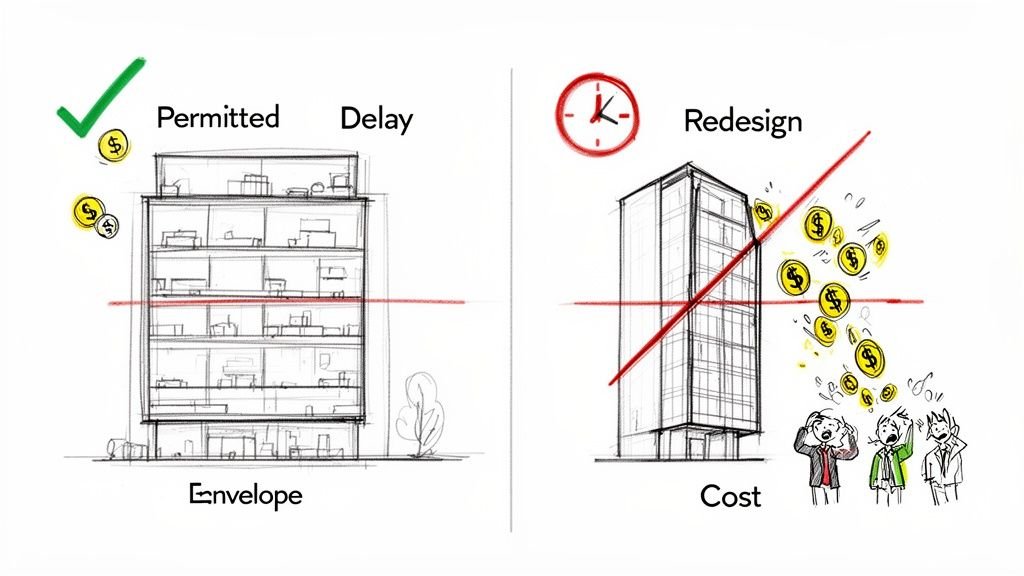
Inadequate feasibility code research is one of the most damaging and expensive mistakes a design team can make. It directly threatens margin protection and operational consistency. The consequences are severe:
- A building designed beyond the allowable FAR has to be reduced in scope—potentially after significant design investment.
- A use that wasn't confirmed as permitted triggers a conditional use permit process that adds months and uncertainty to the schedule, a critical failure in permitting prep.
- A setback that was misread results in a design that can't be permitted without a variance—another entitlement process with no guaranteed outcome.
- Parking requirements that weren't confirmed at feasibility result in a structured parking requirement that blows the project budget. Miscalculating details like ADA parking requirements can be especially costly.
Each of these outcomes is avoidable with thorough code research. Correcting them after design is underway is far more expensive than getting it right before it begins. Discovering a fatal regulatory constraint after schematic design is complete is one of the most damaging things that can happen to an architect's credibility.
How BIM Heroes Supports Feasibility and Early Stage Documentation
BIM Heroes supports architects during feasibility and early design by producing the massing models, site diagrams, and preliminary documentation that translate code research into visual deliverables clients can understand. Our scalable delivery pods work as an embedded production partner, not just producing drawings but understanding the regulatory context that drives them.
We have deep experience producing buildable envelope studies in Revit, showing how setbacks, height limits, and FAR constraints define the 3D zone a project must fit within. We then support the transition from feasibility into schematic design by evolving the massing model, ensuring early regulatory constraints remain visible as design decisions are made. This template discipline is key to a smooth handoff to the permit set documentation phase.
We are familiar with US zoning frameworks, site documentation requirements, and the level of detail planning departments expect in early-stage submissions. We don’t sell hours; we sell clarity, systems, and reliable delivery.
Your Framework for Predictable Project Starts
We return to the opening scenario: the client, ready to design before anyone has checked the zoning. The architect's most valuable contribution at this stage isn't a design idea, but a clear-eyed assessment of what regulations allow.
Zoning, setbacks, and FAR are not obstacles to design—they are the framework within which good design happens. Architects who do this research thoroughly, interpret it accurately, and communicate it clearly set every project up for a smoother path through design, permitting, and construction. Those who do it superficially will eventually find themselves redesigning something that should have been right the first time. This isn’t aspirational; it’s just how successful projects are built.
Starting a new project and need feasibility documentation or early-stage massing models? Let's talk about how BIM Heroes can support your code research and preliminary design workflow.