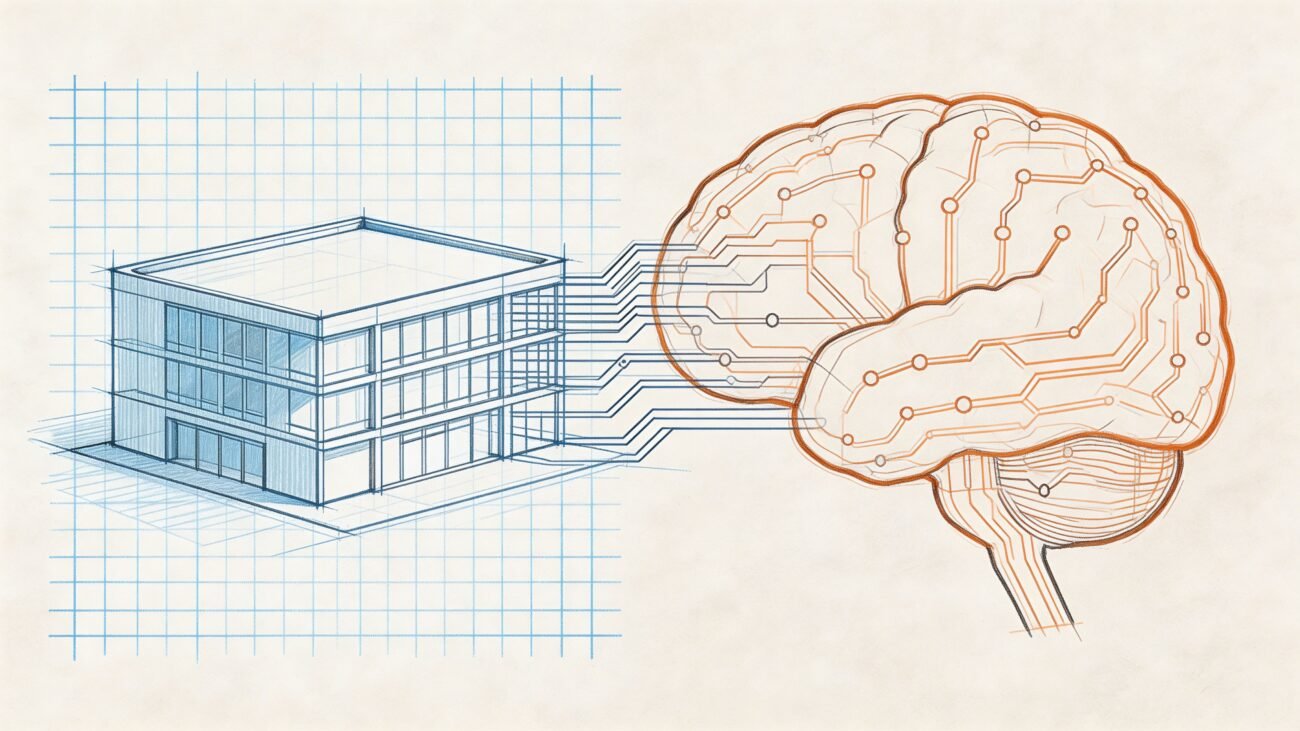
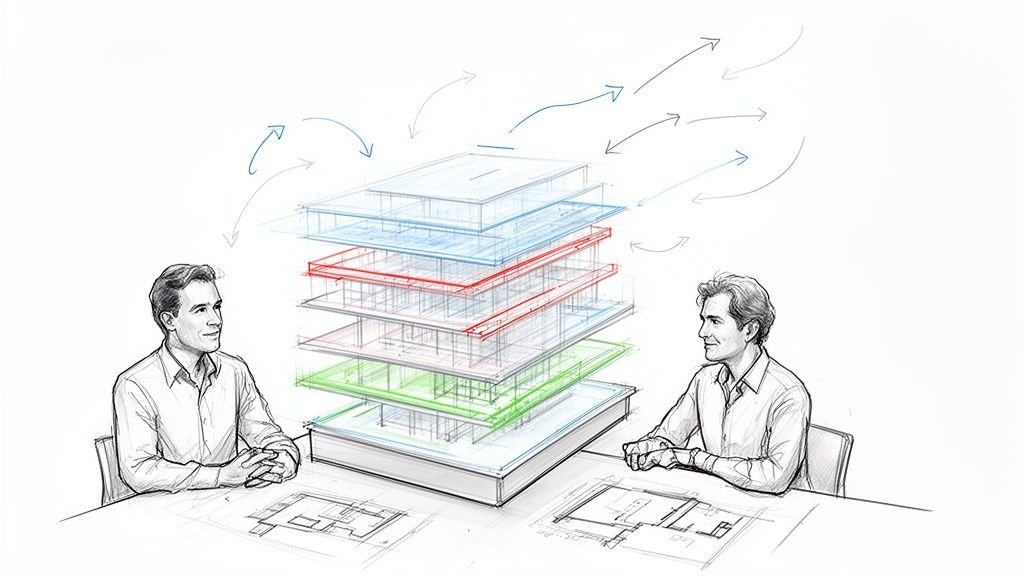
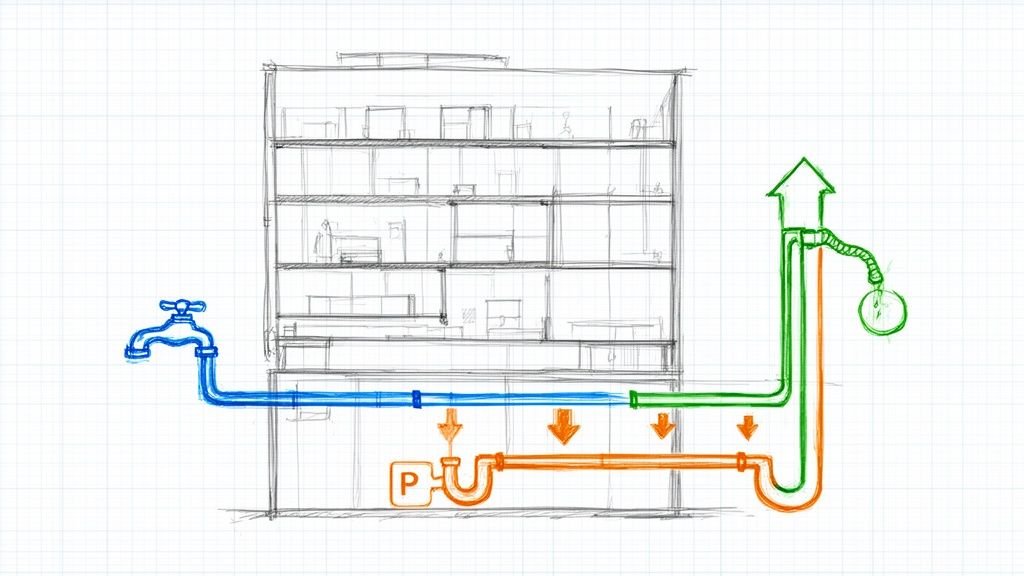
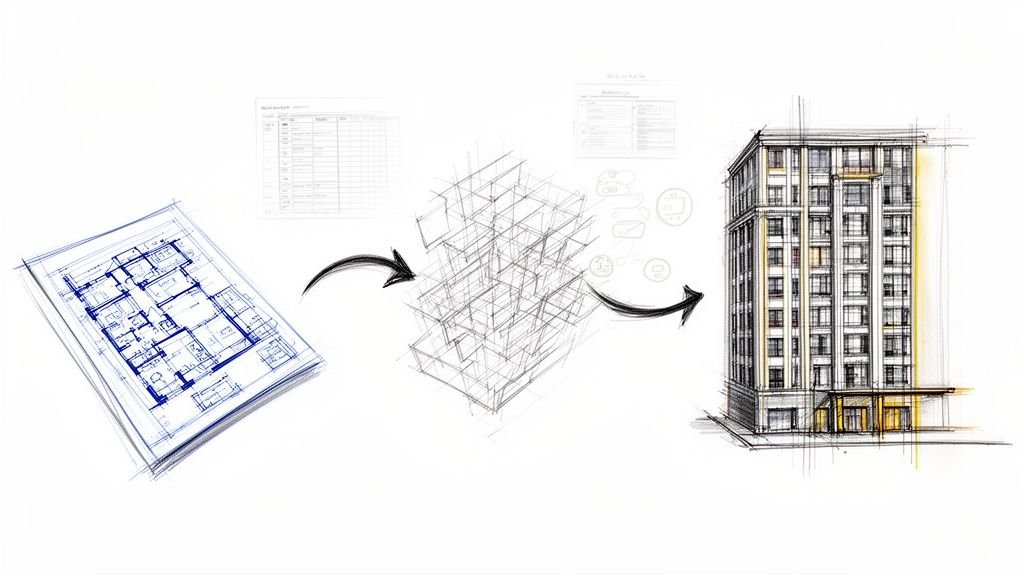
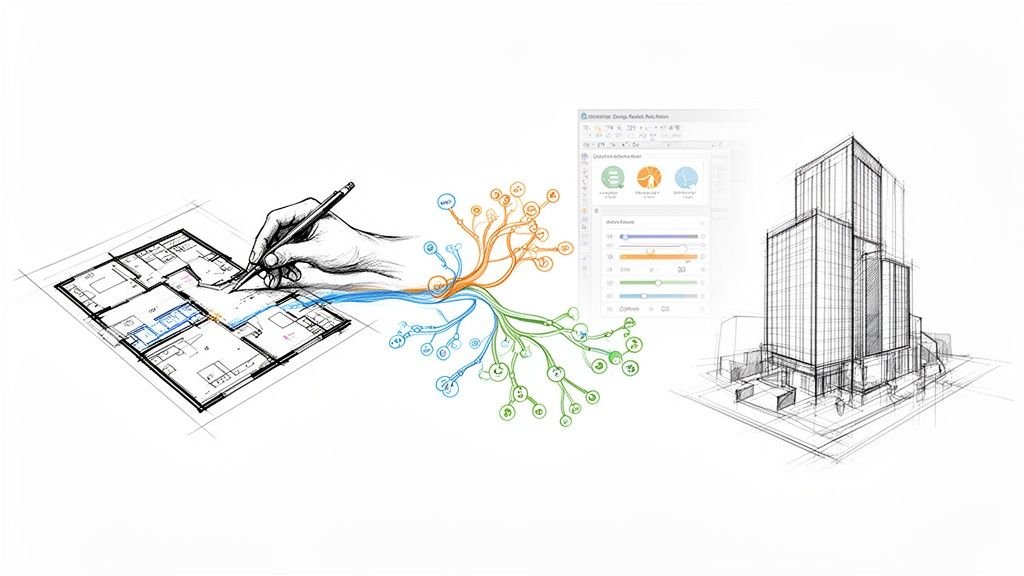
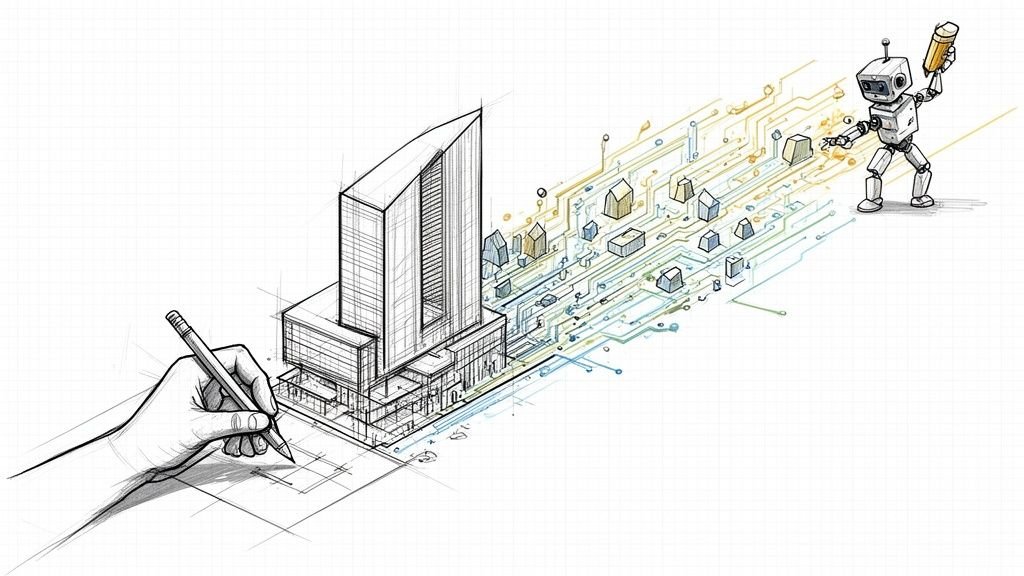
Let's get straight to the point: AI isn't coming for your job, but it is coming for your most tedious tasks. For drafters, BIM techs, and design leads anxious about AI, this is a critical distinction. The rise of AI in BIM doesn't mean production teams are obsolete; it means your value is shifting from manual execution to strategic oversight.
This guide cuts through the noise to discuss the real-world implications: how production teams move from manual drafting to supervision, QA review, and standards enforcement—protecting project margins and building operational consistency along the way.
The Truth About AI in BIM and Your Job
Any conversation about AI in the AEC world is loaded with anxiety. If you’ve spent years mastering drafting and modeling, the thought of an algorithm taking over can feel unsettling.
But that fear misses a key detail. AI is brilliant at repetitive, data-heavy lifting, but it has zero understanding of critical judgment or design intent. That’s where you come in.
We’ve seen AI become faster than humans at layouts, but not better at judgment. The real story here is about role evolution, not replacement. Production teams are moving from being the manual ‘doers’ to the strategic ‘supervisors’ of these automated systems—a shift that requires new skills but leverages your core experience.
How AI Is Changing Production Tasks
This shift is less about eliminating tasks and more about augmenting them. What used to be a hands-on, manual effort is now becoming a process of validation, quality control, and strategic oversight. The core skills are still essential, but the application is changing.
| Traditional Task | AI-Augmented Task | New Professional Focus |
|---|---|---|
| Manually drafting floor plans | Reviewing AI-generated layout options | Validating design intent, optimizing space adjacencies |
| Identifying clashes visually | Auditing automated clash detection reports | Prioritizing critical issues, strategic problem-solving |
| Creating schedules from scratch | Verifying AI-optimized construction schedules | Analyzing logistical risks, ensuring resource allocation |
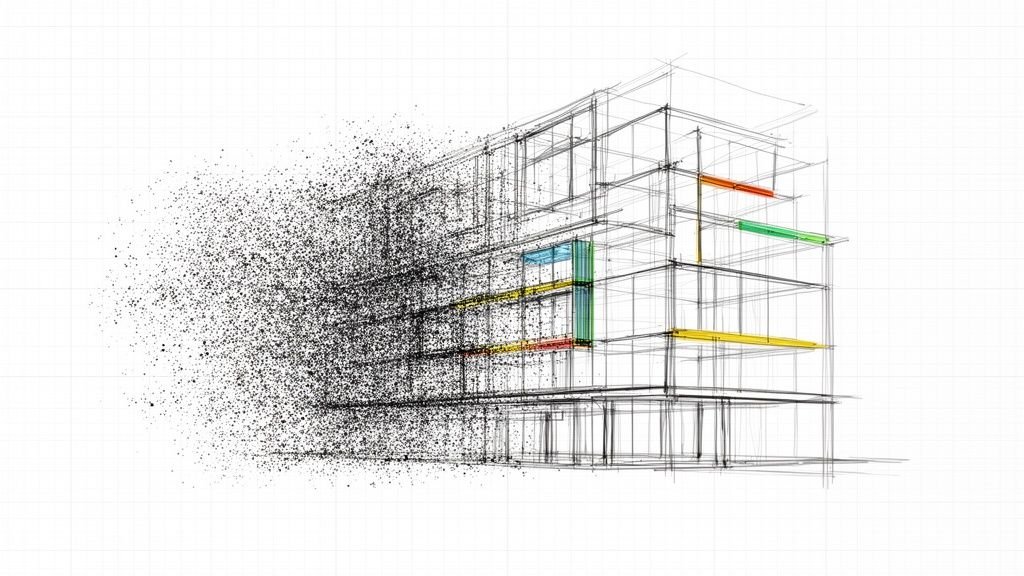
| Modeling from point cloud data | Supervising AI-driven scan-to-BIM conversion | Ensuring model accuracy, enforcing standards |
Ultimately, AI handles the "what" and "how," freeing up professionals to focus on the "why." Your expertise becomes the critical layer of intelligence that guides the technology, ensuring predictable outcomes.
Shifting From Doer To Supervisor
Your day-to-day will increasingly focus on overseeing AI-driven processes, ensuring model quality, and enforcing project standards. It’s not about losing your job; it’s about moving up the value chain from manual modeling to strategic model auditing.
Think of it as the next logical step in the CAD-to-BIM evolution, but on steroids.
This shift does more than just change your role—it protects project margins by making operations more consistent and predictable. By letting automation handle routine work, you get more time to focus on complex coordination, preventing RFIs, and making sure the model is a true digital twin of the design intent.
The Growing Importance of AI in BIM Workflows
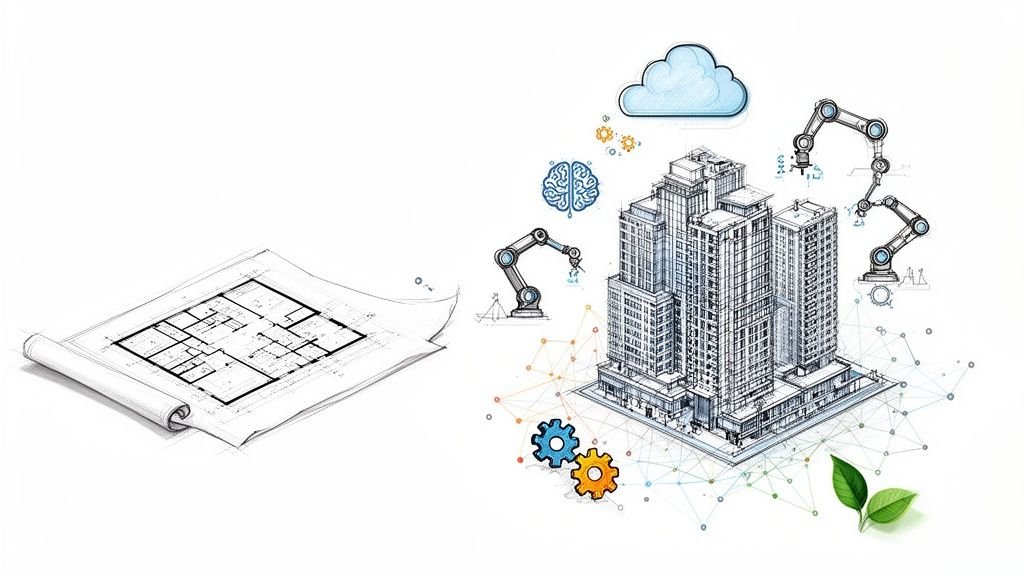
The industry isn't waiting. The global BIM market is expected to hit USD 286.59 billion by 2032, growing at a rate of 14.57% each year—and AI integration is a huge driver of that growth.
AI is already automating quantity takeoffs, sharpening design resolution, and running advanced clash detection long before anyone breaks ground.
The core theme is this: preparation, not panic, is the key to thriving. Your deep understanding of building systems and construction documentation is precisely what’s needed to guide these new tools effectively.
And the technology isn't just staying inside the building model. To really see what’s possible, it’s worth understanding how drones with artificial intelligence are revolutionizing industries by capturing site data that feeds directly into these intelligent models. Your expertise is what turns that raw data into a project that can actually be built.
AI Replaces Tedious Tasks, Not Professional Roles
The anxiety around AI in BIM is understandable, but it's usually rooted in a misunderstanding. AI isn't being designed to take your job; it’s being built to take on your most monotonous, repetitive tasks. Think of it as a tool for boosting production maturity, not a replacement for your professional judgment.
Imagine AI as a new, incredibly fast apprentice. It can handle the grunt work—running the first pass on clash detection, generating basic room layouts from a set of parameters, or automating tedious quantity takeoffs. This is where machines excel: applying pure processing power to rule-based problems.
But just like any apprentice, it needs constant supervision. It doesn't have that nuanced understanding of constructability, the feel for spatial relationships, or the critical eye for design intent that only a seasoned professional brings to the table.
From Manual Input to Strategic Oversight
This evolution in AI in BIM workflows shifts your focus from manual input to strategic oversight. Your value is no longer measured by how quickly you can model a staircase, but by how effectively you can guide an AI to produce a dozen compliant options and then pick the best one.
Here’s what that looks like in practice:
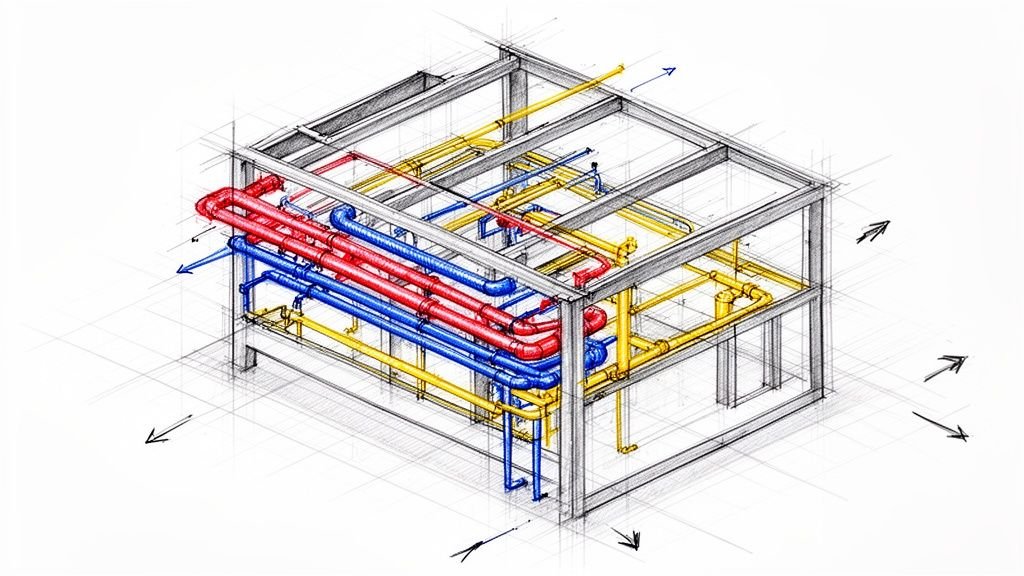
- Automated Clash Detection: Instead of manually hunting for every single pipe-versus-duct conflict, you'll review an AI-generated report that has already flagged and categorized hundreds of potential issues. Your job becomes interpreting the results, prioritizing the critical clashes that impact project sequencing, and coordinating the fix.
- Generative Layouts: Rather than drafting a floor plan from scratch, you feed the AI constraints—square footage, adjacency requirements, egress paths, and structural grids. It spits out multiple valid layouts in minutes. Your role shifts to validating these options against the client's unstated goals and making sure the design intent isn't lost in the algorithm.
- Quantity Takeoffs and Documentation: AI can scan a model and produce a bill of materials with near-perfect accuracy in seconds. This frees you from hours of counting and measuring, letting you spend that time refining the details in the actual construction drawings and preventing costly RFIs down the line.
We’ve seen AI become faster than humans at layouts, but not better at judgment. That distinction is everything. It’s the difference between a tool that generates data and a professional who creates a building.
This shift directly protects project margins and improves predictability. When production teams are focused on high-level problem-solving instead of rote manual input, the entire delivery process becomes more consistent and reliable.
The New Focus on Quality Assurance and Standards
With AI handling the first draft, the production team becomes the ultimate line of defense for quality. Your expertise in QA processes and template discipline becomes more valuable than ever. An AI is only as good as the data and standards it’s given. It’s up to you to enforce those standards and audit the output.
This means your role becomes more analytical. You're not just drawing; you're checking the AI’s work, validating its assumptions, and ensuring every element aligns with the project’s established BIM Execution Plan. To get more insight into how these tools streamline work and free up professionals, you can explore resources on the functionality of AI Assistants, which are designed to handle exactly these kinds of routine tasks.
Ultimately, integrating AI in drafting and modeling doesn't make your skills obsolete—it elevates them. The future of AEC jobs requires you to be the human intelligence guiding the artificial one, ensuring that speed and automation never come at the expense of quality and accuracy.
From Manual Drafter to Model Supervisor
The conversation around AI in BIM is changing what it means to be on a production team. Your job is no longer about drawing every line or modeling every component. Instead, your role is shifting from pure execution to strategic supervision. The goal now is to ensure every element in the model is correct, coordinated, and buildable.
This shift reframes your value. You're moving from a manual drafter to a model supervisor—a critical thinker who acts as the guardian of the project's integrity. It's less about the repetitive clicks of modeling and more about auditing what an AI generates to check for accuracy, compliance, and design intent.
That deep industry knowledge you have—the kind that lets you spot a subtle clearance issue an algorithm might miss—is now your most valuable asset.
The New Pillars of Production Work
In this new supervisory role, your day-to-day work will revolve around three key areas. These aren't new ideas, but their importance is dialed way up when you’re guiding powerful AI tools instead of just a mouse.
- QA Review: This goes beyond simple clash detection. It’s about systematically auditing AI outputs, verifying data accuracy, and confirming the model geometry lines up with project specs and real-world constructability.
- Design Intention Checking: An AI can spit out a technically perfect layout, but it has no clue about the why behind the design. Your job is to make sure the automated output actually reflects the architect's or engineer's vision.
- Standards Enforcement: AI runs on rules. Your job is to set those rules and make sure they’re followed. This means rigorously enforcing the BIM Execution Plan and company standards, ensuring every automated element is consistent and categorized correctly.
This change in focus highlights the need for solid standards. We’ve seen it time and again: template discipline is the absolute foundation for effective AI. An AI working from a messy or inconsistent template will only make a bigger mess, faster.
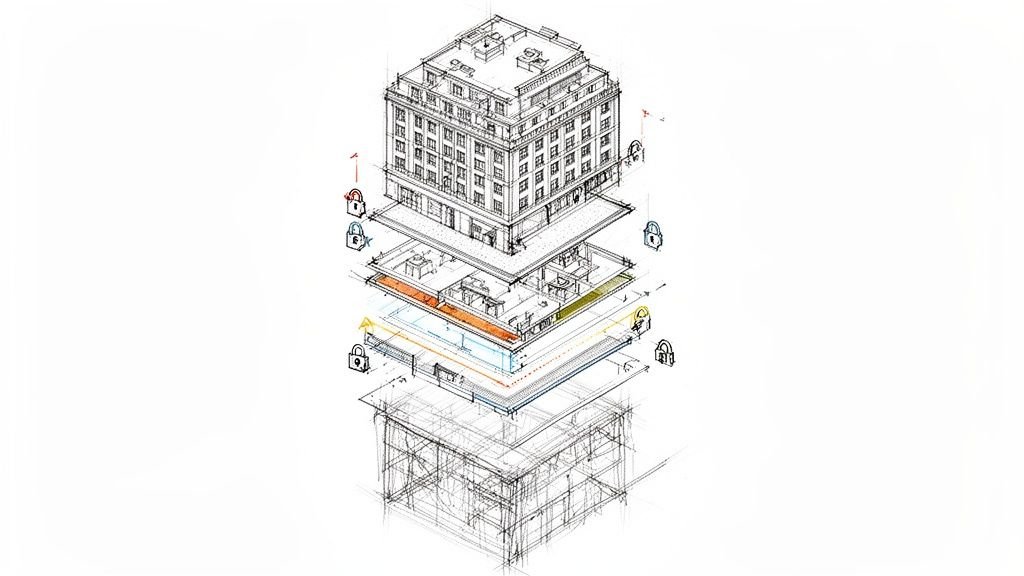
This diagram shows how your professional role sits above the AI, directing it to handle the tedious tasks down below.
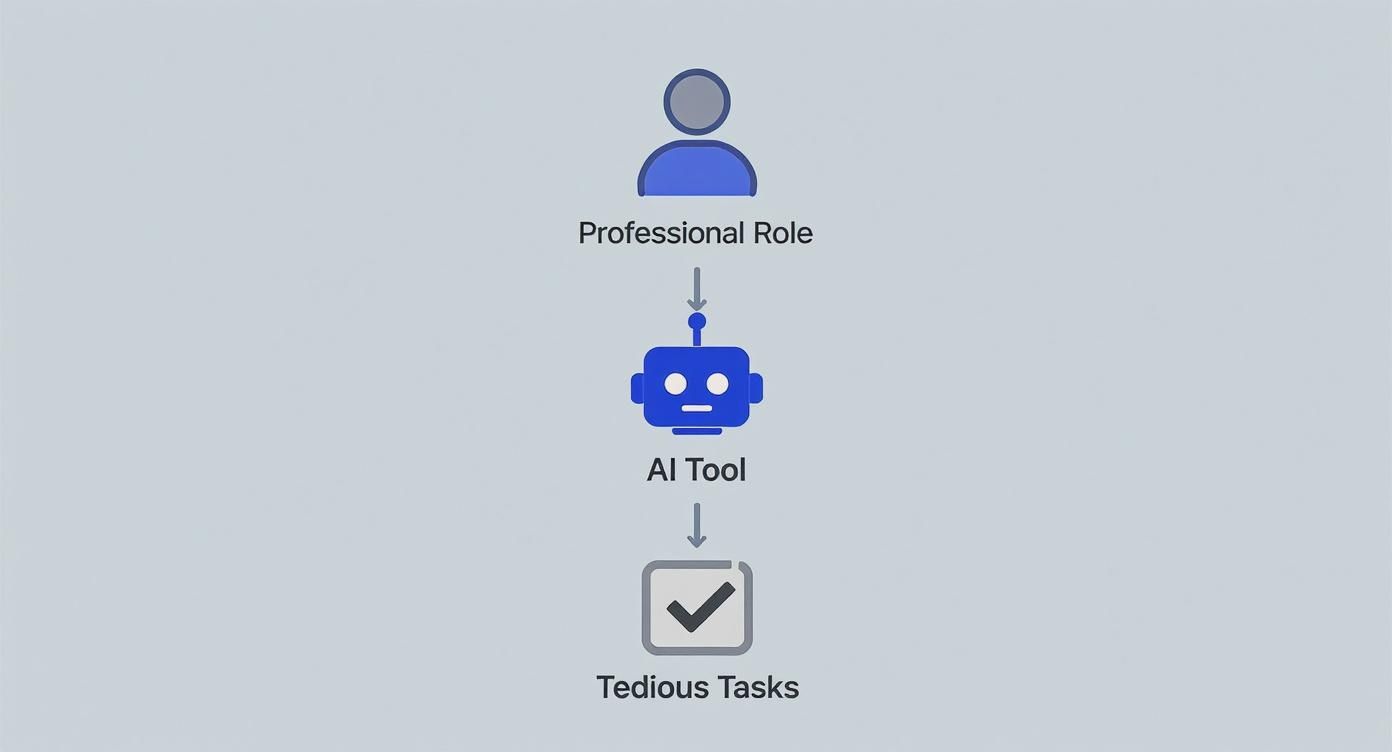
The visual makes it clear: professionals aren't being replaced. You're being equipped with powerful tools to delegate the grunt work.
Your Expertise as a Quality Filter
This new workflow puts you in the driver's seat as a critical quality controller. The future of AEC jobs will depend on professionals who can use their experience to guide technology and catch the subtle mistakes that algorithms overlook. An AI probably won't recognize that a specific wall assembly is a terrible choice for a certain climate zone, or that a seemingly tiny change to the ductwork will create a massive headache for the maintenance crew down the road.
Your value isn’t in doing the work an algorithm can do; it's in knowing what the algorithm should be doing and spotting when it gets it wrong. This is how production teams protect margins and ensure operational consistency on a scalable level.
Market growth is backing up this tech-driven shift. The global Building Information Modeling (BIM) market is projected to grow from about USD 9.7 billion in 2025 to USD 29.6 billion by 2035, at a compound annual growth rate of 11.8%. This boom is heavily influenced by AI in BIM workflows, like automated clash detection and predictive analytics, which all require skilled human oversight to improve project coordination and efficiency. You can check out the full research on future market insights to see what's driving this trend. This all points to supervision becoming a core competency.
By stepping into this supervisory role, you prevent expensive rework, cut down on RFIs, and ensure that every decision is based on reliable, human-validated data. You become indispensable not for how fast you can draft, but for your judgment in verifying.
Essential Skills for the Future of AEC Production
The move from manual drafting to model supervision isn't just a title change—it's a fundamental shift in where your value lies. To thrive when AI in BIM is the norm, you need a different set of skills. This isn’t about learning to code; it's about mastering the human side of collaborating with AI. It’s about learning how to direct the tool, not become the tool.
Your professional judgment, your gut feeling on constructability, and your ability to see the big picture are what make you indispensable. The goal is to build on that foundation, adding skills that let you guide AI effectively so it actually improves your production maturity instead of just creating digital noise. It's time to focus on what machines can't replicate.
Developing Deep Prompt Literacy
The quality of an AI’s output is a direct reflection of how good your instructions are. This is where prompt literacy comes in. Think of it as the art and science of asking the right questions to get useful, relevant, and accurate results from an AI system. It's far less about technical commands and much more about clear, precise communication.
For example, asking an AI to "design a clinic layout" is a recipe for generic, unusable options. A well-crafted prompt from an experienced pro looks completely different.
A better approach would be: "Generate three outpatient clinic floor plans for a 5,000 sq ft space, prioritizing a circular patient flow from reception to exam rooms to checkout. Ensure all exam rooms have natural light and maintain a maximum travel distance of 40 feet from the central nursing station."
That level of detail—mixing constraints, goals, and standards—is what separates a useless AI interaction from one that genuinely speeds up the design process. This skill ensures you’re steering the technology toward a specific goal and protecting the project’s design intent right from the start. Mastering this is non-negotiable for the future of AEC jobs.
Mastering Systematic Model Auditing
As AI takes over more of the initial modeling, your main role shifts to quality control. Model auditing is the systematic process of reviewing AI-generated geometry and data to confirm it meets project standards, building codes, and constructability requirements. This is where your field experience becomes a massive advantage.
An AI can place a thousand light fixtures in perfect alignment, but it can’t tell you the specified model is on backorder for six months. It can model a wall assembly that meets fire code, but it won't flag that it’s notoriously difficult to waterproof in your climate. These are the kinds of judgment calls that algorithms just can’t make yet.
Your job is to be the final filter, applying human intelligence to the AI’s brute-force output. This checkpoint is essential for RFI prevention and ensuring the digital model is a reliable representation of what will actually be built.
This rigorous QA process is the bedrock of scalable delivery. It guarantees that as you lean more on automation, you maintain—and even improve—your standards for quality. For a deeper dive into how AI improves project visibility, the Design-Build Institute of America has some great insights on how AI is unlocking intelligent infrastructure management.
Cultivating Rigorous Template Thinking
AI tools work best inside structured environments. This makes template discipline more important than ever. "Template thinking" means developing and maintaining robust, detailed BIM templates that act as guardrails for any automated process. A well-built template is your primary tool for enforcing standards.
It dictates everything from naming conventions and line weights to family parameters and data classifications. When an AI generates elements within this framework, it automatically inherits the structure and data integrity you’ve built in. Without a strong template, AI in drafting will only produce chaos, faster.
This discipline leads directly to predictable outcomes and protects your project margins. It ensures that whether an element is modeled by a junior tech, a senior lead, or an AI, the result is consistent and follows the project’s BIM Execution Plan. It’s the backbone of any mature production workflow.
Using AI for Proactive Scenario Testing
Finally, one of the most powerful uses for AI in BIM workflows is scenario testing. This is the practice of using AI to rapidly generate and evaluate multiple design variations or construction sequences to find the optimal path forward. Instead of spending weeks modeling one or two options, you can analyze dozens in a single afternoon.
For instance, you could ask an AI to generate five different structural grid layouts for a building and instantly get feedback on material quantities, structural performance, and cost for each one. Or, you could test various site logistics plans to find the one with the fewest crane movements and the most efficient material staging.
This capability transforms production teams from reactive modelers into proactive strategists. You can identify the best solution before committing significant time and money, making the entire project delivery process more predictable and profitable.
Future-Proofing Your AEC Career Skills
| Skill Category | Traditional Skill | Emerging AI-Era Skill |
|---|---|---|
| Design & Modeling | Manual geometry creation | Prompt engineering & generative design oversight |
| Quality Control | Manual clash detection & visual checks | Systematic model auditing & data validation |
| Workflow Management | Adhering to established standards | Developing and enforcing robust BIM templates |
| Problem Solving | Reacting to design or construction issues | Proactive scenario testing & predictive analysis |
| Communication | Inter-team coordination meetings | Articulating complex design intent to AI systems |
| Data Management | Organizing project files | Curating clean, structured data for AI training |
Ultimately, the future isn't about replacing human expertise but amplifying it. By cultivating these emerging skills, you position yourself not as a user of software, but as a strategic partner to intelligent systems, ensuring technology serves the ultimate goal of building better.
How AI in BIM Workflows Protects Project Margins
Technology is only useful if it protects the bottom line. For all the talk about innovation, the real test for AI in BIM is how it directly impacts profitability. This isn’t about chasing shiny new tech; it's about putting systems in place that deliver projects more predictably, reliably, and profitably.
The core idea is simple: AI helps you catch expensive mistakes before they happen. In a typical workflow, a small design error can snowball into a massive change order during construction, chewing through your margins. AI-powered production workflows act as a powerful defense against these costly surprises.
This shifts production teams from being a cost center to a vital part of the firm's financial strategy. By focusing on smart systems and clarity, you directly build operational consistency and protect your margins.
Preventing Rework with Automated QA
Rework is one of the biggest margin killers in our industry. An automated Quality Assurance process, driven by AI, is your best line of defense. These systems can analyze a model against thousands of predefined rules—from code compliance to your own company standards—in a fraction of the time a human could.
This means errors get flagged much earlier in the process, back when they are exponentially cheaper and easier to fix. A clash found in a federated model might take a few hours to resolve. That same clash discovered on-site can cost tens of thousands of dollars and cause weeks of delays.
The real power of AI in BIM workflows isn't just finding problems faster; it's creating a system where fewer problems exist in the first place. This is how you build predictability into your delivery model.
This systematic approach is quickly becoming the norm. Among major U.S. construction contractors, the adoption of AI-powered BIM tools is already nearing 80% to 90%. These firms are using AI in BIM to boost project efficiency, slash errors, and run detailed virtual walkthroughs that eliminate expensive on-site changes.
Smarter Decisions and Fewer RFIs
Well-designed AI in BIM workflows create better decision checkpoints throughout the project. Instead of relying on gut feelings or incomplete information, teams can use AI to explore more cost-effective options without dragging out the design phase.
Take generative design, for example. An AI can churn out hundreds of viable structural or MEP layout options, each one analyzed for cost, material use, and performance. This gives the team hard data to make an informed decision, rather than just settling for the first workable idea.
This leads directly to fewer RFIs. When designs are more thoroughly vetted and coordinated upfront, there are far fewer ambiguities for contractors to find later. Every RFI you avoid is a direct saving of time, money, and potential disputes. We dig deeper into this idea when detailing the many Building Information Modeling benefits that contribute to a smoother project.
Streamlining Permitting and Documentation
Finally, AI-driven automation can seriously speed up the preparation of permitting documents. AI tools can automatically check drawings against local building codes, generate schedules, and ensure all the required data is present and correctly formatted.
This doesn't just save time—it cuts down the risk of rejection from permitting authorities, which can bring a project to a dead stop. A smoother, more predictable permitting process means projects break ground faster and revenue gets recognized sooner.
By integrating AI, production teams are no longer just drafting. They are actively managing risk, optimizing designs for cost, and making sure the project stays on track financially from day one. It’s proof that the best way to protect your margins is to invest in the systems that prevent problems before they even start.
Your Career Skills Checklist for the AI Era
The rapid spread of AI in BIM isn't a threat to your career—it's an invitation to evolve. Let's be clear: AI is a powerful tool built to crush repetitive tasks, not a replacement for your professional judgment. The future belongs to production experts who can supervise and guide these systems, shifting the job from manual modeling to strategic oversight and quality control.
The most valuable skills are moving away from pure execution and toward critical thinking. Your ability to direct the technology, not just operate it, is what will define your value moving forward. This shift gives you the power to protect project margins, lock in operational consistency, and deliver far more predictable outcomes.
To help you figure out where you stand, we put together a checklist to see how ready you are for this new reality.
A Self-Assessment for Production Professionals
Use this checklist to see your strengths and find areas where you can grow. The point isn't to become an expert in everything overnight. It's about consciously building the skills that matter most in modern AI in BIM workflows.
1. Prompt Literacy
- Can I write clear, multi-step instructions for a generative design tool?
- Do I know how to add constraints like code, budget, or materials into my prompts?
- Can I look at an AI's first attempt and refine my prompts to get a better result?
2. Model Auditing
- Am I comfortable reviewing an AI-generated model to make sure it meets our firm’s standards?
- Can I spot the subtle constructability issues that an algorithm is likely to miss?
- Do I have a system for checking the data and geometry in a model for accuracy?
3. Template Discipline
- Do I actively help maintain and improve our firm's BIM templates?
- Can I explain to a junior team member why a strict template is critical for automation to work?
- Do I consistently stick to template standards in my own work and during team reviews?
4. Strategic Scenario Testing
- Am I using modeling tools to explore multiple "what-if" scenarios, not just plugging away at one?
- Can I analyze the trade-offs in cost, schedule, and performance between different AI-generated options?
- Do I actively hunt for chances to test different design or construction sequencing ideas?
We've seen that the professionals who thrive are those who see AI not as a competitor, but as the most powerful apprentice they've ever had. It handles the grunt work, freeing you up to do what you do best: think, solve problems, and ensure quality.
This checklist is more than a to-do list; it’s a roadmap. By focusing on these areas, you are actively preparing for the future of AEC jobs and positioning yourself as a leader in a tech-driven production environment.
Feeling ready to build these skills? Download our Career Skills Checklist for the AI Era to start your self-assessment and map out your professional development path.
Got Questions About AI in BIM? We’ve Got Answers.
The idea of bringing AI into the BIM workflow brings up a lot of questions. Let’s tackle some of the most common ones we hear from production teams on the ground.
Is AI Going to Make the BIM Coordinator Role Obsolete?
No. While AI in BIM workflows will certainly automate the grind—think running basic clash detection or handling mind-numbing data entry—it can't touch the complex problem-solving and critical thinking that defines a good BIM coordinator. Your job isn’t disappearing; it’s leveling up.
The focus will shift away from manual, repetitive tasks and toward managing what the AI produces. You’ll spend more time validating design intent and resolving the high-level coordination issues that demand human negotiation and genuine expertise. You become the strategist, not just the data processor.
What's the Single Most Important Skill to Learn for the Future of BIM?
If you’re looking to future-proof your career, forget the software-specific skills for a moment. The most critical competency emerging is Model Auditing. This is the disciplined art of looking at an AI-generated model and asking, "Does this actually make sense?"
It’s about evaluating the output for accuracy, compliance with standards, and alignment with the real design intent. An algorithm can spot a hard clash, no problem. But it can’t tell you if a design choice "feels right" or violates a client’s unwritten preference. That’s the kind of judgment-based QA where human expertise will always be irreplaceable.
Do I Really Need to Learn How to Code to Use AI in BIM?
For most production roles, the answer is a clear and simple no. You don't need to become a programmer to stay relevant in the future of AEC jobs.
Instead, the skill to focus on is prompt literacy—the ability to give clear, precise instructions to an AI tool. Think of it less like writing code and more like giving perfect directions to an incredibly capable apprentice. You’re learning to articulate your intent, not build the engine from scratch.
At BIM Heroes, we believe the future is about empowering professionals, not replacing them. We help firms build the systems and maturity needed to make AI a tool for growth and predictability.
If you’re ready to future-proof your career, download our Career Skills Checklist for the AI Era to start your self-assessment and map out your professional development path.