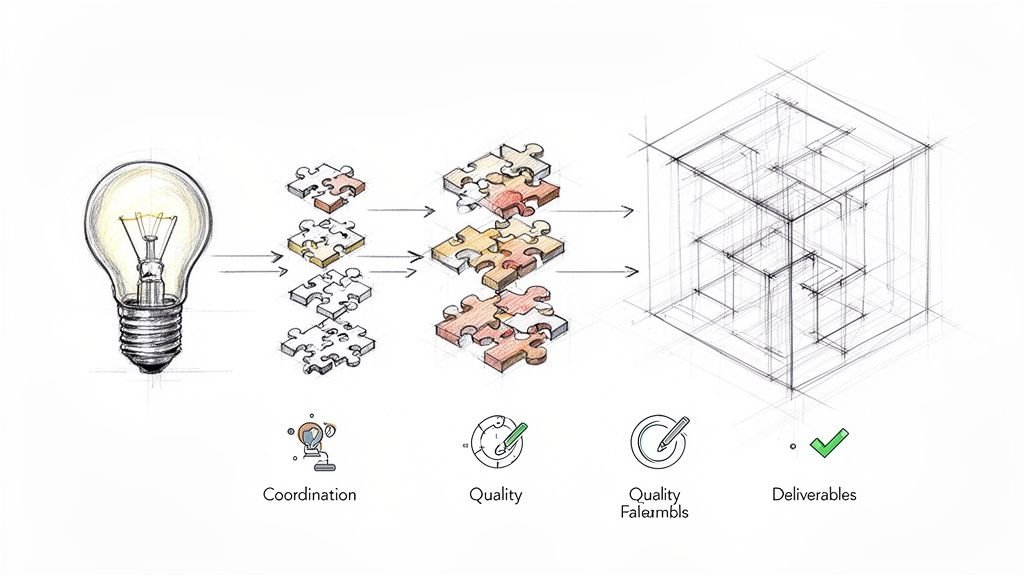
Staring at a fresh architectural services RFP? It’s tempting to treat it as just another sales document—a hoop to jump through before the real work begins. But seasoned firms know the truth: your RFP response is your first, and perhaps most critical, act of project management. It’s where you establish the operational consistency that protects margins and ensures predictable delivery.
The RFP itself doesn’t define the project’s success. How your firm interprets, questions, and structures its response does. This isn’t about finding reasons to walk away; it’s about early risk identification and scope clarity. It's your opportunity to shift from reacting to a client's request to proactively setting the project up for a successful outcome.
Spotting red flags is about identifying signals of future project risk—the small ambiguities that blow up into major production headaches and margin erosion after kickoff. A mature response uses clarifying questions, assumptions, and exclusions to build a framework for clarity. This isn't sales advice; it's delivery discipline.
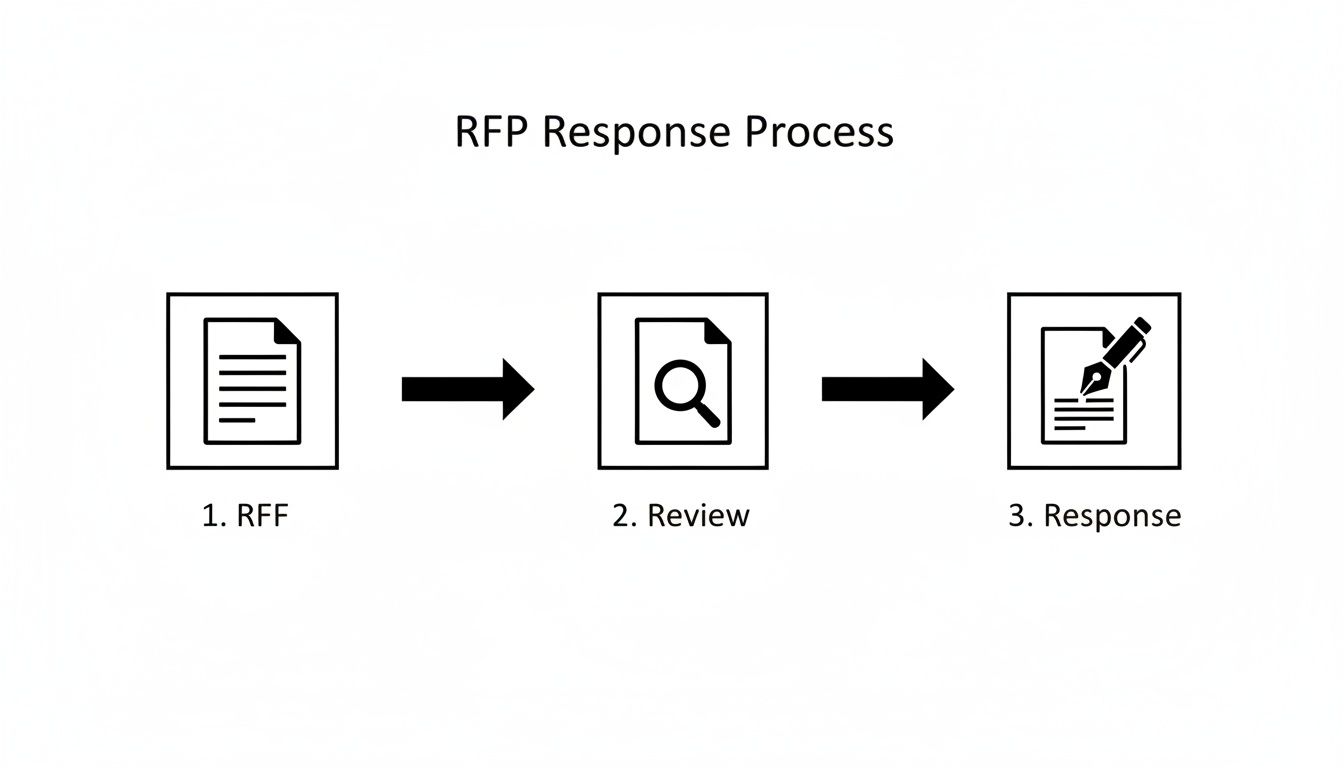
We’ve seen project outcomes improve dramatically when firms addressed RFP ambiguities before signing—not after kickoff. This early diligence is the bedrock of predictable delivery, protecting both the client’s investment and your firm’s bottom line.
When you treat the proposal as the first phase of project execution, you establish the boundaries and systems that lead to clarity. It’s a move that showcases production maturity and protects your team from the chaos of an ill-defined project. For more on instilling this discipline, our guide on project management for architects is a great resource.
Here, we’ll break down five recognizable red flags and provide pragmatic strategies for turning a risky RFP into a well-defined, profitable project.
Red Flag 1: Vague or Conflicting Scope Descriptions
This is the most common and dangerous red flag in an architectural services RFP. It’s the silent margin killer that fuels scope creep disguised as "standard services." When you see vague language, you’re not just looking at a poorly written document; you’re looking at the blueprint for a project that will never stabilize. These projects burn margins and teams as everyone scrambles to "be flexible."
What It Looks Like in an RFP
Vague scope hides in plain sight, often masquerading as collaborative language. It lacks concrete deliverables or measurable outcomes, making it impossible to price or manage effectively.
Look for phrases like:
- "Develop design options as required by the client."
- "Provide architectural support throughout the construction phase."
- "Coordinate with all necessary consultants."
- Or contradictory requirements, like asking for full construction documents in a section describing schematic design.
Statements like these create a fundamental misalignment between your team’s understanding of the work and the client’s expectations—a primary source of architecture RFP risks.
Why It Creates Downstream Risk
Ignoring this ambiguity is a costly mistake. It cascades into serious production and coordination headaches that disrupt even the most disciplined BIM workflows and QA processes.
- Margin Erosion: Without a defined scope, your team will inevitably perform unbillable work. Every "minor adjustment" eats directly into your profit margin because the fee was based on a guess.
- Team Burnout: A constantly shifting target is demoralizing. It prevents your team from hitting milestones, disrupts resource planning, and creates a high-stress environment.
- Coordination Chaos: When your scope is a moving target, managing consultants becomes impossible. This uncertainty breeds RFIs that could have been avoided, causing delays and rework.
How to Address It Proactively
Spotting a vague scope is your cue to lead the conversation toward clarity. Your proposal is the perfect tool to transform ambiguity into a well-defined project before a contract is signed. When responding to architectural RFPs, this is where mature firms set themselves apart.
Your proposal's "Assumptions and Exclusions" section isn't just legal boilerplate; it's a powerful project management tool. Use it to draw sharp boundaries and define what is not included.
Here’s how to tackle ambiguity head-on:
- Ask Specific, Clarifying Questions: Don't just ask, "Can you clarify the scope?" Ask pointed questions that force specific answers. Instead of "develop design options," ask: "Does the scope include three distinct design options presented as 3D massing models, with two rounds of client feedback, to be completed within the first four weeks of the Schematic Design phase?"
- Propose a Phased Discovery: If the scope is truly undefined, propose a limited, fixed-fee "Phase Zero" or discovery engagement. This lets you work with the client to define project requirements before committing to a full design contract.
- Define the Scope in Your Proposal: Use your assumptions and exclusions to define the ambiguity on your terms. Clearly state the number of meetings, revision cycles, and specific deliverables included in your fee. This turns their vague request into your concrete scope of work.
By directly addressing these issues, you protect your firm and position yourself as a strategic partner focused on predictable outcomes. Reviewing architecture proposal samples can offer valuable perspectives on how other firms present scope with clarity.
Red Flag 2: Unrealistic Schedules Tied to Fixed Fees
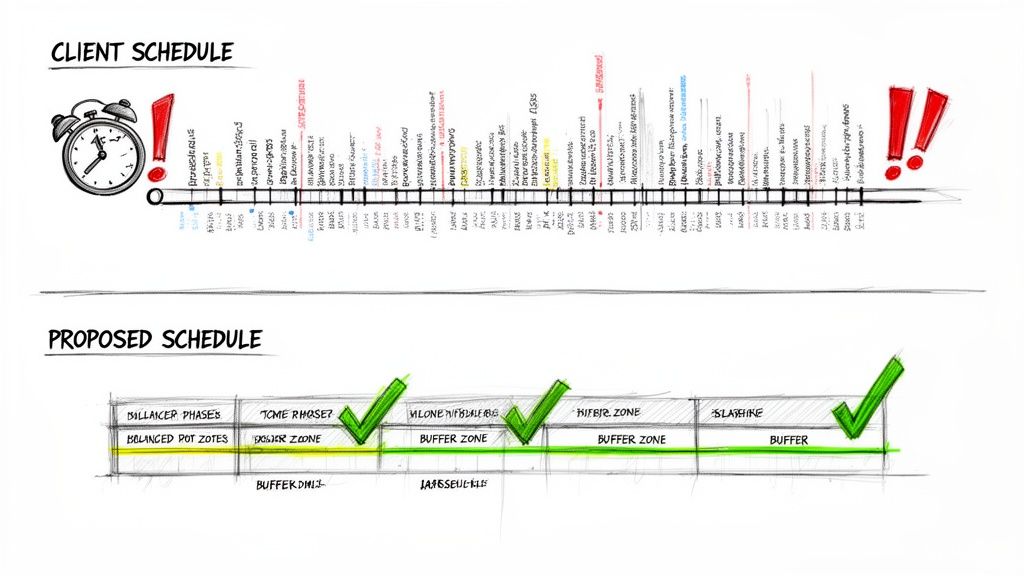
An aggressive schedule paired with a fixed fee is a direct assault on profitability. This combination forces compressed design phases, rushes critical QA processes, and leaves no room for proper consultant coordination or decision checkpoints. Your team is immediately on the back foot, chasing arbitrary deadlines instead of delivering quality. This is a recipe for margin erosion.
What It Looks Like in an RFP
This red flag is rarely subtle. It’s a client dictating a timeline that doesn’t align with the realities of design, permitting, and construction.
You’ll spot it in an architectural services RFP with lines like:
- "Project must achieve substantial completion by Q4" (when it’s already Q2 with no design work done).
- A timeline allocating just two weeks for Design Development on a complex building.
- Mandatory milestone dates that ignore standard municipal review times.
- A rigid fixed fee with no contingencies for client-caused delays.
Why It Creates Downstream Risk
An unworkable schedule chained to a fixed fee creates a domino effect of production problems. The pressure to move fast undermines the very systems that ensure a successful outcome.
- Rushed QA Processes: Quality assurance is the first casualty of a compressed timeline. This leads to coordination errors, preventable RFIs during construction, and costly rework—all of which comes out of your fixed fee.
- Coordination Breakdown: Insufficient time for coordination with structural, MEP, and other consultants creates friction and forces your team into a reactive mode, putting out fires instead of preventing them. This is one of the most common architecture RFP risks.
- Profitability Collapse: With a fixed fee, every hour your team spends accommodating delays or fixing rushed work is unbillable. The project’s margin shrinks with every setback.
How to Address It Proactively
Your response is an opportunity to educate the client and reframe the schedule as a shared tool for success. Propose a path that respects their goals while protecting your firm’s ability to deliver.
A well-crafted project schedule isn't just a list of dates; it's a strategic plan for managing risk. Presenting a realistic timeline with clear decision checkpoints shows the client you’re focused on protecting their investment.
When responding to architectural RFPs with this red flag, explore essential project scheduling techniques and use these strategies:
- Propose an Alternate Schedule: Don't just say their timeline is impossible—show them a realistic alternative. Present a schedule built around your actual production capacity, including time for design, internal QA, consultant coordination, and client decision points. Frame it as the "predictable path to success."
- Structure a Phased or Tiered Fee: Decouple parts of your fee from their rigid timeline. State that your fee covers two review cycles per phase, with additional cycles billed hourly, to protect against client-side delays.
- Build in Assumptions: Clearly state the assumptions your schedule is based on, such as "client feedback will be provided within 48 hours" or "permitting review is assumed to take no longer than 90 days." This transfers schedule risk back where it belongs.
Red Flag 3: Unclear Consultant Roles and Responsibilities
When an architectural services RFP is fuzzy on consultant roles, it’s a recipe for coordination chaos and a direct threat to any efficient BIM workflow. If the document is silent on who provides key engineering services or vague about the lines of responsibility, your firm often ends up shouldering the coordination burden by default, burning unbillable hours to prevent project failure.
What It Looks Like in an RFP
This red flag often appears as an omission. The client may not even realize they are creating a vacuum of responsibility.
Watch for:
- Mention of engineering services without clarifying if the client hires them directly or if they should be part of your proposal.
- A list of required disciplines (MEP, structural) with no mention of a prime consultant or coordination lead.
- Broad language like "coordinate with all project stakeholders" without an org chart or responsibility matrix.
These gaps force you to make risky assumptions about who is doing what, a gamble that can complicate contracts and production. Spotting these pitfalls early is a key part of reviewing architectural contracts for hidden risks.
Why It Creates Downstream Risk
Hoping unclear roles will "get sorted out later" is a fast track to eroding margins. A project without a clear command structure is unstable from day one.
- Coordination Chaos: Without a defined leader for each discipline, your BIM workflows will suffer. Your team will waste production time managing consultant models, leading to clash detection nightmares and rework.
- Scope Creep by Default: When another consultant drops the ball, the responsibility often lands on your team to "just fix it." Each instance expands your scope without a corresponding fee adjustment.
- Delayed Timelines: Finger-pointing is the natural outcome of unclear roles. When critical information is missing, the project stalls while everyone tries to determine who was responsible. This is a preventable issue in AEC proposal best practices.
How to Address It Proactively
Use your response to the architectural services RFP to establish clarity and position your firm as a leader in project delivery.
Proposing a BIM Execution Plan (BEP) as an early, required deliverable is one of the most effective ways to force a conversation about consultant roles. It moves the discussion from abstract responsibilities to concrete data handoffs.
According to industry analysis, the construction and project management segment accounts for 32.1% of revenues in the architectural market, signaling that clients value strong project leadership. You can explore the full architectural services market analysis for more insights.
Use these proactive strategies:
- Request a Responsibility Matrix: Ask the client directly for an organization chart or RACI matrix. If they don’t have one, it signals that you will need to lead that effort.
- State Assumptions Clearly: In your proposal, explicitly state which consultant services are included in your fee and which are excluded. For example: "Our fee includes coordination with structural and MEP engineers retained by our firm. Civil engineering is assumed to be contracted directly by the client."
- Propose a BEP as a First Step: Include the development of a BIM Execution Plan (BEP) as a distinct, initial task in your scope. This ensures all parties agree on roles before significant design work begins.
Red Flag 4: Missing BIM Standards and Deliverable Specs
A modern, and increasingly common, red flag is the architectural services RFP that mentions "BIM" but offers zero specifics. For a firm with mature BIM workflows and template discipline, this signals impending chaos. It often happens when clients are stuck in the CAD-to-BIM evolution; they know they should ask for it but can't articulate what they need. The risk is massive: you could deliver a detailed model when they only wanted visualizations, or miss unspoken data requirements entirely.
What It Looks Like in an RFP
This red flag is a glaring omission. The RFP uses "BIM" as a buzzword but is silent on the details your production team needs to scope the work.
Look for:
- A simple line like, "The project will be delivered using BIM."
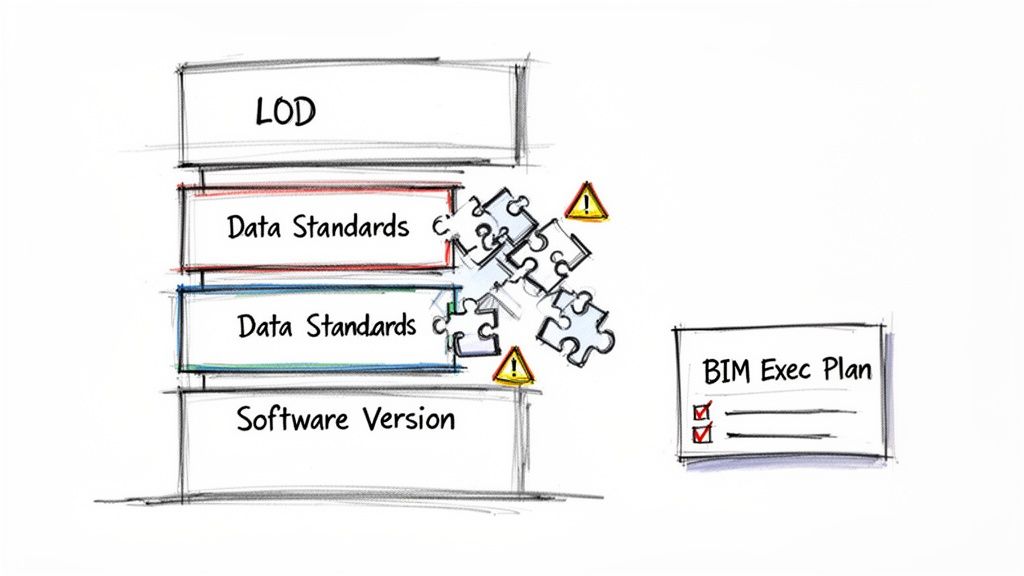
- No mention of the required Level of Development (LOD) for different phases.
- Silence on software platforms, versions, or file exchange formats.
- No reference to a BIM Execution Plan (BEP) or data standards.
This makes it impossible to price your services. Is it an LOD 200 massing model or a fully coordinated LOD 350 model? The difference represents thousands of dollars in labor.
Why It Creates Downstream Risk
Agreeing to a vague BIM scope is like signing a blank check against your margins. It undermines the very predictability that BIM workflows are designed to create.
- Margin-Draining Rework: You build a model to your standards, only to learn the client’s facility management team needed specific asset data embedded. Now you're inputting that data for free.
- Interoperability Failures: Without defined software versions, teams can end up on incompatible platforms, leading to data loss and forcing your team to play tech support.
- Unrealistic Expectations: A client might expect photorealistic walkthroughs when your fee only covers a schematic model. This mismatch erodes trust.
How to Address It Proactively
Treat this as an opportunity to demonstrate your firm's production maturity. Your response should educate the client while defining the scope you propose to deliver.
The goal isn’t to walk away, but to respond intelligently. Use your proposal to introduce the discipline the RFP lacks, turning their ambiguity into a well-defined plan.
When responding to architectural RFPs with undefined BIM requirements:
- Submit a Preliminary BEP Outline: Include a one-page preliminary BIM Execution Plan outline. Specify the assumed software (e.g., Revit 2024), LOD progression, and key workflows. This defines your scope and educates the client. Our guide on developing clear BIM Execution Plans is a helpful resource.
- Scope BIM as an Optional Service: If the client seems unsure, offer a tiered approach. A base fee can cover standard 2D deliverables, with a "BIM Coordination Package" as a separate line item with a clear description of the advanced services included.
- Frame Questions Around Value: Instead of asking, "What LOD do you want?" ask, "What are the primary goals for the model post-construction? Will it be used for facility management or energy analysis?" This connects technical specs to their business goals.
Red Flag 5: Excessive Deliverables with No Clear Purpose
This red flag is tricky. An architectural services RFP with a long list of deliverables—multiple renderings per phase, a physical model, extensive reports—can look like a big opportunity. However, it often signals an indecisive client or an ill-defined project vision. This "ask for everything" approach translates into a massive workload that pulls focus from core design and documentation tasks, threatening your QA processes and margins.
What It Looks Like in an RFP
This appears as a bloated scope of work disconnected from standard project phases or logical decision checkpoints.
Look for demands like:
- Three interior and two exterior renderings required at the end of Schematic Design, DD, and 50% CD.
- A physical site model to be delivered before zoning approval.
- Weekly progress reports with material takeoffs during early conceptual stages.
These requests suggest the client doesn't grasp the purpose of each deliverable. They are tools for making decisions, not items on a checklist.
Why It Creates Downstream Risk
Agreeing to a kitchen-sink list of deliverables sets you up for production chaos and kills your ability to run a tight, efficient project.
- Wasted Production Cycles: Your team will burn hours on high-level visuals or reports that serve no immediate purpose, pulling resources from core design, coordination, or permitting prep.
- QA Overload: Every extra deliverable must go through your quality assurance process. Unnecessary items stretch QA resources thin, increasing the risk that a critical error in the construction documents gets missed.
- Client Paralysis: Too many visuals or options thrown at a client too early can paralyze them, fueling an endless cycle of revisions while the schedule bleeds out.
How to Address It Proactively
Reframe your proposal around value and strategic decision-making. Your job is to turn their messy list into a logical menu of options tied to clear project goals.
Your response is a chance to guide the client. By linking every deliverable to a specific purpose—a fundraising presentation, a community board meeting—you position your firm as a strategic partner, not just a production house.
This consultative approach is a cornerstone of AEC proposal best practices.
- Group Deliverables into Optional Packages: Structure your proposal with a base scope covering essential deliverables. Group extra items into optional packages with line-item pricing, like a "Fundraising Visualization Package."
- Tie Deliverables to Decision Checkpoints: In your narrative, explain the why behind each deliverable. For example: "We will provide two schematic design renderings for the Board of Directors kickoff to secure approval on the massing concept." This connects your work directly to their milestones.
- Ask "Why" Politely: Use the Q&A period to probe the intent. Instead of "Are you sure you need this?" try, "To ensure our renderings effectively support your goals, could you share how the images from the DD phase will be used?"
This strategy forces a conversation about purpose and protects your team, schedule, and bottom line. Navigating these situations can be easier when you see how other professionals handle it; reviewing architecture proposal samples can provide clarity on structuring fees and scope.
At the end of the day, the power isn't in the RFP document—it's in how you interpret it, question it, and structure your response. A smart proposal doesn't just win the job; it sets the terms for a successful, profitable delivery.
At BIM Heroes, we believe project success begins with clarity and a well-defined scope. If you're tired of battling RFP ambiguity and want to protect your margins, our RFP Risk Review Checklist can help you spot hidden risks before they become problems. Get your complimentary checklist here: https://www.bimheroes.com.