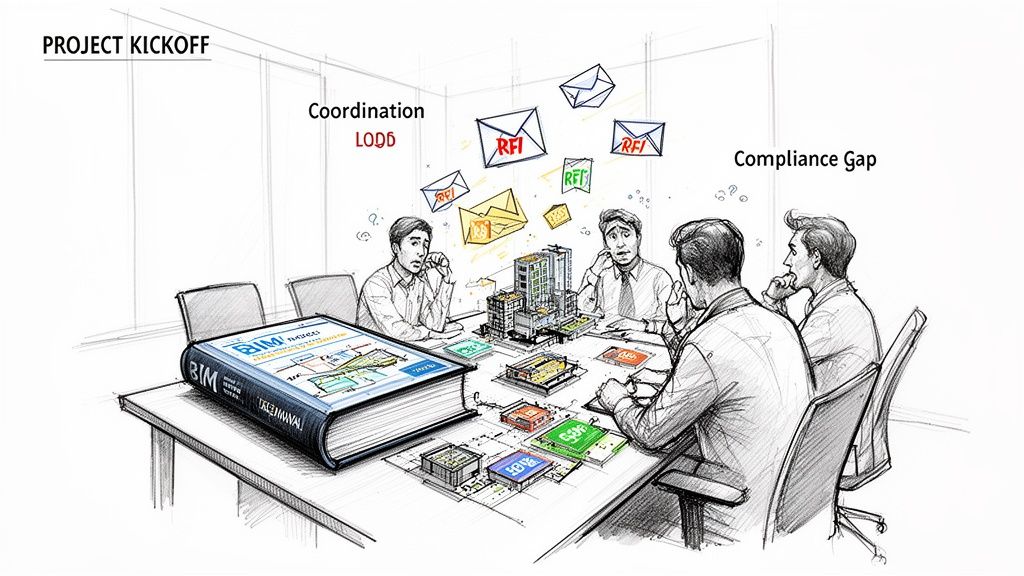
That kickoff meeting feels all too familiar. Someone rolls out the thick BIM standards manual, packed with rules for modeling, naming conventions, and deliverables. Everyone nods along.
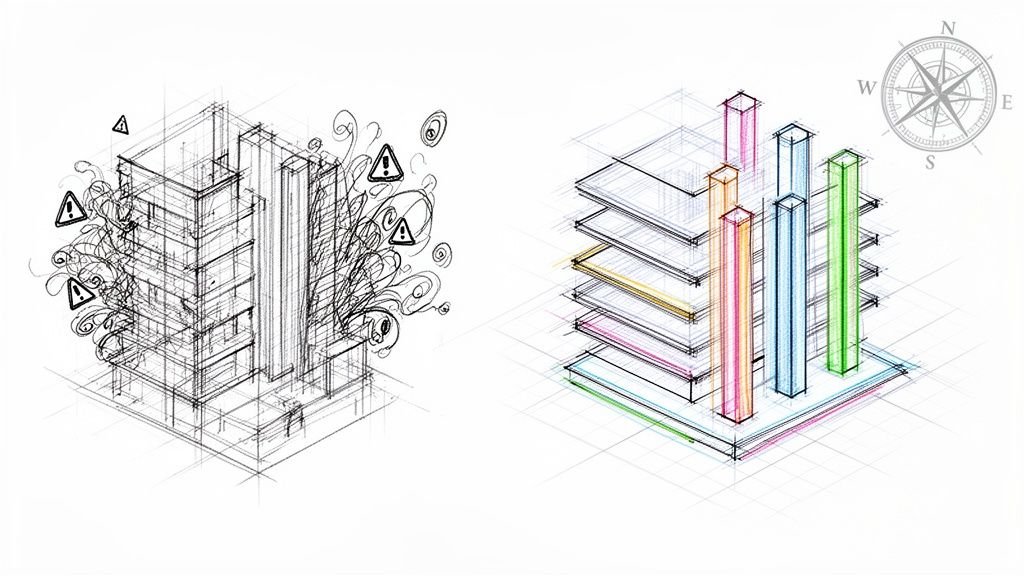
But just a few weeks in, the coordination meetings are tense, the RFI count is skyrocketing, and the finger-pointing begins. This isn’t a failure of compliance; it’s a failure of relevance. The real problem isn’t that teams ignore standards—it’s that the industry has outgrown static rules.
The Real Cost Of Outdated BIM And VDC Standards
Many AEC firms are running on BIM and VDC standards that feel more like historical documents than active playbooks. They were written for a different era—one with simpler models, less aggressive schedules, and fewer digital handoffs. Today, those static rulebooks are actively chipping away at project margins and predictability.
The issue isn’t that teams are ignoring the standards. The real problem is that the standards are ignoring the realities of modern production workflows, where speed, data reliability, and cross-team accountability are paramount.
Where Static Standards Break Down
Outdated standards create friction right where you need flow. We’ve seen projects stabilize the moment their BIM standards evolved from simple documentation rules into true production governance systems. When they don’t evolve, the pain is predictable and costly.
Here are the common failure points we see time and again:
- Ambiguous LOD Requirements: A blanket “LOD 350” requirement for all MEP systems is a recipe for chaos. Vague LOD standards force teams to either over-model (wasting hours) or under-model (creating coordination gaps and RFIs). Modern standards are role-based and phase-specific.
- Templates That Hinder Production: Project templates loaded with outdated families, wrong view settings, or legacy parameters force teams to spend non-billable hours just cleaning up files before work can even start. This initial drag on momentum hurts margin and morale.
- Rules Disconnected from VDC Goals: A BIM standard might demand precise modeling for architectural elements but offer zero guidance on creating coordination zones or data structures needed for prefabrication. This disconnect turns the VDC process into a constant battle of retrofitting models instead of a seamless workflow.
Mini-Case: A hospital project followed its corporate BIM standard to the letter. But the standard had no provisions for model splitting aligned with the phased construction sequence. The result? Weeks of rework to get the digital model to align with site logistics, jeopardizing the schedule.
The Impact on Your Bottom Line
When your BIM and VDC standards are out of sync with project execution, the consequences hit your operational efficiency and profitability directly. Inconsistent model quality triggers a flood of RFIs, all asking for clarity that should have been baked into the process from day one. This kind of reactive workflow protects no one’s margin.
The solution isn’t stricter enforcement of old rules. It’s about developing smarter, adaptive governance that actually supports how your teams need to build today. It requires a system that anticipates the demands of a VDC-driven workflow, not just a dusty set of BIM documentation rules.
Why Yesterday’s BIM And VDC Rules No Longer Work
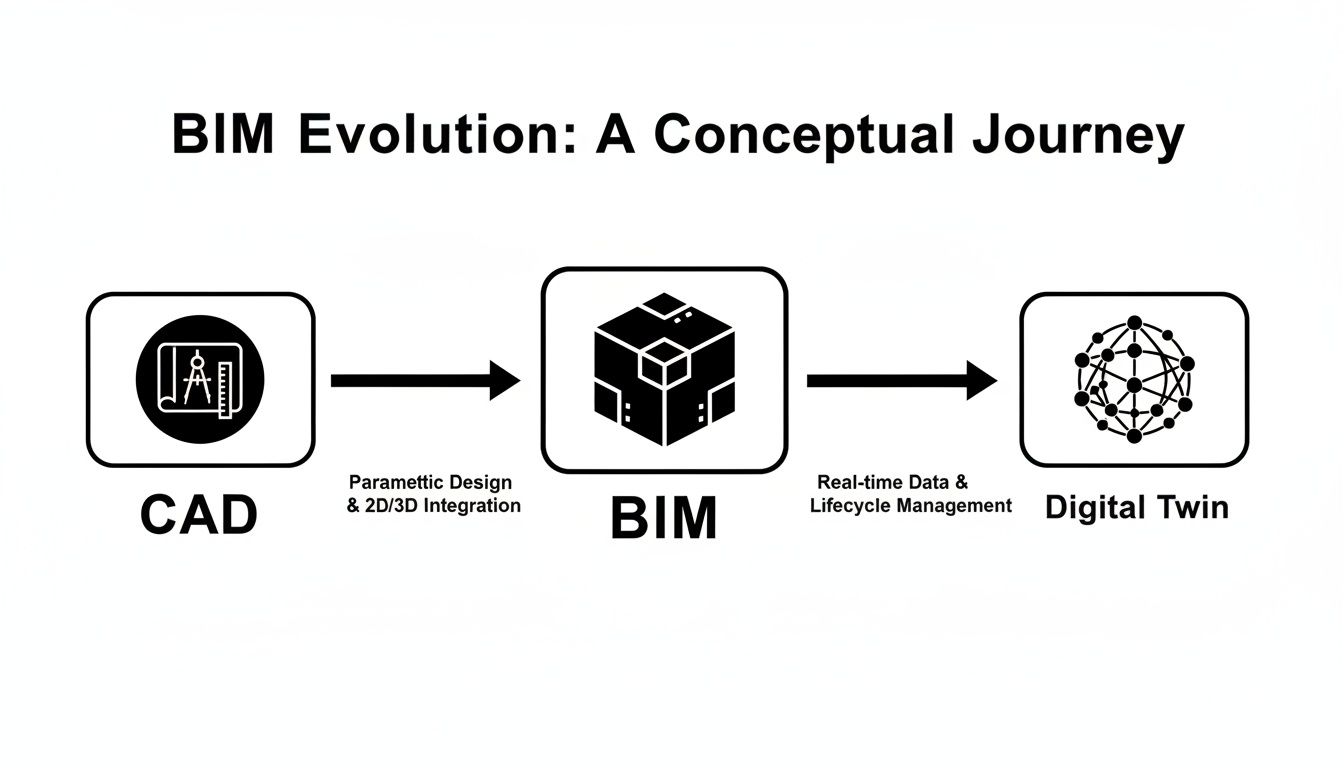
The disconnect between old standards and modern projects comes down to a simple truth: the AEC industry has finally moved beyond CAD-to-BIM thinking and into true digital delivery. A decade ago, a BIM standard was little more than a rulebook for creating a better set of drawings. It focused on modeling conventions and documentation output, and at the time, that was enough.
Today, that same rulebook is completely obsolete. Modern projects run on federated models, high-frequency coordination, and direct-to-fabrication digital handoffs. A standard that only governs geometry and naming conventions misses the entire point of modern BIM and VDC workflows.
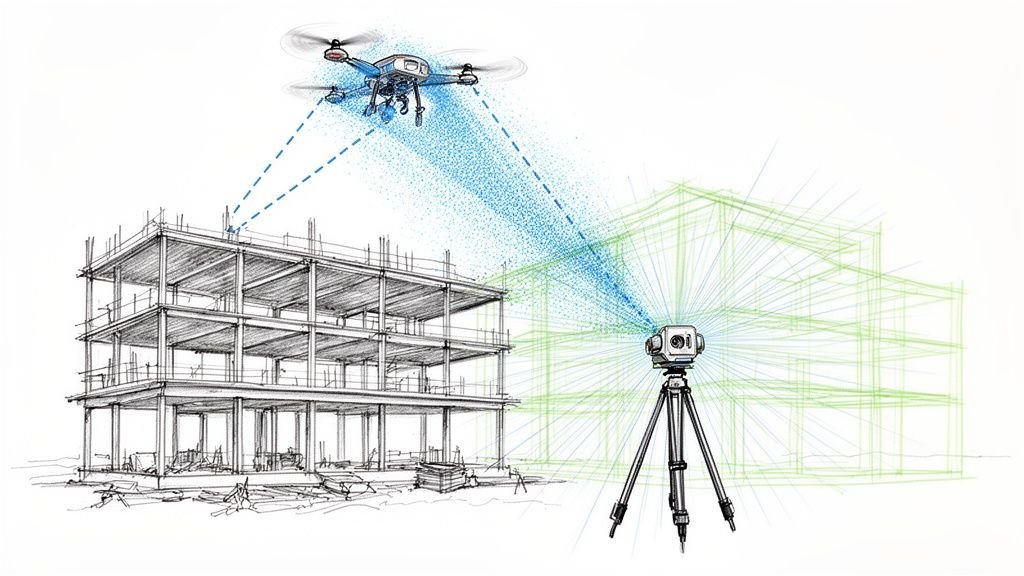
The acceleration is impossible to ignore. The global BIM market is expanding significantly, fueled by the very technologies that break old standards—digital twins, prefabrication, and complex data handoffs. You can dig into the numbers and market forces in recent industry analysis.
The Shift from Static Documents to Dynamic Governance
We’ve seen projects stabilize when BIM standards evolve from documentation rules into production governance systems. This isn’t just semantics; it’s a fundamental shift in purpose. Static documents list rules. Dynamic governance provides frameworks for making decisions at production speed.
Think about the federated model. A legacy standard offers zero guidance on managing this complex environment, leading to data loss, version control chaos, and huge accountability gaps. Modern BIM governance defines the protocols for model federation, data exchange, and clear ownership, ensuring information reliability.
Phase-Specific Needs and Data Reliability
Another critical failure of old rules is their one-size-fits-all approach. Applying a generic LOD standard across the entire project lifecycle creates massive inefficiencies. The level of detail an architect needs for schematic design is worlds away from what a fabricator requires.
Example: On a large commercial tower, the initial design BIM might only need block placeholders for major air handling units. But the VDC workflow for the mechanical contractor demands a fabrication-level model with precise connection points and service clearances. An outdated standard fails to manage this critical information handoff.
This is where the distinction between design BIM and construction VDC becomes vital. Modern BIM and VDC best practices establish clear checkpoints and data requirements for each project phase, ensuring the information is reliable enough for the next person in line. Yesterday’s rules were about geometry. Today’s governance is about information reliability that protects project margins and delivers predictable outcomes.
Comparing Legacy Rules To Evolving Governance
The gap between a project’s potential and its actual performance often boils down to the fine print in its standards. To understand why modern VDC workflows sputter under old rules, you have to compare the legacy mindset with today’s evolving governance. The difference is a fundamental shift from reactive compliance to proactive production management.
To see where your own BIM and VDC frameworks fall short, it helps to put them side-by-side with modern governance models. A great way to do this is to conduct a thorough gap analysis, which can shine a light on the critical weaknesses in your current systems.
Legacy Standards vs. Evolving Governance
| Area Of Focus | Legacy Standards (The Old Way) | Evolving Governance (The New Way) |
|---|---|---|
| Level of Development (LOD) | A single, generic LOD (e.g., “LOD 350”) is applied across an entire phase, creating ambiguity and leading to wasteful over-modeling or risky under-modeling. | LOD is phase-specific and role-based. An architect delivers LOD 300 for design intent, while a trade partner models to LOD 400 for fabrication, aligning detail with actual downstream needs. |
| Coordination Workflow | A reactive event. Teams run weekly clash reports, generating huge lists of issues for a large group to sort through, leading to accountability gaps and meeting fatigue. | A proactive, continuous process. Teams work in standardized coordination zones with clear ownership. Automated clash avoidance and model health checks flag issues in near real-time. |
| Quality Assurance (QA) | A manual, visual spot-check. A BIM Manager periodically scans the model for obvious errors against a checklist—a process that is slow, subjective, and impossible to scale. | Automated and data-driven. Scripts run scheduled checks for data integrity, naming conventions, and element classification, ensuring the model’s reliability for all VDC workflows. |
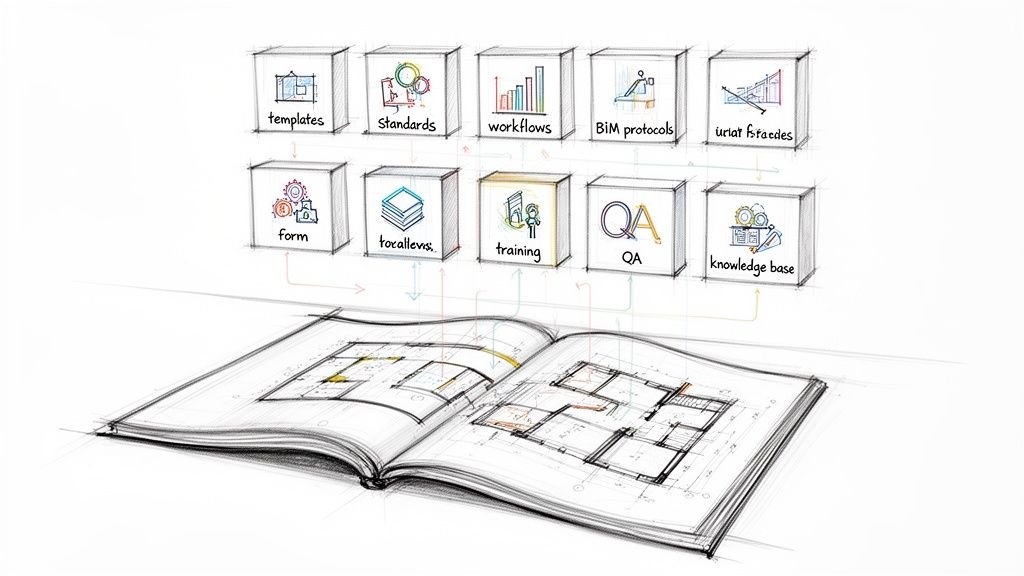
| BIM Execution Plan (BEP) | A static document created at kickoff. It’s often filed away and rarely referenced, quickly becoming disconnected from how the project is actually run. | A living document linked to production templates and QA systems. It defines key decision checkpoints and handoffs, acting as a true governance tool that guides daily work. |
| Data Handoffs | Models are exchanged as monolithic files at milestone deadlines. The data inside is often unstructured, requiring significant cleanup by the receiving team. | Data is exchanged through a Common Data Environment (CDE) based on ISO 19650 principles. Handoffs are defined by specific VDC use cases, ensuring information is structured and immediately usable. |
This comparison makes it clear: the core issue isn’t a lack of rules, but a lack of intelligent systems. Evolving governance is about building frameworks that support production speed, information reliability, and cross-team accountability. These are the cornerstones of protecting margins and delivering projects with predictability.
Adopting Modern BIM And VDC Best Practices
Moving from theory to practice means embedding smart BIM and VDC workflows directly into your project delivery. It’s about shifting your mindset from policing standards to building production systems that bring clarity and stop common failures before they start. Success comes from specific, actionable changes—not broad, aspirational goals.
From Ambiguity to Accountability
At the heart of modern BIM and VDC standards is a simple idea: replace ambiguity with clear accountability. This starts with getting rid of one-size-fits-all rules and creating requirements based on roles and project phases. An architect’s modeling needs are completely different from a trade contractor’s fabrication needs, and modern standards must reflect that reality.
For instance, instead of a vague LOD requirement, a better practice is to define clear data handoffs. The architect delivers a model with defined spatial zones, and the trade partner takes ownership of populating those zones with fabrication-ready elements. This simple switch clarifies who’s responsible for what and drastically reduces RFIs. For a practical roadmap, it’s worth digging into different construction-specific use cases.
Implementing Proactive Coordination Frameworks
Another critical step is moving from reactive clash detection to proactive coordination. The old way involved running massive clash reports once a week, which just created a huge backlog of low-priority issues that buried the truly critical ones.
In Practice: One project team reduced RFIs by over 40% by replacing weekly clash reports with a system of defined coordination zones. Each zone had an assigned owner responsible for resolving conflicts before the federated model was even published. This proactive approach kept the project on track and protected margins.
This approach turns the BIM Execution Plan (BEP) from a static document into a living accountability matrix. It defines not just what to model but who owns which space and when key decisions must be made.
Automating Model Health and Data Integrity
Finally, the best practices emerging today lean heavily on automation to keep information reliable. Manual model checks are slow, subjective, and simply can’t keep up on modern projects. High-performing teams are turning to automated model health checks that run continuously in the background instead.
These checks do far more than just find clashes. They can:
- Verify Naming Conventions: Ensure every element follows a standardized system.
- Check Data Completeness: Flag components missing critical data for procurement or FM.
- Validate Model Geometry: Pinpoint improperly modeled elements that cause downstream issues.
By automating routine QA tasks, BIM and VDC leads can spend their time solving complex constructability problems instead of policing basic modeling errors. You can learn more about how to structure these rules in our guide to modern BIM standards.
Three Actions To Evolve Your Standards This Quarter
Shifting from rigid rules to adaptive BIM and VDC governance feels like a massive undertaking, but real progress comes from small, targeted actions. The goal isn’t to rewrite the entire manual; it’s to prove that smarter BIM governance makes everyone’s job easier and protects project outcomes.
1. Audit Your BEP Template Against Reality
Pull up your standard BIM Execution Plan template and hold it up against your last complex project. Ask the tough questions: Did the documented LOD standards match what the VDC team actually needed? Were file exchange protocols followed, or did teams create workarounds? This simple audit will reveal where your standards are failing to support real-world production. Check out our deep dive on crafting a modern BIM Execution Plan for more.
2. Pilot a Role-Based LOD Checklist
Instead of redefining all your LOD standards at once, start small. Pick a single, high-impact trade—like mechanical or structural steel—and create a simple, role-based LOD checklist for an active project. For example, the structural engineer’s checklist specifies LOD 300 for main members, while the steel fabricator’s demands LOD 400 with connection parameters. This swaps ambiguity for clear expectations.
3. Introduce One Automated Model Health Check
Automation is your best friend for scalable quality control. This quarter, pick just one automated model health check and integrate it into your weekly workflow. Start with something simple but valuable, like a script that verifies all doors use the correct naming convention. This small step saves hours of manual cleanup and demonstrates the shift from manual policing to systemic BIM governance.
The Future Of BIM And VDC Governance
The way we govern BIM and VDC is still evolving. The future isn’t about more rules; it’s about standards so intelligent they practically disappear into the background, driven by emerging technology.
We’re moving into an era where governance isn’t a periodic checklist but a constant, automated hum.
The Rise of Predictive and Real-Time Enforcement
The next leap for BIM governance is shifting from reactive quality checks to predictive issue avoidance. AI-driven tools are emerging that don’t just find clashes but analyze model geometry to flag potential constructability problems before they become RFIs.
Cloud platforms are becoming active governance engines that enforce standards in real-time.
- Real-Time Model Validation: A system can reject a model upload with incorrect parameters or naming, stopping bad data from entering the project ecosystem.
- Automated Data Handoffs: Cloud workflows can trigger data exchanges based on project milestones, aligning with frameworks like the ISO 19650 standard.
- Lifecycle Data Integration: Future BIM and VDC best practices will demand models are built not just for construction but for decades of operation, embedding asset data from day one.
The ultimate goal is a governance system that doesn’t just catch errors but actively steers teams toward better outcomes. This forward-thinking approach all comes back to a core idea: your standards have to be a living system, adapting as fast as the technology itself to ensure both operational consistency and margin protection are baked into every project.
Are your standards causing more problems than they solve? Modernizing your approach to BIM and VDC is critical for protecting margins and delivering projects with predictability. We help teams build adaptive governance frameworks that support production speed and reliability.
Download our BIM-VDC Standards Audit Checklist to identify your biggest gaps.