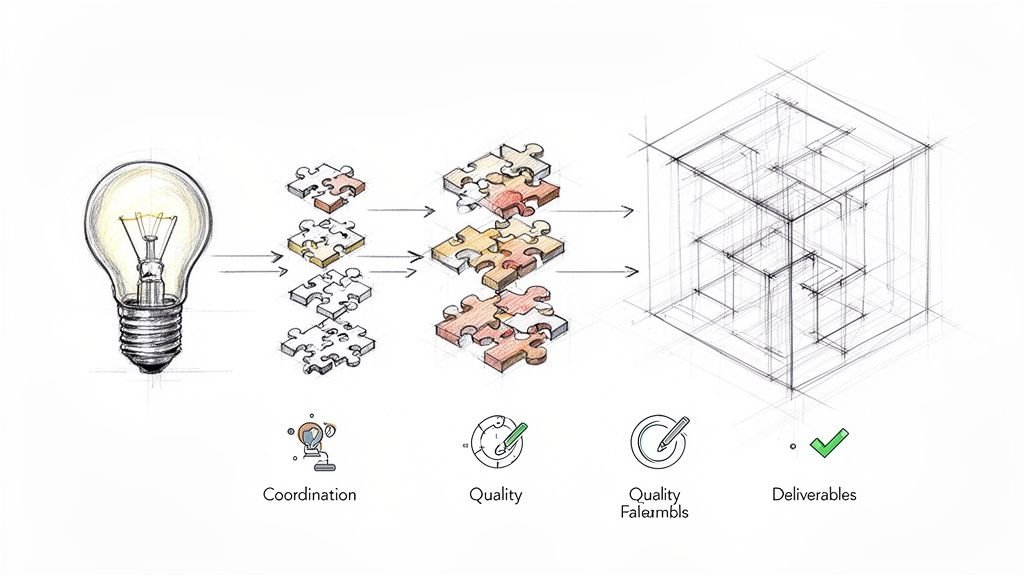
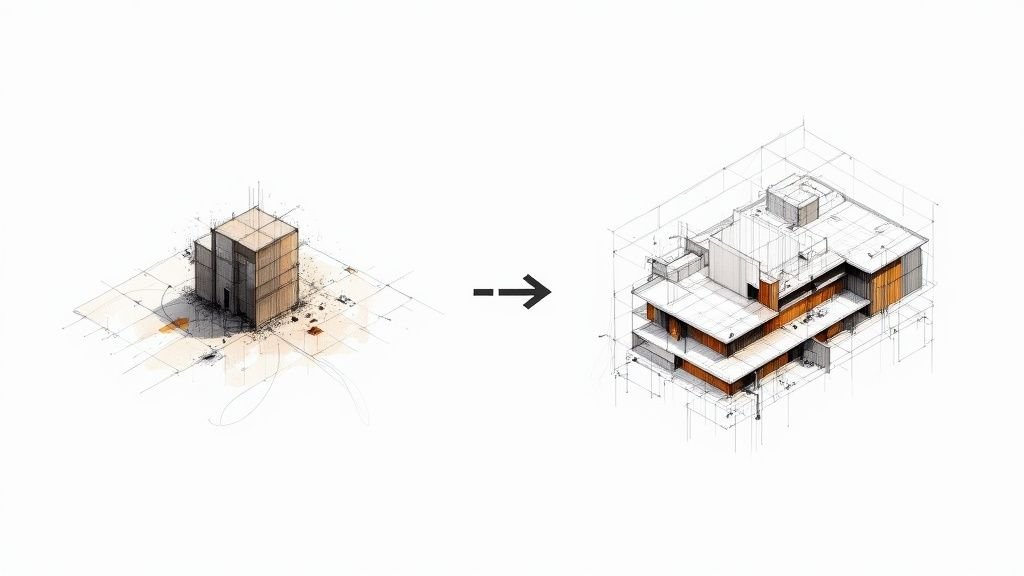
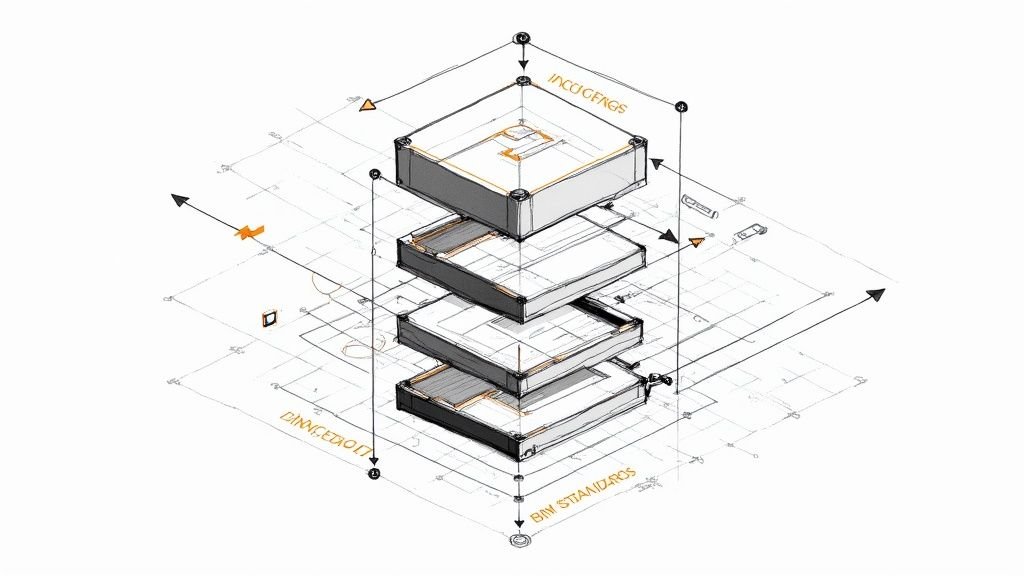
Let's picture two small architecture firms. Firm A sinks $15,000 into new software licenses and generic online training. Six months later, with deadlines looming and staff frustrated, they quietly shelve their BIM initiative, writing off the investment. Firm B invests a similar amount in strategically-scoped BIM consulting, and within three months, they’re delivering their first full BIM project with confidence.
This isn't a hypothetical scenario. It’s the reality we see play out constantly. The difference isn't the budget; it's the strategy. Small firms fail at BIM not because they can't afford it, but because they can't afford the expensive trial-and-error of going it alone.
The good news is, professional guidance—scoped correctly—is far more affordable than most principals believe. It’s a strategic investment in clarity, systems, and reliable delivery.

This guide reframes BIM consulting for small firms from a luxury expense to a practical, margin-protecting investment. It's not about finding "discount" services; it’s about scoping engagements intelligently to build your firm's internal capability, not create ongoing dependency.
Why Small Firm BIM Implementation Fails (and It's Not About Budget)
If you're a principal or studio leader at a 2-15 person firm, you've likely felt the pressure to adopt BIM. You may have even tried it, only to hit a wall.
The pain is real and recognizable: software purchased that no one uses properly; training attended that doesn't translate to your actual production workflows; months of fumbling while projects suffer. Standards don't exist because no one has time to create them. Staff are frustrated by inefficiency they don't know how to fix.
You’re not failing because of a lack of will or budget. You’re failing because the typical BIM implementation strategy is built for large firms and simply doesn't scale down.
The Small Firm BIM Challenge: Different, Not Just Smaller
The reality of running a small practice means you operate under a unique set of constraints that enterprise strategies ignore. Successful small firm BIM adoption starts by respecting these differences.
- Limited Time for Learning: Every hour spent on implementation is an unbillable hour. You can't afford to sink hundreds of hours into a steep learning curve while client work waits.
- No Dedicated BIM Manager: There isn't an in-house expert to build templates, create standards, or troubleshoot. Those jobs fall to people already wearing multiple hats.
- Principals Are Still Producing: Unlike in a large firm, owners are deep in production work. They can't step away for months to manage a complex software rollout.
- Can't Absorb Productivity Dips: A large company can weather a temporary drop in output. For a small firm, a two-month slowdown can be financially crippling.
- Project Diversity: You might handle a mix of residential, commercial, and interior projects, making one-size-fits-all templates useless.
Your firm isn't a miniature version of a large one. Your challenges are different in kind, not just scale. Your implementation approach must be, too. This is where focused BIM consulting provides clarity, not complexity.
The True Cost of "Free" Self-Implementation
The DIY approach to BIM adoption seems like the most affordable path. You buy the software, find some YouTube tutorials, and skip the BIM consulting cost. But this "free" approach is often the most expensive one a small firm can take.
The real costs aren't on an invoice; they're buried in lost time, ingrained mistakes, and staff frustration.

- Unbillable Hours: A principal billing at $150/hour who spends just 40 hours fumbling through self-teaching has burned $6,000 in lost revenue. Multiply that across your team.
- Mistakes Built into Templates: Without expert guidance, small errors get baked into your foundational files. Every new project inherits these flaws, costing you time and money repeatedly.
- Bad Habits Become Institutionalized: Inefficient workarounds become "the way we do things," locking in slow production and preventing true QA processes.
- The Expensive Restart: The most significant expense of a failed self-implementation is the cost of starting over. The unbillable time, staff turnover, and project delays almost always exceed the cost of a focused consulting engagement.
Strategic BIM consulting isn't a luxury. It's risk mitigation—a predictable investment that protects your margins and operational consistency from the spiraling costs of a DIY effort gone wrong.
What Small Firms Actually Need from BIM Consulting
When you hear “BIM consulting,” it’s easy to picture a massive, multi-year overhaul. That’s a mistake. Small firms need practical tools and decision checkpoints, not exhaustive theory.
The goal of affordable BIM consulting for small firms isn't getting a discount. It's about surgical scope—paying only for high-impact deliverables that directly improve production maturity, predictability, and margin protection.
What You Need:
- A Right-Sized Template: A project template built for your specific project types and deliverable standards.
- Workflows that Fit Your Practice: A documented process showing how to get from a blank screen to a clean permit set, matching how your firm actually operates.
- Training on What You'll Use Daily: Hands-on training for the 20% of the software you’ll use 80% of the time—not a week-long course on features you'll never touch.
- Standards You'll Actually Follow: A simple, one-page guide to naming conventions and model organization is far more valuable than a dense binder that collects dust.
- Quick Answers When Stuck: An expert on call to prevent hours of lost time Googling a fix that is holding up production.
What You Don't Need:
- Enterprise-level BIM Execution Plans.
- Comprehensive training on features you won't use.
- Complex, multi-volume standards documentation.
- Multi-year implementation roadmaps with no flexibility.
- An ongoing, full-time consultant presence.
By matching the scope to your actual needs, you shift the conversation from "we can't afford it" to "what's the smartest first investment?" This strategic approach makes professional guidance a powerful tool for building genuine capability.
Affordable Engagement Models That Fit Small Firm Budgets
The idea that professional guidance requires a massive budget is a myth. The secret for small firms is to think in focused, strategic engagements that protect cash flow and deliver immediate results.
Here are eight proven, budget-friendly BIM consulting models that work for small architecture and design firms.
1. The Focused Sprint
An intensive 1-3 day engagement delivering specific, usable outcomes. It's about getting a structured launchpad to build from.
- Scope: Template customization for your primary project type, core workflow documentation, and hands-on training using your actual work.
- Investment: $3,000 – $7,500
- Best For: Firms ready to commit but need to be production-ready fast, avoiding months of trial-and-error.
- Outcome: A production-ready system and a trained team at the end of the engagement.
2. The Quarterly Coaching Relationship
Ongoing access to expert guidance in small, regular doses. This model builds production maturity over time without a large upfront investment.
- Scope: A half-day session each quarter (remote or on-site) for progress reviews and skill-building, with email/call support between sessions.
- Investment: $1,500 – $3,000 per quarter
- Best For: Firms wanting steady improvement and an expert to help navigate challenges as they arise.
- Outcome: Continuous advancement and a reliable decision checkpoint for your evolving BIM workflows.
3. Project-Based Coaching
Consultant support tied directly to a specific, revenue-generating project. This is learning by doing, with a safety net.
- Scope: Project setup, check-ins at key milestones (like permitting prep), real-time problem solving to prevent RFIs, and a post-project review.
- Investment: $4,000 – $10,000+, depending on project complexity.
- Best For: Firms that landed a BIM-required project and have no internal experience.
- Outcome: Successful project delivery plus transferable skills your team can use on the next job.
4. The Template and Standards Package
A one-time engagement delivering the foundational assets for consistency and efficiency. It’s about template discipline from day one.
- Scope: A project template configured for your project types, a curated family library, and concise, usable standards documentation (e.g., naming conventions).
- Investment: $2,500 – $6,000
- Best For: Firms with some Revit or Archicad capability but no solid, repeatable foundation.
- Outcome: A professional-quality starting point for every project, eliminating rework and wasted setup time.
5. Half-Day Workshops
Focused training sessions on specific skills or workflow bottlenecks. It's a surgical strike to address a known weakness.
- Scope: A single-topic deep dive (e.g., documentation sets, family creation, coordination) with hands-on exercises.
- Investment: $1,000 – $2,500 per session
- Best For: Firms that have identified a specific skill gap that is hurting production.
- Outcome: Targeted capability improvement in a high-impact area.
6. The BIM Health Check
A consultant assessment of your current state with prioritized recommendations. It’s a low-risk entry point to get clarity before making a larger investment.
- Scope: A review of your current templates, standards, and workflows, plus a gap analysis and a prioritized improvement roadmap.
- Investment: $1,500 – $3,500
- Best For: Firms unsure where to start, what to prioritize, or recovering from a failed self-implementation attempt.
- Outcome: A clear, objective action plan that ensures your next investment is aimed where it will matter most.
7. The Remote Support Retainer
On-demand access to an expert for questions and problems. Think of it as a virtual BIM Manager on call.
- Scope: A small monthly bank of hours (e.g., 2-4 hours) for email and screen-share support to troubleshoot issues.
- Investment: $400 – $800 per month
- Best For: Firms with some capability that need an expert safety net to resolve issues quickly.
- Outcome: Reduced frustration, faster problem resolution, and the confidence to tackle new challenges.
8. The Training + Template Bundle
A combined package delivering a custom template and the training to use it effectively. This aligns your tools and skills from the start.
- Scope: Development of a custom template, followed by training sessions on its use and the associated workflows.
- Investment: $5,000 – $12,000
- Best For: Firms starting fresh or those needing a complete reset after a failed attempt.
- Outcome: A complete production foundation and a team equipped to use it correctly from day one.
Prioritizing Your Consulting Investment: High-Impact First
For a small firm, every dollar has to count. Prioritization isn't just a good idea; it's essential. Focus your initial investment where it will have the most immediate and widespread impact on your daily production.
Highest Priority (Do These First):
- Template Customization: Affects every hour of every project. A solid template provides immediate ROI.
- Core Production Training: Focus on the daily tasks of modeling and documenting. This saves time every single day.
- Standards Foundation: Simple rules for organization and naming prevent chaos and costly rework later.
Second Priority (After the Foundation is Solid):
- Documentation Workflow Optimization: Streamlining how you create and manage sheet sets.
- Coordination & Collaboration Setup: Defining processes for working with consultants.
- Specialized Training for Project Types: Deep dives into workflows for your most common projects.
Can Often Skip or Defer:
- Comprehensive BIM Execution Plans (a simple checklist is often enough).
- Formal, extensive standards documentation binders.
- Training on advanced, rarely used features like generative design or detailed energy analysis.
- Enterprise-level management processes.
DIY vs. Consultant: A Decision Framework
Deciding when to do it yourself and when to call an expert is critical for managing your budget and time.
DIY Makes Sense When:
- You have a team member with proven expertise and available, non-billable time.
- The task has a low learning curve and mistakes aren't costly.
- You're not on a tight deadline and can afford a period of experimentation.
A Consultant Makes Sense When:
- You need to get it right the first time, especially for a client-mandated project.
- The task requires deep experience you don't have (e.g., transitioning from CAD-to-BIM workflows).
- Your team's billable time is more valuable than the cost of expert guidance.
A hybrid approach is often best. Use a consultant to build the strategic foundation (template, standards, core workflow) and then empower your internal team to execute and refine it over time.

A Phased Implementation That Matches Your Cash Flow
A successful rollout doesn't have to be a massive, one-time expense. A phased approach allows you to build capability over time, with each stage's investment tied to tangible progress.
-
Phase 1 (Months 1-3): Foundation
- Action: Engage a consultant for a Template & Standards Package and core production training.
- Investment: $5,000 – $12,000
- Outcome: A production-ready system and a team capable of starting their first BIM project.
-
Phase 2 (Months 4-6): Stabilization
- Action: Execute your first project internally with a small remote support retainer for troubleshooting.
- Investment: $1,200 – $2,400 (for retainer)
- Outcome: Your team builds confidence and refines the workflow on a live project.
-
Phase 3 (Months 7-12): Optimization
- Action: Move to a quarterly coaching relationship to address advanced topics and drive continuous improvement.
- Investment: $3,000 – $6,000 (for 2 quarters)
- Outcome: Your firm develops true production maturity and an internal BIM champion.
A total first-year investment of $9,200 – $20,400 delivers sustainable capability—often for less than the cost of one failed self-implementation attempt. This strategic spending protects margins and builds a scalable delivery model.
Building Internal Capability, Not Consultant Dependency
A critical goal of any consulting engagement for a small firm should be self-sufficiency. You are hiring an expert to transfer knowledge and build your systems, not to create a permanent line item on your P&L.
A good consultant's primary mission is to make themselves obsolete.
Warning Signs of a Consultant Creating Dependency:
- They don't provide editable, open-format documentation of your systems.
- They resist training an "internal champion" on your team.
- Their proposals focus on ongoing retainers rather than knowledge transfer.
- They use proprietary tools or families that only they can manage.
The relationship should be designed to transition from intensive support to light-touch, as-needed guidance.
How to Negotiate with a BIM Consultant
Before you sign anything, you need to ensure the consultant understands your small-firm reality. You are the client; you set the terms.
What to Ask For:
- A scope focused on your actual production needs.
- Clear, tangible deliverables you can see and use (e.g., "a Revit template," "a one-page PDF of standards").
- Skills transfer as an explicit goal of the engagement.
- A flexible structure that can adapt to your cash flow.
- References from firms your size (2-15 people).
What to Push Back On:
- Comprehensive assessments or "discovery phases" before any real work is done.
- Enterprise-level deliverables like 50-page BEPs you won't use.
- Long-term contracts without clear exit clauses or deliverables.
- Vague outcomes like "improved BIM maturity" instead of measurable goals.
Red Flags: Consultants Who Don't Understand Small Firms
- They have no experience with firms your size.
- They can't explain the value of their service in terms of production efficiency or margin protection.
- They push a comprehensive program when you ask for focused help.
- Their deliverables are PowerPoints and reports, not working systems and trained staff.
The right partner will sound less like a salesperson and more like a seasoned practitioner who has solved your exact problems before. They get that you don't sell hours; you sell clarity and reliability. That's the core of our approach to BIM services.
Measuring Success with Limited Resources
For a small firm, success metrics should be simple, meaningful, and tied directly to business outcomes.
- Time on First BIM Project: How did it compare to your CAD baseline for a similar project?
- Reduction in Rework: Did you see fewer RFIs or coordination errors?
- Staff Confidence: Is your team less frustrated and more empowered?
- New Business: Are you now able to compete for projects that require BIM?
You don't need complex KPIs. You need to know if the investment is making your practice more predictable, profitable, and competitive. The AEC industry is rapidly embracing digital tools, a trend analyzed in depth by reports like this one from Global Market Insights. Being on the right side of that trend is a success metric in itself.
In the end, strategic, right-sized BIM consulting is the most affordable and reliable path for any small firm. It costs less than you think, and it delivers results far more dependable than going it alone. The real luxury you can't afford is the time and money wasted on another failed implementation attempt.
Ready to stop guessing and start building? Let's talk about what a focused, affordable engagement would look like for your firm. Schedule a complimentary Small Firm BIM Consultation to get a clear, no-obligation action plan for your practice.