

How Much Coordination Is Too Much Coordination? A Guide to Predictable Project Delivery

When you're buried in BIM coordination services, the dream of a smooth-running project can feel a million miles away. You're stuck in an endless loop of coordination meetings, staring at clash reports that generate more noise than clarity. And there’s that nagging sense of déjà vu as the same issues resurface, week after week.
It's a frustrating cycle where more effort seems to create less value. The harder you work, the further behind you get.
The Coordination Trap: When More Effort Creates Less Value
For architects, BIM managers, and VDC leads, the entire point of a BIM coordination workflow is to create predictability. So why do so many teams find themselves stuck in a loop where coordination is the bottleneck, not the solution?
The problem isn't coordination itself. It’s the flawed assumption that more coordination is always better. In reality, drowning your project in coordination is often a symptom of deeper problems: unclear modelling standards, undefined responsibilities, or a weak LOD plan. You’re coordinating issues that should never have existed in the first place.
This guide is for the professionals who feel trapped by their own process—and know there has to be a better way than booking another four-hour meeting to argue over recurring clashes.
From Volume to Precision in Coordination
Think of coordination not as a volume exercise, but as a precision tool. Too little coordination creates risk, RFIs, and expensive rework. But too much coordination creates its own set of problems:
- Decision Fatigue: When every minor issue is escalated, senior team members burn out on low-impact calls, leaving them drained for the high-stakes problems that actually need their expertise.
- Delayed Accountability: Constant group reviews water down ownership. Teams start waiting for coordination approval before making basic modelling decisions, grinding the project to a halt.
- Operational Noise: Massive clash reports and back-to-back coordination meetings in construction just create noise. It becomes impossible to spot the critical issues that threaten project milestones.
Mature project teams don’t have more meetings; they have better systems. They don’t coordinate every possible conflict. They establish rules that prevent most conflicts and reserve coordination for high-risk interfaces where it adds the most value.
We’ve seen coordination cycles shrink dramatically once teams stopped coordinating avoidable problems and focused only on high-risk interfaces. This shift protects margins and restores schedule predictability.
This guide will show you how to trade that reactive, brute-force approach for an intentional one. We'll dig into how to set clear rules, filter out noise, and establish a production maturity that prevents problems instead of just endlessly documenting them. The goal is to make coordination a rare, high-value event—not a daily grind.
Recognizing the Symptoms of Over-Coordination
Effective BIM coordination services should feel like a source of clarity, not a constant struggle. When the process is working, it drives momentum. When it’s broken, the symptoms are often disguised as "just another busy project."
For experienced BIM managers, VDC leads, and architects, these warning signs are obvious. They aren't just minor headaches; they're indicators that your BIM coordination workflow is a symptom of deeper issues. If your team is stuck putting out fires, you’re probably seeing these issues every day.
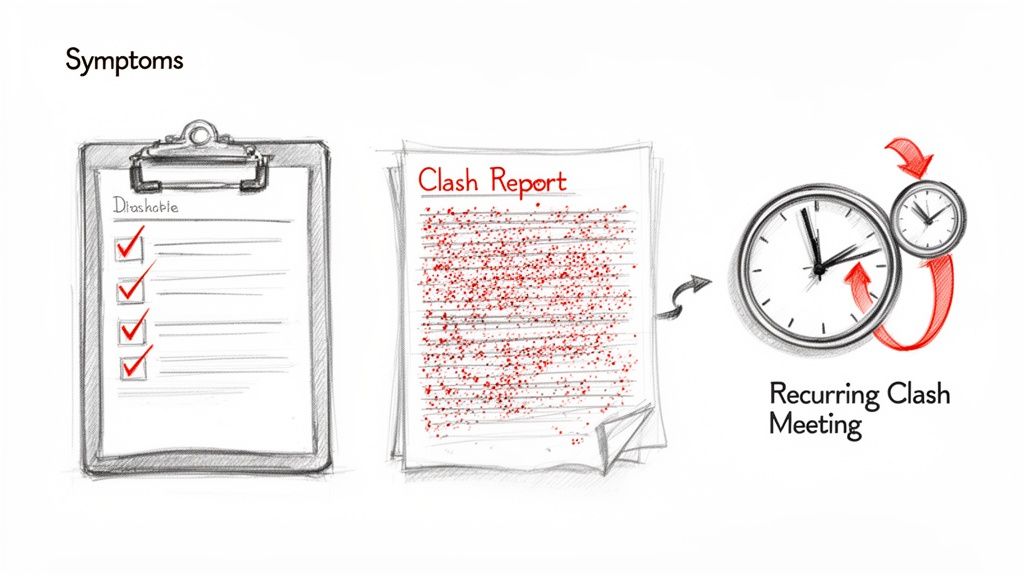
Déjà Vu Clashes and Never-Ending Reports
The most glaring sign of a failing system is the recurring clash. You spend hours in a meeting resolving a ductwork conflict, only to see the exact same issue reappear in the next model update.
This isn’t bad luck. It’s a symptom of weak accountability and poorly defined modelling standards. It’s a clear sign that changes are being made in a silo, undoing previously agreed-upon solutions.
The problem is compounded by bloated clash reports. Instead of a focused, actionable list, teams get a document with hundreds—or even thousands—of low-priority issues. Information Overload stalls decisions. When critical clashes are buried in a sea of trivial ones, the entire report becomes useless noise.
Marathon Meetings with No Clear Outcomes
Another red flag is the endless cycle of unproductive coordination meetings in construction. These sessions often have no clear agenda, drag on for hours, and end without firm decisions or assigned actions. The conversation wanders while high-risk conflicts get punted to the next meeting.
A healthy coordination meeting is a decision-making forum, not a discovery session. If your meetings feel like a place where problems are admired instead of solved, it’s a sign the real work isn’t happening beforehand. This is where a lack of preparation and undefined decision-making authority brings progress to a halt.
We’ve seen teams spend 80% of their meeting time discussing issues that could have been resolved with a five-minute call between two trade partners. This isn’t coordination; it’s a process bottleneck that puts margins and milestones at risk.
Paralysis by Analysis and Team Bottlenecks
Finally, pay attention to how your team acts between meetings. Does all modeling progress stop while everyone waits for the next coordination call for approval on basic decisions? This is a classic symptom of a "wait-for-coordination" culture.
This mindset is incredibly toxic. It signals that your trade partners either lack confidence or the project standards aren't clear enough to guide them. True coordination empowers teams with clear rules, letting them solve most issues independently and reserving group time for only the most complex, multi-trade problems.
It's easy to blame the tools, but these symptoms point to deeper issues. This table breaks down what you might be seeing versus what's really going on.
Symptom vs. Root Cause in BIM Coordination
| Observable Symptom | Potential Root Cause | Impact on Project |
|---|---|---|
| Endless, unproductive coordination meetings | No clear agenda; lack of pre-meeting prep | Wasted billable hours, decision fatigue, slow progress |
| The same clashes appear week after week | Poor accountability; no clash resolution tracking | Rework, schedule delays, eroding team morale |
| Clash reports with 1,000+ non-critical issues | Poorly configured clash tests; lack of filtering | Critical issues get missed; teams ignore the reports |
| Modeling progress stalls between meetings | Culture of dependency; unclear lines of authority | Creates bottlenecks, slows down the entire project |
| Team members seem disengaged or frustrated | The process feels punitive, not collaborative | Loss of trust, finger-pointing, poor quality work |
These symptoms reveal a deeper truth: the problem is rarely the model itself, but the system—or lack thereof—governing its creation. By addressing root causes like unclear BIM standards or a weak LOD strategy, you transform coordination from a source of frustration into a driver of predictability.
How Over-Coordination Threatens Project Predictability
Good BIM coordination services should be a source of stability, not chaos. But when coordination becomes a reactive, error-catching hamster wheel, it injects unpredictability into your project, threatening the very margins and schedules it was meant to protect.
Think of it like this: you wouldn't run a factory by skipping the assembly line process and just hiring an army of inspectors to catch mistakes at the end. You'd fix the process. A project that leans on constant coordination meetings in construction is just reactively fixing problems that a mature, well-defined workflow should have prevented.
The Hidden Costs of Constant Review
When every minor modeling decision gets funneled into a coordination call, it creates a toxic ripple effect. Your most experienced team members get bogged down in low-value discussions, leading to decision fatigue.
Accountability gets watered down, too. When every choice is made by committee, no single trade partner truly owns the outcome. This creates a dangerous bottleneck where teams wait for group approval before making basic updates, fostering a culture of dependency that grinds progress to a halt.
From Process Bottleneck to Margin Erosion
This constant churn isn't just frustrating—it's a direct hit to your bottom line. Every hour spent debating a recurring pipe clash is an hour not spent on fabrication planning or other critical-path activities. Schedules slip, rework orders pile up, and project margins shrink. When every little issue is flagged as a coordination priority, nothing is.
The global Building Information Modeling (BIM) service market is exploding, set to grow from USD 391 million in 2025 to USD 503 million by 2032, fueled by the promise of slashing project delays. You can find more details on the BIM market's projected growth on snsinsider.com. But throwing more services at a broken workflow won't fix it.
Excessive coordination is usually a symptom of deeper problems: unclear modelling standards, undefined responsibilities, weak LOD planning, or teams coordinating issues that should never have existed.
This is where the focus has to shift. Effective coordination isn’t about doing more; it’s about building a system where less coordination is needed.
Adopting a Proactive Coordination Stance
The solution is to treat coordination like a scalpel, not a sledgehammer. A well-run project sets clear rules of engagement from day one, empowering teams to solve most problems on their own. This requires a mature BIM coordination workflow built on a few key pillars:
- Strong BIM Standards: Clear, enforceable standards prevent the vast majority of common clashes.
- Defined Responsibilities: When trade partners know what they own, they model with confidence.
- Strategic Clash Detection: Focus on high-risk interfaces, not noisy, unfiltered tests. Our guide on clash detection best practices can help refine this.
- Decision Thresholds: Define which issues need a group meeting versus those that can be handled by trade leads.
By moving from a reactive "catch-all" approach to a proactive, rules-based system, you transform coordination from a bottleneck into a strategic asset. You stop managing an endless stream of problems and start governing a predictable process.
Shifting to an Intentional BIM Coordination Workflow
The solution to coordination chaos isn't more meetings or bigger clash reports. It’s a strategic shift from reactive firefighting to a proactive, intentional BIM coordination workflow.
The approach is built on a simple premise: your team’s time and expertise are finite. Those resources should be spent solving complex, high-risk problems—not fixing issues that good standards and discipline should have prevented.
An intentional workflow turns coordination from a volume-based exercise into a precision tool. It’s about establishing clear rules of engagement upfront so the entire team knows what’s expected and who’s responsible. This isn’t aspirational; it’s a practical system for protecting margins and delivering predictable outcomes.
Establishing the Rules of Engagement
The foundation of an intentional approach is a solid BIM Execution Plan (BEP). A well-defined BEP acts as the project’s constitution, outlining the processes, standards, and protocols that govern all modeling.
Learn more about crafting a powerful BIM Execution Plan in our detailed guide.
This document should clearly define:
- Modeling Standards: Prescribe exact requirements for how models are created, from naming conventions to element placement. This alone eliminates a huge source of avoidable clashes.
- Responsibility Matrix: Clearly assign ownership for every system and subsystem. When trade partners know what they own, they can resolve minor overlaps directly.
- Level of Development (LOD) Strategy: Define the required level of detail at each project milestone. This prevents both under-modeling and wasteful over-modeling.
From Noisy Reports to Filtered Clash Sets
One of the biggest productivity drains is the thousand-item clash report filled with low-priority junk. An intentional workflow replaces this noise with highly filtered, actionable clash sets.
Instead of running one massive test, you create targeted clash tests focused on high-risk interfaces—like primary MEP runs against major structural elements.
We’ve seen coordination cycles shrink dramatically once teams stopped coordinating avoidable problems and focused only on high-risk interfaces. This frees up senior staff to solve genuine design challenges instead of debating minor modeling errors.
This approach requires discipline. It means trusting your standards to handle the small stuff. Making this transition is essential for turning BIM coordination services into a driver of efficiency.
The global BIM market is set to expand from USD 11.29 billion in 2026 to USD 21.42 billion by 2031, with service revenues growing at 15.6% CAGR as firms seek this exact kind of production maturity. Explore more on the outsourced BIM services market growth to see how this trend is shaping the industry.
Empowering Teams with Decision Thresholds
Finally, an intentional workflow empowers teams by setting clear decision-making thresholds. Not every clash requires a full-blown coordination meeting. The BEP should define which types of issues can be resolved between trade leads and which must be escalated.
This tiered approach fosters accountability and prevents bottlenecks. It encourages trade partners to communicate and collaborate directly, building a more resilient and efficient project team.
A well-oiled BIM coordination workflow not only streamlines design and construction but also sets the stage for a smoother building commissioning process, verifying that all systems operate as designed.
By putting these principles into practice, you move from a culture of constant, reactive review to one of proactive, disciplined execution. The goal is to make coordination meetings in construction rare, focused, and incredibly productive—a strategic checkpoint, not a daily chore.
Building Your Framework for Right-Sized Coordination
If you're tired of endless coordination meetings that feel more like firefighting than project management, it's time to shift from a reactive to a proactive workflow. This isn't about adding bureaucracy. It's about building an intentional system that makes high-quality modeling the path of least resistance.
Effective BIM coordination services are built on clarity, not the sheer volume of meetings. By investing in solid governance and mature production workflows upfront, you can prevent most common issues from ever showing up in a clash report. That’s how you protect project margins and restore operational consistency.
The Three Pillars of a Disciplined Workflow
A right-sized coordination process stands on three core pillars that bring predictability to your projects. When these are in place, coordination becomes a targeted, high-value activity instead of a project-wide bottleneck. It's the difference between catching errors and preventing them.
The flowchart below shows how this intentional framework moves from foundational rules to specific, filtered actions.
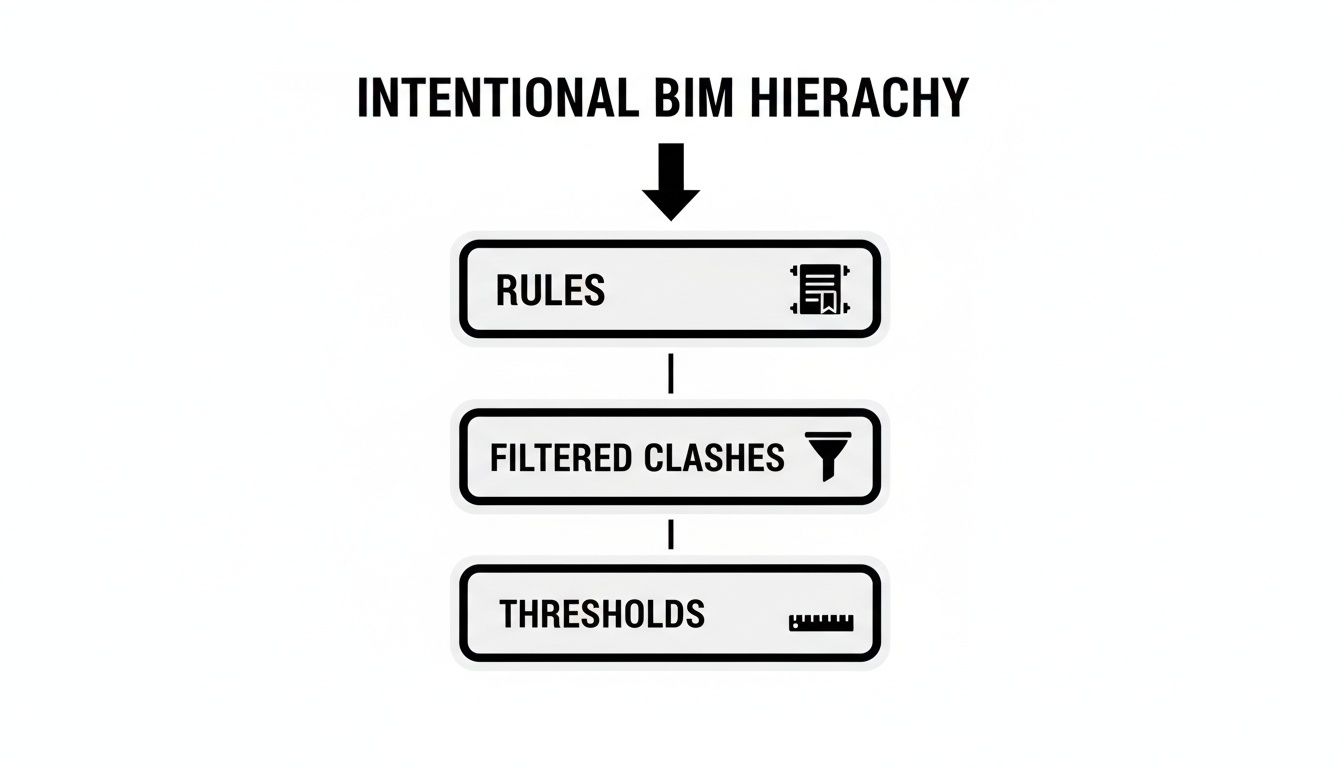
As you can see, strong rules and standards form the base. This allows for precise, filtered clash detection and clear decision-making, which optimizes the entire process.
Pillar 1: Robust BIM Standards
The single best way to reduce coordination churn is to implement and enforce robust BIM standards. These standards are your project’s DNA, spelling out everything from file naming conventions to modeling protocols for each discipline. They eliminate ambiguity and establish a single source of truth.
Good standards aren't just about keeping things neat; they're a direct line to margin protection. When every trade partner models to the same clear requirements, you wipe out an entire category of self-inflicted clashes. For a deeper look at setting up these crucial protocols, check out our guide on BIM standards.
Pillar 2: A Clear Responsibility Matrix
The second pillar is absolute clarity on ownership. A Responsibility Matrix, often a RACI chart (Responsible, Accountable, Consulted, Informed), definitively assigns every system, component, and spatial zone to a specific trade partner. There should be zero question about who models hangers for a duct run or who is responsible for fireproofing on a structural beam.
When responsibilities are spelled out in the BIM Execution Plan, it builds accountability. Trade partners can model their scope with confidence and resolve minor overlaps directly, rather than waiting for a group meeting. This cuts down RFIs and empowers teams to maintain momentum.
Pillar 3: A Well-Defined LOD Strategy
Finally, a well-defined Level of Development (LOD) strategy prevents the twin threats of over- and under-modeling. By specifying the required level of detail at each project milestone, you ensure teams provide the right amount of information at the right time. This stops wasted effort on detailing components too early and avoids creating coordination gaps with underdeveloped models later on.
With BIM adoption widespread, these frameworks are becoming standard practice. In the United States, around 75% of architectural firms have adopted BIM, a number that speaks to its impact on predictability. This broad usage shows how model-based workflows and clash detection can slash construction delays and rework by up to 30%.
The core message is this: effective coordination isn’t about doing more—it’s about knowing exactly what deserves coordination and what should be governed by standards instead.
By building your BIM coordination workflow on these three pillars, you transform it from a chaotic, reactive process into a predictable, value-driven system. It’s a shift that takes discipline and upfront planning, but the payoff is a project that runs smoother, stays on schedule, and protects your bottom line.
Your Path to Productive and Predictable Coordination
This guide started with a shared frustration: the feeling of being stuck in endless, unproductive coordination meetings in construction. We’ve unpacked the signs of over-coordination, the risks it creates for your bottom line, and the strategic shift needed to get back in control. The road from chaos to clarity isn't about working harder—it’s about working smarter within a disciplined system.
Great BIM coordination services aren’t measured by hours burned in meetings or the page count of a clash report. Real success is building a system so solid that coordination becomes a quick, high-value checkpoint, not a frantic scramble. Predictability comes from discipline, not from endless reviews.
From Reactive Firefighting to Intentional Governance
The way forward means shifting your mindset from reactively putting out fires to proactively preventing them. It’s about building a strong foundation with the right pieces:
- Robust BIM Standards: Your project’s constitution. They eliminate guesswork.
- Clear Responsibility Matrix: Assigns ownership and keeps everyone accountable.
- Defined LOD Strategy: Ensures the right information is there at the right time.
When these systems work, your BIM coordination workflow is completely different. You stop policing basic modeling mistakes and start directing your team’s brainpower toward solving real, high-risk design problems. You trade noise and decision fatigue for clarity and consistency, creating an environment where projects are delivered on time and on budget.
The ultimate goal is to make good coordination feel almost invisible—a natural outcome of a well-run production system, not a constant, manual effort.
This approach puts you back in control, empowers your team, and protects your firm’s profitability. You’re no longer just selling hours; you’re delivering reliable, predictable outcomes.
Ready to see how your own processes stack up? We created a Coordination Maturity Framework to help you identify strengths and find opportunities for improvement. Download this technical resource to start building a more predictable workflow today.
Frequently Asked Questions About BIM Coordination
Even with a solid plan, moving to a structured BIM coordination service brings up practical questions. Here are straight answers to the common hurdles teams face when they try to break free from the coordination hamster wheel.
What Is the First Step to Fix Endless Coordination Meetings?
The very first step is a process audit. Before buying new software or piling on more rules, take a hard look at your last few coordination meetings in construction.
Categorize every clash you discussed. Was it due to missing standards? Unclear responsibility? A late design change? Or a genuinely complex interface that needed group input? You’ll likely find that most of your time is wasted on problems that a stronger BIM Execution Plan and clearer modeling standards would have solved before they ever hit an agenda. Fix the root cause, not the symptom.
How Do We Get Trade Partners to Follow New Rules?
You don't get buy-in by just dropping a rulebook on their desk. It comes from showing them how the new process protects their own time and money.
Frame it as a system that helps them. For instance, when you introduce filtered clash reports, explain it like this: "We're killing the 1,000-item reports and focusing only on the 50 critical clashes that need your input, so your team can get back to fabrication." When they realize that a disciplined process means less rework and fewer pointless meetings for them, they’ll champion the system themselves. A collaborative kick-off meeting is non-negotiable for setting this tone.
When Should the BIM Coordination Workflow Be Defined?
The BIM coordination workflow must be defined and agreed upon during the project kick-off, long before significant modeling begins. It should be a central part of your BIM Execution Plan (BEP).
Waiting until models are developed and full of clashes is a recipe for disaster. It’s reactive, inefficient, and stressful. Be proactive: define the rules of engagement, LOD requirements, a responsibility matrix, and clash detection protocols upfront. This creates a foundation of accountability and stops the chaos of making up rules in the middle of a fire.
At BIM Heroes, we know that predictable outcomes come from disciplined processes, not from more meetings. We help AEC firms build mature production workflows that protect their margins and deliver genuine clarity. If you're tired of reactive coordination and ready for a proactive system, let's talk.
Find out how we can help at https://www.bimheroes.com.
Related Posts
The Real Cost of Coordination Failures: A GC’s Guide to BIM Savings

Beyond Clash Detection: What BIM Coordination Services Really Deliver
Why Your Coordination Meetings Are Ineffective (And How to Fix Them Fast)

How to Manage Multiple Projects Without Burning Out Your Team
Beyond the Checkbox: Why Your BIM Execution Plan is a Profit Machine

From Factory to Foundation: The Complete Prefabrication Workflow Explained
-
Posted by
Deepak Maratha

Lighting Fixture Detailing in BIM Projects
-
Posted by

Clash Detection in BIM: Process and Standards
-
Posted by
Hitesh Pariyani