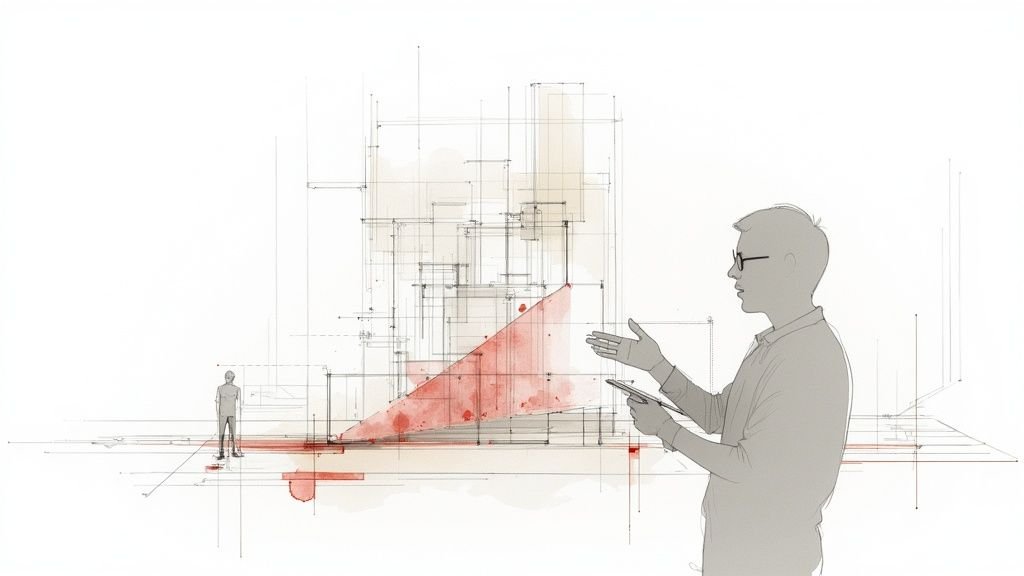
Most general contractors see BIM coordination services as a line item expense for 3D models. That’s missing the point. The real value isn't in flashy visuals—it’s in systematically eliminating risk to protect your margins. Coordination failures are expensive, and a disciplined BIM process is a pragmatic strategy to get ahead of predictable field mistakes that drain your budget.
This isn’t a marketing pitch about exaggerated ROI. It’s a cost-breakdown analysis for GCs, preconstruction leads, and operations managers who are skeptical of hype but understand that coordination failures have a real, measurable cost.
BIM Coordination as a Risk Elimination Strategy
Big savings claims for BIM are easy to dismiss. The idea of catching one dramatic, multi-million-dollar clash is appealing, but those moments are rare. The true financial impact of good coordination accumulates quietly through the steady prevention of daily friction that bleeds a project dry.
It’s about shifting from a reactive footing to a proactive one. Instead of discovering a duct bank runs through a structural beam after installation, you solve that problem digitally, months ahead of schedule. It’s the difference between paying for demolition and investing in predictability. The core message is this: BIM coordination saves money when it eliminates predictable field risk—not when it simply generates clash reports.

Where Coordination Savings Truly Accumulate
Think of disciplined BIM coordination as a financial governor on your project. It’s not about generating mountains of clash reports; it’s about establishing production maturity and operational consistency. We’ve seen savings materialize when coordination is tied directly to field decision-making, not just model review.
These savings rarely appear as a single line item. Instead, they are spread across several key financial categories:
- Avoided Rework and Demolition: You stop paying crews to tear out finished work because of a trade conflict that a disciplined workflow would have caught months ago.
- Reduced Labor Downtime: You eliminate the frustrating days when a trade shows up ready to work, only to find their area obstructed. No more paying for standby time.
- Fewer Change Orders: Late discovery of constructability issues is a primary driver of costly change orders. A structured BIM process surfaces these problems before they become RFIs.
- Improved Material Ordering Accuracy: An accurate, coordinated model provides precise material takeoffs, reducing waste and panicked, last-minute orders at a premium.
- Compressed Coordination Cycles: You shorten the endless loop of coordination meetings that go nowhere, which directly cuts your project management overhead.
- Faster Dispute Resolution: When subcontractors start pointing fingers, the model becomes the documented source of truth, resolving arguments quickly and objectively.
On a typical mid-size commercial or multifamily project, the cost of just one or two major field blunders can easily exceed $50,000. These are the predictable risks a structured coordination process is built to eliminate. The real BIM coordination benefits extend far beyond simple clash detection; they create a more stable and predictable environment for the entire project.
Here’s the bottom line: The evolution from CAD to a mature BIM workflow isn’t a visualization upgrade. It’s a system that delivers clarity, predictability, and margin protection to the job site.
The Cost of Avoided Rework and Demolition
The most direct financial win from BIM coordination services comes from something beautifully simple: preventing problems before they happen in the field. Every time you catch a major system clash in the model, you’ve just dodged a costly, schedule-killing headache—the kind that eats away at contingency and profit.
These aren't hypotheticals. They're the all-too-common pain points that plague projects lacking disciplined preconstruction coordination. Think of a main duct run designed to occupy the exact same space as a primary structural beam. Or discovering electrical conduits running right through a spot claimed by plumbing stacks after install. These are budget-killers discovered far too late.

A Realistic Cost Breakdown of One Field Conflict
Exaggerated savings claims don't help anyone. Let’s use a conservative example. Imagine a standard clash on a mid-size commercial project: a large HVAC duct and a steel girder conflict is found after both are installed. This isn't a rare disaster; it’s a classic coordination failure. The financial damage ripples through the project, wrecking the schedule and budget.
Let's break down the realistic costs of that single, avoidable conflict:
- Demolition Labor: Mobilizing a crew to cut out the conflicting ductwork and potentially modify steel. (Estimated Cost: $4,000 – $6,000)
- Re-fabrication and Material Costs: The ductwork needs a redesign and re-fabrication. New materials are ordered, often with rush charges. (Estimated Cost: $5,000 – $8,000)
- Re-installation Labor: The new, correctly routed duct is installed, often taking longer due to constrained site conditions. (Estimated Cost: $6,000 – $9,000)
- Project Management Overhead: Your team burns dozens of hours in crisis mode—meetings, calls, and site visits—instead of pushing the project forward. (Estimated Cost: $8,000 – $12,000)
- Schedule Delay Impact: The entire sequence is disrupted. Drywall, electrical, and sprinkler crews are now stuck, creating a ripple effect of delays. (Estimated Cost: $15,000 – $25,000+)
We’ve seen savings materialize when coordination is tied directly to field decision-making, not just model review. The goal is to make a cheaper decision in the office instead of an expensive one on-site.
That one "simple" clash easily blows a $38,000 to $60,000 hole in the budget. On a mid-size project, stopping just one or two of these events through early-stage cost savings from clash detection more than pays for the entire investment in coordination services.
This is the real value proposition. It’s a risk elimination strategy. By sorting out conflicts digitally—using Navisworks for clash detection, aligning trade-specific LOD, and defining model ownership—you are making decisions when they are cheapest. The mindset shifts from reactive damage control to proactive QA processes. Your contingency is shielded from being drained by predictable—and preventable—field errors.
Reduced Labor Downtime from Trade Conflicts
Beyond preventing demolition, the financial wins from BIM coordination services multiply when you look at labor productivity. One of the biggest drains on a GC’s budget is field inefficiency. We’ve all seen it: a mechanical crew shows up to hang ductwork, only to find the electricians have run conduit through their zone. Work grinds to a halt.
This isn't just a delay; it's a direct hit to your budget. You are now paying a skilled team to stand around while project managers scramble to fix a problem that a mature BIM workflow would have caught months ago. This is where a coordinated model becomes a powerful production sequencing tool.

From Model Clarity to Field Predictability
A disciplined coordination process ensures every subcontractor’s scope is deconflicted in the digital world first. This creates a predictable construction sequence where each trade has undisputed access to their work area. The subcontractor finger-pointing that erupts when clashes are found in the field simply disappears.
This predictability delivers several direct financial benefits:
- Maximizing Productive Hours: Crews arrive on-site and start working. You stop paying for idle time and start paying for progress.
- Preventing Trade Stacking: A clash-free model prevents the chaos of multiple trades trying to cram into the same congested space at once, a common result of schedule compression.
- Reliable Material Deliveries: When the schedule is predictable, 'just-in-time' material ordering becomes a reality, freeing up on-site storage and reducing damage risk.
The Financial Drain of Unproductive Hours
Let’s put conservative numbers to this. A crew of four mechanical installers might cost a project anywhere from $250 to $400 per hour. Losing half a day to a coordination failure is a $1,000–$1,600 hit. For one crew. On one day. When this happens repeatedly across trades, the total cost of this "non-productive time" can easily surpass $50,000 on a mid-size project.
Effective BIM coordination, supported by a clear LOD strategy and template discipline, acts as a preventative measure. By locking in trade ownership and solving spatial fights in the model, you build a reliable production plan. This systematic approach is a key reason the global market for these services is expanding, projected to grow as more firms rely on BIM for AEC projects.
The lesson learned in the field is clear: a coordinated model isn't about avoiding clashes; it's about creating a predictable, efficient, and profitable work environment. It ensures that when your trades show up, they can build—not debate.
Fewer Change Orders and Compressed Coordination Cycles
Change orders are where project budgets go to die. They erupt when predictability fails, usually because of conflicts or ambiguities discovered far too late. BIM coordination services are a direct countermeasure, systematically reducing the risk of late-stage surprises that unleash a flood of RFIs and inflate costs.
When the federated model becomes the single source of truth, constructability is something you can verify. Problems that once would have only surfaced after the concrete was poured are now caught and fixed during preconstruction. This is a fundamental shift from a panicked RFI from the field to a collaborative solution in a model months earlier. This relies on production maturity: clear agreement on the Level of Development (LOD) and defined QA decision checkpoints.
From Endless Meetings to Decisive Action
Every project manager knows the pain of recurring coordination meetings with no resolution. You burn hours debating the same clashes week after week. These meetings are a huge, unbilled overhead cost.
A structured BIM coordination workflow makes these meetings shorter, more decisive, and less frequent. The goal of the process is to produce decisions, not just clash reports. It filters out noise, assigns clear ownership to each issue, and forces resolution before it impacts the field.
A mature coordination process achieves this by:
- Systematic Clash Filtering: Grouping conflicts by severity and trade responsibility so teams can tackle critical issues first.
- Defined Trade Ownership: Each trade's scope is clearly defined in the model. When a clash appears, there’s no argument about who needs to solve it.
- Decision Checkpoints: The process is built around scheduled milestones where specific coordination problems must be solved, creating accountability.
The Real Cost Savings of a Shorter Cycle
Let's do some quick math. A typical coordination meeting might involve a GC PM, a VDC manager, and leads from four major trades. If each person’s loaded rate averages $150/hour, a two-hour meeting that goes nowhere costs the project $1,800 in pure overhead. If that happens weekly for two months, you've burned nearly $15,000 with nothing to show for it.
By compressing the coordination cycle, you reclaim that time and money. Meetings become focused reviews of pre-vetted solutions, not open-ended arguments. Ultimately, a streamlined coordination cycle is a powerful health indicator. It demonstrates a disciplined workflow where problems are found and solved systematically. The broader benefits of BIM coordination shine when the process itself becomes as predictable as the building it helps create.
Improved Material Ordering and Faster Dispute Resolution
Inaccurate material orders and job site disputes are two of the quietest margin killers in construction. They create a slow bleed on profitability through waste, rush fees, and dead-in-the-water delays. Solid BIM coordination services address both by turning the model into a single source of truth for materials and accountability.
A well-coordinated model provides a rock-solid foundation for quantifying materials. When every element is modeled to an agreed-upon Level of Development (LOD), takeoffs become a matter of data extraction, not educated guesswork.
From Model Accuracy to Material Savings
Adding a 5-10% buffer to material orders is a traditional way to cover for field changes, but it's a hidden cost. With a clash-free model, you can confidently slash that buffer.
This precision saves money in several ways:
- Reduced Over-Ordering: You buy what you need, cutting upfront capital and eliminating leftover material headaches.
- Fewer Shortages: You avoid expensive rush orders and paying a crew to stand around waiting for a delivery.
- Optimized Prefabrication: Accurate models are the lifeblood of off-site fabrication, translating to less on-site labor and waste.
Settle Disputes in Hours, Not Weeks
When subcontractors point fingers over a field conflict, the argument quickly devolves. A coordinated BIM model cuts through that by acting as an impartial, time-stamped record of who modeled what, and when.
We’ve seen disputes that would have taken weeks of meetings get resolved in a single afternoon. The model provides a clear, data-backed audit trail that replaces subjective arguments with an objective review.
This digital paper trail documents everything:
- Model Revisions: A complete version history shows exactly what was modeled and when the change was made.
- Clash Reports: Dated reports prove when a conflict was first identified and who was assigned to fix it.
- Coordination Meeting Logs: Records of decisions provide a clear reference for why a particular change was implemented.
This audit trail is your ultimate backstop. If a trade deviates from the coordinated plan, the model provides undeniable proof. It shuts down arguments fast and protects the GC from unfair blame.

These BIM coordination benefits get to the heart of what GCs care about most: driving predictability and protecting the bottom line by controlling costs and keeping a factual record of every decision.
Realizing BIM Savings: A Practical Framework
Theoretical benefits don't mean much until they appear on the bottom line. The real ROI of BIM for GCs comes from turning digital insights into smart field decisions. This isn’t about buying software; it’s about implementing a production-level risk management system.
From Model Review to Production Control
To capture real BIM coordination savings, you must move beyond passive model reviews and into active production control. This happens when the BIM Execution Plan (BEP) is treated as a binding agreement, not a document that collects dust. A practical framework connects every coordination task to a financial outcome.
- Establish a Clear BEP with Trade Partners: This is your primary accountability tool. It must define LOD requirements, set decision checkpoints, and assign ownership for fixing clashes.
- Tie Coordination to Field Operations: Use the model for more than just clash detection. Use it to verify prefabrication dimensions, plan crane picks, and prepare clear work packages for crews.
- Use the Model for Permitting Prep: Submitting a well-coordinated 3D model can often speed up approvals by demonstrating a thoroughly vetted design, a key strategy for organizations like the GSA.
The ultimate goal here is operational consistency. By creating scalable delivery pods and disciplined QA processes, you turn BIM from an aspirational goal into a reliable system that delivers predictable results on every project.
This is a field-tested approach for general contractors and operations managers who know that coordination failures are expensive. The real ROI of BIM for GCs is the quiet confidence that comes from knowing your project is de-risked before the first shovel hits the ground.
To help apply these ideas to your own projects, we've created a strategic resource.
Instead of guessing at the savings, take a structured approach. Use our GC Coordination Cost-Savings Calculator to analyze your project’s risk profile and pinpoint where disciplined BIM coordination can best protect your margins.
Related Posts
How Much Coordination Is Too Much Coordination? A Guide to Predictable Project Delivery
What is Constructability Review (And Why It Matters)

Beyond Clash Detection: What BIM Coordination Services Really Deliver