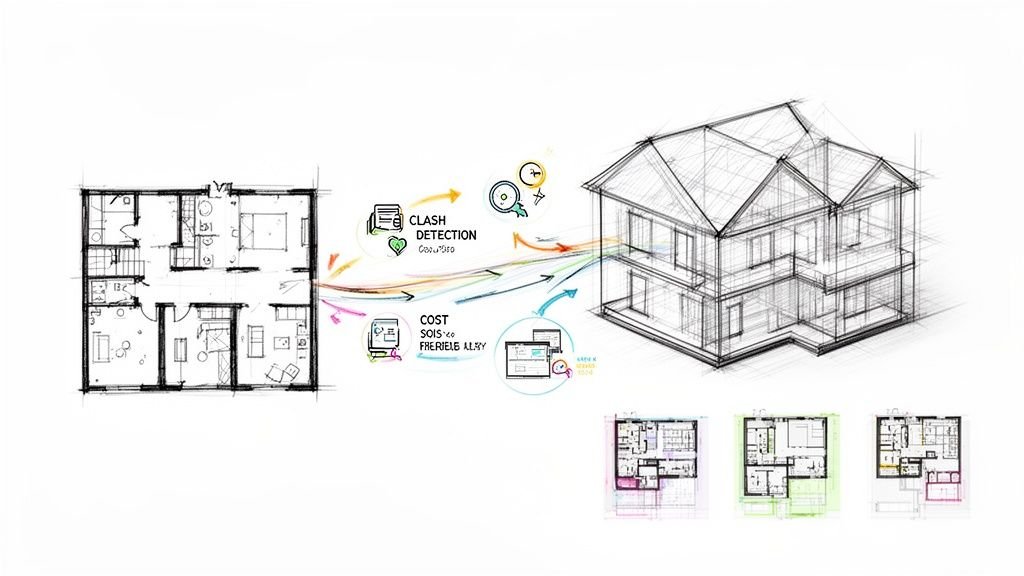
Your BIM services proposal isn't just another sales document—it's your first delivery milestone. It’s a risk-reduction and clarity document, not a marketing brochure. A winning proposal succeeds because it removes uncertainty and proves you can deliver predictably, responsibly, and without surprises.
Why Your Proposal Is a Delivery Plan, Not a Sales Pitch
Too many firms treat proposal writing like a marketing task. They load up pages with software logos, vague promises, and aspirational language. This completely misses what sophisticated clients are actually buying.
They aren't purchasing software licenses or fancy renderings. They're buying predictability, margin protection, and operational consistency. A proposal that lands the job is one that demonstrates you have the systems in place to deliver precisely those outcomes. Clients choose BIM partners who demonstrate control over process, not just software expertise.
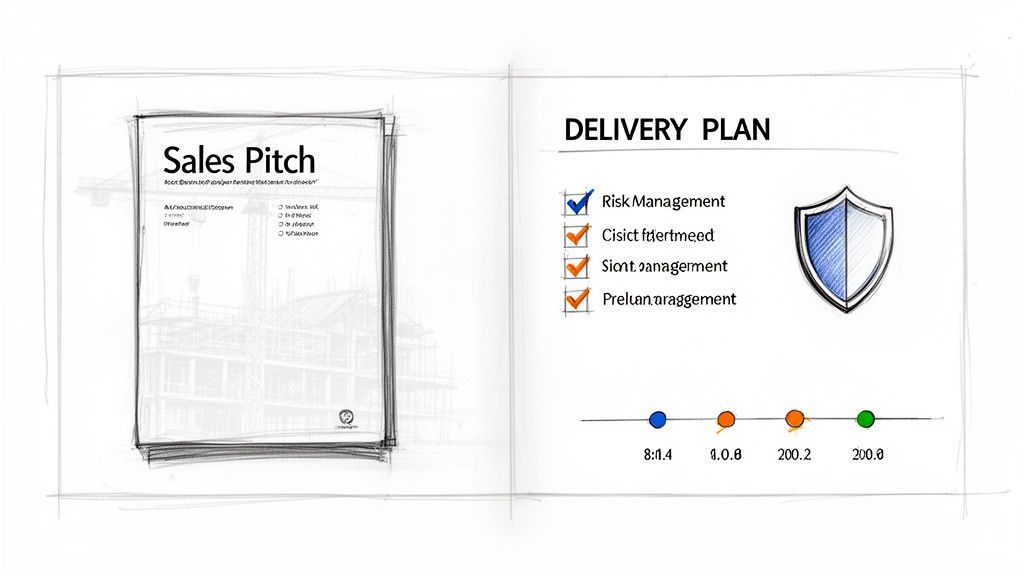
Shifting from Selling to Demonstrating
We’ve seen BIM proposals convert more reliably when they focus on execution clarity instead of feature lists. Your goal is to pivot the conversation from "what" you do to "how" you'll get it done. This shift from CAD-to-BIM evolution is critical, especially as project complexity demands mature BIM workflows, not just software skills.
A focus on production maturity and template discipline is what sets a professional BIM services provider apart. It’s less about persuasion and more about providing clear, actionable information. To really get a handle on the difference between selling and informing, it's worth exploring the nuances of copywriting vs content writing.
The Antidote to Common Project Pains
A well-structured proposal is your best preventative tool. It directly addresses the common pain points that kill trust and eat away at your profitability.
- Vague Scope: By clearly defining inclusions, exclusions, and Level of Development (LOD) for each phase, you shut down scope creep before it even starts.
- Client Misunderstandings: Documenting workflows and spelling out responsibilities ensures everyone is on the same page about who does what, and when.
- Price Pressure: When you articulate value through process control—like how your QA processes prevent costly RFIs—you justify your fee beyond a simple hourly rate.
- Post-Award Disputes: Stating your assumptions upfront protects both you and the client from "he said, she said" arguments down the road.
Ultimately, a proposal framed as a delivery plan is the natural precursor to a solid BIM Execution Plan (BEP). You can get a deeper dive into structuring these critical documents in our guide to crafting effective BIM Execution Plans. When you prove you can manage the process from day one, you build the confidence a client needs to sign on the dotted line.
1. Uncover Client Intent Before You Write a Word
The biggest mistake we see in BIM services proposals is writing them too soon. A firm gets an RFP, opens a template, and starts plugging in details. That approach treats every client request like a commodity, completely missing the business problem that triggered the need for BIM in the first place.
Before you type a single word, your job is to get behind the document and figure out what the client is actually trying to accomplish. A great proposal doesn't just list services; it answers a question the client might not even know how to ask. It’s a diagnostic process.
Asking the Right Questions to Reveal the Real Goal
Think of the RFP as the opening line of a conversation. Your job is to dig deeper to find the "why" behind their request. They might say they need "clash detection," but the real driver is likely the costly RFIs that crushed their margins on the last project.
For more on navigating these early conversations, our article on responding to an architectural services RFP provides a framework for asking smarter questions.
Here’s how you can steer the conversation to uncover what’s really going on:
- Is it about Risk Reduction? "Were there specific coordination issues on past projects that led to significant delays or change orders?" This helps you frame your clash detection services around margin protection and predictability.
- Is it for Operational Handover? "What are the key data points the operations team will need at project closeout to manage the building effectively?"
- Is it for Fabrication Accuracy? "Which building components are planned for off-site manufacturing, and what level of model accuracy is required to ensure seamless assembly?"
- Is it for Permitting Prep? "What are the specific submission requirements for the permitting authority, and what format do they need the models in?"
Connecting Your Services to Their Business Objective
Once you understand their core objective, you can stop selling generic BIM consulting proposal packages. Instead, you can tie every part of your proposal directly to their specific, high-value problem.
A winning proposal doesn't just promise BIM; it demonstrates a clear understanding of the client's business challenge and presents a tailored workflow to solve it. This is how you shift from being a vendor to a scalable delivery partner.
When you propose a clash detection workflow, you’re not just offering a service—you’re offering a system to prevent the exact type of RFIs that cost them six figures on their previous job. When you define a specific Level of Development (LOD) for MEP systems, you’re not just modeling pipes; you’re guaranteeing the precision needed for their prefabrication strategy to succeed. This is how you demonstrate production maturity.
2. Define BIM Scope and LOD by Project Phase
This is where winning proposals are made or broken. A vague scope is the number one cause of disputes, margin erosion, and unhappy clients. The goal here is to kill all ambiguity by translating your process into a clear, phase-by-phase delivery plan that protects both you and your client.
A classic mistake is promising "BIM" without a clear BIM scope definition. This almost always leads to your team over-delivering well beyond the agreed-upon fee because the client's expectations were never properly set. The antidote is precision, and that comes from tying the Level of Development (LOD) to the exact BIM use case for each phase.
Aligning Model Detail with Project Needs
LOD isn't just industry jargon; it’s a tool for managing expectations and controlling production costs. An LOD 200 model is perfect for early-stage massing studies but useless for detailed trade coordination. Conversely, modeling to an LOD 350 standard during conceptual design is a colossal waste of time and budget.
Think of it like this: client requests often boil down to a few core intents, and each one demands a different level of detail.
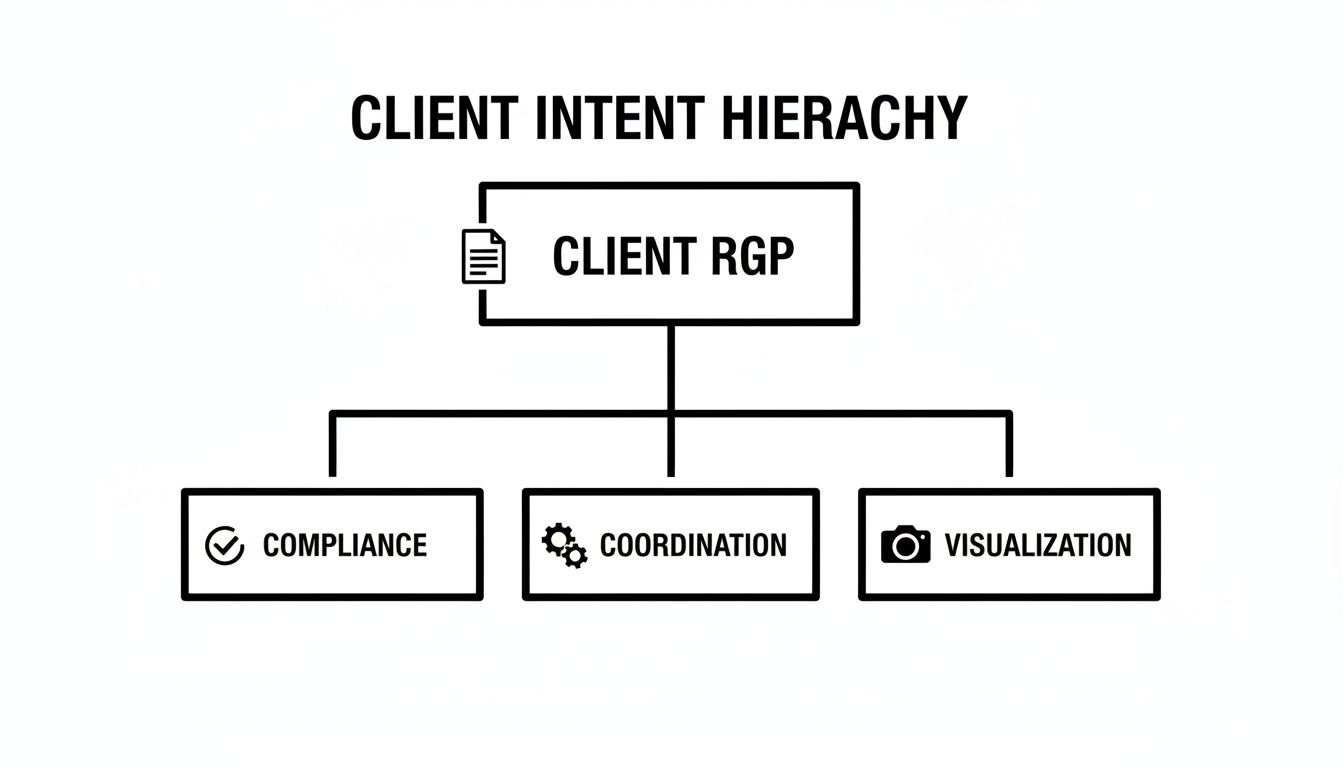
As you can see, a simple RFP request can lead down very different delivery paths. That’s why you have to pin down the true goal. By tying your LOD specification directly to the client’s intent—be it compliance, coordination, or visualization—you show them you run a tight ship.
A great proposal frames the scope as a series of decision checkpoints. At each phase, you will deliver a model developed to a specific LOD, sufficient for the client to make the necessary decisions for that stage—and no more.
A Practical Framework for Scope Definition
To prevent scope creep, your proposal has to clearly map out the BIM services for each project phase. This gives the client a clear roadmap and gives your team a defensible scope of work. If you need a deeper dive, you can learn exactly how to apply LOD 100 to 500 in our detailed guide, which breaks down the specific use cases for each level.
To make this crystal clear in your proposal, a table illustrating how LOD aligns with specific project phases and uses is invaluable. This clarity prevents scope creep and ensures everyone is on the same page from day one.
Aligning LOD with Project Phase and BIM Use Case
| Project Phase | Example BIM Use Case | Appropriate LOD | Rationale |
|---|---|---|---|
| Schematic Design (SD) | Massing studies, area analysis, and high-level visualization. | LOD 200 | Model elements are placeholders, showing approximate size, shape, and location to validate the program and overall design concept. |
| Design Development (DD) | System-level coordination and initial clash detection (e.g., structure vs. primary duct runs). | LOD 300 | Systems are modeled as generic objects with approximate quantities and specific locations to resolve major system conflicts early. |
| Construction Documents (CD) | Detailed, multi-trade coordination, clash detection, and preparation for permitting. | LOD 350 | Elements are modeled with specific assemblies, accurate quantities, and precise locations, including interfaces with other systems. |
| Construction | Fabrication, assembly, and detailed scheduling. | LOD 400 | Elements are modeled with complete fabrication, assembly, and detailing information, ready for shop drawings and field installation. |
This table doesn't just list technical specs; it tells a story. It shows the client that you have a disciplined, predictable production workflow and that every hour you bill is tied to a tangible, necessary deliverable.
This phase-based scope is the backbone of a defensible proposal. It establishes clear boundaries, links your fee directly to tangible deliverables, and proves to the client you know how to run a project successfully from day one.
3. Clarify Roles, Responsibilities, and Workflows
Once you’ve nailed down the scope and LOD, the next critical layer is assigning ownership. Projects don't stall because the software glitched; they grind to a halt because nobody is sure who’s supposed to do what. Assumptions are the single biggest source of friction, leading to delays and finger-pointing that kills both trust and profit.
A proposal that converts doesn't leave this to chance. It shows the client you have a repeatable, mature system for managing complex projects with multiple stakeholders. This is where you prove you’re in control of the process, not just the model.
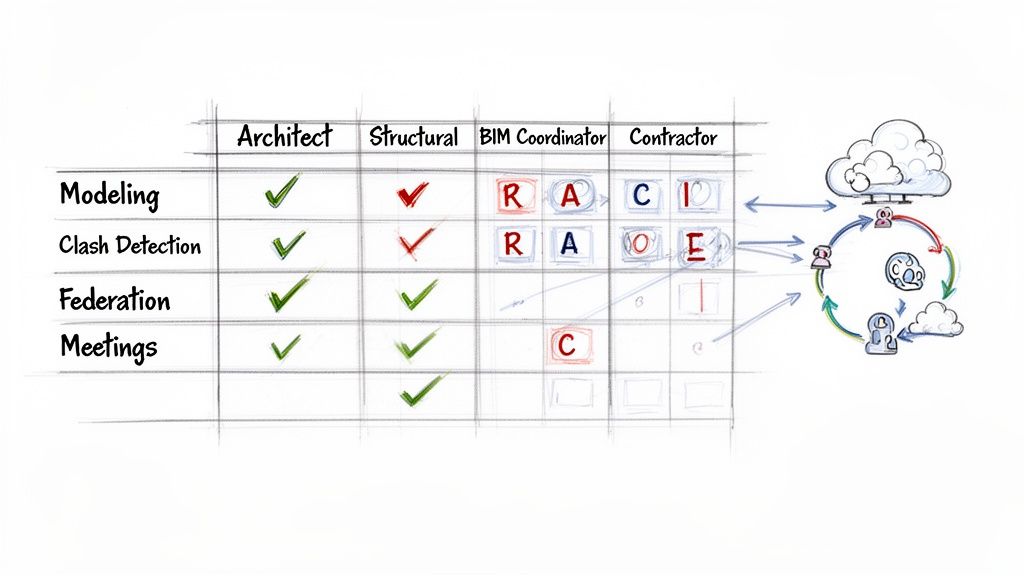
Defining the Responsibility Matrix
Your proposal needs a clear responsibility matrix. Think of it as a simplified RACI chart (Responsible, Accountable, Consulted, Informed) built specifically for BIM execution. It answers the basic questions that, if left unanswered, create chaos down the road.
Laying out these roles upfront positions you as a partner who sees problems coming and solves them before they start.
Here are the key roles to define:
- Who models each discipline? (e.g., Architect models architectural, Structural Engineer models structure).
- Who owns and manages the federated model? This is often your firm's role as the BIM coordinator.
- Who is responsible for running clash detection? Define the frequency and the specific software you'll use.
- Who resolves clashes? Spell out the process for assigning and tracking clash resolution among the teams.
Outlining the Coordination Workflow
Beyond just roles, you need to map out the entire coordination workflow. This is your project’s operating system. A clear, documented workflow shows the client you have a system for maintaining momentum and ensuring quality control.
The global BIM market is projected to reach $18.7 billion by 2030, a growth fueled by cloud platforms that enable real-time collaboration. Your proposal must show you're equipped to manage this. You can find out more about the trends shaping the BIM market.
Your proposal should detail these steps:
- Model Exchange Protocol: How often will discipline models be submitted to the BIM coordinator? Be specific (e.g., "every Friday by 4:00 PM EST").
- Clash Detection Cycle: When will clash tests be run? (e.g., "every Monday morning").
- Coordination Meetings: Set a meeting cadence (e.g., "bi-weekly on Wednesdays") and state the purpose—to review critical clashes and assign responsibility for resolution.
- Reporting: Define the format and frequency of reports (e.g., "a clash report in BCF format will be distributed within 24 hours of each coordination meeting").
Specifying the Technology Stack
Finally, remove all technological uncertainty. Your proposal should state exactly which software platforms, versions, and file formats will be used. This isn't just a technical detail; it’s a sign of production maturity.
A proposal that specifies "Revit 2024 and Navisworks Manage 2024" gives a client far more confidence than one that vaguely promises "BIM coordination." It proves you have a disciplined approach to ensuring interoperability and have considered the practical realities of file exchange.
By documenting these three areas—roles, workflows, and technology—you create a proposal that acts as a blueprint for collaboration. It removes ambiguity, sets clear expectations, and proves that you don't just sell BIM services; you deliver clarity and reliable project outcomes.
4. Set Clear Review Milestones and Deliverables
A proposal without a clear timeline is just a list of promises. Clients don’t buy promises—they invest in predictable outcomes. This is where you turn your well-defined scope into a delivery schedule, showing the client exactly what they’ll get and when. It’s all about taking the guesswork out of the equation and proving your BIM services are backed by a disciplined, accountable process.
A vague line item like "BIM coordination provided" is a red flag for any savvy client. Your proposal should read more like a production calendar, giving them a concrete checklist of what to expect at every major decision checkpoint.
From Scope to a Tangible Checklist
Every phase you defined in your scope needs a corresponding list of specific, tangible deliverables. This is how you prove your process has structure and that you've thought through the nuts and bolts of delivery. Get precise with your deliverables, and don't forget to include file formats. That small detail signals production maturity.
- Weekly Clash Detection Report in BCF format for easy import into review software.
- LOD 300 Federated Architectural Model delivered in RVT format at the end of Design Development.
- 4D Construction Sequence Simulation video file (.MP4) submitted two weeks before breaking ground.
- Monthly Progress Report with key metrics like clash resolution rates.
This level of detail sets crystal-clear expectations and protects your team from those dreaded, out-of-scope "Can you just send over…" requests.
Demonstrating a Commitment to Quality
Beyond just listing what you'll deliver, a winning BIM proposal writing guide emphasizes how you ensure quality. Clients aren't just buying a model; they're buying the confidence that the model is accurate and reliable. You need to show them you have a system for catching mistakes.
Your QA process is a powerful differentiator. It proves you don’t just know how to use the software; you have a systematic approach to quality control that protects the project from costly errors and downstream rework.
The North American BIM market is set for significant growth, with a projected value of $12.9 billion by 2027. This growth is driven by the need for expert providers who can handle complexity. You can learn more about the growing BIM market and its drivers here. In this market, a documented QA process makes you stand out.
Lay out your internal review checkpoints so there’s no question about your process:
- Internal Model Audit: Before we issue any model, our team runs a health check for warnings, file size, and adherence to project standards.
- Peer Review: A senior BIM manager reviews each major deliverable against the BIM Execution Plan to guarantee compliance.
- Clash Simulation: We run one final, internal clash detection simulation to catch any lingering issues before federating the model.
By detailing your deliverables and the QA process that underpins them, you elevate your proposal from a price quote to a statement of your firm’s reliability and operational strength.
5. State Assumptions, Inclusions, and Exclusions
This isn't the fine print; it's the part of your BIM services proposal that shields your firm from disputes, stops uncompensated work, and builds professional trust. It’s where you shift from talking about what you will do to drawing a clear line around what you won't.
A proposal fails when important details are left unsaid. By clearly spelling out your assumptions, inclusions, and exclusions, you kill ambiguity before it starts and set realistic expectations from day one. This isn't a defensive legal move—it's a sign of a mature production process.
Why Ambiguity Kills Profitability
When boundaries are fuzzy, you leave the door wide open for scope creep, client misunderstandings, and arguments over what was "included" in the fee. Think about the typical points of friction on any project. Almost all of them trace back to an undocumented assumption. Your proposal is the place to get ahead of these problems.
A Checklist for Clarity
Your goal here is simple: create a clear, easy-to-read list that leaves zero room for interpretation. Frame it as a way to ensure everyone is working from the same playbook.
Typical Inclusions (Be Specific):
- Clash Detection: "Includes two rounds of clash detection reviews and reporting per design phase (SD, DD, CD)."
- Model Deliverables: "We will deliver one federated model in Navisworks NWD format at each major milestone."
- Meeting Cadence: "Bi-weekly coordination meetings, lasting a maximum of one hour each, are included in our fee."
Critical Exclusions (Be Direct):
- Specialized Modeling: "Scan-to-BIM services are not included in this scope but can be quoted separately."
- Content Creation: "The creation of custom Revit families for manufacturer-specific equipment is excluded."
- Renderings: "Photorealistic renderings or marketing animations are outside this scope of work."
Key Assumptions (Document Dependencies):
- Input Timeliness: "We assume the structural engineer will provide their model in a compatible Revit 2024 format by the agreed-upon dates."
- Model Quality: "It is assumed all consultant models will be modeled to the project's specified LOD and coordinate system."
- Decision-Making: "We assume client feedback will be provided within three business days of each review submission."
Beyond clearly stating your assumptions, effectively managing client expectations is crucial to avoid misunderstandings and build a foundation of trust for a successful project.
A well-defined inclusions and exclusions list doesn't create conflict; it prevents it. It shows the client you've thought through the project's practical realities and are committed to a transparent partnership, free of surprises.
By taking the time to spell out these boundaries, you turn your proposal from a simple quote into a precise, defensible plan of action. This discipline protects your margins, reinforces your professionalism, and sets a tone of operational consistency that sophisticated clients value most.
From Proposal to Partnership
A BIM services proposal built this way does more than just list a price. It becomes your first tangible deliverable, proving you have the production maturity to turn complex designs into reality without costly, late-game surprises.
The whole point is to shift the conversation from cost to value. When you stop selling BIM and start showing how you manage it, you’re no longer just another vendor; you're a strategic partner who gets that success is built on clarity and process. A winning BIM proposal doesn’t sell BIM — it proves you can deliver it.
The Blueprint for a Successful Project
The message behind every one of these steps is simple: remove uncertainty. A proposal wins because it systematically stamps out the ambiguities that lead to scope creep, disputes, and shrinking margins.
Let's quickly recap the elements that build this foundation of trust:
- Defining Scope and LOD by Phase: This stops you from over-delivering for free and makes sure the client knows exactly what they’re paying for.
- Clarifying Roles and Workflows: Documenting who does what prevents the finger-pointing that can derail a project.
- Setting Concrete Deliverables: This turns your services into a tangible checklist the client can see, touch, and measure.
- Stating Assumptions and Exclusions: This protects both you and the client by ensuring everyone plays by the same rules.
When a client reads a proposal that meticulously outlines these details, they feel safe. They see a firm that’s learned from experience and is committed to a predictable partnership. They see a team that knows how to protect a project's margins—both theirs and yours.
Ultimately, a winning BIM services proposal doesn't sell what you do; it proves how you do it. It’s a testament to your ability to deliver clarity, manage risk, and execute with discipline.
The client finishes reading not thinking about your price, but about your process. They're left with the clear impression that your firm understands production better than most and is the safest pair of hands for their project.
A great proposal is the foundation of a great project. To help you build that foundation, we've created a practical tool based on the principles in this guide.
Download Our Free BIM Services Proposal Checklist
Use this checklist to ensure your next proposal nails every critical detail, from scope definition to final deliverables. It’s designed to help you win more work with clients who value clarity and reliable delivery.