A project can look finished and still be far from occupancy.
The floors are down. The lights are on. The owner is lining up move-in. The superintendent is thinking about demob. Then the final inspection stalls, and everyone starts asking the same question: what is holding up the certificate of occupancy?
In much commercial, multifamily, and mixed-use work, the answer is not a dramatic construction failure. It is a documentation gap hiding inside the MEP scope. A rerouted duct that never made it back into the record set. A panel schedule that does not match what got installed. A fire alarm sign-off sitting on a separate track that nobody chased hard enough. The building looks complete, but the paperwork does not prove it.
That is why the certificate of occupancy timeline frequently slips at the end. Teams treat CO as a closeout milestone, when in reality it is the last test of whether the building was documented, coordinated, and inspected the way it was permitted.
For MEP, that distinction matters more than often recognized. Mechanical, electrical, plumbing, fire protection, controls, testing, balancing, commissioning, and life safety all intersect at final inspection. If those threads are not tied together, the AHJ has one responsible move: hold the CO.
The Final Hurdle A Delayed Certificate of Occupancy
The ugliest CO delays usually show up after the building looks done.
I have seen jobs where the owner was scheduling move-in, the GC was down to punch work, and the team felt confident the last inspection would be routine. Then the inspector opened the approved set, walked the space, and found that the installed MEP work did not match what had been permitted. One unresolved discrepancy was enough to stop handover.
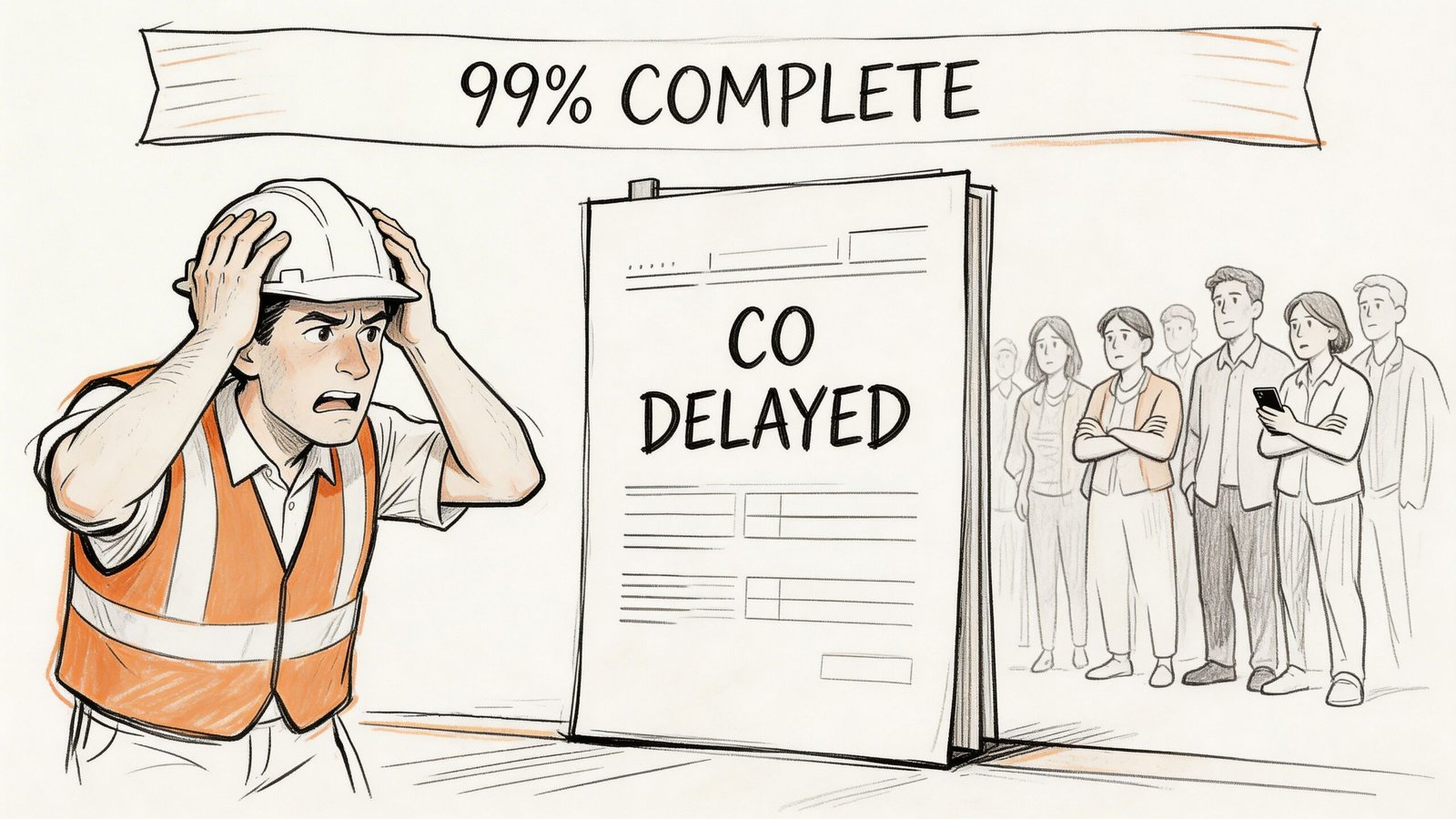
That is why I do not treat a delayed certificate of occupancy as a last-week construction problem. More often, it is the final result of a documentation problem that started months earlier in design coordination, permit issuance, or field change control.
Where the delay usually starts
The pattern is painfully consistent.
A field condition changes: Ductwork shifts around structure, piping moves to clear another trade, or electrical gear gets relocated after a room layout revision.
The drawing set does not keep up: The site team solves the installation problem, but the permit set, sketches, panel schedules, or coordination backgrounds do not get updated in a controlled way.
The mismatch gets buried: The work is in place, so attention moves to the next issue. Nobody wants to stop progress over paperwork that seems fixable later.
Final inspection turns it into a stop-work issue for occupancy: The inspector compares the approved documents to the installed condition and finds that the record is incomplete, inconsistent, or outdated.
Track field changes from day one, rather than waiting for closeout or substantial completion.
What stalls the CO is rarely the fact that a change happened. Jobs change. What causes the delay is the missing trail that explains what changed, who approved it, whether other disciplines were affected, and which set now governs the installed work.
Why this hurts so much at the end
At that stage, every loose end is expensive.
The owner may have tenants, staff, equipment deliveries, or financing milestones tied to occupancy. The GC is trying to close subcontractors and release final billing. Retainage often stays locked until the CO is issued, so a documentation miss in one MEP scope can freeze cash, strain relationships, and trigger blame across the whole team.
The hard lesson is straightforward. A building can be physically complete and still fail the final test for occupancy if the MEP story does not line up on paper. Designed, permitted, installed, tested, and signed off all have to reconcile. If they do not, the AHJ has a clear reason to hold the CO.
What the CO Process Demands from MEP
Two weeks before turnover, the building can look finished, startup can be underway, and the owner can already be scheduling move-in. Then final inspection hits a wall because the mechanical schedule in the approved set does not match the unit that was installed, the fire alarm device count differs between sheets, and nobody can produce a clean revision trail. I have seen that delay a CO faster than a punch list ever did.
A certificate of occupancy confirms the jurisdiction is satisfied that the building, as built and documented, meets the approved requirements for use and occupancy. For MEP, that standard is tighter than many teams expect. The work has to function, and the paper trail has to support what is in the field.
That is the part teams learn late. MEP permit drawings are not just a ticket to start construction. They become the reference set the AHJ uses to verify installed conditions, supporting certifications, and final sign-offs.
The AHJ is verifying installed systems against the approved record
At CO, inspectors are checking whether the permitted design, field installation, testing, and sign-off package line up. If those pieces drift apart, the issue is no longer just construction quality. It becomes a documentation failure.
For MEP scopes, that usually means the AHJ expects a clear record of:
Mechanical systems: equipment served, air distribution, ventilation intent, controls interfaces, and access
Electrical systems: panel schedules, circuiting, emergency and life safety components, labeling, and required working clearances
Plumbing systems: fixture counts, piping connections, venting, and tie-ins reflected in the approved documents
Life safety-related systems: fire alarm, sprinkler, smoke control, monitoring, and any separate approvals that have to reconcile before occupancy
One unresolved MEP item can hold the entire CO package. That happens all the time on projects that are physically ready but administratively unready.
Document alignment is the true test
The common failure is not a dramatic installation mistake. It is a gap between what was designed, what was permitted, what changed in the field, and what got formally updated.
A rerouted duct is not automatically a CO problem. A substituted pump is not automatically a CO problem. A controls adjustment made during startup is not automatically a CO problem. The delay starts when those decisions never make it back into the governing set, the supporting reports, or the inspection record.
That is why I treat CO risk as a design-to-closeout document control issue, not just a field execution issue. If the reflected ceiling plan shows one diffuser layout, the mechanical sheets show another, and TAB is balancing a third condition, the inspector is left sorting out which version the team built. That usually ends with a correction notice and another review cycle.
MEP has to be complete, coordinated, and current
Teams get into trouble when they assume final inspection is mainly about seeing equipment in place. It is also a check for consistency across the record. The AHJ, commissioning agent, testing firm, and design team may all be working from different subsets of the job, unless someone keeps them synchronized.
The CO process puts pressure on four habits:
documenting field changes as they happen
updating MEP sheets in a controlled way
collecting certifications, test reports, and approvals before the last week
reconciling MEP information with the architectural set and life safety package
If those habits are weak, the last month turns into a paper chase. That is when small drawing errors become schedule delays, retainage gets stuck, and everyone starts blaming construction for a problem that often started in design coordination.
Four MEP Documentation Gaps That Wreck Your CO Timeline
Friday at 3:40 p.m., the building is clean, the owner is planning move-in, and the inspector writes one note that blows up the handover: revise documents to match installed MEP conditions. I have seen that single comment cost a week when the work itself was fine. The delay came from a record set that was incomplete, split across inboxes, and never brought back under control.
That pattern shows up again and again. CO delays tied to MEP often start months earlier, when field changes, substitutions, testing records, and life safety sign-offs drift away from the governing set. If your team wants fewer surprises at the end, start with MEP permit drawing quality and coordination, not just punch list production.
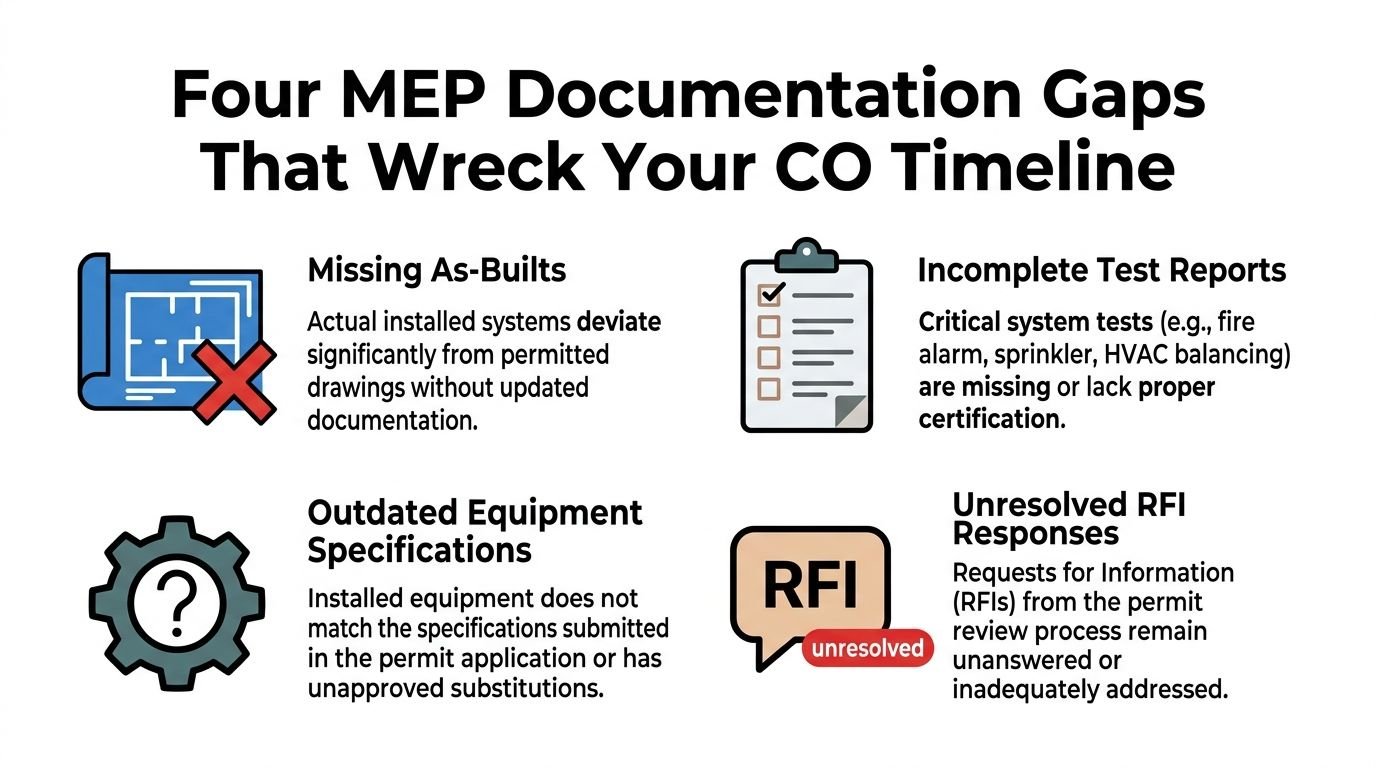
Field changes that never made it back to the drawings
A pipe moves because steel landed lower than expected. A duct branch shifts to clear lighting. Conduit gets rerouted after another trade takes the planned path. Those are normal jobsite decisions. They become CO problems when nobody converts marked-up prints into an approved revision, engineer response, or controlled as-built package.
Inspectors usually do not care that the reroute made sense in the field. They care that the approved documents and the installed condition tell the same story. If they do not, the correction notice is usually short and the schedule impact is not.
One sentence can trigger design review, updated sheets, new stamps, and a return inspection.
What works
Track field changes from the first install: Closeout is too late to reconstruct weeks of reroutes.
Put one person in charge of MEP redlines: Shared responsibility usually means missing revisions.
Review unresolved changes before requesting final inspection: The trailer whiteboard and a text thread are not record documents.
What fails
Relying on superintendent memory: The inspector needs a document trail.
Calling reroutes minor without checking downstream impacts: Small relocations can affect access, fire ratings, ceiling coordination, and test reports.
Waiting until punch to sort out record conditions: That timing forces review onto the back end, where every approval takes longer.
Practical takeaway: If installed work differs from the permit set, decide early whether you need revised sheets, an engineer letter, or a formal resubmittal. Make that call before final inspection is on the calendar.
Equipment schedules that no longer match what was installed
Substitutions are common. Supply chain gaps, owner-directed changes, and value engineering all push equipment away from the original basis of design. The delay shows up when the schedule still lists one unit, the submittal log shows another, and the field has a third condition after startup adjustments.
That mismatch reaches further than the equipment tag. A different unit can change MCA and MOCP, feeder requirements, control points, curb dimensions, outside air capability, and startup procedures. By the time the equipment is operating, the team feels finished. The permit record may still be wrong in several places.
| Situation | Why it delays CO |
|---|---|
| Scheduled unit differs from installed unit | Reviewer may ask for proof the substitution still complies with the approved design intent |
| Electrical characteristics changed | Panel schedules, feeders, disconnects, or overcurrent protection may need updates |
| Mechanical performance changed | Calculations, ventilation summaries, or supporting reports may no longer match |
| Controls package changed | Sequences, point lists, startup records, or commissioning sign-off may be incomplete |
The hard lesson is simple. A substitution is not closed when purchasing approves it. It is closed when the drawings, schedules, calculations, submittals, and startup records all reflect the same equipment.
Missing commissioning and performance records
Some of the worst CO delays come from paperwork the team assumed could wait until the end. TAB was never locked in early. Controls startup notes stayed with the vendor. The engineer expected a final report that nobody was compiling.
For HVAC systems, the jurisdiction may expect a clean record showing what was designed, what was installed, and what was measured in the field. As noted earlier, some jurisdictions get very specific about ventilation verification. If the final report does not reconcile design outdoor air, scheduled air quantities, and measured results, the CO can stall even when occupants would swear the building feels ready.
Common warning signs show up well before final inspection:
TAB is bought late and treated as a paperwork vendor
Controls changes during startup never reach the design record
Commissioning responsibility is split across too many parties
No one owns the final package for AHJ review
Measured airflows and approved reports have not been reconciled
I have watched teams lose days here because everyone assumed someone else had the binder. Nobody did.
Fire protection and life safety sign-offs that run on their own clock
A building can be physically complete and still be nowhere near a CO if fire protection approvals are lagging. Sprinkler certification is pending. Fire alarm final needs another witness test. Smoke control has one open sequence issue. The elevator recall test is waiting on a vendor. Each item sounds isolated. Together they stop occupancy.
This is not just a closeout sequencing problem. It is another documentation control problem. Life safety contractors, MEP trades, the architect, and the AHJ often work from separate logs and separate assumptions about what is still open. If those lists are not reconciled every week, the GC hears four versions of “almost done” while the CO stays frozen.
A few realities govern this phase:
Fire protection vendors close on test and approval dates, not on the owner’s move-in date
Third-party witnesses and municipal sign-offs create dependencies outside the GC’s control
Passing one discipline does not offset an open life safety item
Temporary occupancy still depends on documented life safety readiness
Late-stage teams often call this a construction delay. In practice, it is usually a coordination and documentation delay that started much earlier.
How MEP Permit Drawing Quality Impacts Final Inspections
Two days before a planned CO, the inspector opens the approved mechanical sheet, looks up at the ceiling, and asks a simple question: where is the installed route shown here? If the field condition is real but the drawing trail is weak, the inspection stops while the team hunts for revised sheets, RFIs, sketches, and sign-off history.
That delay usually gets labeled as a construction problem. In my experience, it starts as a document control problem during design and permit production.
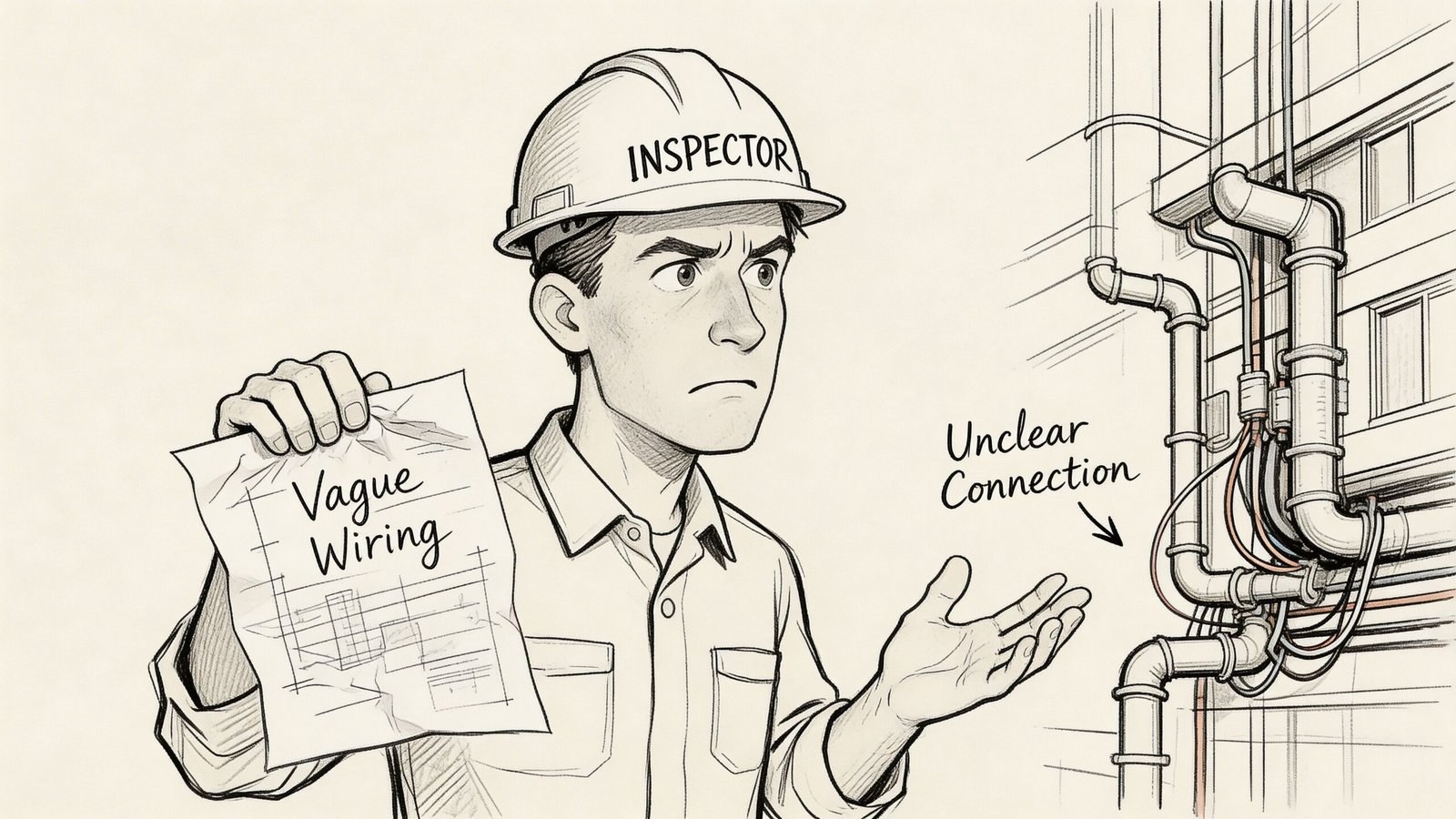
Final inspectors use the approved set to verify what was built. They are not there to reconstruct months of field decisions or sort out whether a subcontractor had a reasonable basis for an on-site adjustment. If the permit drawings are incomplete, uncoordinated, or outdated, the inspector has to slow down and ask for proof. That is where hours turn into days.
The quality issues that create trouble are usually mundane:
equipment tags on plans do not match schedules
feeder sizes, breaker sizes, or panel names change between sheets
duct or piping routes are shown diagrammatically, but installed conditions require exact locations for clearance and access
control intent is implied, not stated clearly enough for testing and verification
permit revisions exist, but the field set and closeout set do not show the same story
Good MEP permit drawings reduce that friction because they give the field team and the inspector one verifiable baseline. Clear plans show what matters at final: what equipment was approved, where it belongs, what capacity it serves, what access must remain, and what changed after permit. Poor plans create gray areas, and gray areas are expensive at CO.
There is also a trade-off teams often ignore. Early permit packages are sometimes pushed out fast to keep procurement and site work moving. That can be the right call on schedule. But if the team does not tighten those drawings, issue disciplined revisions, and keep the approved record current, the time saved early gets paid back during final inspection with interest.
High-quality permit sets also change field behavior. When the MEP documents are precise, supers, foremen, and vendors are more likely to flag a deviation when it happens. When the sheets are loose, people make reasonable assumptions, build around constraints, and plan to clean up the paperwork later. CO is where that backlog shows up.
For teams trying to prevent that drift, disciplined MEP permit drawing workflows help because they force revision control, sheet-to-sheet consistency, and better handoff from design to field.
Key takeaway: Final inspection moves faster when the approved MEP set matches the installed building closely enough that the inspector can verify, not interpret.
A sloppy permit set does not stay a design problem. It becomes an inspection problem, then a CO problem.
The Coordination Problem Between MEP and Architectural Sets
Some CO delays are caused not by missing information. They are caused by conflicting information.
The MEP set may be technically complete on its own. The architectural set may also be complete on its own. The problem appears when those two sets describe different buildings.
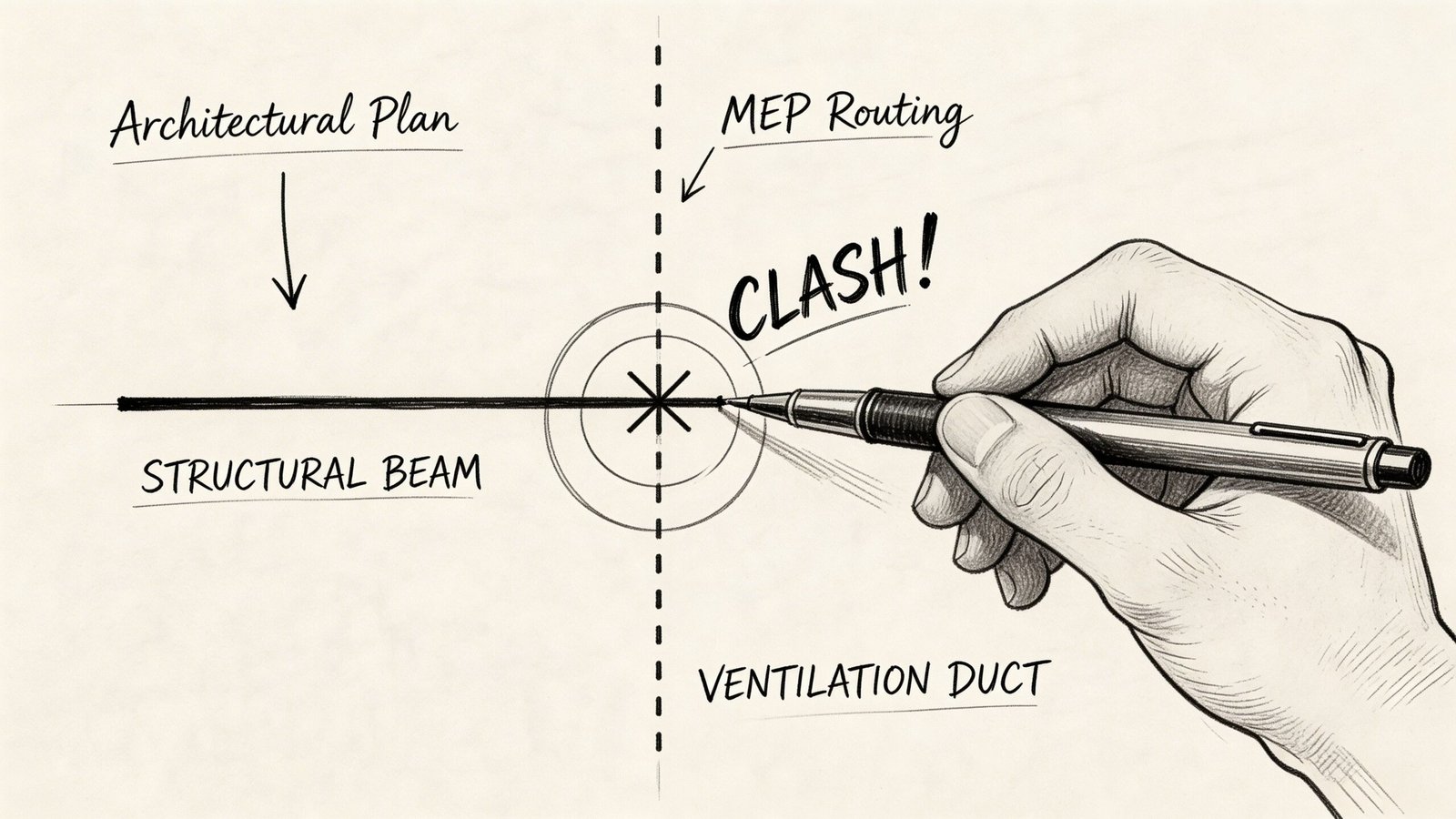
The issues that show up late
These are the kinds of conflicts that frequently survive longer than they should:
Ceiling conflicts: Duct routes assume space the reflected ceiling plan no longer gives them.
Room use mismatches: Electrical equipment ends up in a finished or public-facing space that changed architecturally.
Access problems: Cleanouts, panels, or valves remain code-compliant on paper but become inaccessible after finishes are installed.
Life safety coordination misses: Device locations and architectural revisions drift apart.
Permit reviewers do not consistently catch these because review can be discipline-based. Final inspection is where the combined building gets tested.
Why siloed production creates inspection landmines
When architectural and MEP teams work on separate tracks without disciplined cross-checking, small inconsistencies compound. One revision to room dimensions can affect diffuser placement, equipment clearance, panel access, and finish coordination all at once.
The issue is not software alone. Revit, Navisworks, and scan-based validation help, but only if the team uses them as part of a decision process. A model that is not updated is a better-looking version of stale information.
A coordinated production workflow usually includes:
Cross-discipline review before permit submission
A formal method for recording design changes during construction
Periodic reconciliation between field conditions and the coordinated set
A pre-final review focused on occupancy-critical items
Teams dealing with recurring coordination misses often find that the root problem is not design talent. It is workflow maturity. This summary of common coordination issues in AEC delivery is relevant because many CO delays come from exactly those cross-discipline blind spots.
Field lesson: A set can be code-compliant and still be coordination-poor. The inspector walks the physical building, not isolated consultant packages.
When MEP and architectural information drift apart, the CO delay looks like a site problem. In reality, it is often a production control problem that surfaced late.
How GCs and Owners Can De-Risk the CO Process
A CO delay usually looks like a closeout failure. On the projects that hurt the most, the underlying issue happened months earlier when the permit set stopped matching the job.
GCs and owners lower that risk by treating MEP documentation as a live control item from preconstruction through final sign-off. If the approved drawings, field changes, and closeout package do not stay aligned, the inspector finds the gap at the worst possible time.
Start with a preconstruction review that is aimed at CO risk
A standard coordination review is not enough. Review the permit set with one question in mind: will the installed work, the approved drawings, and the final documentation still agree at turnover?
That changes what the team looks for. The review should focus on items that routinely trigger final inspection comments or force late drawing revisions:
Equipment locations that affect access, egress, or rated construction
Clearances required for service, panels, and mechanical equipment
Diffuser, grille, and device locations tied to room layout changes
Life safety components that rely on matching architectural and MEP backgrounds
Room names, use types, and occupancy assumptions that drive code requirements
I have seen clean-looking permit sets still cause CO trouble because the room use changed during leasing, the reflected ceiling plan moved, and nobody pushed those revisions through the mechanical and electrical sheets. The field team built what fit. The final documents described a different building.
Put one person in charge of MEP drawing drift
This role matters more than another generic closeout meeting.
Someone on the GC side needs clear ownership of MEP drawing changes from the first field deviation onward. That person tracks what changed, who approved it, whether the engineer needs to issue a revision, and whether the closeout set reflects the installed condition. Without that control, changes live in email chains, foreman markups, and memory.
A workable process usually includes four parts:
A live log of MEP field deviations, tied to sheet numbers and dates
A weekly review with the superintendent, project engineer, and affected trades
A decision on each item: field fix, engineer response, or revised drawing
A requirement that accepted changes feed back into record documentation before closeout
The point is simple. If a change does not make it back into the controlled set, it is still waiting to become a CO problem.
Build inspection dependencies into the schedule early
Final sign-offs do not fail in isolation. One missing test report, one outdated riser, or one unresolved access issue can hold the whole chain.
Owners and GCs should map the occupancy path early and assign dates, owners, and prerequisites to each approval item. That schedule should cover more than inspection appointments. It should also include the documentation each sign-off depends on, especially for mechanical testing, electrical service sign-off, fire alarm, sprinkler, and any engineer certifications required by the AHJ.
For teams trying to connect permit-stage decisions to final approval risk, this building permit workflow for design and construction teams is a useful reference.
Audit the closeout package before the AHJ does
Too many teams wait until finals are underway to find out the approved set, as-builts, test reports, and trade certifications do not line up.
Run an internal CO readiness audit before the first final inspection window opens. Compare the latest approved MEP drawings against installed conditions and the documents the AHJ will review. Confirm that deferred submittals, revised sketches, balancing reports, start-up documentation, controls narratives, and life safety certifications are all present and consistent. Owners can help by forcing clarity early at this stage. Ask direct questions. Which MEP sheets govern the final inspection? Which field changes were never folded back into the set? Which sign-offs depend on third parties who are not under the GC's daily control? Those answers usually show where the schedule is exposed.
Do not let use, tenant, and scope changes bypass the document trail
CO risk climbs on tenant improvements, fit-outs, and late program changes because the paperwork often lags behind the built work.
If a space use changes, a room is subdivided, equipment is swapped, or a ceiling layout shifts, check whether that change affects ventilation, power, fire alarm, sprinkler coverage, accessibility clearances, or occupancy classification. Then make sure the revision is carried through the architectural set and every affected MEP sheet. Field coordination alone does not close that gap.
The lesson is painful but clear. GCs and owners do not de-risk the CO process by pushing harder at the end. They de-risk it by controlling drawing quality, change tracking, and document alignment long before final inspection.
Your CO is Delayed What to Do Right Now
When the CO is already stuck, speed matters. Guessing does not.
The first move is to stop talking about the problem in broad terms. “MEP issue” is not actionable. “Failed final mechanical because installed ventilation documentation does not match approved report” is actionable.
Step one, get the exact hold item
Ask for the specific correction, failed inspection note, or required sign-off. If possible, get the exact code reference or the official wording from the AHJ.
That lets the team sort the issue into one of three buckets:
A drawing problem
A field correction problem
A missing documentation problem
Those are different recovery paths. Treating them as one often burns days.
Step two, decide what closes it
Some CO holds need a re-inspection only. Others need revised drawings, engineer confirmation, or third-party certifications. The delay gets longer when the team assumes the smallest remedy and learns later that the jurisdiction expects a formal resubmittal.
A quick triage table helps:
| If the issue is… | The likely next move |
|---|---|
| Installed work differs from approved set | Determine whether revised drawings or an engineer response is required |
| Test or commissioning package is incomplete | Collect and submit missing reports in the format the AHJ accepts |
| Separate life safety sign-off is still open | Chase the responsible contractor, witness test, or certifying party immediately |
| Zoning or use classification is unresolved | Confirm required approval path directly with the AHJ |
Step three, prioritize life safety first
If several items are open, do not attack them by trade ego. Attack them by occupancy impact.
Fire alarm, sprinkler, smoke control, emergency systems, and related life safety approvals tend to hold the CO hardest. Resolve those first. Cosmetic closeout items can wait if the jurisdiction allows it. Life safety often cannot.
Recovery tip: Do not rely on hallway interpretations of what the inspector “probably meant.” Call the AHJ, confirm the remedy, and repeat it back in writing.
Step four, put one person in charge of the closeout path
In a delay, too many voices make the process worse. The architect, MEP engineer, GC, owner’s rep, and trade partners all have a role, but one person should own the action log and the communication sequence.
That person should know:
what is open,
who owes what,
what requires AHJ confirmation,
and what has to happen before re-inspection is worth scheduling.
The goal is not to win an argument about whose miss caused the delay. The goal is to remove uncertainty promptly to get the building occupied.
Predictable COs Begin with Documentation Discipline
A delayed certificate of occupancy frequently gets described as a construction problem because the pain shows up at the jobsite. In practice, it is often a documentation problem with a long lead time.
The building reached the end. The information did not.
That is the central lesson behind most certificate of occupancy delay stories. MEP drawings, equipment data, field changes, test reports, life safety sign-offs, and architectural coordination all have to converge into one verifiable picture. If they do not, the inspector has every reason to stop the process.
What reliable teams do differently
They do not treat CO as a ceremonial last step. They build for it.
That means:
Using permit documents as a live compliance benchmark
Tracking field changes before they become memory-based
Reconciling MEP and architectural information throughout the job
Collecting closeout records in parallel with construction
Flagging occupancy-critical sign-offs early
The point is not paperwork for its own sake. The point is predictability. Strong document control protects margin, lowers rework risk, and makes final inspections less dramatic.
A fundamental shift
Teams that improve their certificate of occupancy timeline usually make one mindset change. They stop asking, “What do we need for closeout?” and start asking, “What will the AHJ need to verify at the end, and how are we preserving that trail now?”
That question changes design reviews, RFIs, redlines, coordination meetings, and turnover planning.
If your team keeps getting surprised at the end, the answer is seldom more heroics during closeout. It is better production discipline earlier.
If you want a calmer closeout on the next project, BIM Heroes shares practical frameworks for permit-ready production, coordination QA, and documentation workflows that help teams reduce avoidable CO friction. A simple internal checklist for MEP drawing QA and as-built tracking is often enough to expose the weak points before they become occupancy delays.
Category: Construction Coordination & Documentation