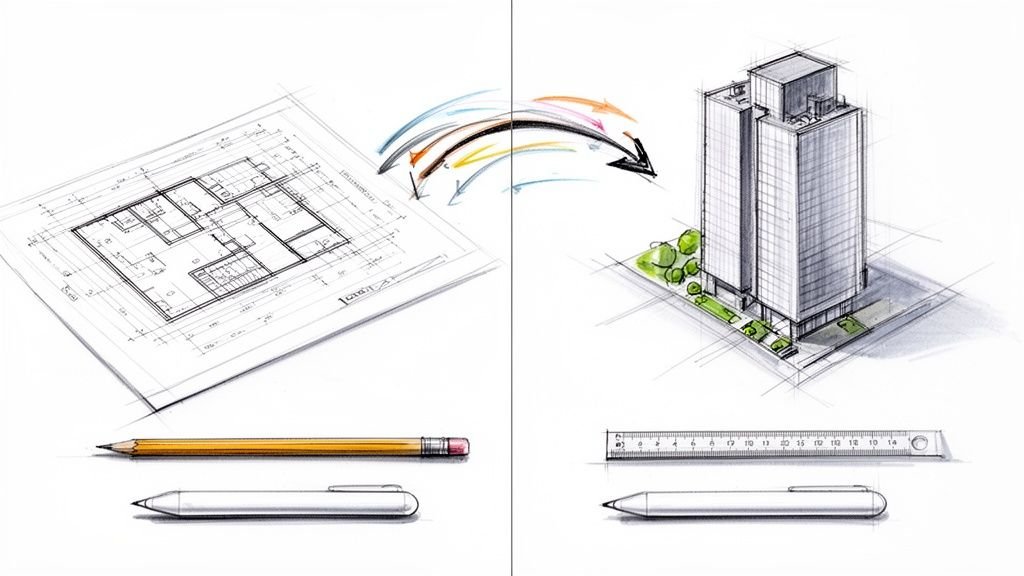
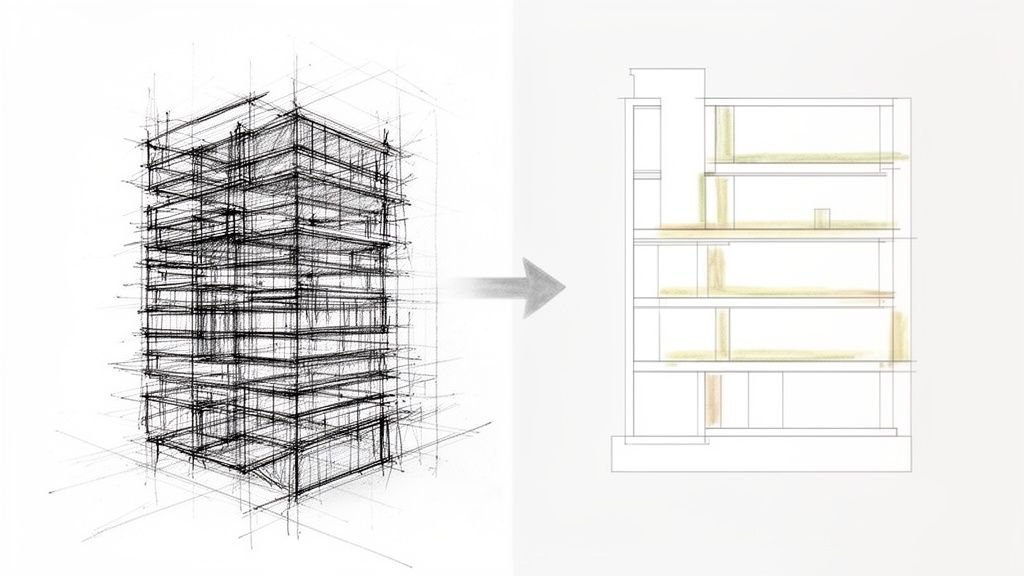
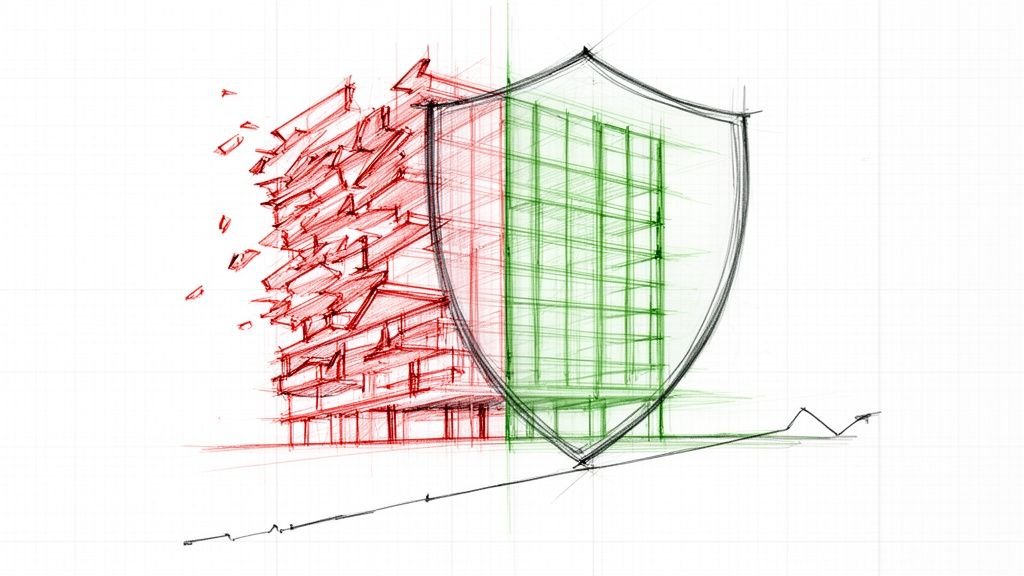
Construction documentation is where design intent becomes contract-ready, buildable, and enforceable information. This isn't just about drafting; it's the critical production discipline of turning ideas into unambiguous instructions that protect your margins, prevent RFIs, and keep crews building instead of guessing.
Translating Vision into Buildable Instructions
Every architect, builder, and project manager knows the pain of drawings that look complete but generate endless RFIs. The issue usually stems from treating construction documents as a task instead of a production discipline for managing risk. Professional construction documentation services are the system that ensures design intent becomes clear, coordinated, and buildable information.
This is the phase where quality has a direct ripple effect on everything that follows: permitting, trade coordination, site execution, cost certainty, and risk exposure. Weak documentation doesn't just slow projects down; it transfers ambiguity to contractors and the field. We’ve seen projects move faster on site when documentation removed interpretation instead of adding detail for detail’s sake.

From Drafting Task to Production Discipline
The gap between basic drafting and a structured documentation process is massive. One creates drawings; the other creates clarity and predictability. The goal is to establish a single source of truth that aligns every stakeholder. This isn't an accident—it's the outcome of a deliberate, system-driven approach that resolves issues long before they hit the field.
Thinking of this as a "discipline" instead of a "task" is a crucial mental shift. Let's break down what that really means.
Documentation Discipline vs Drafting Task
| Attribute | Standard Drafting Task | Professional Documentation Discipline |
|---|---|---|
| Goal | Create a set of drawings. | Create clear, buildable, and contract-ready instructions. |
| Focus | Drawing production. | Risk management and project predictability. |
| Output | Lines and symbols on a sheet. | A coordinated system of information (drawings, specs, schedules). |
| Process | Reactive; addresses issues as they arise. | Proactive; anticipates and resolves clashes and ambiguities upfront. |
| Value | A commodity deliverable. | A strategic asset that protects budget and schedule. |
A professional documentation discipline is built on a few core pillars that ensure nothing is left to chance.
- Template Discipline: It starts with robust, enforced templates for sheets, schedules, and details. This creates a baseline of consistency that makes the entire CD set in architecture easier to navigate.
- Structured QA Processes: Quality assurance isn't a last-minute check. It’s a series of milestone-based QA checkpoints designed to catch errors early, when they're cheap and easy to fix.
- Proactive Coordination: Structural and MEP information isn't an afterthought. It's integrated from the beginning to prevent the on-site clashes that derail schedules.
- BIM-Driven Workflows: Using construction documentation BIM strategies means plans, sections, and schedules are all pulled from a single, coordinated model. You can get a great overview of setting up a BIM execution plan from this guide by the National Institute of Building Sciences.
The core purpose of high-quality CDs is to remove guesswork. When a contractor can build directly from the plans without needing to ask for clarification, you’ve protected your schedule, your budget, and your reputation.
Ultimately, superior construction drawings services deliver something far more valuable than paper: they deliver operational consistency. By focusing on creating buildable, contract-ready information, these services become a powerful tool for protecting your profit margins. They stop the slow bleed of budget caused by rework, change orders, and schedule slips, paving the way for a smoother, more profitable project from start to finish.
Understanding the True Cost of Ambiguous Documents
Every seasoned project manager knows the feeling. A CD set lands on their desk, looking complete. The sheets are organized, the title blocks are filled out, and at a glance, everything seems ready. But once it hits the field, the project is quickly buried under a mountain of RFIs, each one flagging a point of ambiguity, a hidden clash, or an unbuildable detail.
This isn't a rare mishap; it’s a symptom of weak upstream discipline. Weak construction documentation doesn’t just create small headaches—it systematically pushes risk and decision-making from the design team straight to the contractor. Every question a builder has to ask on-site is a moment the project stalls, and every assumption they’re forced to make is a potential change order in the making. This is the real cost of ambiguity. It eats into margins, wrecks schedules, and kills project predictability.

Where Ambiguity Hides in Plain Sight
Poor documents are rarely empty; they’re often cluttered with conflicting or incomplete information. The problems usually show up in familiar ways that every builder or architect has dealt with firsthand.
- Inconsistent References: A detail callout on a floor plan points to a section that doesn’t match the architectural intent or clashes with the structural grid.
- Uncoordinated Disciplines: MEP layouts look fine on their own but conflict directly with ceiling heights or structural members shown on the architectural plans.
- Vague Specifications: Notes like "field verify" or "coordinate on-site" are used as a crutch instead of clear instruction, essentially making the contractor responsible for design-level decisions.
These issues aren't just mistakes. They point to a failure in the production process, often born from a last-minute CD crunch or a lack of disciplined QA/QC checkpoints. This is why professional construction documentation services treat the CD phase like a production discipline. The goal is to produce an instruction manual so clear that the field team can execute without having to guess.
The Financial Impact of Unclear Instructions
Ambiguity on paper always turns into real costs in the field. Change orders, schedule delays, and rework are the direct results of a documentation set that fails to give clear direction. The financial stakes are huge, and the industry is finally taking notice.
The U.S. construction industry is booming, with spending now topping $2 trillion, which makes managing project complexity more critical than ever. In this climate, labor shortages have pushed 45% of construction firms to look toward automation for error-prone documentation tasks. Outsourcing to dedicated construction drawings services can reduce costs by up to 30%, and with 40% of firms planning higher investments in document management, the trend toward specialized production is clear. You can find more insights on this industry shift in the U.S. Construction Industry Report.
A well-coordinated CD set is one of the most effective forms of margin protection a project can have. It stops the financial bleed from change orders and rework before it even starts.
Ultimately, the cost of ambiguous documents goes beyond a single project's budget. It hits your firm's reputation. When contractors can't trust your drawings, it creates friction, damages relationships, and makes it harder to get competitive bids on future work. Investing in a structured, professional construction documentation BIM workflow isn't an expense—it's a direct investment in project certainty, client satisfaction, and your firm's long-term credibility. It ensures that what you designed is what gets built, on time and on budget.
The Hallmarks of High-Quality Construction Documents
World-class construction documentation doesn't just happen. It's the result of a production discipline that values clarity over complexity and predictability over speed. While a weak CD set might look complete, a high-quality one proves its worth in the field—minimizing questions, preventing conflicts, and letting contractors build with confidence. The difference isn't the software; it's the systems that govern how information is created, checked, and organized.
This systematic approach is what separates a simple drafting task from a true production discipline. The goal is a set of instructions so clear it becomes the undisputed source of truth for everyone on the job.
Disciplined Organization and Standards
The foundation of any great CD set is its organization. High-quality construction documentation services start with rigid adherence to established standards, ensuring anyone can pick up the drawing set and navigate it intuitively.
This discipline touches every element on the page:
- Logical Sheet Organization: A clear, predictable numbering system and sheet index make it easy to find information fast.
- Rigorous Annotation Standards: Consistent use of line weights, text styles, and symbols removes ambiguity and the chance of misinterpretation.
- Well-Maintained Template Libraries: Starting every project from a proven template guarantees a baseline of quality and consistency, stopping teams from reinventing the wheel and introducing errors.
For a deeper dive, our guide on architectural drawing standards gives you a solid framework for baking this consistency into your own process.
Proactive Quality Assurance Checkpoints
Too many firms treat quality assurance as a last-minute cleanup. That’s a recipe for missed clashes and costly oversights. A mature production workflow embeds QA/QC into the process from day one, using milestone-based checkpoints to validate work as it progresses.
The point of a QA checkpoint isn't just to find errors. It's to confirm that design intent is being translated into clear, buildable instructions at every single stage. This shifts the process from reactive correction to proactive validation.
Instead of one massive review at the end, this approach breaks it down into multiple, targeted checks. For example, a checkpoint at 50% CD might focus entirely on coordinating structural and architectural elements, while a later one verifies annotation consistency. To make sure your construction documents meet the highest standards, understanding effective process documentation is key to making these checkpoints repeatable and reliable.
Model Intelligence and Constructability Reviews
In modern construction documentation BIM workflows, the model is the engine driving the documents. The quality of your drawings is therefore directly tied to the quality of your model. This means sticking to the project's Level of Development (LOD) strategy is non-negotiable. An LOD-aligned model ensures that what you see in the drawings accurately reflects the level of detail needed for that phase.
Beyond model accuracy, effective construction drawings services integrate early constructability and coordination checks into the workflow. This involves:
- Clash Detection: Running regular clash reports between architectural, structural, and MEP models to find and resolve conflicts long before they can become problems on site.
- Constructability Analysis: Reviewing complex details and assemblies from a builder's perspective to ensure they are practical and efficient to build as designed.
This proactive approach turns the documentation phase into a powerful risk-mitigation tool. By systematically finding and fixing problems before they ever make it onto a sheet, a high-quality CD set delivers the ultimate prize: operational consistency and a project that can be built right the first time.
Integrating BIM Workflows for Seamless Documentation
The leap from 2D CAD to 3D BIM has completely redefined how effective construction documents are created. While CAD produces static drawings, an integrated BIM workflow generates a living, interconnected set of instructions. This is where modern construction documentation services truly shine—by turning a digital model into a perfectly coordinated CD set.
A mature BIM process ensures that every plan, section, elevation, and schedule is just a different "view" of one central model. Change a window in one view, and it instantly updates everywhere else. This single source of truth is a game-changer, drastically reducing the human error and inconsistencies common in disconnected workflows. It’s no longer about just drafting lines; it's about managing a data-rich model that produces drawings as one of its outputs.
From Disconnected Drawings to an Integrated Model
The early days of the CAD-to-BIM evolution often amounted to little more than "3D drafting." But true construction documentation BIM is a production system. It starts with a well-defined BIM Execution Plan (BEP), which lays out the ground rules for model health, Level of Development (LOD) requirements, and data exchange. This document is the project's constitution, making sure everyone is working from the same playbook.
Without that discipline, a model can quickly become a mess, leading to documents that look coordinated but are riddled with hidden clashes. A robust BIM workflow is the key to preventing this, ensuring the model remains a trustworthy source for generating information that can actually be built.
This move toward structured, digital-first processes is picking up steam across the industry. A key trend is the significant adoption of new digital tools, with 44% of construction firms planning to increase their investment in AI and 40% boosting spending on document management software. This directly tackles the chronic problem of scattered project data, which cripples effective decision-making. You can explore more about these industry changes in this analysis of construction trends.
The health of your documentation is a direct reflection of the health of your BIM model. A disciplined, well-managed model is the engine that drives clarity and prevents RFIs.
CAD vs. BIM for Construction Documentation
The difference in outcomes between old-school CAD drafting and a true BIM-driven process is night and day. One is about managing lines; the other orchestrates a fully coordinated system of project information.
The table below breaks down the practical differences you'll see on a project.
| Process Step | Traditional CAD Approach | Integrated BIM Workflow |
|---|---|---|
| Changes & Revisions | Manual updates required across multiple drawings, inviting errors. | A single model change automatically populates across all relevant sheets. |
| Coordination | Relies on manual 2D overlays and visual checks, often missing complex clashes. | Automated clash detection identifies conflicts between disciplines early. |
| Data & Schedules | Schedules (doors, windows, etc.) are created manually and can become disconnected. | Schedules are generated directly from model data, ensuring accuracy. |
| Visualization | Limited to 2D representations, making complex assemblies hard to understand. | Provides 3D views and sections on demand, clarifying complex conditions. |
Ultimately, a BIM workflow turns documentation from a reactive process into a proactive one. By building a virtual version of the project first, teams can find and fix problems digitally—where the cost of a change is almost nothing. Our article on Revit workflows to speed up CD sets offers practical strategies for putting these efficiencies into practice.
Integrating BIM isn’t just about new software; it’s about adopting a production mindset. Expert construction drawings services use this technology to create a seamless pipeline from design intent to buildable instructions, delivering the kind of operational consistency that defines a well-executed project.
Structuring for Success with Scalable Delivery Processes
Delivering consistent, high-quality construction documents isn’t about individual heroics; it’s about a rock-solid production system. The best construction documentation services operate less like a traditional design studio and more like a high-performance manufacturing line. It’s all about process discipline and structured workflows that guarantee a predictable outcome.
This mindset shifts the conversation from "hiring drafters" to partnering with a production system built for operational consistency.
The heart of this system is the concept of scalable delivery pods. These are small, specialized teams with deep expertise in specific project types—whether it's multi-family residential, commercial interiors, or complex industrial facilities. This structure ensures that no matter how big the project gets, the team handling your CD set has the production maturity and field-tested knowledge to deliver.
The Power of a Systemized Approach
A delivery pod isn't just a group of people; it's an ecosystem of standardized processes designed to protect your project margins and deliver reliable results. This is where template discipline, rigorous QA checks, and clear decision checkpoints come together to form a repeatable engine for quality.
This system is built on a few non-negotiable pillars:
- Strict Template Discipline: Every project kicks off from a battle-tested template. This ensures that sheet organization, annotation standards, and detailing conventions are consistent from day one, which is fundamental to a clean CD set in architecture.
- Clear Decision Checkpoints: Quality is verified at predetermined milestones (think 30%, 60%, and 90% CDs), not in a frantic rush at the end. These checkpoints are go/no-go gates that prevent downstream errors.
- Standardized Communication: Protocols for RFIs, submittals, and internal reviews are locked in. This prevents information silos and makes sure every stakeholder is working from the same page.
The diagram below shows how a structured workflow moves a project from a central model to coordinated, buildable plans.

This process shows how a central BIM model acts as the single source of truth, directly feeding coordinated plans and fabrication data without the usual disconnect.
Protecting Margins Through Predictability
At the end of the day, this structured delivery model is designed to do one thing exceptionally well: protect your profit margins. Unpredictability is the enemy of profitability. When construction drawings services lack a repeatable process, every project starts from scratch. That invites inconsistencies, errors, and the inevitable last-minute crunch that multiplies RFIs and bleeds your budget dry.
A documented, repeatable process is the single greatest defense against scope creep and schedule delays. It turns production into a science, ensuring outcomes are consistent regardless of who is on the team.
By partnering with a firm that runs on a system of scalable delivery pods, you’re not just outsourcing a task; you are plugging into an established production engine. This gives you an operational consistency that ensures your clients get the same high-quality deliverables, whether it’s your first project together or your fiftieth.
This system is the backbone of reliable construction documentation BIM, delivering the clarity and certainty that crews in the field need to execute without guesswork.
Preparing for Permitting, Bidding, and Beyond
A meticulously prepared CD set is the key to a predictable project outcome. The value of disciplined construction documentation services shines at this stage, becoming the bedrock for every external stakeholder—from permitting authorities to bidding contractors. This is where high-quality documentation acts as a powerful tool for knocking down risks.
When documents are clear and coordinated, they speed up administrative approvals and give contractors the clarity needed to submit confident, competitive bids. On the flip side, weak documentation forces bidders to inflate their numbers to cover unknowns, directly hitting your project's bottom line.
Streamlining Approvals and Securing Bids
A clean submission package significantly smooths the path to regulatory approval. Permitting offices are tasked with verifying code compliance, and a well-organized set of drawings from professional construction drawings services makes their job easier, often leading to faster review cycles.
As your project moves from design to reality, securing the necessary approvals is a critical hurdle. Understanding the local hoops you have to jump through for securing building permits is a crucial step where organized documentation makes a tangible difference.
This same clarity provides a massive advantage during the bidding phase.
A robust CD set in architecture accomplishes two key goals here:
- Reduces Contractor Risk: By eliminating guesswork, you remove the need for contractors to add "contingency" padding to their bids to cover potential issues they can't quite pin down.
- Minimizes Bid-Phase RFIs: A clear set of documents generates fewer questions, streamlining the bidding timeline and setting a professional tone right from the start.
Creating a Strong Contractual Foundation
Beyond approvals and bidding, the CD set becomes the core of the construction contract. These documents are legally binding instruments that define what will be built, to what standard, and for what price. Any ambiguity left in the drawings becomes a potential loophole for disputes, change orders, and litigation.
Think of your CD set as the project's primary legal defense. Its clarity and completeness directly protect your budget and schedule from the erosion caused by disputes and change orders.
This is why a mature construction documentation BIM process is so vital. It ensures that what is represented in the documents is a coordinated, buildable reality, forming a solid basis for execution. By investing in this clarity upfront, you are not just buying drawings; you are buying project certainty.
To help you assess your own project readiness, we’ve developed a Construction Documentation Quality Framework. It’s a simple tool to gut-check your documents before they go out the door, ensuring you’re set up for a smooth transition into construction.
Frequently Asked Questions
Here are a few clear, no-nonsense answers to the questions we hear most often from architects, builders, and project managers about construction documentation.
What Is the Difference Between Level of Development and a CD Set?
People often mix these two up, but they play very different roles. Level of Development (LOD) is a scale that tells you how much reliable detail is packed into a BIM element. It ranges from conceptual (LOD 100) all the way to a precise as-built model (LOD 500).
A Construction Document (CD) set is the final deliverable—the actual drawings and specs that tell the contractor what to build. It uses model elements at a specific LOD, usually 300 to 350, to create buildable instructions.
Think of it this way: LOD is the specification for an element's reliability, while the CD sets in architecture are the complete, detailed blueprints for building the project. A great CD set depends on using elements at the right LOD to ensure what's on paper can actually be built on-site.
How Do Construction Documentation Services Help Prevent RFIs?
High-quality documentation services stop RFIs before they have a chance to start. It’s all about proactive coordination and crystal-clear communication. By using an integrated construction documentation BIM workflow, we run clash detection between the architectural, structural, and MEP models early and often.
This lets us find and fix problems on a screen instead of on a job site, where they cost real time and money. Our QA/QC process also includes constructability reviews at key milestones, so we’re constantly asking, "Can this actually be built efficiently?" This catches issues long before they become official documents and gives contractors clear, unambiguous instructions to work from.
When Should We Engage a Construction Documentation Service Provider?
The sweet spot is toward the end of the Design Development (DD) phase. Bringing a documentation partner on board at this point gives them enough time to get up to speed with the design intent before the heavy lifting of production begins. It also lets us help establish BIM standards and workflows early on.
Starting at this stage ensures a smoother transition into the Construction Documents (CD) phase. It allows for early constructability feedback and prevents the last-minute crunch that so often compromises document quality and leads to downstream issues.
This early partnership turns documentation from a reactive, end-of-project task into a proactive risk management tool. It sets the project up for a much smoother, more predictable build.
At BIM Heroes, we believe great projects are built on a foundation of clarity. If you're looking to improve the quality and predictability of your CD sets, our Construction Documentation Readiness Checklist can help you assess your current process.
Download Your Free Construction Documentation Readiness Checklist Now