


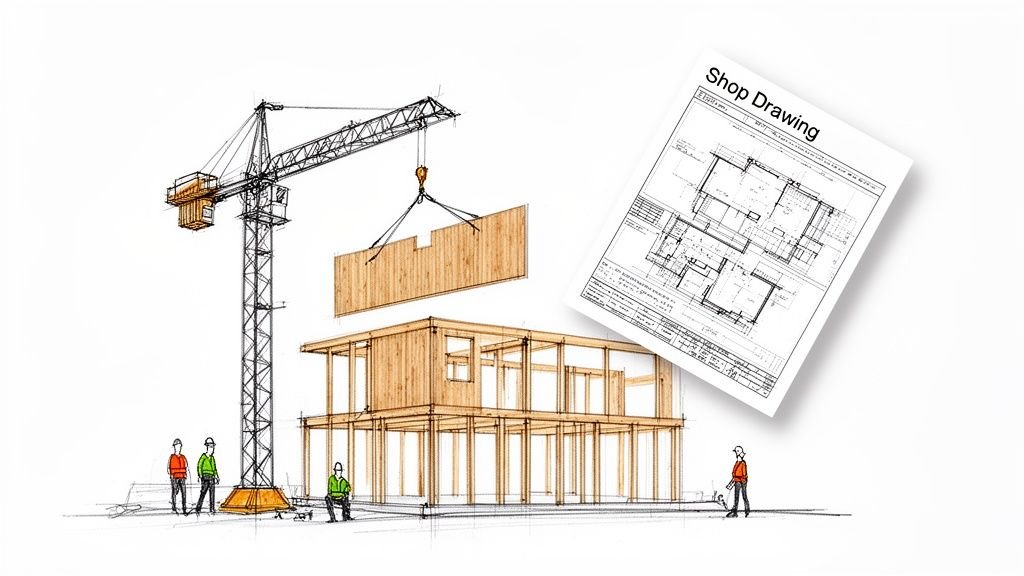
Picture this: prefabricated wall panels arrive on site, a crane swings them into place, and a multi-story wood frame goes up in days instead of weeks. That’s the promise of modernizing construction wood framing—trading job site chaos for factory precision. Then comes the reality check: that outcome only happens when the shop drawings and framing documentation are accurate enough to manufacture from. A panel built from vague or incomplete drawings is worse than no panel at all—it gets to site and doesn't fit, costing time, money, and trust.
Prefabricated wall panel success is a documentation problem before it's a manufacturing problem. The quality of what comes off the truck is a direct reflection of the quality of what went into the drawings.
What Prefabricated Wall Panels Are and Why Builders Are Adopting Them
Prefabricated wall panels are wood-framed wall assemblies manufactured off-site in a controlled shop environment and delivered to the job site ready to install. They can range from open panels—just the stud frame—to closed panels that include sheathing, insulation, windows, and sometimes MEP rough-ins.
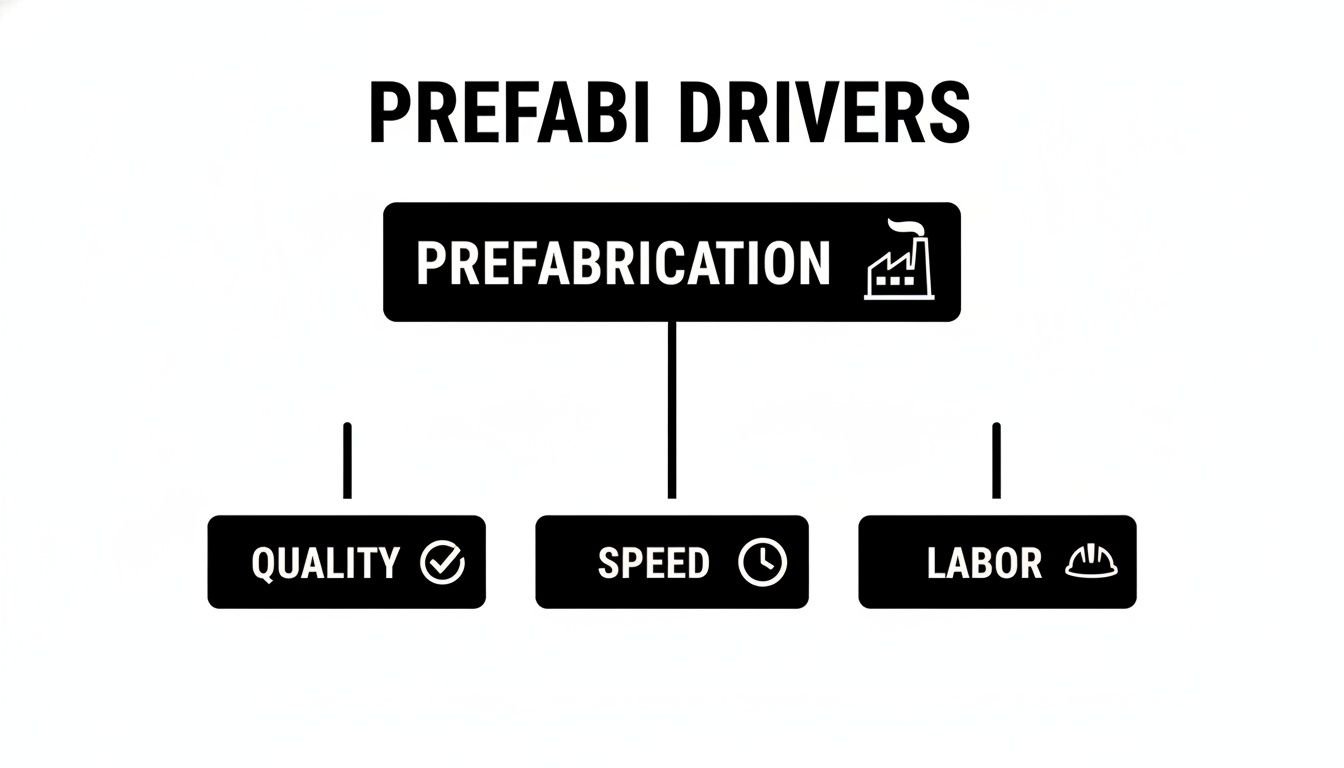
Builders are adopting them for several compelling reasons that directly impact margin protection and operational consistency:
- Faster Site Cycle Times: Structures are framed and weathered-in in a fraction of the time of stick-building, pulling the entire project schedule forward.
- Better Quality Control: A factory environment eliminates site variables like weather, leading to tighter tolerances and higher-quality assemblies.
- Reduced Site Labor: With skilled framer shortages, prefabrication reduces the number of workers needed on site, mitigating labor-related risks.
- Predictable Scheduling: Factory production isn't subject to typical job site delays, resulting in more reliable project timelines.
Growing adoption across production homebuilders, multifamily developers, and light commercial contractors proves the model works. The catch? Prefabrication front-loads the documentation work. Decisions that would normally be made in the field have to be made on paper before manufacturing begins. This is where many teams struggle—their standard framing documentation isn't detailed enough to support shop production.
What Standard Framing Documentation Typically Looks Like—and Where It Falls Short
The gap between typical design-level framing plans and what a panel fabricator actually needs is where projects go wrong. This is a workflow gap, not a competence failure—most firms were never set up to produce fabrication-level framing documentation because field framing didn't require it.
Standard framing plans show wall locations, stud spacing, and structural elements but often lack the granularity a panel fabricator needs to prevent RFIs and protect margins.
Specific shortcomings often include:
- Vague Opening Details: Opening dimensions are frequently shown to rough opening size without accounting for the king studs, jack studs, cripples, and sill framing that are critical for panel layout.
- Ambiguous Corner Conditions: Corner and intersection conditions are often left to the framer's judgment in the field. In a shop environment, every condition needs to be explicitly documented to ensure panels fit.
- Siloed Structural Information: Bearing conditions and load path information are often referenced to separate structural drawings rather than integrated into the framing package.
- Inaccurate Rough Openings: Window and door rough openings may not reflect the actual manufacturer's specified RO—a common source of field fit problems.
- Uncoordinated Shear and Hardware: Shear wall locations, hold-down hardware, and nailing schedules are sometimes on separate structural drawings rather than coordinated into the panel layout.
- Missing MEP Coordination: MEP rough-in locations—if included in closed panels—are rarely coordinated with framing at the documentation stage, leading to on-site clashes.
What Fabrication-Ready Framing Documentation Actually Needs to Contain
This is the core of a mature production workflow. A fabrication-ready document is a set of explicit instructions, not a guide for interpretation. It’s where template discipline and rigorous QA processes pay off, ensuring predictability from the shop to the site.
Panel Layout and Sequencing
- Unique Panel ID: Each wall panel needs a unique identifier that links the shop drawing example to the installation plan.
- Net Dimensions: Panel dimensions must be the net fabricated size, not nominal, accounting for plate thicknesses and connection details.
- Installation Sequence: The floor plan must indicate the erection order so the crew knows which panel goes up first.
- Lift Information: Panel weight and designated lift points must be included for crane or mechanical assist planning.
Stud Framing Details
- Explicit Specifications: Stud size, spacing, and species/grade must be explicitly called out, not left to code minimum assumptions.
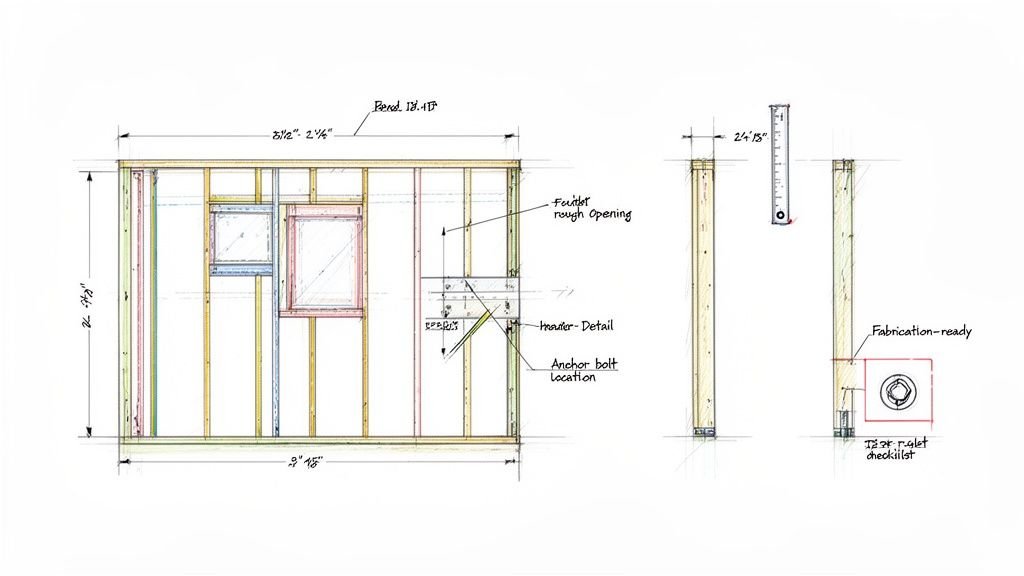
- Opening Framing: King stud and jack stud counts at every opening, with heights dimensioned to the underside of the header. Cripple stud layouts must be shown explicitly.
- Plate Details: Double top plate laps and splices must be located to avoid conflicts with panel joints. Bottom plate configuration—single or double, pressure-treated—must be clearly noted.
Opening Conditions
- Manufacturer Specs: Rough opening dimensions must be taken directly from window and door manufacturer specifications, not the architectural schedule alone.
- Structural Elements: Header size, species, and bearing length must be shown for every opening.
- Clear Dimensions: Sill height must be dimensioned from the subfloor, not the finished floor, to avoid confusion between architectural and framing dimensions.
Structural and Shear Elements
- Integrated Information: Shear wall panels must be flagged separately with nailing schedules, sheathing specifications, and hold-down hardware locations directly on the panel drawing.
- Anchor Locations: Anchor bolt locations must be shown on the bottom plate layout.
- Hardware Callouts: Strap ties and connectors must be called out with manufacturer references.
- Load Path: The load path from above needs to be clearly indicated for bearing wall panels.
MEP Coordination (for Closed Panels)
- Dimensioned Locations: Electrical rough-in locations—outlets, switches, fixture boxes—must be dimensioned from panel edges.
- Penetrations: Any plumbing or mechanical penetrations must be shown with sleeve size and location.
- Clash-Free: All MEP locations must be confirmed against the stud layout to avoid conflicts. This level of coordination is critical for off-site construction.
Panel Connections and Interfaces
- Detailed Intersections: Corner and T-intersection conditions need to be detailed, showing which panel is continuous and which butts.
- Fastener Specs: Panel-to-panel connections at joints must be shown with fastener type and spacing.
- System Interfaces: The interface with the floor system above and below—rim board, ledger, or bearing condition—must be detailed.
The Role of BIM in Prefabricated Panel Documentation
A well-built Revit model of a wood-framed building contains most of the information needed for panel documentation—but only if it was modeled at the right level of detail. This is the evolution from CAD to BIM workflows: building with fabrication intent, not just permit intent.
Generic wall types don't carry stud layout, opening framing, or connection information. The model needs to be built with individual framing members as intelligent components. This is where BIM-driven framing documentation becomes superior to manually drafted panel drawings.
A production-mature BIM workflow enables:
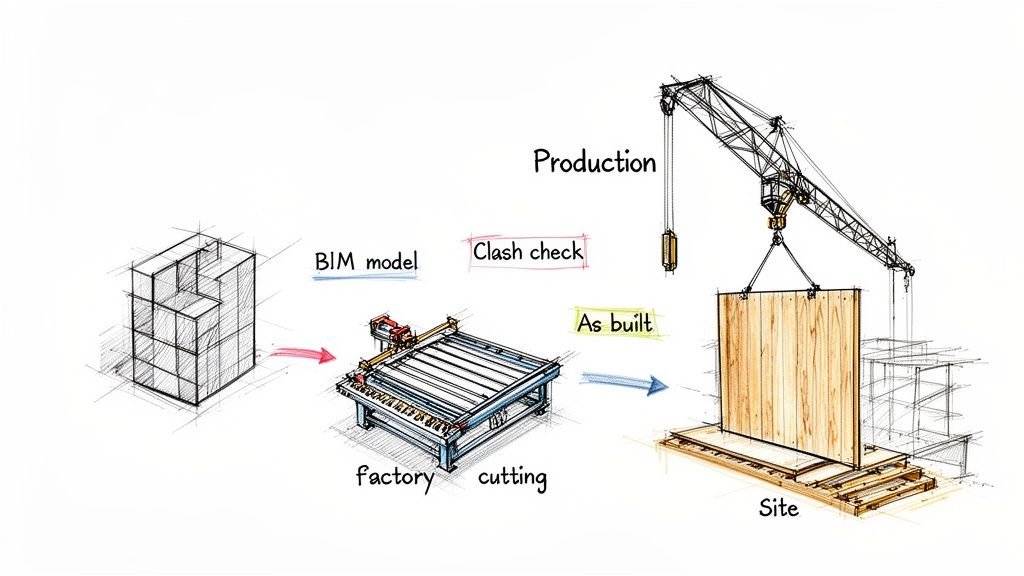
- Accurate Data Extraction: Panel layouts can be extracted directly from the model, reducing manual dimensioning errors.
- Automated Change Management: Changes to the architectural design automatically propagate through the model, making it easier to keep panel drawings current.
- Pre-emptive Clash Detection: Clash detection between framing and MEP rough-ins can be run in the model before panel documentation is issued, preventing shop errors before they happen.
- Logistics Planning: The model supports panel sequencing and logistics, allowing teams to visualize the installation in 3D to reduce coordination risk during erection. This is key for scalable delivery pods. While many tools exist, a good QA process with clear markups is crucial; platforms like Exayard as a Bluebeam Revu alternative can support this review cycle.
What Happens When Documentation Isn't Fabrication-Ready
Treating panel documentation as an afterthought instead of a primary deliverable is a direct threat to your margins. The consequences aren’t theoretical; they are real-world costs that erase the schedule and cost benefits prefabrication was supposed to deliver.
The fallout of underdeveloped panel documentation includes:
- Incorrect Rough Openings: Panels arrive on site, and window units don't fit, requiring field modification that compromises the assembly.
- Mismatched Corners: Undetailed corner conditions mean panels don't connect cleanly, leading to gaps, misalignments, and structural deficiencies that need remediation.
- Missing Hardware: Shear wall panels fabricated without hold-down hardware pre-installed require the structural engineer to demand field drilling and retrofitting.
- MEP Clashes: MEP rough-ins in closed panels conflict with the stud layout—an electrical box lands in the middle of a king stud.
- Chaotic Sequencing: The erection crew installs panels in the wrong order because the sequence wasn't documented, requiring disassembly.
Each of these problems is a failure of the documentation process, leading to a cascade of RFIs and change orders that kill predictability. To dive deeper into market trends, see this report: Discover more about these market trends and their drivers. For a better approach, learn how to write documentation that teams actually love.
How BIM Heroes Supports Prefabricated Wood Framing Documentation
BIM Heroes produces detailed wood framing documentation as part of our residential and light commercial production services. We understand that our clients don't buy hours; they buy clarity, systems, and reliable delivery.
Our approach is built on production maturity:
- We have deep experience with US residential framing standards, IRC requirements, and the level of detail production homebuilders and panel fabricators expect.
- We work from coordinated BIM models to produce panel layouts, framing elevations, and schedules that are fabrication-ready—not just permit-ready.
- We are familiar with the coordination required between architectural, structural, and MEP disciplines at critical decision checkpoints.
- We operate as an embedded production partner, supporting architects and builders who want to move toward prefabrication without building a new in-house documentation capability. Our expertise in wood framing construction ensures operational consistency.
The Takeaway: Predictability is Earned in Documentation
Return to the opening image—the wall panels arriving on site and going up smoothly. That outcome is earned in the documentation phase, not on the day of delivery. As prefabrication continues to reshape residential and light commercial construction—driven by labor shortages, schedule pressure, and quality demands—the firms that invest in fabrication-ready documentation will have a clear advantage. They will achieve the margin protection and predictability that others only aspire to.
The gap between a good framing plan and a great panel package is a documentation gap. Closing it is one of the highest-value things a production team can do for a builder adopting prefabrication.
Building with prefabricated wall panels or exploring the transition to prefabrication? Let's talk about how BIM Heroes can produce the documentation your panel fabricator actually needs.