Most BIM teams have production down to a science. Whether it’s an office building, a multifamily complex, or a retail rollout, your workflows are mature, your templates are disciplined, and you know how to get a project from design to documentation efficiently. Then, a data center project lands on your desk.
The complexity is immediately different. The stakes are higher. The MEP systems are denser than anything you’ve seen before. Suddenly, the standard way of doing things feels inadequate.
This isn’t just your imagination. Data center BIM isn’t just more of the same—it requires a fundamentally different approach to modeling, coordination, and documentation. The cost of getting it wrong isn't just an RFI or a minor field change. It's delayed commissioning, operational risk, and significant financial exposure for your client. Getting this right demands a new level of production maturity.
What Makes Data Centers Unique as a Building Type
For architects and MEP engineers coming from standard commercial projects, the leap to a mission-critical facility can be jarring. The entire project is governed by a set of non-negotiable requirements that have no parallel in other building types. Understanding these constraints is the first step toward building a reliable production workflow.
Key differentiators include:
- 24/7 Operational Requirement: There is zero tolerance for construction errors that require rework post-occupancy. A simple mistake that necessitates a shutdown isn't an inconvenience; it's a breach of the facility's core purpose. This raises the bar for documentation accuracy and clash avoidance.
- Extremely High MEP Density: Data centers pack more power, cooling, and data infrastructure into less space than almost any other building. This density makes MEP coordination exponentially more complex, turning overhead spaces and underfloor plenums into a three-dimensional puzzle.
- Built-in Redundancy: Systems are designed with N+1 or 2N configurations to eliminate single points of failure. This means you aren’t just modeling one power path; you’re modeling two (or more) completely independent systems and ensuring they never conflict. This multiplies the coordination workload.
- Strict Performance Requirements: Power, cooling, and airflow aren't just systems—they are finely tuned environments that must perform to exact specifications. The BIM model is often used to validate these performance metrics before construction begins.
- Long Lead-Time Equipment: Critical equipment like generators, UPS systems, and switchgear have long procurement times. Design decisions involving this equipment lock in very early, making later changes prohibitively expensive. The model must be right from the start.
- Phased Construction & Live Upgrades: Many projects involve expanding live facilities. This adds a huge layer of complexity, as design and construction must proceed without impacting ongoing operations.
These factors together mean that standard commercial BIM workflows, which are often built for flexibility and lower levels of detail in early stages, fall dangerously short.

Where Standard BIM Workflows Break Down in Data Centers
When teams apply typical commercial BIM practices to mission-critical projects, preventable problems inevitably surface. These aren't usually the result of individual mistakes but rather systemic gaps in a workflow not built for this level of rigor. The transition from a standard CAD-to-BIM process to a true data center BIM workflow reveals common failure points.
- Generic MEP Families: Using placeholder families that don't reflect actual equipment footprints, service clearances, or connection points is a recipe for disaster. A generic UPS block in the model leads to a real-world collision on site.
- Insufficient LOD (Level of Development): Teams accustomed to LOD 200 for design development often carry that habit too far. In a data center, installation requires LOD 350+ detail. Modeling elements loosely creates ambiguity that translates directly into field errors and RFIs.
- Loose Cable Tray and Conduit Routing: In a typical project, cable trays are often modeled schematically. In a data center, they are a primary source of conflict. Without modeling them to actual size, with bend radii and support structures, severe congestion conflicts are guaranteed.
- Uncoordinated Cooling Infrastructure: Placing CRAC units without modeling the hot aisle/cold aisle containment strategy is a critical oversight. The BIM model must validate that the cooling layout works with the server rack layout and airflow plan.
- Delayed Structural Coordination: The immense weight of batteries, generators, and transformers is often not flagged early enough. When structural loading isn’t coordinated from day one, it leads to costly redesigns that impact the entire facility.
- System-Level Power Modeling: Modeling power distribution as a simple one-line diagram is insufficient. The model must be detailed enough to support installation sequencing and verify that redundant A/B power paths are physically separate.
These gaps threaten margin protection and project predictability. The lesson learned in the field is that you must elevate your process before you even begin modeling.
Key Areas Where Data Center BIM Requires a Higher Standard
To achieve the operational consistency that mission-critical facilities demand, BIM production must be elevated across several key areas. This is where template discipline and rigorous QA processes become non-negotiable.
Power Infrastructure
The electrical system is the lifeblood of the data center. Its modeling must be flawless.
- Equipment Accuracy: UPS systems, PDUs, and busway runs must be modeled using manufacturer-specific families that include accurate dimensions, weight, and mandatory service clearances.
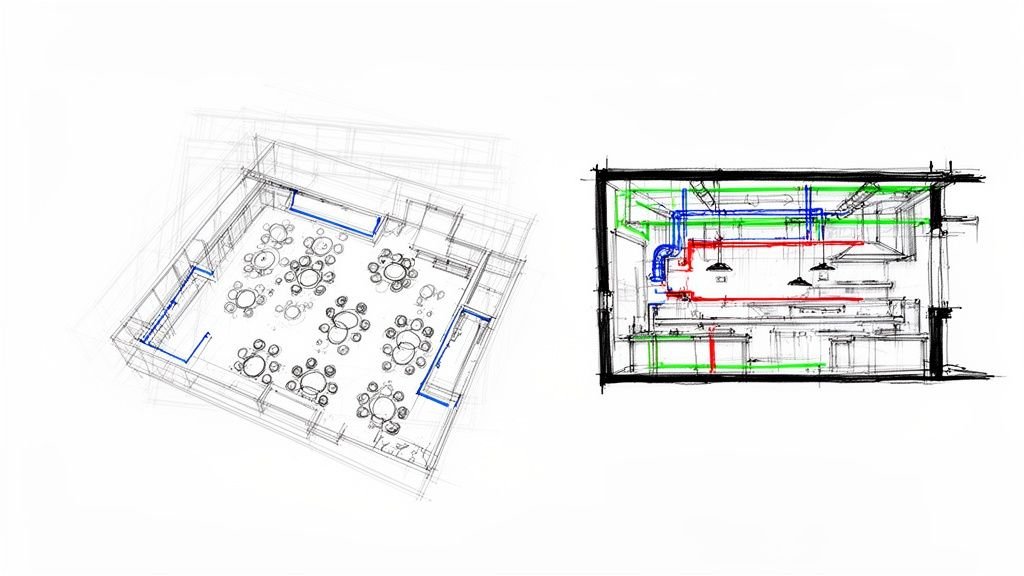
- Redundant Paths: The A-side and B-side power paths must be modeled as distinct, physically separate systems. They need to be clash-checked independently and against each other to prevent a single event from compromising both.
- Precise Coordination: Generator and switchgear rooms are incredibly dense. The model must precisely coordinate fuel systems, exhaust routing, ventilation, and electrical connections to ensure everything fits and is serviceable.
Cooling and Airflow
Cooling is inextricably linked to power. The model is where you prove the two can work in harmony.
- Containment Geometry: CRAC/CRAH units must be placed in the Revit model relative to actual hot aisle/cold aisle containment geometry. The model should be used to visualize and validate airflow paths.
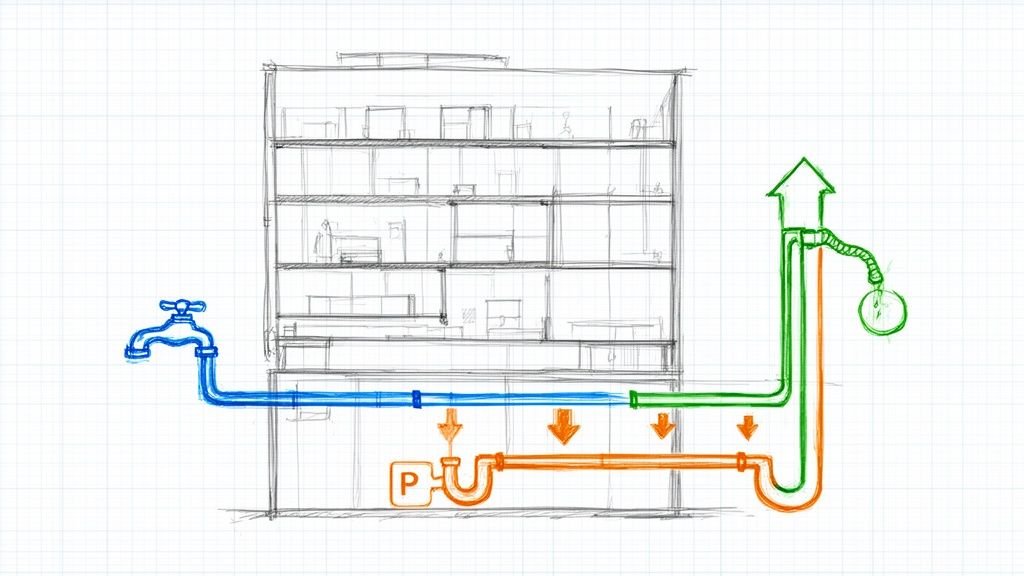
- Plenum Voids: The raised floor plenum must be modeled with its true void depth, including pedestals and all service penetrations. This is critical for coordinating underfloor piping and cabling.
- Overhead Coordination: Chilled water piping, fan coil units, and other overhead cooling infrastructure must be coordinated in the same congested zone as cable trays and lighting, demanding meticulous clash detection.
Cable Management
In data centers, "cable tray" is a discipline unto itself. It's among the most conflict-prone elements.
- Detailed Modeling: Proper data center Revit modeling of cable trays includes tray type, width, depth, bend radii, and fill capacity assumptions—not just a symbolic line. This prevents routing impossibilities.
- Pathway Separation: The model must explicitly coordinate and maintain separation between power and data cabling pathways to prevent electromagnetic interference and ensure compliance with standards like TIA-942.
Structural Considerations
Structural integrity is paramount due to extreme equipment loads.
- Load Mapping: Floor loading requirements from server racks, battery systems, and major mechanical equipment must be mapped and shared with the structural engineer from the earliest design stages.
- Accurate Pads and Anchorage: Equipment pads, housekeeping pads, and seismic anchorage points all need to be modeled with accuracy to ensure they align with the equipment they support.
Documentation Standards
Your data center construction documentation must support a zero-error installation process.
- Detailed Drawings: Expect to produce more detailed plans, sections, and elevations than on typical projects, often at a larger scale, to clarify complex areas.
- Data-Rich Schedules: Equipment schedules must carry critical data like power loads, heat output, weight, and service requirements, pulled directly from the model to ensure consistency.
The Role of Clash Detection in Mission-Critical Projects
In a data center, a clash isn't an inconvenience—it's a threat to the commissioning timeline and a direct hit to your margin. This is why a mature clash detection and resolution process is a core component of risk management. It's about preventing RFIs before they're ever written.
The focus must go beyond simple hard clashes. For MEP coordination in a data center, soft clashes are just as critical. A "soft clash" occurs when elements don't physically intersect but violate the required clearance for maintenance or code. If a technician can't access a valve or pull a filter because a busway is six inches too close, the design has failed.
An effective workflow involves:
- Discipline-Specific Clash Sets: Running targeted clash tests in Navisworks (e.g., power vs. cooling, cable tray vs. structure, cooling vs. fire protection) to isolate and solve high-priority issues first.
- Modeling Service Clearances: Creating "clearance boxes" around equipment as part of your BIM families to automatically flag encroachments on service access zones.
- Structured Coordination Meetings: Holding iterative clash resolution meetings focused on root-cause analysis, not just pointing out collisions. These decision checkpoints are vital for keeping the project on track.
The federated model becomes the single source of truth, where every discipline’s work is visible in context, enabling a level of proactive problem-solving that is impossible with 2D workflows.
Scan-to-BIM for Data Center Renovations and Expansions
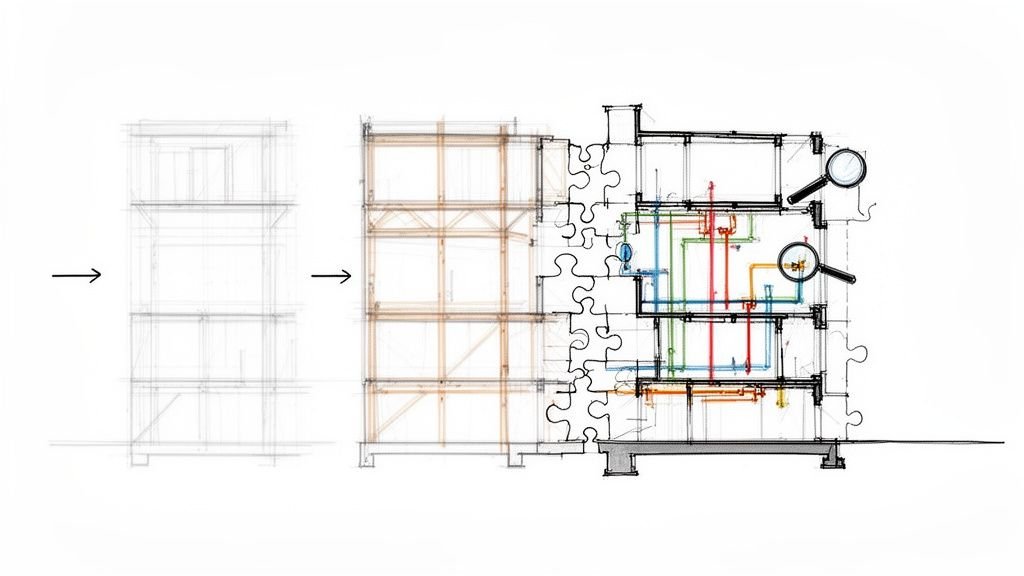
Many data center projects aren't greenfield builds; they are complex retrofits or expansions within live, operational facilities. In these environments, as-built drawings are often outdated or completely unreliable. Making design decisions based on inaccurate information is a massive gamble that can lead to significant cost overruns and delays.
Scan-to-BIM de-risks these projects by capturing existing conditions with millimeter accuracy. Using high-definition laser scanners, we create a precise point cloud of the facility, which serves as the foundation for a trustworthy as-built BIM model. This is especially valuable for:
- Mapping undocumented conduit, piping, and structural elements in congested overhead plenums.
- Verifying exact equipment locations and clearances in packed mechanical and electrical rooms.
- Capturing the true state of underfloor systems before designing new rack layouts or cooling upgrades.
This process enables your team to design additions and modifications with confidence, knowing the base model reflects reality. It turns assumptions into certainty, which is crucial when working in a live environment where mistakes can have immediate operational consequences. Our Scan-to-BIM services page offers more detail on this workflow.

How BIM Heroes Approaches Mission-Critical Documentation
We understand the higher standards required for BIM for data centers. Our entire production model is built on the discipline and rigor that mission-critical projects demand. We function as an embedded production partner for architects and MEP engineers, delivering the clarity and reliable documentation needed to protect margins and ensure predictability.
We don’t sell hours; we sell a system. Our approach includes:
- High-LOD Production: We are fluent in the LOD 350+ modeling required for fabricating and installing dense MEP systems.
- Scalable Delivery Pods: Our teams are structured to provide consistent, high-quality production documentation, acting as a seamless extension of your firm.
- Deep Coordination Experience: We specialize in the complex MEP coordination that data centers require, preventing RFIs through rigorous, proactive clash detection.
- Regulatory Familiarity: We are experienced with US building codes, ASHRAE standards, and the Uptime Institute's Tier classification system that govern data center design.
We support design teams who need a production partner that understands the stakes and can execute with precision.
Your Takeaway: Data Center BIM is a Discipline
Data center BIM is its own discipline. Teams that treat it like any other commercial project will encounter problems that are disproportionately expensive to fix. The firms that succeed are those that bring the right level of rigor, template discipline, and QA processes to their modeling, coordination, and documentation from day one.
As demand for data centers continues to explode—driven by AI infrastructure, cloud expansion, and edge computing—the ability to execute mission-critical BIM well is becoming a genuine competitive differentiator. It’s a measure of your firm’s production maturity. The reader should finish thinking “these people understand production better than most firms” and feel safe reaching out for help.
Working on a data center or mission-critical facility? Let's talk about how BIM Heroes can support your production documentation and MEP coordination services page workflow.