


Managing project scope creep isn’t about setting boundaries or having tough client conversations. It’s about building production systems that make expectations crystal clear from day one. Successful architecture and design-build firms don’t just manage scope creep—they prevent it by systematizing clarity, locking in decision checkpoints, and protecting their margins before the first RFI hits their desk.
This isn’t about being rigid. It’s about creating predictability. The core message is simple: scope creep isn’t stopped by saying no—it’s stopped by building systems that keep everyone aligned.
Why Scope Creep Is a Production Problem, Not a Client Problem
Scope creep always feels like a client issue, but it's a symptom of internal process failure. It thrives in ambiguity. When requirements aren’t documented, drawing packages aren’t locked, and decisions aren’t timestamped, chaos is inevitable.
Those endless revisions buried in email threads? The client changing materials late because options weren't defined early? That's the direct result of relying on informal communication instead of structured production workflows. Scope creep in construction doesn't happen because of difficult clients; it happens because of unclear processes.
This isn’t just a hunch. The Project Management Institute (PMI) found that projects derailed by scope creep jumped from 43% to over 52% in the last decade. That trend eats directly into profitability and operational consistency.
Shifting from Reactive to Systemic Control
Firms with strong production maturity operate differently. They don’t just “set boundaries” in a kickoff meeting; they build those boundaries into their BIM workflows and QA processes. Instead of reacting to a stream of "small changes," they create an environment where the impact of every decision is transparent and traceable.
The shift involves a few key disciplines:
- Documentation Discipline: Moving from verbal agreements to formalized decision logs and change requests.
- Decision Checkpoints: Using BIM Execution Plans and defined Level of Development (LOD) milestones as firm gates for permitting prep and design lock-in.
- Locked Deliverables: Treating drawing sets as locked deliverables, not fluid documents.
- Template Discipline: Leveraging the right software for architect design to enforce structured workflows and maintain a single source of truth.
We’ve seen teams cut back on last-minute chaos simply by formalizing decision checkpoints inside their production workflow. It changes the conversation from someone's opinion to a documented agreement.
Reactive vs. Systemic Scope Management
Too many firms fall into reactive traps, fighting fires instead of building fireproof systems. The difference impacts client trust, team morale, and margin protection.
| Challenge Area | Common Reactive Tactic (Ineffective) | Systemic Production Solution (Effective) |
|---|---|---|
| New Client Requests | "We'll just handle this one small change…" | Log the request in a change control system; assess the impact on timeline and budget before proceeding. |
| Ambiguous Feedback | Endless email chains trying to clarify comments. | Require formal, consolidated feedback at predefined project milestones to prevent RFI escalation. |
| Decision Tracking | Hunting for a decision in old emails or meeting notes. | Use a centralized, timestamped decision log as the single source of truth. |
| Undefined Deliverables | Constantly revising drawings based on informal feedback. | Define and lock drawing sets at each stage (e.g., DD, CD) with formal sign-offs. |
| Budget Overruns | Absorbing costs for "minor" additions to keep the client happy. | Issue a formal variation order for any work outside the original SOW, no matter the size. |
Adopting a systemic approach transforms scope management from a constant battle into a predictable process. When your team and your client understand the rules from the start, conversations become collaborative discussions about trade-offs, not stressful confrontations.
If you're looking for more tactics, these key strategies for avoiding scope creep offer a great starting point. By focusing on production maturity, you stop fighting scope creep and start preventing it altogether.
Define Your Boundaries with BIM Execution Plans and LOD
Your best defense against scope creep isn’t a tough conversation—it’s a document you establish before a single line is drawn. Too many firms treat their BIM Execution Plan (BEP) as a kickoff formality. This is a massive missed opportunity. A well-crafted BEP is the project’s constitution, setting the rules of engagement and replacing ambiguity with clarity.
Instead of just listing software versions, a solid BEP defines who has decision-making authority, what the official communication channels are, and the standards governing model exchanges. This is how you shut down scope creep before it starts. It's the ultimate tool for architecture scope management.
Turning Your BEP into a Scope Control Tool
A BEP that protects your margins goes beyond technical specs. It becomes the single source of truth that halts the informal, off-the-record conversations where scope issues are born.
Your BEP should explicitly define:
- Roles and Responsibilities: Who signs off on design changes? Who is responsible for model updates? This prevents unapproved tweaks.
- Communication Protocols: Insist that all key decisions are logged through a designated channel—not buried in an email thread. This creates a traceable record.
- Model Exchange Standards: Define the frequency and format for sharing models, ensuring everyone works from current, approved information. Learn more in our guide to BIM Execution Plans.
The BEP is your first line of defense. When a client asks for a change, the conversation isn't about if you're willing to do it; it's about following the agreed-upon process outlined in the BEP that they already signed off on.
Using LOD to Create Firm Project Gates
Alongside the BEP, the Level of Development (LOD) framework is your most powerful ally. LOD specifies the detail and reliability of a model element at each project stage. Tying specific LOD milestones to your design phases creates natural "gates" that lock in decisions and prevent endless backtracking.
This is where production maturity really shows its value. A firm’s maturity directly impacts its vulnerability to scope creep. According to PMI’s Pulse of the Profession Report, just 30% of highly mature organizations report issues with scope creep, compared to 47% of low-maturity organizations. Mature firms use systems like LOD to build predictability into their delivery process. You can find more insights on how process maturity reduces risk on aliresources.hexagon.com.
Once structural elements hit LOD 300 and the client signs off, that part of the design is locked for that phase. Any request after that to change a beam size isn't just a revision—it's a formal scope deviation that triggers your change control process.
This system gives you critical advantages for BIM and scope control:
- It creates traceability: The impact of a proposed change becomes transparent. You can clearly demonstrate how a "small tweak" affects drawings, schedules, and costs.
- It prevents design drift: It stops the slow, incremental changes that quietly blow the budget.
- It empowers your team: It gives project managers an objective reason to flag scope changes without seeming difficult. They're just enforcing the agreed-upon plan.
By combining a detailed BEP with clear LOD milestones, you build a production framework that keeps everyone aligned. You’re no longer hoping people stick to the plan; you’re building systems that make following it the easiest path forward.
Implement Ironclad Decision And Change Control Workflows
Even the best plans unravel through hundreds of tiny, unchecked tweaks. Those “small changes” buried in an email or tossed out in a meeting are where scope creep quietly enters. Informal communication lacks an audit trail, putting your margin protection, schedule, and sanity on the line.
This isn’t about red tape. It’s about maturing your delivery process so every decision has clear, documented consequences. We’ve seen project teams slash last-minute chaos simply by embedding decision checkpoints into their workflow. The question shifts from “Can we do this?” to “Here’s the impact—how should we proceed?”
This infographic illustrates how a clear process flow—from the BEP to defined LOD milestones and formal gates—creates boundaries for managing project scope creep.
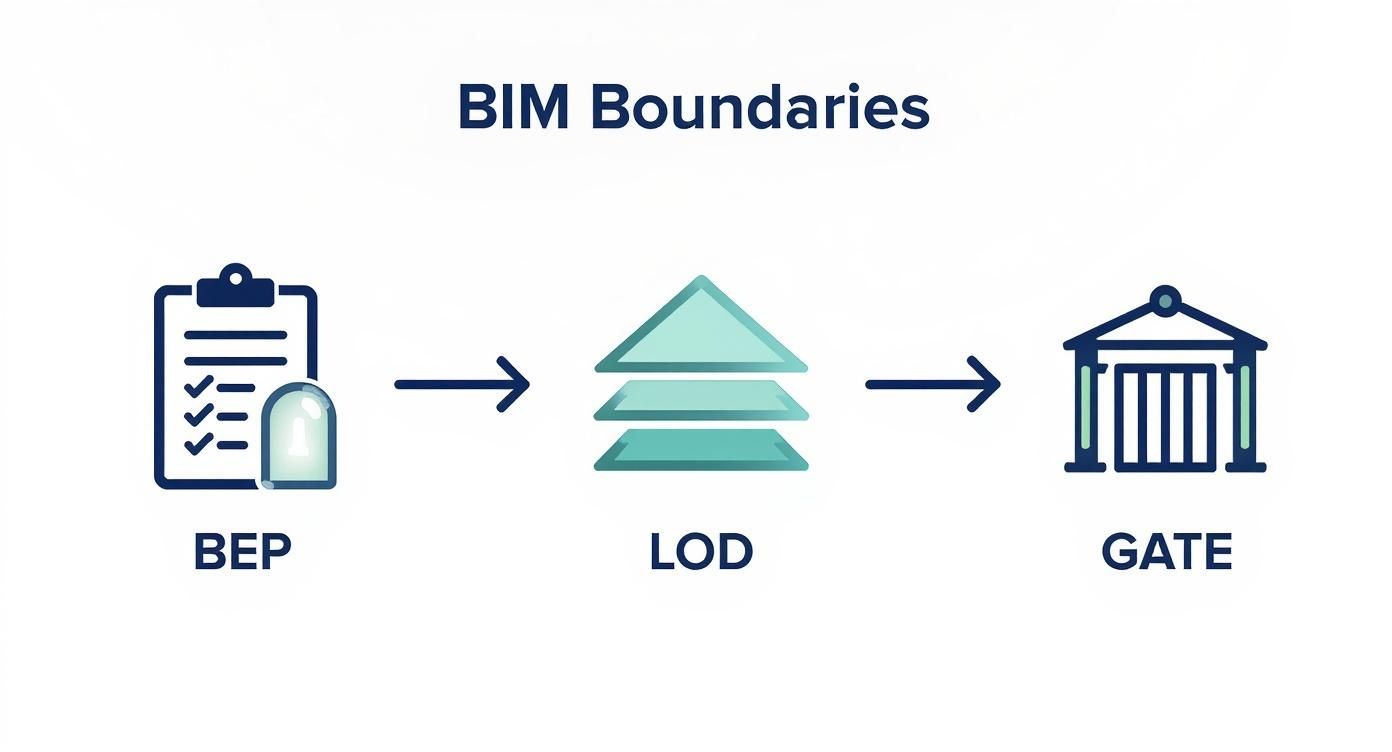
Each stage locks in the previous one, so informal tweaks can’t slip through and derail downstream work.
Establish Weekly Decision Check-Ins
Pull decisions out of email threads and into a dedicated weekly slot on your project meeting agenda. This is a focused session to clear blockers, not a design critique.
- Log Pending Items: Keep a shared list of every open decision, RFI, or client query.
- Assign an Owner: Tag each item to a single individual responsible for resolution.
- Set a Hard Deadline: Give every decision a non-negotiable due date.
This simple ritual builds an accountability loop where nothing gets lost.
A timestamped decision log is one of the most potent tools in architecture scope management. It ends the debate over “what was said” by creating an immutable record of who decided what, when.
Create A Practical Change Log System
Once decisions are tracked, a change log captures every out-of-scope request. Think of it as a living ledger that records each deviation.
- The Request: A clear summary of the proposed change.
- The Originator: Who asked for it (client, structural engineer, etc.).
- The Date: When the request was made.
- The Impact: A concise rundown of effects on schedule, budget, and other disciplines.
- The Status: Pending, Approved, or Rejected.
Suddenly, a last-minute window spec tweak isn’t a knee-jerk yes or no. It’s “Let’s log that. We’ll analyze impacts on procurement and the energy model, then review at our next check-in.” For more on formalizing this process, see our comprehensive guide to change orders for architects.
When scope creep goes unchecked, the cost is staggering. The Berlin Brandenburg Airport, planned at €5.2 billion, ballooned to €7.9 billion after years of uncontrolled changes. This case shows how small deviations can spiral into catastrophic overruns. You can read a breakdown at Harvest’s Scope Creep Glossary.
By putting these structured workflows in place, you foster clarity, not conflict. Everyone works from the same transparent playbook, protecting all sides from the hidden costs of ambiguity.
Use Drawing Sets and Model Boundaries to Lock In Scope
A design that keeps changing isn’t finished—it’s a liability. One of the most common ways scope creep enters a project is through the idea of a perpetually fluid model. When drawings and models are treated as endless works-in-progress, there are no firm goalposts. This is where the tactical discipline of locking down deliverables becomes a powerful defense.
This isn’t about being rigid; it’s about creating predictability. Using drawing sets as physical evidence of decision checkpoints transforms an abstract design into tangible, contractually significant deliverables. This is fundamental to protecting your margins and ensuring operational consistency.
Treat Drawing Sets as Immutable Records
The strategic importance of issuing drawing sets for specific purposes cannot be overstated. When a drawing package is stamped ‘For Permit,’ ‘For Tender,’ or ‘For Construction,’ it must be treated as a fixed record. It is a snapshot in time that everyone has agreed upon.
Any change requested after that point isn't just a revision—it's an event. It must trigger a formal addendum or a change order, not an invisible model update that quietly ripples through the project. This documentation discipline ensures the full impact of every post-issuance change is acknowledged, assessed, and approved with complete transparency.
This simple shift in mindset provides several key advantages:
- It creates accountability. Changes move from informal emails into a formal, traceable process.
- It protects against rework. This prevents one team's "small" tweak from forcing three other teams to redo their work, preventing RFI escalations.
- It provides clarity for permitting. Officials review a fixed set of documents, avoiding confusion from ongoing design tweaks.
Define Clear Modeling Boundaries in a Federated Environment
In a modern BIM workflow, modeling boundaries are critical for BIM and scope control. This means clearly defining which team "owns" certain model elements at each project stage. Without these boundaries, uncoordinated adjustments cascade into massive scope and coordination headaches.
For example, the structural engineer owns the steel frame. The architect owns the curtain wall. The MEP engineer owns the ductwork. Your BIM Execution Plan (BEP) should codify these lines of ownership and establish clear protocols for how changes are requested across disciplines.
When modeling boundaries are vague, trades are more likely to make on-the-fly "field-fit" adjustments that never make it back into the model. This leads directly to clashes, RFIs, and rework. Clear ownership prevents this by establishing a single source of truth for every element.
Turning the Model into a Deliverable
This practice transforms your BIM model from an evolving design tool into a series of contractually binding deliverables. Each model version, tied to a specific drawing set issuance, becomes a hard milestone. This creates a clear "before and after" picture, making it simple to identify and quantify scope deviations.
Firms that excel at architecture scope management build this discipline into their core production workflow. They understand a locked drawing set isn’t a barrier to progress; it’s the foundation of it. It ensures every stakeholder is aligned and the project moves forward on a basis of shared, documented understanding—not shifting assumptions.
By locking in scope with drawing sets and defining clear model ownership, you stop relying on conversations and start relying on systems. It’s a fundamental shift that builds the operational consistency your scalable delivery pods depend on.
Communicate Scope to Build Trust, Not Walls
The systems we've discussed—from a detailed BIM Execution Plan (BEP) to locked drawing sets—aren't rigid walls that kill conversation. Their real purpose is to build a foundation of shared clarity. True architecture scope management isn't just having these processes; it's about communicating their value to clients and stakeholders.
Positioning these controls as a mutual benefit is everything. It’s not about finding new ways to say "no." It’s about collaboratively protecting the project's integrity, schedule, and budget. This shift in framing turns tense moments into opportunities to build trust and demonstrate your firm’s production maturity.
Frame Processes as a Shield for Everyone
When you introduce a change log or a formal decision checkpoint, don't present it as a bureaucratic hurdle. Explain how it shields everyone from risk.
A project with a fuzzy scope is organized chaos—a mess of endless RFIs, surprise budget overruns, and a constant feeling of spiraling out of control. A well-managed project is predictable. The systems you put in place are the tools that create that predictability.
We’ve seen teams slash rework just by formalizing decision checkpoints. It gets critical conversations out of messy email chains and into a structured forum where the impacts of a choice—on time, cost, and design—are clear to everyone.
Use Collaborative Language
The words you choose can forge a partnership or create an adversarial dynamic. The goal is to guide conversations back to the agreed-upon framework in a supportive way. This is where communication becomes your best tool for managing project scope creep.
Effective Communication for Scope Management
This table shows how to turn difficult conversations into productive, system-driven discussions that reinforce your role as a trusted advisor.
| Scenario | Ineffective Response | Effective System-Based Response |
|---|---|---|
| A client requests a "small" change after a milestone. | "We can't do that; it's already been approved." | "Great idea. Let's log that in our change system so we can assess its impact on the schedule and budget before we proceed. We want to ensure there are no surprises for you down the line." |
| A decision is needed, but the client is delaying. | "We need you to decide now, or the project will be late." | "Just a heads-up, the window procurement deadline is next Friday. To lock in current pricing and avoid delays, we'll need a final decision by Tuesday, as noted in our decision log." |
| A stakeholder questions a cost variation for a change. | "That's just what it costs to make the change." | "Happy to walk you through it. As per our process, this change requires updates to the structural model and MEP drawings, which totals X hours. Here’s the breakdown for full transparency. How would you like to proceed?" |
By consistently tying your actions back to the shared goal of protecting the project, you transform the dynamic.
The core message is always: "Our process is here to protect your budget and timeline." When clients see that your systems serve their best interests—cost certainty and schedule predictability—they become advocates for the process.
Demonstrating Value Through Predictability
Every time you walk a client through the change log or explain an LOD milestone, you're doing more than enforcing a rule. You're demonstrating your firm's commitment to operational consistency. You're showing them you don't run on guesswork.
What you're really selling is clarity, systems, and reliable delivery.
This disciplined communication, backed by solid production systems, is what separates mature firms from the rest. It ensures that when scope creep in construction inevitably appears, it’s not a crisis. It’s an event to be managed through a clear, predictable, and mutually agreed-upon process that keeps everyone aligned.
Common Questions About Managing Scope Creep
Shifting from a reactive to a proactive approach for managing project scope creep always brings up a few questions. Here are some of the most common ones we hear from architects, builders, and design firms.
How Do We Introduce These Processes Without Making Clients Feel Restricted?
Frame it as a direct benefit to them from the very first kickoff meeting.
Explain that your mature production process includes clear decision checkpoints and transparent change logs specifically to ensure there are no surprises on their budget or timeline. This isn't about restriction; it's about a mutual commitment to clarity and predictability.
Instead of saying, “We don’t allow changes after this date,” try this:
“To protect your schedule and lock in pricing, we’ll finalize all material selections by this checkpoint. This helps us guarantee availability and keeps the project moving forward without a hitch.”
The conversation is positioned around positive outcomes for the client: cost certainty and a predictable process.
What Is the Single Most Effective Change a Small Firm Can Make?
Implement a formal Decision Log for every client meeting.
This can be a simple shared spreadsheet listing every open decision, who is responsible, and its due date. Make it a non-negotiable part of your agenda to review this log at the beginning and end of each meeting.
This simple discipline moves critical decisions out of ambiguous email chains and into a formal, tracked system. It creates a timestamped record of what was decided and when, making it harder for "small changes" to slip in unnoticed. It's a low-tech, high-impact tool for effective architecture scope management.
How Do These Systems Help with Internal Scope Creep?
Internal scope creep—where your team’s over-delivery or uncoordinated changes cause rework—is a sign of an undefined workflow.
The same systems designed for external scope creep in construction are critical for keeping your team aligned. A detailed BIM Execution Plan (BEP) is your team's rulebook. It's not a document to be filed away; it's the playbook for the entire project.
A strong BEP clarifies roles, modeling protocols, and handoff responsibilities. When your team understands that the structural model is locked at LOD 300 and cannot be altered without a formal review, it prevents the downstream chaos that happens when one discipline’s changes force another to redo their work. This is how BIM and scope control protect your margins from the inside out.
Ready to build a system that stops scope creep before it starts? Our Scope Control Checklist can help you implement the disciplined workflows that create clarity and protect your bottom line. It’s a helpful resource designed for firms that sell clarity, systems, and reliable delivery.