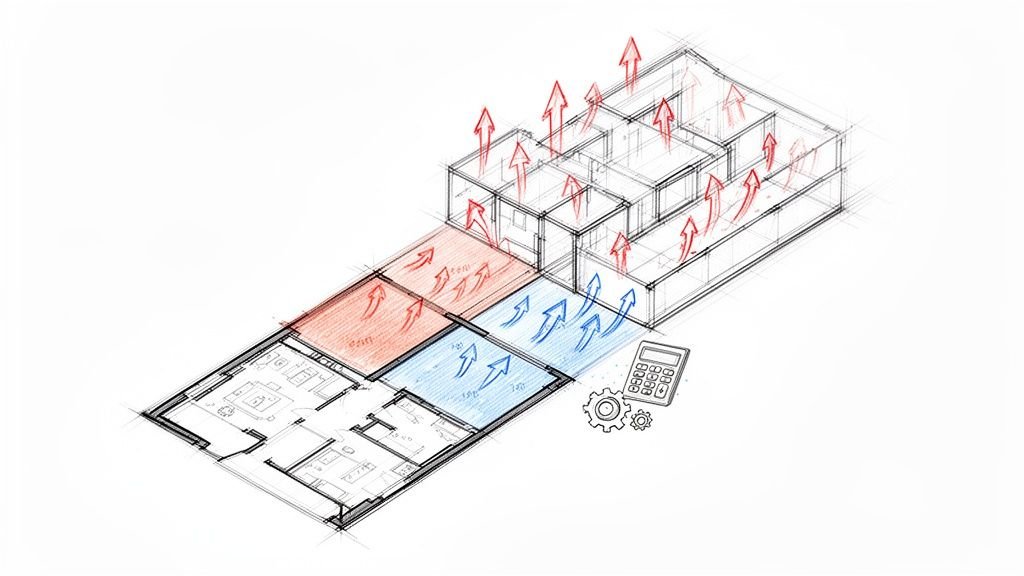
Ever walked into a brand-new commercial space only to find the HVAC system short-cycling, leaving the air humid and uncomfortable? The problem often comes down to a simple but critical mistake: a contractor used a Manual J calculation, treating a small office as if it were a house. We've seen commercial tenant fit-outs with HVAC systems sized this way produce 30% oversized equipment—comfortable on paper, but a mess of humidity problems and wasted energy in reality.
This guide is for HVAC designers, mechanical engineers, and building professionals who need to get it right the first time. It's not a technical dive into calculation formulas. It’s a practical decision guide to clarify a common point of confusion in the HVAC industry.
Why Understanding Both Methods Matters for HVAC Professionals
Choosing the right method isn't just about following best practices—it's about protecting your project margins, delivering predictable comfort, and ensuring a smooth permitting prep process. Using the wrong standard leads to improperly sized equipment, comfort complaints, and rejected plans, undermining operational consistency.

Manual J and Manual N are not interchangeable. They are designed for fundamentally different building types with different load characteristics. This guide helps you select the correct method from project inception, ensuring your calculations reflect actual building use and your systems perform as designed.
What Is Manual J? The Standard for Residential HVAC
ACCA Manual J, 8th Edition (AE), titled Residential Load Calculation, is the industry-standard protocol developed by the Air Conditioning Contractors of America (ACCA) for sizing heating and cooling systems in homes. For decades, it has been the definitive method, evolving from simple rules of thumb to a sophisticated, ANSI-recognized standard.
Its purpose is clear: to provide a precise, repeatable process for calculating the heating and cooling loads (measured in BTU/h) for single-family homes, low-rise multifamily buildings, and other residential structures. The calculation produces a total heating load and a total cooling load (both sensible and latent) for the entire house, which is essential for accurate AC sizing. A proper Manual J is often a mandatory part of the permitting process, validating that a system is sized for efficiency and comfort, not guesswork. You can learn more on ACCA's technical manuals page.
What Is Manual N? The Standard for Commercial HVAC
ACCA Manual N, 5th Edition, titled Commercial Load Calculation, is the ACCA standard for determining the heating and cooling loads in commercial, institutional, and industrial buildings. It was developed to address the complex and highly variable thermal environments found in non-residential spaces.
Manual N shares a theoretical foundation with ASHRAE methods but is packaged as a comprehensive, step-by-step procedure. Its primary output is not a single number but a detailed breakdown of block loads, zone loads, and system-level requirements. This allows engineers to design sophisticated multi-zone systems that respond to diverse and changing conditions—a core requirement for any commercial project. Manual N provides the clarity needed for reliable delivery in complex environments.
The Fundamental Difference: Building Use Patterns
The core reason you cannot swap Manual J and Manual N is that they are built on fundamentally different assumptions about how buildings are used. A house is an envelope-dominated structure. Its heating and cooling loads are primarily driven by heat transfer through its walls, roof, and windows. Occupancy is relatively consistent and predictable.

In contrast, a commercial building is an internal-load-dominated space. The primary driver of its cooling load is heat generated inside the building—from people, lights, computers, and equipment. These internal gains can be massive and are tied to variable schedules, often dwarfing the load from the building envelope. Using a residential method here ignores the primary heat source, leading to system failure.
Manual J: Residential Approach in Detail
Manual J is optimized for the predictable physics of a home. Its methodology is tailored for structures where the building envelope is the star of the show.
- Building Types: Single-family homes, duplexes, townhouses, and low-rise (three stories or less) multifamily buildings.
- Occupancy Assumptions: Assumes a standard number of occupants based on bedrooms, with predictable schedules (e.g., home in evenings/weekends).
- Internal Loads: Uses simplified, standardized values for heat gain from people, appliances, and lighting.
- Ventilation: Primarily addresses natural infiltration (air leakage) and can incorporate simple whole-house mechanical ventilation.
- Sizing Philosophy: Size the equipment to match the peak load closely. Oversizing is a primary cause of short-cycling, poor humidity control, and wasted energy.
The output is a clear, whole-house heating and cooling load, providing a direct target for selecting unitary equipment. It offers clarity for a straightforward application.
Manual N: Commercial Approach in Detail
Manual N is built for the dynamic and demanding nature of commercial spaces. It’s a tool for managing complexity and ensuring system performance under variable conditions.
- Building Types: Offices, retail stores, restaurants, schools, healthcare facilities, and other non-residential buildings.
- Occupancy Assumptions: Based on specific space use (e.g., occupants per 100 sq. ft. for an office) and tied to detailed daily/weekly schedules.
- Internal Loads: Requires a detailed accounting of all heat-generating sources: people, high-wattage lighting, computers, kitchen equipment, and other machinery.
- Ventilation: Integrates code-mandated outdoor air requirements, typically based on ASHRAE 62.1, a major load component.
- Sizing Philosophy: Accounts for diversity—the fact that not all zones will experience peak load simultaneously—to avoid gross oversizing of central plants and air handlers.
The output includes block loads (for the whole building), zone loads (for individual areas), and airflow (CFM) requirements, providing the necessary inputs for designing complex, multi-zone VAV or other commercial systems.
Key Technical Differences
The devil is in the details. These fundamental differences in assumptions are why the methods are not interchangeable.
- Occupancy Assumptions: Manual J uses a fixed number based on bedrooms. Manual N uses variable density based on the function of the space (e.g., office vs. conference room).
- Internal Heat Gains: Manual J applies simplified, generic values. Manual N demands detailed schedules and power densities for all equipment and lighting.
- Ventilation Calculation: Manual J focuses on infiltration. Manual N incorporates mandated outdoor air rates from ASHRAE 62.1, a significant load.
- Schedules and Diversity: Manual J assumes one simultaneous peak for the whole house. Manual N applies diversity factors, recognizing that peak loads in different zones occur at different times.
- Zone Analysis: A Manual J calculation is primarily a whole-house (block) load for equipment selection. Manual N performs true multi-zone analysis essential for commercial VAV systems.
- Equipment Sizing Approach: Manual J aims to match the peak load with minimal oversizing. Manual N sizes central equipment based on a diversified block load while sizing zone terminals for local peaks.
Building Types: Which Method Applies?
Selecting the right method starts with identifying the building type. This is a critical decision checkpoint.
Clearly Manual J:
- Single-family detached homes
- Townhouses and rowhouses
- Duplexes, triplexes, and fourplexes
- Low-rise apartments and condominiums (typically 3 stories or fewer)
- Accessory Dwelling Units (ADUs)
Clearly Manual N:
- Office buildings
- Retail stores and shopping centers
- Restaurants and food service establishments
- Healthcare facilities (clinics, hospitals)
- Educational buildings (schools, universities)
- Hotels and large hospitality venues
- Conditioned warehouses and industrial spaces
Gray Areas Requiring Judgment:
- Large Custom Homes (>5,000 sq. ft.): Though residential, their scale and complex zoning might tempt a commercial approach. Stick with Manual J, but perform a rigorous room-by-room calculation. Using Manual N will lead to oversizing.
- Mixed-Use Buildings: These require a hybrid approach. Use Manual J for the residential portions and Manual N for the commercial spaces.
- Live-Work Units: The calculation method depends on the dominant use and zoning. If the commercial space is significant, it needs a Manual N calculation.
- Small Commercial in Residential-Scale Buildings: A small law office in a converted house is still a commercial space. Its occupancy and equipment loads demand a Manual N calculation.
- Assisted Living Facilities: These often straddle the line. While units feel residential, common areas and ventilation requirements are commercial. A hybrid approach is often best.
Code Requirements: What Jurisdictions Mandate
Code officials are trained to spot mismatches. The International Energy Conservation Code (IECC) and ASHRAE 90.1 provide clear direction.
- IECC Residential Provisions: Explicitly reference ACCA Manual J as the required standard for residential load calculations.
- IECC Commercial Provisions / ASHRAE 90.1: Point to ASHRAE-based methodologies, for which ACCA Manual N is a recognized and compliant procedural standard.
- State and Local Amendments: Always verify local codes, as they may have specific requirements or amendments.
Submitting a permit application with a calculation performed using the wrong method is a common reason for rejection. It signals a lack of professional diligence and can cause significant project delays, creating the need for preventable RFIs.
What Happens When You Use the Wrong Method
Misapplication isn't a minor error; it guarantees a failed outcome.
Manual J on a Commercial Building:
A contractor used Manual J on a 3,000 sq. ft. dental office, thinking "it's basically a house." The calculation completely missed the heat from sterilization equipment and high occupancy, leading to an undersized AC unit. The system couldn't keep up on summer afternoons, resulting in comfort complaints and an expensive replacement.
- Result: Undersized equipment, poor comfort, and code violations.
Manual N on a Residential Building:
An engineer applied commercial methods to a 6,000 sq. ft. custom home, wanting to be "more thorough." The calculation, assuming commercial-level internal gains and ventilation, produced a cooling load 40% too high. The installed system short-cycled constantly, leading to humidity problems, occupant discomfort, and sky-high energy bills.
- Result: Grossly oversized equipment, short-cycling, high humidity, and wasted capital.
Software Tools for Each Method
Software automates the math, but it doesn't make the decision for you. You must select the right tool and standard for the job.
- Manual J Software: Wrightsoft Right-J, Elite Software RHVAC, CoolCalc
- Manual N Software: Trane TRACE 3D Plus, Carrier HAP, IESVE, Wrightsoft Right-N
Garbage in, garbage out. The software is only as good as the user's understanding of the underlying principles. Choosing the wrong method in the software setup menu guarantees an incorrect result.

Side-by-Side Comparison Table
Use this table as a quick reference to solidify the core differences.
| Factor | ACCA Manual J | ACCA Manual N |
|---|---|---|
| Building Type | Residential (homes, low-rise multi-family) | Commercial & Institutional |
| Occupancy Pattern | Consistent, predictable, based on bedrooms | Variable, scheduled, based on space function |
| Internal Gains | Simplified, standardized assumptions | Detailed, scheduled calculation (people, lights, equipment) |
| Ventilation | Infiltration + simple mechanical (e.g., bath fans) | ASHRAE 62.1 outdoor air compliance |
| Diversity | Not applied (assumes simultaneous peak) | Applied to non-simultaneous loads |
| Zone Analysis | Room-by-room for duct design; block load for equipment | True multi-zone block and peak zone loads |
| Software Complexity | Moderate | High |
| Primary Code Reference | IECC Residential | IECC Commercial, ASHRAE 90.1 |
Professional Responsibility and Getting Help
Selecting the appropriate HVAC load calculation method is a fundamental act of engineering judgment. Documenting this choice is a critical part of a mature QA/QC process. For complex projects like mixed-use buildings, high-performance designs, or situations with ambiguous code interpretations, consulting an expert is a sign of strength, not weakness.
At BIM Heroes, we believe that predictable outcomes are built on production maturity and template discipline. Choosing the right load calculation method is a critical first step toward a successful project, protecting margins and ensuring system performance.
If your team is focused on scalable delivery and needs to bring more consistency to your HVAC design and documentation, our expert production and consulting services can provide the clarity and systems you need.