The real headache with MEP systems isn’t a last-minute change order. It’s the systemic mismatch in Level of Detail (LOD) from one project stage to the next—a production reality that eats margins and blows up timelines. Coordination often fails before it has a chance to succeed because teams model too much too soon or too little too late.
This isn't about modeling preference. For MEP, LOD is a risk management strategy.
Why BIM LOD for MEP is a Coordination Strategy, Not a Modeling Preference

MEP engineers, BIM managers, and VDC teams know the pain: models are either packed with pointless detail too early or are frustratingly generic when it’s time for critical decisions. This isn't a failure of skill; it's a breakdown in governance.
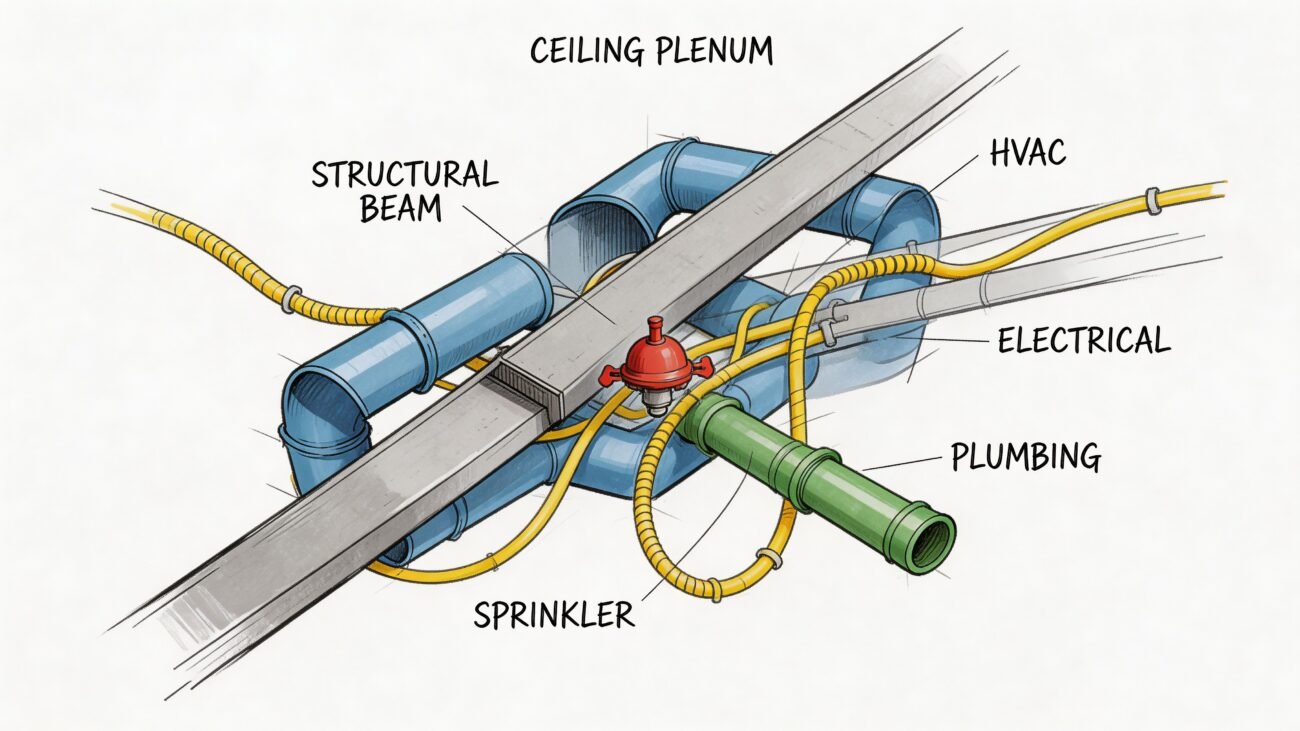
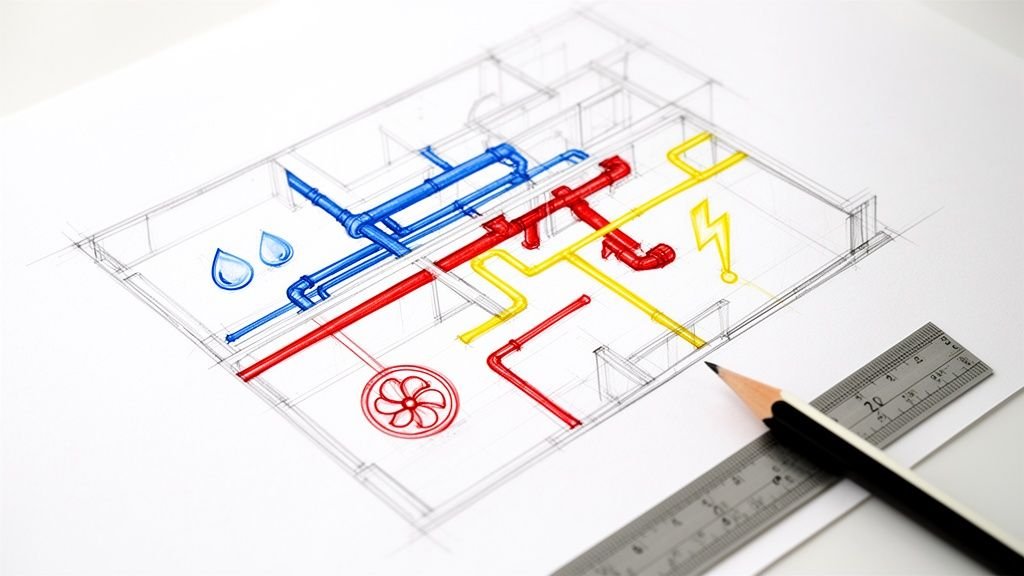
Think about it: MEP systems are the most space-sensitive and change-prone parts of a building. Their routes, equipment sizes, and clearance needs are dictated by architectural and structural elements that are in flux during early design. When your model’s detail gets ahead of design certainty, you’re just inviting rework.
The Real Root of Coordination Failures
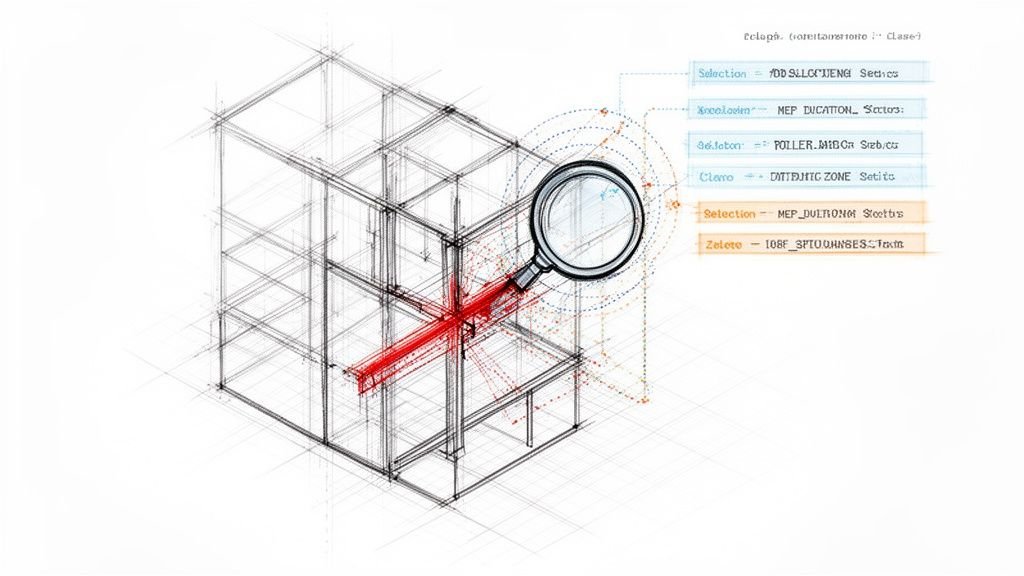
We have a habit of blaming "late changes" for clashes, but the failure was often baked into the process months earlier. It happened when ducts were fully sized and detailed before the final ceiling plenum height was locked. It happened when generic equipment was used until the day an exact unit footprint was needed for coordination.
The real cause of many coordination problems is not a sudden change, but an MEP model built with the wrong level of detail at the wrong time. This creates a domino effect of rework, RFIs, and busted timelines.
This isn’t a skill issue; it’s a system and governance gap. Without a disciplined, phased approach to MEP LOD levels, you end up with the exact issues that destabilize projects. Nailing down efficient MEP systems integration and coordination from the start is the only way to sidestep these common traps.
Common Production Pains from Poor LOD Timing
These aren't one-off incidents; they are the predictable results of a broken system.
- Ducts sized too early: Teams model complex duct runs based on schematic plans, only to remodel everything when actual wall thicknesses and ceiling heights are confirmed.
- Generic equipment placeholders: A generic box is used for an AHU, and all trades coordinate around it. When the actual submittal arrives with a larger footprint and different service clearances, a cascade of clashes is created.
- Over-detailed fittings: Modeling every pipe fitting and valve before the main routing is finalized leads to bloated Revit models and massive rework after the first major layout change.
These issues highlight a critical truth: the pain felt during coordination is almost always a direct result of decisions made—or not made—much earlier in the process. Successful MEP coordination BIM isn’t about modeling more; it's about modeling with discipline, evolving detail in lockstep with design certainty.
The True Cost of Misaligned MEP LOD Levels
A misaligned Level of Detail isn't just an abstract process problem; it's a direct threat to your project's bottom line. When BIM LOD for MEP is treated like a modeling preference instead of a core risk management strategy, the consequences ripple through every phase. You’ll see it in wasted hours, blown budgets, and operational chaos that eat into your margins every single day.
The pain often starts with something that seems harmless, like detailing a pipe run based on an early, schematic model. Your team might spend weeks meticulously modeling the routes, only for the ceiling heights to change or a structural beam to shift. The result? Every hour spent on that detailed modeling work gets thrown out. This isn't a "late change"—it's the predictable outcome of adding detail without spatial certainty.
This exact scenario plays out again and again across all mep systems, creating a painful cycle of rework that drains resources and kills team morale.
From Small Gaps to Major Project Failures
Another common failure point is relying on generic equipment placeholders long after their usefulness has expired. A team might model a simple box to represent an "air handling unit" and coordinate all surrounding trades to its basic dimensions. Then, weeks down the road, the actual submittal data arrives. The real unit is six inches wider and needs an extra foot of clearance for service.
Suddenly, all that meticulously routed pipe, duct, and conduit is clashing. The flood of RFIs that follows brings productivity to a screeching halt. This is a classic example of how under-modeling at a critical coordination stage creates more problems than it solves.
The most expensive clashes are not the ones you find, but the ones you create by building certainty around uncertain information. Incorrect MEP LOD levels create a false sense of coordination that is destined to break.
The damage isn't just from rework. Over-modeling—like detailing every single pipe fitting in the early design phase—bloats your Revit models. Performance grinds to a halt and files become unstable, slowing down the entire project team for a level of detail that was going to be thrown away after the first major routing change.
Connecting LOD Failures to Your Bottom Line
These issues are systemic gaps that come from a project lacking clear rules for LOD in MEP BIM. Here’s how these seemingly small process failures translate into significant financial and operational pain:
- Wasted Modeling Hours: Every time a system gets remodeled due to a foreseeable change, those hours are a sunk cost. This is pure margin erosion.
- Endless RFIs: Problems caused by LOD misalignment generate a storm of RFIs, tying up senior staff in administrative churn instead of productive work.
- Unstable Models: Over-detailed and constantly reworked models become slow and corruptible, creating a frustrating and inefficient environment.
- Fabrication Errors: When shop drawings are based on an uncoordinated model, the mistakes are manufactured in steel and installed on-site—leading to the most expensive rework of all.
The sheer scale of the industry amplifies these costs. The global MEP services market is projected to surge from $169.83 billion in 2026 to $376.72 billion by 2034, driven by a boom in infrastructure demand. You can get more insights on this growth over at the Fortune Business Insights website. For firms tackling these complex projects, undisciplined LOD practices represent a massive, and unnecessary, financial risk.
By putting a disciplined framework in place, teams can avoid the self-inflicted wounds that undermine even the most talented engineers. For a deeper look at the foundational principles, check out our guide on a comprehensive BIM Level of Detail strategy. The goal isn't just to model; it's to build a production system that delivers clarity and consistency, protecting your margins and ensuring predictable outcomes.
A Phased Framework for Developing MEP Systems
The solution to chronic rework in MEP systems isn't working harder; it’s working smarter within a structured framework. A successful project requires moving beyond generic LOD definitions and adopting a production-centric approach where model detail evolves in lockstep with design certainty.
This isn’t just a better way to model. It’s a system for protecting your margins and delivering predictable outcomes.
A disciplined progression is the only way to break the cycle of over-modeling too soon or under-modeling too late. The goal is to align modeling effort with coordination milestones, ensuring every decision is built on a solid foundation of confirmed information.
Stage 1: Schematic Zoning and Routing
First, establish the big picture. Instead of jumping into precise pipe and duct dimensions, the initial focus should be on schematic zoning and defining major routing pathways. This phase uses simple massing elements or single-line diagrams to reserve space for main trunks and equipment.
This initial layout provides a critical spatial framework without the burden of excessive detail. It allows architects and structural engineers to make informed decisions around plenum heights and shaft locations with a clear understanding of MEP's spatial needs. It's a low-effort, high-impact step that prevents major routing disasters before they happen.
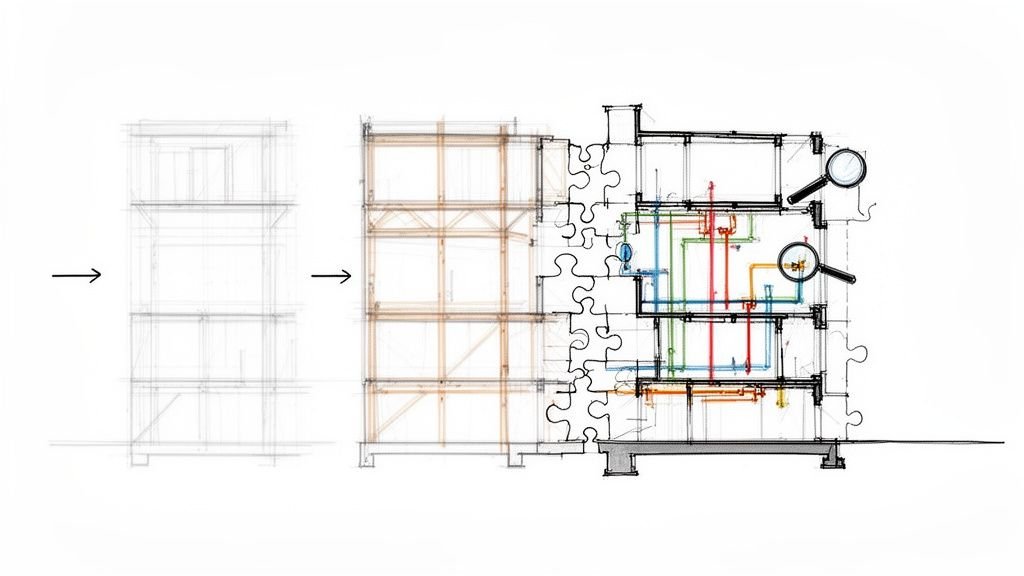
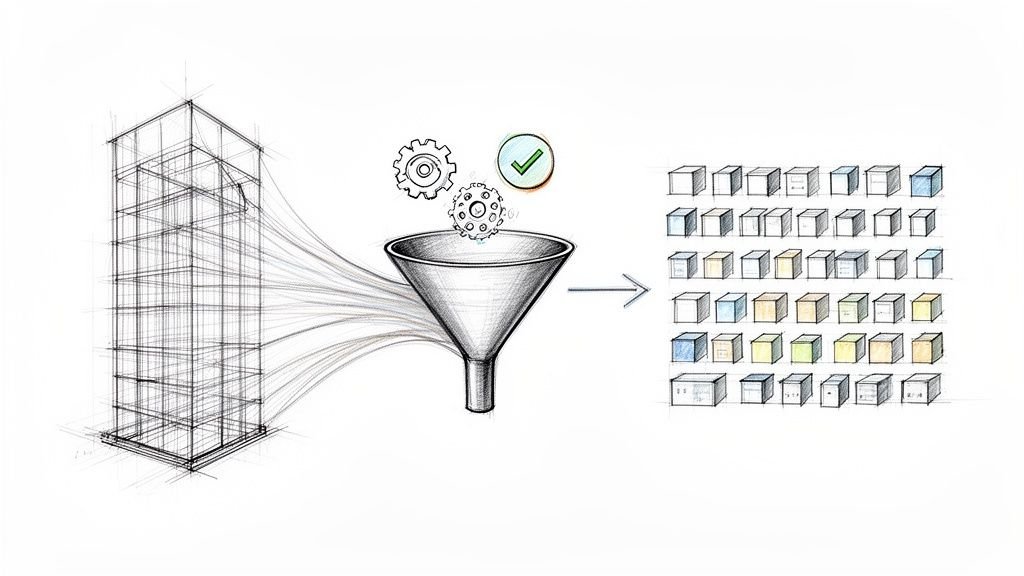
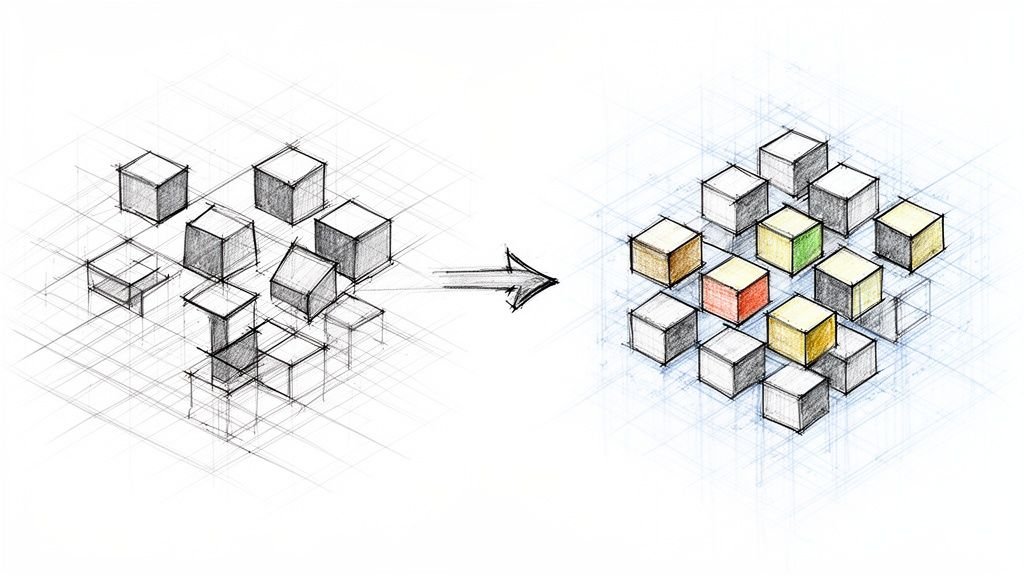
This visualization shows the costly process flow when MEP LOD is misaligned, starting with bad data, which inevitably leads to rework and erodes project profits.

The key insight here is that profit loss isn't a random event. It's the direct and predictable outcome of a broken process that begins with poor information management.
Stage 2: Spatially Coordinated Systems
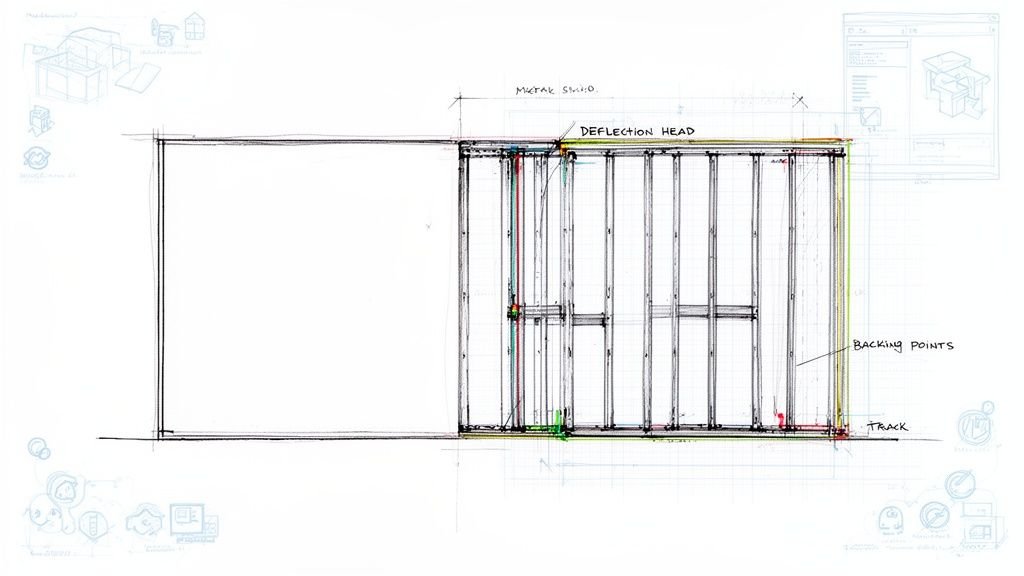
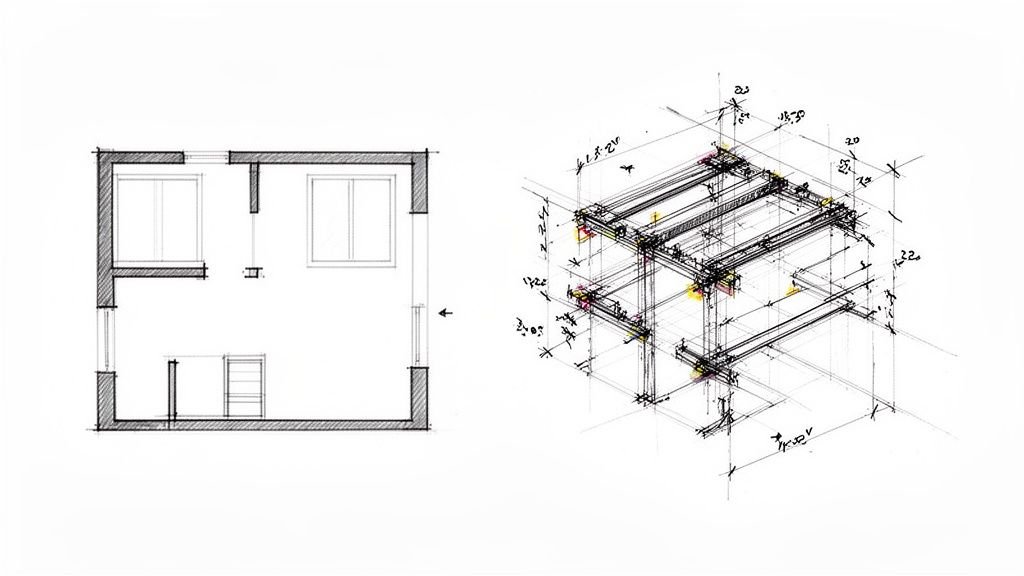
Once primary routes and equipment zones are approved, the model can progress to a defined state. In this stage, systems are modeled with dimensionally accurate sizes and clearances. Ducts, pipes, and conduit are now represented by their real-world dimensions, but—and this is critical—without fabrication-level detail like specific fittings, joints, or hangers.
This is the workhorse phase of MEP coordination BIM. The model now contains enough information for truly effective clash detection and constructability reviews. The VDC team can run clash tests against structure and architecture with high confidence, resolving the vast majority of spatial conflicts.
Effective BIM LOD for MEP is about achieving spatial certainty first. Fabrication detail should only be added after the path is clear and all major conflicts have been resolved. Modeling fittings on an uncoordinated route is a recipe for rework.
Stage 3: Fabrication-Ready Detailing
Only after major routes are finalized and signed off—a critical decision checkpoint—should the team move to fabrication-level detail. This is when specific fittings, connections, valves, and hangers are added. Because the heavy lifting of spatial coordination was completed in the previous stage, this detailing work is built on a reliable foundation.
This disciplined separation of tasks prevents the classic scenario where a minor routing change forces the team to delete and remodel hundreds of meticulously detailed components. By waiting until the layout is frozen, you ensure detailing effort is final and productive, not speculative and disposable.
This methodical approach is fundamental to reliable MEP design services that deliver consistency project after project. It transforms the modeling process from a reactive scramble into a predictable production system.
Establishing Clear Ownership and Decision Checkpoints
A phased framework for MEP systems is powerful, but it’s only as effective as the processes that support it. Without clear ownership and firm decision checkpoints, even the best plan will crumble under project pressure. A strategy on paper is not a strategy in practice.
This is where many production workflows fall apart. Teams might agree on a phased approach to BIM LOD for MEP but then fail to define who owns what, and when. This ambiguity creates gaps where assumptions thrive and mistakes take root.

Defining LOD Ownership by Trade and Phase
The first step is assigning explicit ownership for the Level of Development (LOD) of each system at every project stage. A well-written BIM Execution Plan (BEP) must clearly state which trade is responsible for bringing their model from schematic to spatially coordinated, and finally to fabrication-ready detail.
This clarity ensures all trades are marching in lockstep, preventing one team from getting ahead while another is still working with placeholders.
The Power of Freeze Points in MEP Coordination
A critical piece of governance is establishing freeze points. These are hard deadlines after which major system routes and equipment locations are locked. Nothing changes without a formal review. Think of it as a gate that protects all the work that comes after.
Once a zone is "frozen," the team has a stable foundation to begin fabrication detailing. This simple rule prevents the chaotic, last-minute routing changes that trigger a cascade of rework for every trade involved. It transforms coordination from a messy negotiation into a series of sequential decisions.
A freeze point isn't a barrier to progress; it's a guarantee of it. By locking in coordinated routes, you give your detailers the certainty they need to work efficiently and accurately, protecting your schedule and budget from preventable churn.
Aligning Milestones with Production Triggers
Great governance aligns MEP LOD levels with real-world project milestones like permitting submissions and fabrication releases. For instance, the BEP might mandate that all major mechanical units must be modeled at LOD 350—with exact dimensions and service clearances—before the structural team finalizes their surrounding steel.
This one checkpoint prevents a costly problem: discovering a 2-ton air handler won't fit through its designed opening. By linking LOD in MEP BIM to these external dependencies, you build a system that proactively stops errors, rather than just finding them after the fact. This approach is the foundation of effective BIM clash detection strategies, ensuring the model is mature enough for meaningful analysis.
This system of clear ownership and defined checkpoints brings consistency and predictability. It turns the modeling process into a repeatable system that supports scalable delivery and protects your margins from the chaos of unmanaged change.
How LOD Discipline Protects Margins and Enables Scale
A well-defined framework for LOD in MEP BIM does more than just clean up your models—it directly protects your margins and lays the groundwork for scalable growth. When the rules of engagement are clear, delivery stops being a reactive, fire-fighting process and becomes a consistent, repeatable system.
This is the definition of production maturity.
This operational consistency allows firms to scale without breaking. Instead of reinventing the wheel on every project, teams can operate in efficient "delivery pods"—small, focused groups that execute with precision because the workflow is predictable. They aren't wasting time debating how much to model; they're following a proven system.
Building a Scalable Production Engine
The cornerstones of a scalable production operation are template discipline and solid QA processes, both built around a strong BIM LOD for MEP framework. Well-built Revit templates with pre-defined settings and parameters ensure every project starts from the same solid baseline.
A strong QA process acts as the guardrail. Regular model audits, guided by a simple checklist, catch deviations from the LOD plan before they snowball. This isn't about blaming people—it's about spotting gaps in the system and reinforcing the agreed-upon standards.
Margin protection is a direct result of production discipline. When you control the process, you control the costs. A disciplined LOD workflow is one of the most effective ways to prevent the unforced errors that eat away at profitability on complex mep systems projects.
The global push for digitally-driven construction only raises the stakes. For instance, a report from Mordor Intelligence notes that growth in the global MEP market is fueled by a shift to performance contracting and building electrification, where BIM is critical for streamlining design and speeding up delivery. You can dig into more analysis on the global MEP market to see how efficiency is becoming the main differentiator.
In this competitive environment, a haphazard approach no longer cuts it. Success demands a production engine built on clarity, consistency, and control.
Ultimately, a disciplined approach to MEP coordination BIM is about more than better models. It’s about building a business that delivers reliable results, project after project. By turning production into a predictable system, you create an operation that can handle more complexity and higher volume without sacrificing quality or profitability. We get into more detail on this in our resources covering our strategic BIM consulting approach.
Your Coordination-Ready MEP LOD Checklist
If you’re stuck in a cycle of rework, endless RFIs, and costly fabrication errors, the problem probably isn’t your team's modeling skills. Success with complex MEP systems comes from a clear plan for what to model and when.
The solution is to stop treating LOD as a modeling preference and start treating it as a risk management strategy. When you move to a phased approach, your teams get out of reactive fire-fighting mode and into a rhythm of predictable, consistent delivery. This protects your margins and builds a foundation you can scale.
A Recap of the Core Principles
To get there, your workflow needs to be built on a few key pillars. These principles turn BIM LOD for MEP from a vague concept into a practical production system:
- Schematic Zoning First: Don't jump into detailed modeling. Block out major equipment zones and routing pathways first.
- Disciplined Progression: Advance your model's detail in lockstep with design certainty: from schematic intent, to spatial coordination, to fabrication detail.
- Clear Ownership: Assign responsibility for each system's LOD at every project phase in the BIM Execution Plan.
- Defined Freeze Points: Establish firm decision checkpoints after which major routes are locked, protecting all downstream detailing work from chaos.
The bottom line is this: profitable MEP coordination BIM comes from a system that models the right amount of information at the right time. It’s about building certainty on top of certainty.
This disciplined approach ensures every hour spent modeling is productive. It prevents the self-inflicted wounds of over-modeling too early or under-modeling too late.
To help you put these ideas into practice, we’ve created a practical tool. Our Coordination-Ready MEP LOD Checklist is a simple, actionable resource designed to help your BIM managers and project leads implement a more structured workflow. This isn’t academic theory; it’s a field-tested framework focused on giving your team the clarity they need for reliable delivery.
Download the checklist to start building a more resilient production process today.
Frequently Asked Questions About MEP LOD Planning
Even with a solid strategy, practical questions always pop up when implementing a structured LOD plan for MEP systems. Moving from a reactive, "just model it" culture to a disciplined, phased approach means answering tough "how-to" questions from the team. Here are a few we hear all the time.
How Do We Get Trade Partners to Follow a New MEP LOD Plan?
It starts with the BIM Execution Plan (BEP). Clearly define the MEP LOD levels, ownership, and key freeze-point milestones at project kickoff. It's critical to frame this not as more work, but as a system designed to head off RFIs and protect everyone's schedule.
Use visual examples in the BEP so everyone knows exactly what "LOD 300 for ductwork" looks like on this project. From there, hold regular coordination meetings focused on the next LOD milestone—not just another clash report review. This proactive rhythm keeps everyone accountable.
What Is the Biggest Mistake Teams Make with MEP LOD Levels?
The single most costly mistake is jumping to fabrication-level detail (LOD 400) before spatial coordination is locked down at LOD 350. Teams get ahead of themselves, modeling every pipe fitting, duct connection, and hanger way too early.
When an inevitable change happens—like a structural beam is revised or the owner picks different equipment—all that meticulous, time-consuming work gets thrown out. It has to be completely remodeled. This wastes a staggering amount of effort and destabilizes the model.
This habit of detailing too soon is the number one source of rework in MEP coordination BIM workflows, and it usually stems from a lack of clear rules and decision checkpoints.
Can We Apply This LOD Framework to Smaller Projects?
Absolutely. The principles of a phased LOD in MEP BIM are completely scalable. On a smaller job, the phases might be compressed and the "freeze points" less formal, but the logic is identical. You still have to confirm major equipment locations and main routing paths before your team starts detailing every connection.
The key is to match the level of effort to the level of certainty. For a small project, this could be as simple as a single review meeting to lock in the layout before anyone touches fabrication detailing. That one step prevents the same kind of rework you'd see on a massive project.
A disciplined approach to BIM LOD for MEP isn't about adding red tape; it's about creating clarity and predictability. When you build a reliable system, you protect your margins and create an operation that can scale. At BIM Heroes, we help firms put these kinds of production-focused workflows into practice.
If you're tired of constant fire-fighting and want to build a more consistent delivery model, see how our BIM consulting services can give your team the frameworks and support they need.