Imagine this: your sleek, award-worthy floor plan gets torpedoed late in the design phase. The culprit? A surprise plumbing chase that is suddenly three times wider than anticipated, forcing frustrating redesigns and awkward conversations with the client. It’s a pain point many architects, structural engineers, and project managers know all too well.
This scenario happens because we often treat plumbing as a mysterious black box—someone else’s problem to solve. The result is almost always conflict: confusing redlines, last-minute compromises that ruin the aesthetic, and coordination meetings that feel more like one-sided lectures than collaborative discussions.

But what if you could sidestep these issues entirely? Understanding plumbing design fundamentals isn’t about becoming a plumbing engineer. It’s about developing cross-disciplinary literacy—knowing enough to anticipate needs, ask intelligent questions, and make informed architectural decisions from day one.
When you grasp the basic logic of gravity, pressure, and venting, your entire process changes. Instead of receiving plumbing redlines as a frustrating surprise, you can start anticipating them. This knowledge transforms your relationship with MEP consultants. They no longer see you as an obstacle to work around, but as an informed partner dedicated to a successful, integrated outcome.
We've seen projects save weeks of coordination time simply because the architect understood basic plumbing routing logic before locating restroom cores—knowledge that takes an afternoon to acquire but pays dividends for an entire career.
This guide provides the essentials of plumbing design, empowering you to create better buildings, protect your project's margin, and lead more effective teams.
Plumbing Systems Overview: The Big Picture
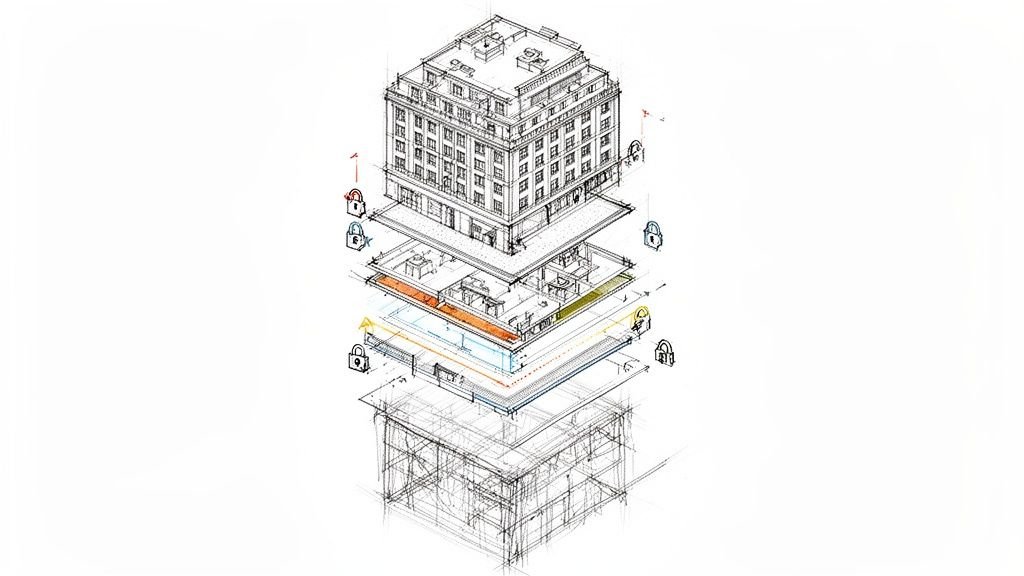
To an outsider, a building’s plumbing looks like a chaotic web of pipes hidden inside walls and ceilings. In reality, a well-executed plumbing design is three distinct systems working in perfect harmony. Getting a firm grasp on these systems gives you a mental map of what’s happening behind the finishes.
The Three Core Systems
At its core, building plumbing boils down to three primary jobs, each with its own network of pipes and its own set of rules.
- Domestic Water Supply: This is the pressurized delivery system that brings clean water into the building. Think of it like a hose, pushing water to every fixture.
- Sanitary Drainage: This is the gravity-powered system for getting waste out. It’s basically a waterslide, where getting the slope just right is everything.
- Venting System: This is the unsung hero—the "breathing" apparatus for the drainage system. It allows air into the pipes, which prevents the pressure imbalances that cause slow drains, gurgling sounds, and dangerous sewer gas.

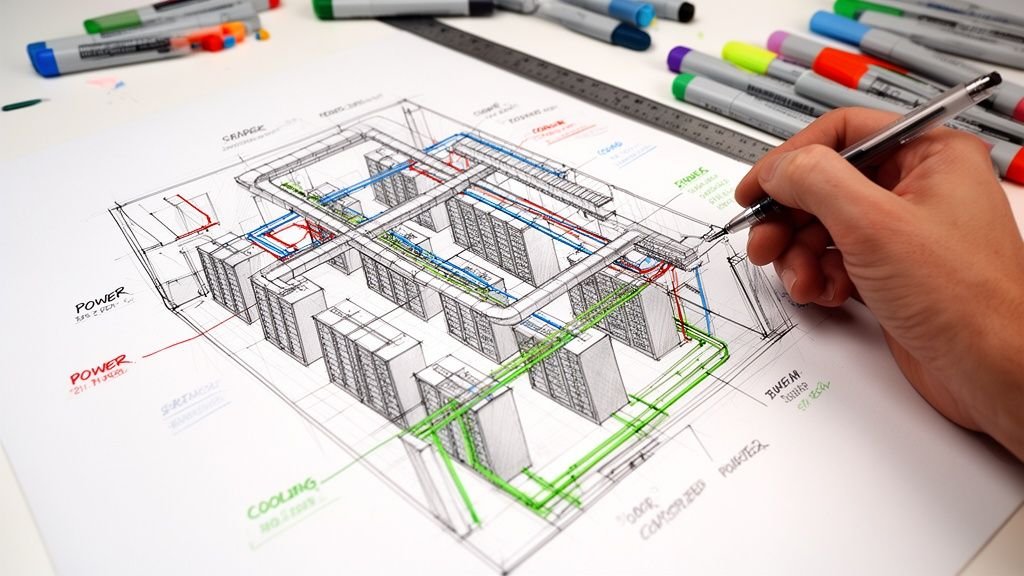
These systems are interconnected but operate independently. The supply lines bring water in, the drainage lines take it out, and the vent pipes make sure the whole process happens smoothly. Architecturally, these pipes are routed vertically through dedicated shafts or chases (risers) and horizontally through ceiling plenums or under floors (mains and branches).
The efficiency of your layout—especially how well you group those vertical runs—has a direct impact on the project's cost and complexity. It all starts by tapping into municipal systems or on-site solutions like wells and septic fields.
Domestic Water Supply: Getting Water In
Every building's plumbing starts with getting clean, potable water inside. This is the role of the domestic water supply system, a pressurized network that functions like a building's circulatory system.
It starts at the street, where the building’s service line taps into the municipal water main. From there, water passes through a meter before entering the building's distribution pipes. The entire network operates under pressure, the force responsible for pushing water up multiple floors and across long horizontal runs to reach every fixture.
Pressure: What It Is and Why It Matters
A plumbing engineer’s main challenge is a balancing act. They have to make sure the pressure at the furthest fixture never drops below what’s needed for it to function properly, even during peak demand. At the same time, the pressure can't be so high that it damages pipes or fixtures.
This focus on managing pressure isn’t new. The Romans were masters of it, using lead pipes that could handle impressive pressure, a huge step up from earlier gravity-fed systems. You can learn more about the fascinating history of plumbing systems and see how little the fundamentals have changed.
Example: If city water pressure is too low to serve your building's top floors, a booster pump is required. If the pressure is too high for the lower floors, a pressure-reducing valve (PRV) is needed. These aren't just notes on a drawing; they are physical pieces of equipment that require space, access, and budget.
Hot vs. Cold Water and Pipe Materials
Once inside, the supply system splits into cold and hot water lines. Hot water comes from a water heater, and the type you choose directly impacts your architectural plans. A classic storage tank heater demands a dedicated mechanical closet. A modern tankless heater can be mounted on a wall but has its own needs for venting and power.
Water travels from the main to the fixture through risers, branches, and runouts. Supply pipes are typically smaller in diameter and made from materials like copper, PEX, or CPVC. Understanding the differences, like in this comparison of PPR vs PVC vs CPVC pipes, is key for design success and code compliance.
Sanitary Drainage: Getting Waste Out
While the water supply system is all about pressure, the sanitary drainage system runs on a force that’s far simpler and non-negotiable: gravity. This is the network that carries wastewater safely out of the building, and its entire design comes down to getting the slope just right.

Gravity and Slope: The Fundamental Principle
Every horizontal pipe needs a slight, consistent downward pitch—typically ¼ inch of fall for every foot of run. That specific angle is everything.
- Too shallow a slope, and solids won't have enough push to keep moving, leading to clogs.
- Too steep a slope, and the liquid waste rushes ahead, leaving solids behind to create a blockage.
This is why drainage pipes (made of cast iron, PVC, or ABS) are larger than supply pipes—they need more room for both waste and air. Waste follows a clear path from fixture drains to branch drains to vertical stacks, finally collecting in the main building drain before connecting to the municipal sewer or an on-site septic system. Every fixture also needs a trap (the U-shaped pipe underneath) to hold water and block sewer gas, and cleanouts are required for maintenance access.
Venting: The System Everyone Forgets
For every pipe carrying waste down, there has to be another pipe letting air in. This is the venting system, and it’s the essential "breathing tube" for your entire drainage network. Without it, the whole system fails.
What Venting Actually Does
Venting does two critical jobs: it equalizes pressure so waste can flow smoothly, and it protects the water seals in your fixture traps.
Without proper venting, the rush of wastewater down a pipe can literally siphon the water right out of a nearby P-trap. That broken seal creates an open pathway for foul-smelling and hazardous sewer gas to pour into your beautifully designed space. Gurgling drains are the classic tell-tale sign of a venting problem.
This is why you see vent stacks sticking out of a building’s roof—they must terminate to the open air. This functional requirement often impacts roof layouts and aesthetics, making it a key point for early plumbing coordination. It also explains why island sinks can be complicated; they require special venting solutions like Air Admittance Valves (AAVs) or complex loop vents.
Storm Drainage: Handling Rainwater
Often overlooked in initial design, storm drainage is a completely separate system designed to manage rainwater from roofs, plazas, and other surfaces. It consists of roof drains, leaders (downspouts), and underground piping that carries water away from the building. This system is typically connected to a municipal storm sewer or an on-site detention system. Improperly managed stormwater can lead to flooding, foundation damage, and erosion.
How Architectural Decisions Impact Plumbing
Every choice an architect makes—from the building’s shape to a minor floor plan tweak—sends ripples through the plumbing design. Knowing how the two connect is what separates a smooth project from one drowning in costly conflicts.
Floor Plan Layouts
The single biggest impact an architect can have on plumbing cost comes down to the floor plan. Grouping rooms with plumbing—restrooms, kitchens, laundry—creates a "wet core."
- Example: Back-to-Back Restrooms. Placing restrooms back-to-back lets them share a common plumbing wall. That one thicker wall can house all the supply, drainage, and vent pipes for both rooms, drastically cutting down on material and labor.
- Example: Vertical Wet Stacking. In multi-story buildings, stacking these wet cores vertically is even more powerful. A restroom on the ground floor lines up directly under one on the second floor, letting a single set of vertical pipes (stacks and risers) do the work. It’s the most cost-effective strategy.
Ceiling Heights and Chase Sizes
Gravity drainage is not negotiable. That ¼ inch per foot slope means long horizontal pipe runs need a surprising amount of vertical space.
- Example: Ceiling Height. If your floor-to-floor height is too tight, it can be physically impossible to route drainage pipes correctly without them dropping below the finished ceiling, forcing costly soffits or plan changes.
Likewise, vertical "chases" that hide plumbing stacks aren't an afterthought. They are critical infrastructure that must be sized and located early.
- Example: Chase Sizing. A typical residential plumbing wall might be 2×6 construction, but a commercial restroom core with large-diameter pipes might need a chase that’s several feet wide. Providing this space early prevents major layout revisions.
Fixture Selections and Floor Systems
Your choices here have direct consequences for rough-in.
- Example: Wall-Hung vs. Floor-Mounted Toilets. Wall-hung fixtures look clean but require a bulky in-wall carrier system to support the toilet and hide the tank. This demands a much thicker plumbing wall (e.g., 8-10 inches) compared to a standard floor-mounted toilet.
- Example: Slab-on-Grade vs. Raised Floors. For buildings with a concrete slab-on-grade, all underground drainage has to be perfectly placed before the concrete is poured. A mistake here means saw-cutting and expensive trenching.
Coordination with Structure, HVAC, and Fire Protection
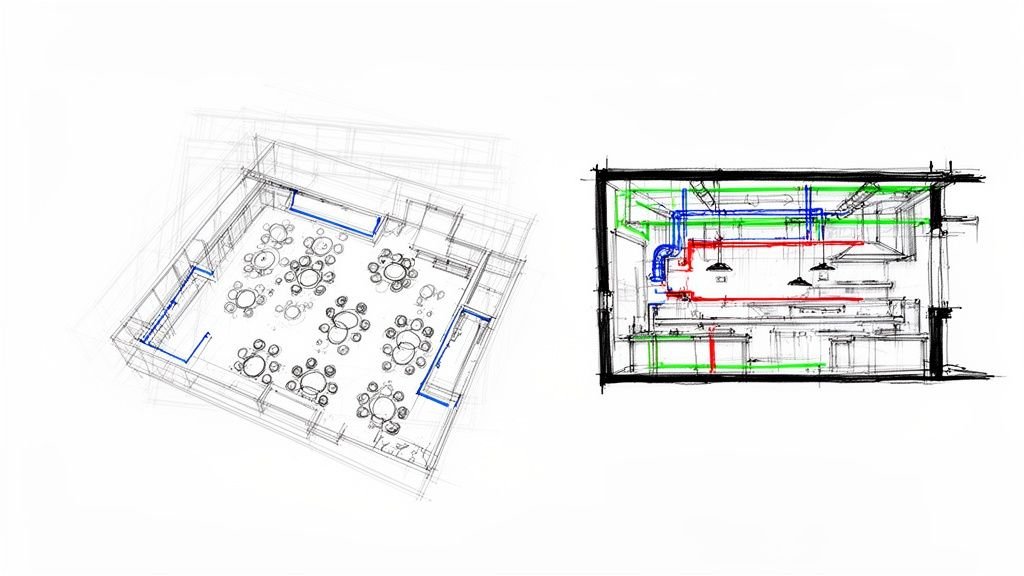
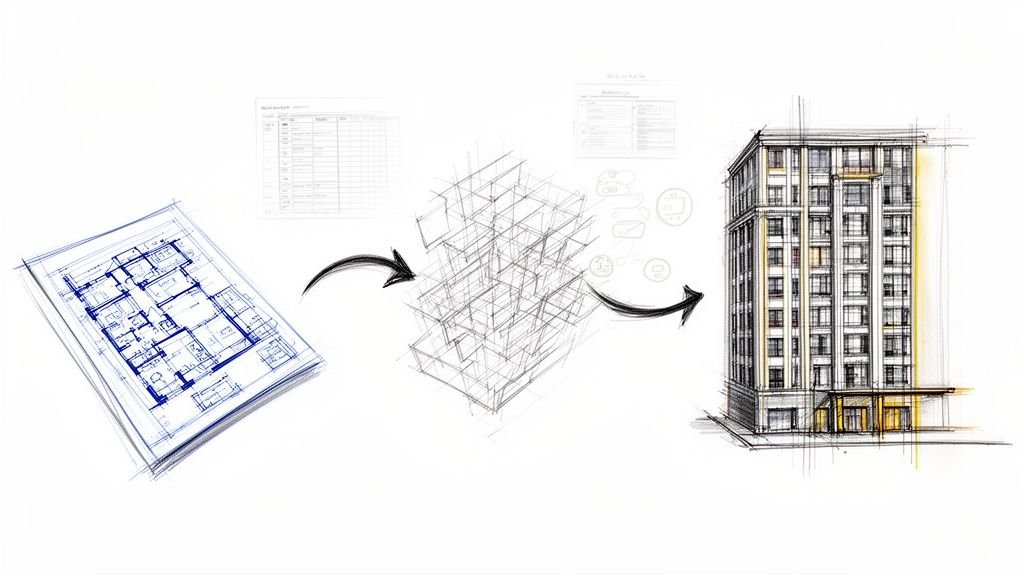
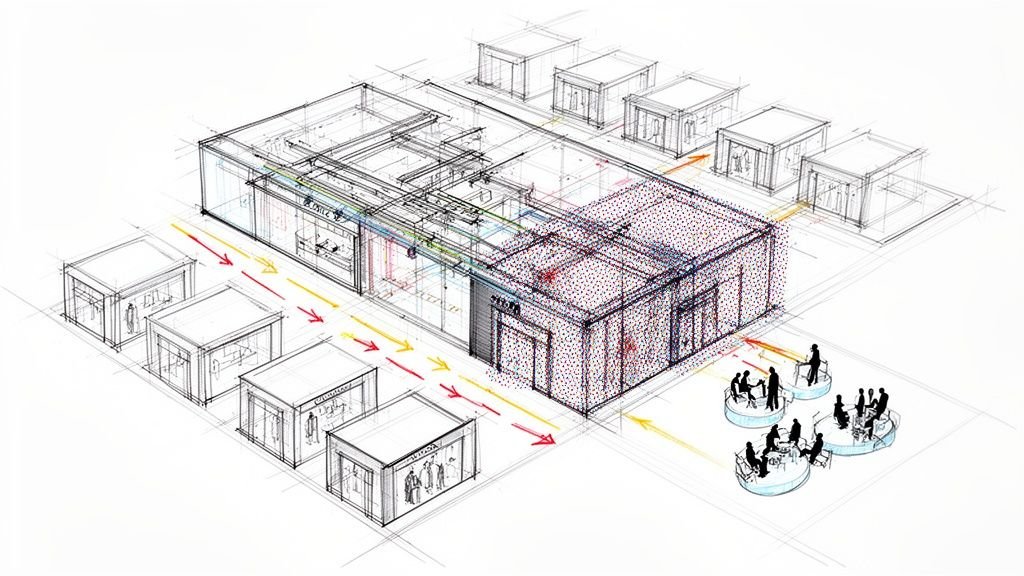
Plumbing never lives in a vacuum. Inside walls and ceilings, it’s a constant fight for space against structural beams and HVAC ductwork. This is where BIM workflows and clash detection shine, moving conflict resolution from the field to the digital model.
Coordination with Structure
- Beam Penetrations: You can sometimes drill through beams for small pipes, but there are strict rules. Assume a beam is off-limits until the structural engineer approves the penetration size and location.
- Post-Tensioned Slabs: This is a hard "no-go" zone. These slabs contain high-strength steel cables that absolutely cannot be cut. All sleeves must be perfectly coordinated before the concrete pour.
Coordination with HVAC and Fire Protection
Ceiling plenums are the most contested real estate in any building. There's a generally accepted pecking order:
- Gravity-Sloped Pipes: Sanitary and storm drainage lines get top priority due to their non-negotiable slope.
- Large HVAC Ducts: Main ducts are the next biggest occupants and are difficult to reroute.
- Pressurized Pipes and Conduits: Domestic water, fire sprinkler pipes, and electrical conduits are the most flexible and are typically woven around the larger systems.
This hierarchy is why plumbing coordination must happen early. It ensures the least flexible systems get the paths they need. This proactive collaboration is central to the success of integrated MEP design services.
Basic Plumbing Code Concepts
Plumbing codes like the IPC (International Plumbing Code) and UPC (Uniform Plumbing Code) exist to protect public health and safety. They govern everything from minimum fixture counts by occupancy to accessibility requirements (ADA). One core concept is the Fixture Unit (FU)—the "currency" of plumbing sizing. Instead of guessing how many fixtures will run at once, engineers sum the FUs on a pipe and use code tables to find the right diameter.
This probabilistic approach, established by foundational research a century ago, allows for realistic and less expensive pipe sizing. You can discover more about this foundational plumbing research and see how it continues to shape modern plumbing design. Without it, pipe sizes and costs would be significantly higher.
What Drives Plumbing Cost
- Pipe Material and Length: More pipe means more cost. Compact layouts save money.
- Vertical Alignment: Stacking wet cores is efficient. Offsetting them horizontally adds significant cost in piping and labor.
- Fixture Count and Type: More fixtures and specialized fixtures (e.g., wall-hung) increase cost.
- Coordination Complexity: Poorly coordinated projects lead to expensive field fixes and delays.
Questions Architects Should Ask Plumbing Engineers Early
To start a project on the right foot, ask your plumbing engineer these questions at the kickoff meeting:
- What chase sizes do you need and where do you prefer to locate vertical risers?
- What is the minimum ceiling depth you need for horizontal drainage runs?
- Are there fixtures that require special considerations, like floor drains or grease interceptors?
- What are our water heater location and type options?
- Are there any pressure concerns for upper floors that might require a booster pump?
- What underground rough-in is required before we pour the slab?
Glossary of Essential Plumbing Terms
- Backflow Preventer: A device that prevents contaminated water from flowing backward into the clean water supply.
- Branch: A horizontal pipe that connects one or more fixtures to a vertical riser or stack.
- Chase: A vertical shaft built to conceal plumbing, electrical, or mechanical pipes and ducts.
- Cleanout: An access point in a drainage pipe that allows blockages to be cleared.
- Fixture Unit (FU): A design value assigned to fixtures to represent their load on the plumbing system, used for sizing pipes.
- Main: A primary artery of the supply or drainage system, serving multiple branches.
- PRV (Pressure-Reducing Valve): A valve that reduces high incoming water pressure to a safe and functional level for the building.
- Riser: A vertical water supply pipe that extends one or more floors to carry water to fixture branches.
- Stack: A vertical drainage pipe that carries waste from upper floors down to the building drain.
- Trap: A U-shaped section of pipe located under a fixture that holds water to block sewer gas from entering the room.
- Vent: A pipe that allows air into the drainage system to equalize pressure and prevent siphoning of traps.
Plumbing design isn't mysterious—it follows logical principles. Architects and engineers who understand these fundamentals make better design decisions, collaborate more effectively, and avoid costly surprises. The goal isn't to become a plumbing engineer; it's to become an informed design partner.
At BIM Heroes, we know that clarity and solid processes are the foundation of predictable project delivery. If your team is running into MEP coordination challenges or just wants to build better BIM workflows, we have the experience and systems to help.
Download our free Plumbing Coordination Checklist for Architects