Every residential remodel starts with what seems like a simple task: measuring what’s already there. But when those initial numbers are wrong, the entire project is built on a shaky foundation. This leads to a cascade of costly errors, from custom cabinets that don't fit to designs that can't be built, ultimately blowing up schedules and erasing profit margins. A successful job doesn’t kick off with demolition—it begins with precise, systematic field documentation that captures reality, not just a few quick dimensions.
The True Cost of Inaccurate Remodel Measurements
Every remodeler has felt that gut-wrenching moment. The custom cabinets finally arrive, only to be two inches too wide for the wall. A kitchen design that looked flawless on paper hits a real-world obstacle because no one documented the slightly sloped ceiling. These aren't just frustrating hiccups; they are direct hits to your bottom line, your schedule, and your professional credibility. We've seen remodeling companies lose thousands on a single project because field measurements missed that the floor drops 2 inches across the kitchen—a condition that takes 30 seconds to document and costs days to fix when discovered during cabinet installation.
This is the expensive truth of a residential remodel: bad remodel measurements are the root cause of the most painful and preventable problems in the business.

Why Precision Prevents Pain and Protects Margins
The fallout from poor existing conditions documentation ripples through every phase of a project, turning what should be predictable work into a string of expensive emergencies. Inaccurate measurements directly cause:
- Design Rework: When CAD drawings don't align with reality, the design team is forced back to square one. This wastes valuable hours and stalls the project, eroding client confidence before a hammer is even swung.
- Material Ordering Errors: Ordering cabinets, countertops, or flooring based on bad data is a surefire way to burn cash. Materials that don't fit become expensive scrap, and reordering can add weeks to your timeline.
- Construction Delays: Discovering a bowed wall or an out-of-square corner during installation brings work to a screeching halt. The crew is left standing around while a fix is engineered on the fly, wrecking your production schedule.
- Profit Margin Erosion: Every return trip, rejected material order, and change order stemming from a measurement error eats directly into your profit. A job that looked great on paper can quickly become a break-even project or a loss.
- Loss of Client Confidence: Nothing kills trust faster than amateur mistakes. Explaining why the brand-new fridge won't fit through the doorway or why the tile layout is off because the floor isn't level is a conversation no professional ever wants to have.
The hour you invest in thorough field documentation saves days of design rework, estimating errors, and construction surprises. It's the single most effective risk management tool for protecting your margins.
To cut down on the errors baked into a residential remodel, modern builders are looking at advanced techniques like drone use in construction, which can help capture precise exterior and site data. But at its core, the foundation of a great project is a disciplined, ground-level approach to interior as-built documentation. The goal isn’t just to measure; it’s to see, document, and anticipate what’s coming.
Why Existing Homes Are So Challenging to Measure
Measuring an existing home for a residential remodel isn't just a different task than measuring for new construction—it's an entirely different discipline. A new build starts with a clean slate. You have a flat, predictable surface where walls are square and floors are level by design.
But an existing home? It has a history. It’s been lived in, shifted, settled, and tinkered with for decades. A simple tape measure reading can be dangerously misleading.

Here’s the core challenge: in an old house, nothing is ever truly square, level, or plumb. Houses settle. Foundations shift, joists sag, and walls bow. That kitchen wall you measure as 12'-6" on one end might be 12'-4 ½" on the other. That’s a massive problem when you’re ordering a tight run of cabinets and a new countertop.
The Unseen Complications in Existing Conditions
Behind the simple surfaces of drywall and flooring lies a history of modifications. Every previous remodel—whether done by a pro or a weekend warrior—adds another layer of unpredictability. You're not just documenting a space; you're an investigator uncovering its past.
This systematic approach is non-negotiable because you’ll inevitably run into hidden issues like:
- Decades of Settling: Gravity and time are not your friends. Floors slope, ceilings droop, and corners are almost never a perfect 90 degrees. These small deviations cause major headaches for anything that needs precision, like cabinetry or tile work.
- Layered Finishes: You’ll find walls with multiple layers of drywall over plaster and lath, changing the room's true dimensions. Floors can be just as bad, hiding old vinyl, tile, and subflooring that throw off your finished height calculations.
- Unknown Previous Remodels: You might discover a wall was moved without proper support, or plumbing was rerouted in a way that blocks your new design. This is where RFIs are born.
- Non-Standard Framing: Older homes are notorious for framing that doesn't follow modern codes or standard spacing. This complicates everything, from running new electrical to securely hanging cabinets.
Measuring an existing home isn’t just about pulling a tape. It’s about building a three-dimensional understanding of an imperfect space, anticipating where problems are hiding, and documenting reality so your design can actually be built.
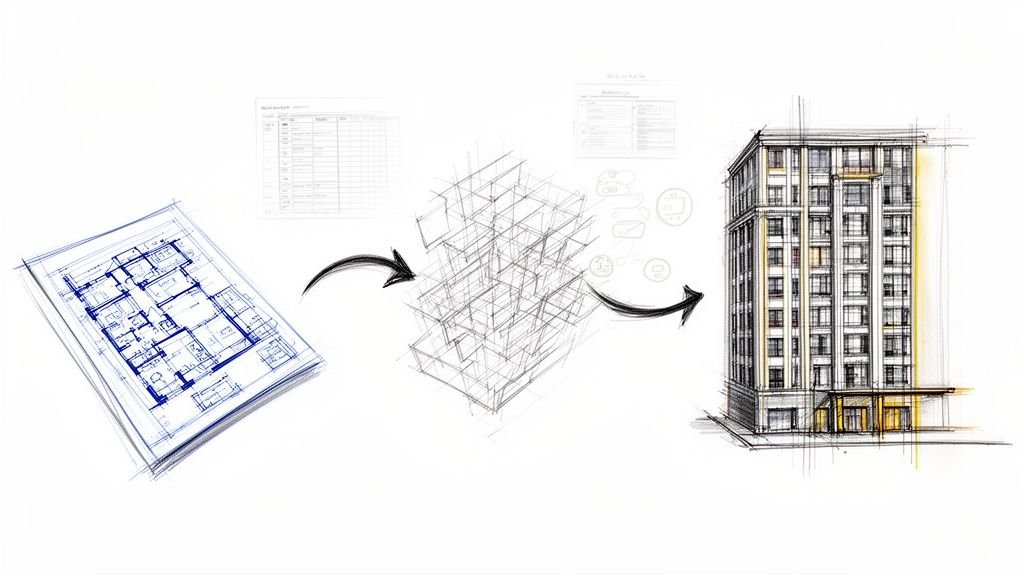
This is why solid existing conditions documentation is so important—it acknowledges these messy realities from day one. For complex projects, tools like 3D scanners are becoming a go-to for capturing this complexity, a topic we cover in our guide to the Scan-to-BIM process. The goal is to get past simple measurements and create a true model of the home—flaws and all.
Essential Equipment for Field Measurement
Getting your field documentation right isn't about expensive gear—it’s about having a solid kit you know how to use. A disciplined approach to your residential remodel measurements starts with the right tools, but it’s the systematic process that truly protects your margins and prevents costly rework.
We break it down into three buckets: tools for measuring, tools for documenting, and tools for investigating. This keeps you organized on-site and ready for whatever the house throws at you.
Core Measuring Tools
This is the bedrock of your field kit. Getting this part right saves you from a world of headaches.
- Tape Measure (35'): A 35-foot tape lets you measure most rooms in one shot, reducing addition errors. A wide blade with a strong standout is non-negotiable.
- Laser Distance Meter: Essential for quickly capturing overall dimensions, long runs, and ceiling heights. It's a key part of an efficient BIM workflow.
- 4-Foot Level: Your truth-teller. It’s the simplest way to find out if walls are plumb and floors are level, exposing the bows, dips, and slopes your design software assumes don’t exist.
- 6-Foot Folding Rule: Perfect for accurate inside dimensions where a tape measure can't get a good reading.
- Angle Finder: No corner in an old house is a perfect 90 degrees. An angle finder is critical for capturing the real-world conditions that make or break cabinet and countertop installs.
- Stud Finder: Essential for locating framing before design gets too far down the road.
Documentation & Investigation Tools
Measurements are useless if they aren't recorded clearly and backed up with visual proof.
- Documentation Tools: Clipboard with graph paper or field sheets, sharp pencils (not pens), colored pencils for MEP systems, and a smartphone or camera. Photos are not optional; they are essential.
- Investigation Tools: A bright flashlight or headlamp is as important as your tape measure. Add a small inspection mirror, an outlet tester, a non-contact voltage tester, and a moisture meter for any suspect conditions.
- Advanced Tools (When Needed): For complex jobs, a rotary laser level, a 3D scanner (like those from Leica), or a thermal imaging camera can be invaluable. This is where you evolve from CAD to BIM with high-fidelity data.
For a deeper dive into modern documentation methods, check out our guide to construction documentation.
A Systematic Workflow for Flawless Field Documentation
The most expensive mistakes in a residential remodel are born from chaos in the field. A rushed site visit, forgotten measurements, or sloppy notes create a domino effect of errors. The answer isn't to measure faster; it's to have a repeatable system that guarantees you capture everything needed for design, estimating, and construction—the first time.
This isn’t about gadgets—it's about production discipline. A systematic workflow for field documentation turns a chaotic task into a strategic process. The philosophy is simple: capture once, use many times. A complete and accurate set of field notes becomes a single source of truth for your designers, estimators, and production team, stamping out miscommunications that erode margins.

1. Before You Arrive (Preparation)
Success starts before you set foot on site. Preparation turns you from a simple measurer into an informed investigator.
- Review Available Information: Dig into tax records, old permit drawings, or any plans the client has.
- Prepare Field Sheets: Use project-specific templates (kitchen, bath, basement). Template discipline ensures you don't miss critical dimensions.
- Check Your Equipment: A dead battery in your laser measure can derail the entire visit. Do a full gear check.
2. Upon Arrival (Walkthrough)
When you arrive, fight the urge to start pulling a tape measure. The first ten minutes are for observation.
Walk the entire project space. Your goal is to build a mental map and identify obvious issues: a sagging ceiling, a cracked foundation, or an odd jog in a wall. Take overall context photos from each corner before you start. This initial survey is a vital decision checkpoint.
3. During the Visit (Measurement Sequence)
With a clear mental map, begin the core task of residential field measurement. A structured sequence is key.
- Work Large to Small: Capture overall dimensions first. These "control" measurements frame your detailed work.
- Proceed Room by Room: Tackle one room completely before moving on. This prevents you from forgetting details like window trim depths.
- Verify by Closing Loops: Dimensions must add up. The sum of individual wall segments must equal the overall wall length. If not, re-measure before moving on.
4. Before You Leave (Quality Control)
Before you pack up, perform a final QC check. This five-minute review can save a five-hour return trip.
Review your notes, sketches, and photos. Did you get every wall, the ceiling, the floor, and all MEP elements? Re-measure a few critical dimensions, like the wall where new cabinets will go. This is your last chance to catch an error. While taking notes on a computer can improve legibility, a disciplined review process is what guarantees accuracy.
This rigorous QA process is fundamental to producing precise as-built documentation. You can learn more about how this data is used in our guide on the reality capture process.
Critical Dimensions Commonly Missed
A profitable residential remodel is won in the details. The line between a smooth installation and a project-halting crisis often comes down to a few critical dimensions missed during that first site visit. This is a battle-tested list of the measurements that cause the most pain when you miss them.
Ceiling & Vertical Dimensions
- Ceiling Height Variations: Measure height in each corner and the center. A ceiling sloping 1.5 inches over a 12-foot cabinet run is a fatal flaw discovered only at installation.
- Soffit & Beam Dimensions: Document the height, width, and depth of every soffit and beam.
- Vertical Clearances: Note floor-to-sill height for windows, top-of-window to ceiling, and counter height to window sill.
Wall Conditions
- Out-of-Square Corners: Never assume 90 degrees. Measure diagonals in every room. If they don’t match, the room isn’t square.
- Bowed or Wavy Walls: Run a 4-foot level along walls planned for cabinetry or tile. A half-inch bow creates an ugly, unprofessional gap.
- Wall Thickness: In older homes, wall thickness varies. Note it wherever new doors or windows are planned.
Floor Conditions
- Floor Level Changes: Use a laser or long level to check for slope across the room, especially where cabinets or vanities will sit.
- Slope Direction & Amount: Document how much a floor slopes and in which direction. This is vital for kitchens and baths.
Window & Door Details
- Rough vs. Finished Opening: Always measure both.
- Trim Depth & Projection: This is a non-negotiable measurement. Thick window trim can project into planned countertop space, forcing a costly, on-site redesign.
- Header Heights: Document the height of headers above all openings.
The most expensive lesson in remodeling is learning that design software operates in a perfect world of square corners and level floors. Your job in the field is to document the imperfect reality so the design can be adapted to it.
Documenting MEP & Structural Systems
A residential remodel is won or lost in the details hidden behind the walls. Your field documentation is incomplete without a thorough accounting of the systems that make a house run: Mechanical, Electrical, and Plumbing (MEP), plus its core structure. Ignoring these is a fast track to expensive change orders and RFIs.
MEP Documentation
- Electrical: Document the panel location, clearances, and circuit labels. Measure the location of every outlet, switch, and fixture. Note their height from the floor and identify dedicated circuits.
- Plumbing: Mark the location of all visible supply and drain lines, especially the centerlines. Document shut-off valves, fixture rough-ins, and visible vent stacks. For a deeper look, see our guide on plumbing shop drawings.
- HVAC: Measure the location and size of all registers, returns, and the thermostat. In basements and attics, document the location and size of visible ductwork to prevent headroom conflicts.
Structural Documentation
You don’t have to be an engineer, but your as-built documentation must include observations of the visible structure to spot red flags.
- Visible Framing: In basements or attics, note the direction, spacing, and size of exposed joists or rafters.
- Load Path: Document the location and size of all visible beams, headers, and support columns. Try to understand the load path.
- Red Flags: Photograph and note any sagging floors, significant cracks in foundation walls, or previously cut joists. This is crucial information for permitting prep and deciding when to bring in an engineer.
A core tenet of production maturity is anticipating the needs of every trade. Your MEP and structural documentation is the playbook that prevents your plumber, electrician, and framer from showing up to a site with unbuildable plans.
Common Measurement Errors and How to Prevent Them
Even with a good system, errors happen. Here are the most common mistakes and how to prevent them.
- Reading Tape Measures Incorrectly: Fractional errors are common. Prevention: Double-read critical dimensions out loud.
- Inconsistent Reference Points: Measuring to the finish in one spot and the rough framing in another. Prevention: Be explicit in your notes (e.g., "to finish," "to stud").
- Forgetting Vertical Dimensions: Missing the counter-to-sill height is a classic mistake. Prevention: Use a vertical dimensions checklist for every room.
- Assuming Square, Level, or Plumb: Most existing homes are none of the above. Prevention: Verify, don’t assume. Use your level and check diagonals.
- Illegible Field Notes: Rushed handwriting and unclear dimension lines cause confusion back at the office. Prevention: Review and clean up notes before leaving the site.
From Field to Drawings: The Final Step
The jump from field notes to clean CAD or BIM drawings is where many errors occur. The secret is to process your notes immediately—ideally the same day—while the site is fresh in your mind.
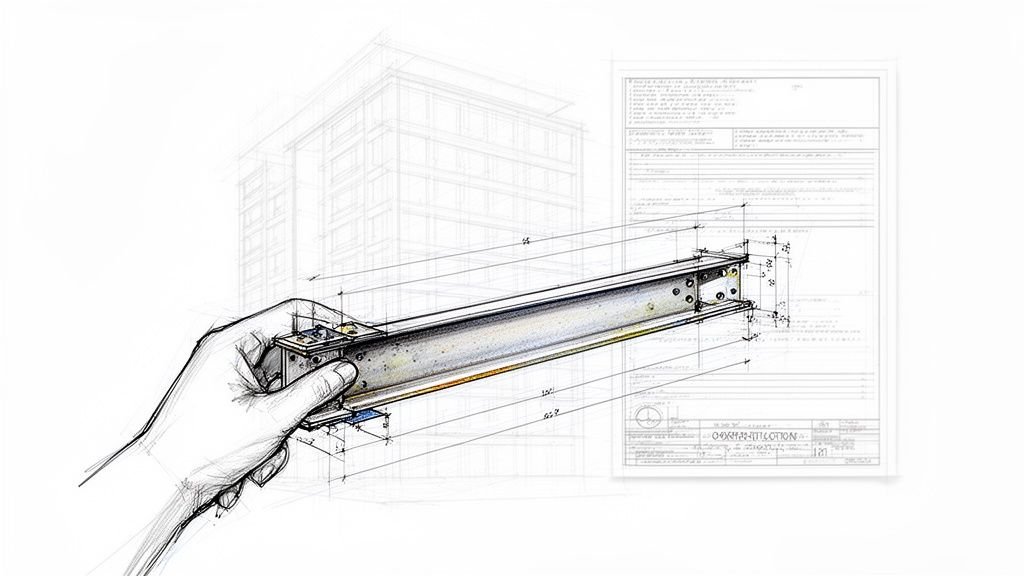
Start by drawing the main control dimensions to establish the overall shell. From there, fill in the details, working room by room. Most importantly, your drawings must reflect reality. If a wall is bowed or a room is out-of-square, draw it that way and call it out with diagonal dimensions and notes. Link your field photos to clarify tricky conditions. The goal is to create as-built documentation that tells the whole story, so your design and construction teams can build with confidence and predictability.
For specific project types, a checklist is your best defense. A kitchen remodel needs different details than a basement finish. For example, in a kitchen, you must capture trim depth at windows, while in a basement, minimum ceiling height under ductwork is the critical dimension. A detailed plan for a bathroom remodel planning project will have its own unique set of non-negotiable measurements.
Accurate field documentation is more than a task—it's a system that protects your margins, builds client confidence, and delivers predictable outcomes. If your team is constantly battling rework from bad field data, it’s time for a better process.
Download our Field Documentation Master Checklist to start implementing these production-focused workflows on your next residential remodel.