Meta description: Learn the shop drawing submittal process from the reviewer’s side. See why shop drawings get returned, what reviewers check, and how to structure submittals for faster first review approval.
A subcontractor submits shop drawings on time. The product matches the spec. Fabrication logic is solid. Two weeks later, the package comes back marked Revise and Resubmit.
That outcome frustrates people because it feels like a rejection of the trade work. Often it is not. The issue is that the submission did not give the reviewer enough information to confirm conformance to the contract documents without doing extra detective work.
That is the heart of the shop drawing submittal process. Reviewers do not approve confidence. They approve documented conformance.
If you want better shop drawing approval rates, the goal is simple. Reduce reviewer effort. Give the architect, engineer, and GC a package that answers the installation question, the coordination question, and the contract question in one pass.
Why Your Perfect Fabrication Still Gets Rejected
A common pattern looks like this. The shop drawings show the fabricated item well. The welds are identified. The profiles are right. The dimensions needed by the shop are there. But the set does not clearly show how the item ties back to the design drawings, where the adjacent trade interface lands, or whether the submitted product is exactly what the specification called for.

That is why a technically correct package still fails the first review. The reviewer is not looking only at whether your piece can be made. They are looking at whether your submittal proves it belongs in this project, at this location, under this contract.
If your team needs a quick refresher on what counts as a shop drawing versus other submittals, this explanation of shop drawings meaning is a useful baseline.
The issue is usually proof, not product
A returned submittal often contains comments that feel administrative.
- Missing references: The reviewer cannot tell which detail, plan note, or spec section the sheet is answering.
- Missing fit information: The product is drawn, but the installation condition is not.
- Missing coordination evidence: The submittal assumes surrounding work is compatible instead of showing it.
- Missing revision clarity: The reviewer cannot quickly see what changed since the last package.
Those comments are not minor. They stop review.
A submittal gets approved faster when it answers the reviewer’s next question before they have to ask it.
What this means in practice
The fabrication may be fine. The submission was not decision-ready.
That distinction matters because it changes how you improve. Better first-review approval does not start with drawing more beautifully. It starts with assembling a package that is easier to verify than to reject.
The Reviewer’s Mindset What They Check
Shop drawings have been treated as a formal review item for a long time. The requirement was codified in the AIA A201 General Conditions in the 1915 edition, which established shop drawings as submittals prepared by the contractor or subcontractor, distinct from the original contract documents and subject to review by architects and engineers, as outlined in this CSI discussion of shop drawings and submittals.
That history still matters because it defines the reviewer’s role. The reviewer is not redesigning your work. The reviewer is checking whether your submission demonstrates conformance.
Review starts with the contract, not your drawing
When a reviewer opens a submittal, the first question is rarely, “Is this manufacturer good?” It is usually, “What contract requirement is this package responding to?”
They check against:
- the relevant specification section
- the contract drawing detail or keyed note
- code-related requirements shown in the design set
- known adjacent conditions that affect fit, support, or access
- prior RFIs, ASIs, sketches, or accepted changes if they exist
If your package does not clearly point to those references, the reviewer has to do the cross-checking for you. That slows review and increases the chance of a return.
What forces a hold
A reviewer can work through a lot of complexity. What they cannot work through is ambiguity that shifts risk back to them.
The biggest triggers are usually these:
| Reviewer sees | Reviewer thinks | Likely result |
|---|---|---|
| No spec reference | I cannot confirm basis of review | Hold or return |
| Product shown without field relationship | I cannot verify fit or installation | Return |
| Unflagged deviation | I may be accepting a substitution by accident | Return |
| Missing contractor review marks | The upstream quality check may not have happened | Delay |
| Incomplete revision trail | I cannot tell what changed | Slower review |
Missing information is treated like wrong information
This is the part many subs underestimate. If a dimension is absent, the reviewer cannot assume it works. If a clearance is not shown, the reviewer cannot treat it as compliant. If support conditions are implied but not documented, the reviewer cannot certify them by inference.
That is why shop drawing review can feel strict even when the product itself is fine. The review is a decision process. Missing information blocks the decision.
Reviewers do not reject because they enjoy comments. They reject when the package leaves them carrying a risk they are not supposed to carry.
Common Reasons for First-Review Rejection
Most rejected packages are not failing for exotic reasons. They fail on repeatable patterns. A Billd analysis says inadequate shop drawings are a primary cause of 15-25% of all field rework in construction, costing U.S. firms an estimated $177 billion in 2022, according to Billd’s review of shop drawing issues. That cost starts long before the field. It starts in weak submissions.

Weak ties to the contract documents
A lot of submittals show the item well but do a poor job showing exactly where that item sits in the contract.
That happens when the sheet omits the spec section, omits the design drawing reference, or uses internal naming that does not match the construction documents. The reviewer now has to figure out whether your “Type B frame” is the same thing the architect called out elsewhere.
If the reviewer cannot trace the line from contract requirement to proposed fabrication, they stop. They should.
Dimensions that work in the shop, not in the field
Many rejected shop drawings answer fabrication questions but not installation questions.
A solid fabrication set might include cut lengths, member sizes, hardware, and joinery logic. But the first review often hinges on different information:
- field dimensions
- interface dimensions to adjacent work
- maintenance or access clearances
- support and anchorage locations
- offsets from gridlines, slab edges, or wall faces
When those are missing, the reviewer cannot verify fit. They cannot approve an assumption that belongs to the submitting team.
Unflagged substitutions
This one burns time because it damages trust.
If the contract calls for one product, finish, gauge, profile, or assembly basis and the submittal shows another, the reviewer now has to investigate intent. Even if the proposed item is acceptable, the fact that the deviation was not clearly identified creates a process problem.
A straightforward deviation log would have saved the whole cycle.
Partial coordination with other trades
Coordination gaps often appear in places where each trade believes someone else has already solved it.
Common examples include:
- embeds or supports not confirmed with structural
- access panels not reconciled with ceilings
- MEP routing not shown against framing or soffits
- equipment clearances missing at doors, valves, or service zones
- finish tolerances not aligned with adjacent millwork or glazing
These are not drafting niceties. They affect whether the submitted work can be installed as shown.
A reviewer is much more likely to return a package that says “by others” in critical interface locations without showing who verified those others.
Administrative errors that stall the package before technical review
A lot of delay happens before the architect or engineer even studies the sheets.
Wrong revision numbers, inconsistent sheet indexes, incomplete transmittals, or missing submittal log references create confusion immediately. If the title block says one revision and the transmittal says another, the reviewer has to stop and verify what they are even reviewing.
That is why shop drawing requirements include administrative discipline, not just technical detail. Sloppy packaging signals sloppy verification.
Anatomy of a First-Review-Ready Submittal
A strong package does not make the reviewer hunt. It guides the review.
The contractual standard is clear. Shop drawings must establish the detail of fabricated items, show their relationship to adjacent construction, include complete title blocks, and be stamped by the contractor so the package is traceable and aligned with the specs and contract drawings before design-team review, as shown in these Western Water submittal requirements.
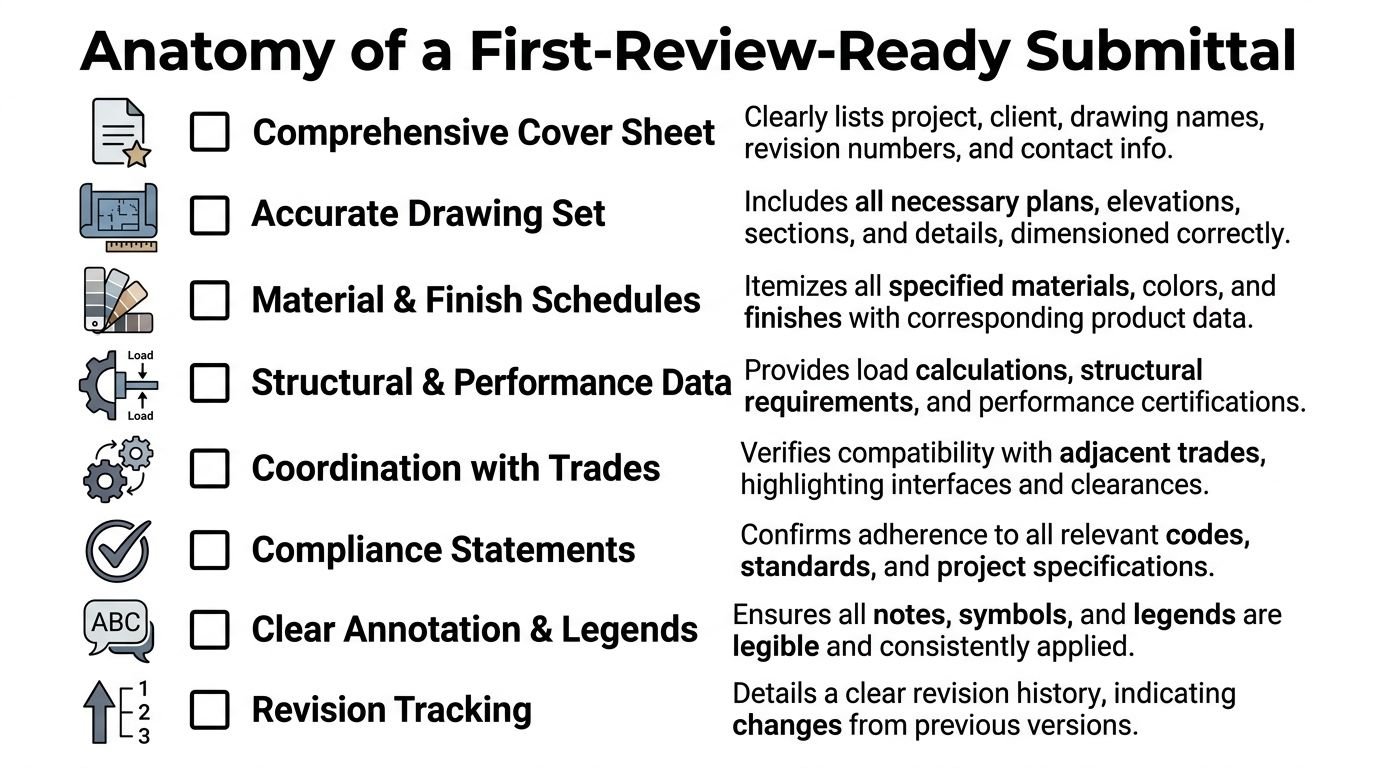
If you want a visual reference for what a coordinated set can look like, this shop drawing example helps frame the level of completeness reviewers expect.
Start with a cover sheet that does real work
A cover sheet should do more than identify the project.
It should tell the reviewer, in seconds:
- what scope is included in the package
- what spec section this package addresses
- which drawing numbers and details are relevant
- whether this is an initial submission or a revision
- what changed since the last version
- whether any deviations or substitutions are included
A weak cover sheet says “Metal stairs shop drawings.” A strong one says exactly which stairs, what basis of design, which contract references, and whether the package includes changes from prior comments.
Put contract references on the sheets, not only in the transmittal
A frequent mistake is hiding critical references in the submittal form while the sheets stay generic.
Reviewers spend their time inside the drawing set. Each sheet should make its basis of review obvious. If a detail responds to A5.2/Detail 6 and Section 05 50 00, put that on the sheet. If a guard attachment reflects a revised sketch, identify that clearly.
That single habit improves the submittal process construction teams rely on because it removes avoidable cross-checking.
Draw the installation condition, not only the fabricated object
Including the installation condition makes many submissions first-review-ready.
Include dimensions that answer these questions:
- Where does it land in plan and elevation?
- What is the offset from fixed project geometry?
- What are the required clearances?
- How does it attach?
- What adjacent material or assembly is it bearing on, penetrating, or aligning to?
- What field verification was required before final sizing?
That may mean adding enlarged sections, interface details, anchorage diagrams, or notes that identify field-measure hold points.
Show coordination deliberately
Do not rely on “coordination by installer” if the interface can be documented now.
A reviewer gains confidence when the set clearly shows adjacent conditions. In practical terms, that may mean:
| Interface | What to show |
|---|---|
| Structural support | Base material, embed condition, anchor type, attachment location |
| MEP adjacency | Clearance zone, access swing, service space, penetration relationship |
| Architectural finish | Face alignment, reveal, joint condition, termination, tolerance relationship |
| Life safety element | Rated assembly relationship, required clear opening, hardware conflict check |
The point is not to redraft everyone else’s trade. The point is to show the interface well enough that the reviewer sees the coordination happened.
Flag deviations before the reviewer discovers them
If you are proposing a different finish, profile, fastening method, manufacturer, or performance path, state it plainly.
A short deviation log is enough if it is clear:
- Reference the contract requirement
- State the proposed deviation
- Explain why the change is being proposed
- Identify whether separate approval is required
- Show where the change appears in the sheet set
This is one of the simplest ways to improve first review approval. Reviewers are more receptive to transparent deviations than hidden ones.
If something differs from the contract documents, put it on page one. Do not make the reviewer discover it on sheet six.
Make the contractor stamp mean something
Reviewers can usually tell when the GC or CM reviewed the package and when they only routed it.
A meaningful contractor review catches basics before the design team ever sees them. That includes scope alignment, schedule fit, interface conflicts, and whether the submitted item belongs in the project at that stage.
For the subcontractor, this means your package should be organized for upstream review too. Do not send a pile of PDFs with vague filenames and expect efficient routing.
Revision tracking has to be visible
When you resubmit, the revised package should be easy to compare.
Best practice is simple:
- cloud the changes on sheets where practical
- update revision dates consistently
- keep the revision description specific
- retain prior context so comments can be traced
- resubmit a full set, not isolated pages without context
A reviewer should never need to compare folder names to guess what changed.
The General Contractor’s Role in Submittal Quality
Many subcontractors treat the GC review as paperwork. That is a mistake.
The GC is the last serious quality filter before the design team sees the package. If the GC review is meaningful, it catches coordination gaps, sequence issues, and administrative misses that would otherwise come back as reviewer comments.
Why the GC review matters to you
The GC sees the broader project map in a way no single trade does. They know which related submittals are still pending, which field areas are constrained, and which interfaces are already causing friction.
That makes the GC review useful, not redundant.
When coordinated shop drawings are generated digitally, often from BIM at LOD 350-400, projects can see a 20-30% reduction in field errors because clashes are addressed during GC and design-team review before fabrication, as reflected in the federal context around shop drawing submissions in FAR 52.236-21.
If your team works in model-based coordination, this is also where a lot of value from shop drawings for construction becomes real. The package is not just documentation. It becomes a coordination checkpoint.
What a useful GC review catches
A strong GC review usually catches things like:
- scope mismatch between submitted work and bid package
- missing related submittals that affect approval
- unsupported assumptions about existing or field conditions
- sequencing conflicts with structure, envelope, or MEP
- incomplete identification of delegated or deferred design items
Those are exactly the items that consume review time later if they are not filtered early.
How to help the GC help you
Subcontractors can improve the GC review without adding bureaucracy.
Send a package that is easy to route and easy to understand:
- Use consistent file names: Match submittal log naming where possible.
- State pending dependencies: If approval depends on another trade, say so.
- Call out field verification holds: Do not bury them in fine print.
- Separate deviations clearly: Avoid mixing standard compliance and proposed changes on the same note line.
- Make scope boundaries visible: Show what is in your package and what is not.
A GC review should not feel like a gatekeeper slowing you down. It should feel like a pressure test that catches what would cost you more later.
How Submittal Timing and Sequence Affect Approval
A good package submitted at the wrong time can still stall.
Reviewers do not evaluate submittals in a vacuum. They review them in the context of other pending decisions, incomplete backgrounds, and related work that has to line up.
Early is not always helpful
Submitting early sounds responsible. Sometimes it is. Sometimes it just creates an impossible review condition.
If your steel connection package arrives before the supporting concrete information is settled, the reviewer cannot confirm the attachment logic. If your millwork set depends on final field dimensions that do not exist yet, the package is premature. If your diffuser layout arrives before reflected ceiling coordination is mature, review comments are almost guaranteed.
The issue is not the quality of the sheet. The issue is sequence.
Reviewers look for readiness, not eagerness
A submittal is reviewable when the information around it is mature enough to support a decision.
That usually means the package should align with:
- issued contract backgrounds relevant to your scope
- related trade decisions that affect fit or support
- any required RFIs already resolved
- field verification milestones that lock dimensions
- procurement deadlines that still leave revision time
A rushed package often creates a false start. It enters the log, accumulates comments, and then has to be reissued after upstream conditions change.
The best submission date is not the earliest date. It is the earliest date when the reviewer can approve what you drew.
Sequence protects the approval path
Think of the shop drawing submittal process as part of production planning. A good sequence reduces circular review.
For example, if your package depends on another approved condition, state that relationship openly. It gives the GC and reviewer a chance to route the package sensibly instead of returning it for a problem everyone could see coming.
What to Do When a Submittal Comes Back with Comments
A returned submittal is not a signal to argue first. It is a signal to process carefully.
Discrepancies between shop drawings and contract documents are a frequent source of conflict, and standards such as ConsensusDocs 200 §3.14.1 often place shop drawings lower in the order of precedence, leaving contractors responsible for verifying field conditions. The 2018 Salesforce Transit Center failure is often discussed in that context because a shop drawing note led to unapproved holes and fractures, as described in this Eng-Tips discussion on shop drawing discrepancies.
That is the practical backdrop for resubmittals. You need to respond in a way that closes risk, not in a way that defends pride.
Read all comments before acting on any of them
Review comments are often interconnected.
One note may ask for revised support information. Another may ask for added dimensions at the same location. If you start addressing comments one by one without understanding the whole pattern, you can miss the root issue and create another review cycle.
Print them. Mark them up. Discuss them internally. Then assign action.
Respond specifically, not generally
A weak response says, “Comments incorporated.”
A useful response maps each comment to a direct answer:
| Reviewer comment | Good response approach |
|---|---|
| Show clearance at adjacent duct | Add clearance dimension on plan and section, identify revised sheet and detail |
| Confirm spec compliance for finish | State submitted finish, reference spec requirement, identify whether deviation remains |
| Verify field condition before fabrication | Add note defining hold for field measure and revise schedule status accordingly |
That approach helps the reviewer see closure quickly.
Ask when a comment is unclear
Do not guess at reviewer intent if the note is ambiguous.
A short clarification request can save a full cycle. Keep it precise. Reference the exact sheet, detail, and comment number. State what you think the reviewer is asking, then ask for confirmation.
That is far better than resubmitting a package that solves the wrong problem.
Put revision history on the drawings
Do not rely only on the transmittal to explain changes.
The drawing set itself should tell the story. Revision marks, notes, clouds where appropriate, and updated detail references all reduce reviewer effort. A resubmittal should be easier to review than the original because the changes are now concentrated and visible.
Resubmit the full package
Sending only revised sheets may feel efficient. It often creates confusion.
A full package gives the reviewer context. It lets them verify that your fix in one location did not create a conflict elsewhere. It also keeps the project record cleaner.
The fastest way through a resubmittal is to make the new package easier to audit than the old one.
Conclusion Building Confidence Not Just Components
A submittal can show the right product, the right dimensions, and clean fabrication details, and still stall at first review. The usual reason is simple. The package does not give the reviewer enough confidence to approve it without carrying hidden risk.
First-review approval depends on reviewer confidence, not just the right product. Reviewers are checking whether the work matches the contract documents, fits verified field conditions, and coordinates with adjacent scopes. If they have to chase references, infer intent, or guess whether a conflict was resolved, they will hold the package.
That is the standard to build to. Make it easy to confirm scope, compliance, coordination, and changes in one pass.
Teams that treat shop drawings as a review tool, not just a fabrication record, get fewer avoidable rejections. They protect schedule, reduce back-and-forth, and spend less time reworking packages that were technically correct but poorly presented.
If you want tighter production systems around submittals, coordination, and drawing quality, BIM Heroes shares practical resources on BIM workflows, shop drawings, and documentation standards that help teams build repeatable review-ready packages.