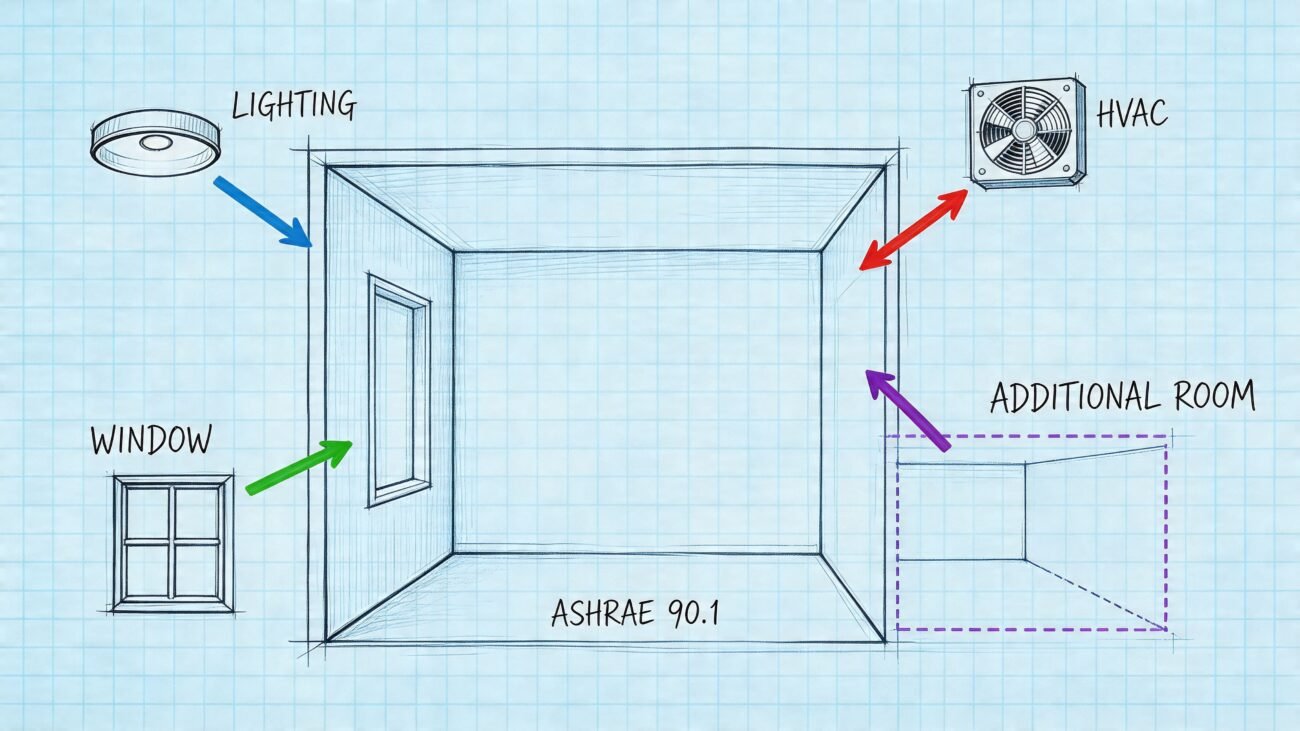
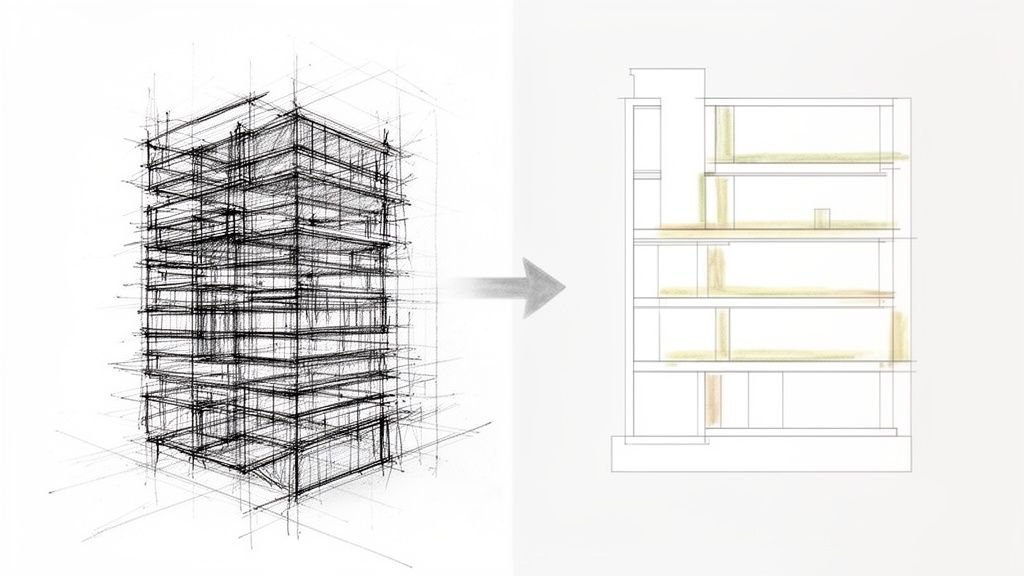
Meta description: A practical guide to Title 24 compliance California teams can use to avoid permit rejection, drawing mismatches, missing forms, and late-stage energy code rework.
A California permit set can look complete, include an energy report, and still get kicked back before anyone touches the site.
Usually the rejection notice doesn’t say the building is flawed at its foundation. It says the documentation doesn’t line up. The compliance report used one climate zone. The plans imply another. The mechanical sheets show equipment that doesn’t match the modeled system. Mandatory measures exist in the report, but not where the reviewer expects to see them in the set.
That’s the part out-of-state teams often miss about title 24 california work. The failure usually isn’t lack of code awareness. It’s lack of production discipline.
When teams treat Title 24 as a separate consultant deliverable instead of a coordinated permit package, they create gaps the AHJ can spot in minutes. Those gaps trigger comments, resubmittals, and avoidable RFIs long before construction starts. If you’ve dealt with a California Title 24 permit rejection, you already know the pain isn’t just technical. It hits schedule, fee, and team confidence.
The Permit Rejection Notice No One Saw Coming
The familiar version goes like this.
A team submits a permit package believing the Title 24 work is covered. The architectural sheets are issued. Mechanical schedules are in place. The energy consultant has produced the compliance documentation. Everyone assumes the package tells one coherent story.
Then plan check comes back with a short list of comments that creates a long delay.
The reviewer flags a mismatch between fenestration values in the report and the window schedule. The compliance forms reference a project address formatted differently from the permit application. A required mandatory measure is buried in the report but missing from the correct plan sheet. Nothing feels catastrophic on its own. Together, it stops the job.
That’s why Title 24 energy compliance feels frustrating to teams new to California. The project may comply. The submittal just doesn’t prove it cleanly enough for a reviewer to approve without questions.
Most permit rejections tied to Title 24 aren’t design failures. They’re documentation failures that expose a weak handoff between disciplines.
On well-run projects, somebody owns that handoff. On rushed projects, everyone assumes someone else owns it.
The cost isn’t only time. It’s redraw effort, consultant churn, updated forms, and an internal scramble to determine which document is now the source of truth. By the time the corrected package goes back out, the team has already burned margin on work that should have been caught in pre-submission QA.
That’s the practical lens for Title 24 compliance California teams need. This is less about memorizing code language and more about submitting a package that can survive plan check without forcing the AHJ to reconcile contradictions for you.
What Plan Checkers Actually Look For in Title 24 Submissions
Plan checkers aren’t reading the energy report as a stand-alone artifact. They’re checking whether the report can be traced to the permitted drawings without ambiguity.
California’s Title 24, Part 6 is widely treated as the country’s toughest building energy code, first implemented in 1978 and updated on a three-year cycle across 16 climate zones, applying to new construction, additions, and alterations for all building types, as outlined in this overview of California Title 24 Part 6. That complexity is exactly why traceability matters.
They want one story, not three partial ones
A clean submission lets a reviewer move from report to drawing to schedule without second-guessing what the design team intended.
That means the plan checker is looking for things like:
- Climate zone alignment: The address, jurisdiction, and compliance assumptions need to point to the same zone.
- Envelope consistency: Window U-factors, SHGC values, roof descriptions, insulation notes, and assembly callouts need to match the compliance inputs.
- System consistency: HVAC equipment on schedules should be the same equipment or same performance basis used in the compliance documentation.
- Mandatory measures on the right sheets: If a requirement must appear on the plans, it can’t live only in a consultant appendix.
If your process for energy code compliance depends on a reviewer “understanding what you meant,” you’re already exposed.
Traceability beats volume
A thicker permit package doesn’t help if it’s internally inconsistent.
I’ve seen teams submit more notes, more attachments, and more backup in response to Title 24 confusion. That usually makes things worse. Reviewers don’t reward document bulk. They reward document clarity.
A good package answers basic questions fast:
| Reviewer question | What they expect to find |
|---|---|
| Which climate zone governs this project? | Clear, consistent identification tied to the project address |
| What fenestration values were modeled? | Matching values in report, schedules, and details |
| What system was used for compliance? | Same basis in MEP schedules and energy documentation |
| Where are mandatory measures shown? | On the actual permit sheets, not only in backup |
Practical rule: If a junior coordinator can’t cross-check the report against the plans in one sitting, the reviewer probably can’t either.
The submission has to be reviewable
That’s the hidden standard behind many California building permit requirements. It’s not enough that the project team knows the building complies. The permit set has to make compliance reviewable, quickly and with minimal interpretation.
That’s why teams get tripped up by small inconsistencies. The issue isn’t only whether an item is wrong. The issue is whether the inconsistency forces the reviewer to stop and ask for clarification.
Once that happens, the permit clock starts stretching.
The Most Common Title 24 Permit Rejection Triggers
Most rejections follow a handful of repeat patterns. Different project types, different jurisdictions, same production mistakes.
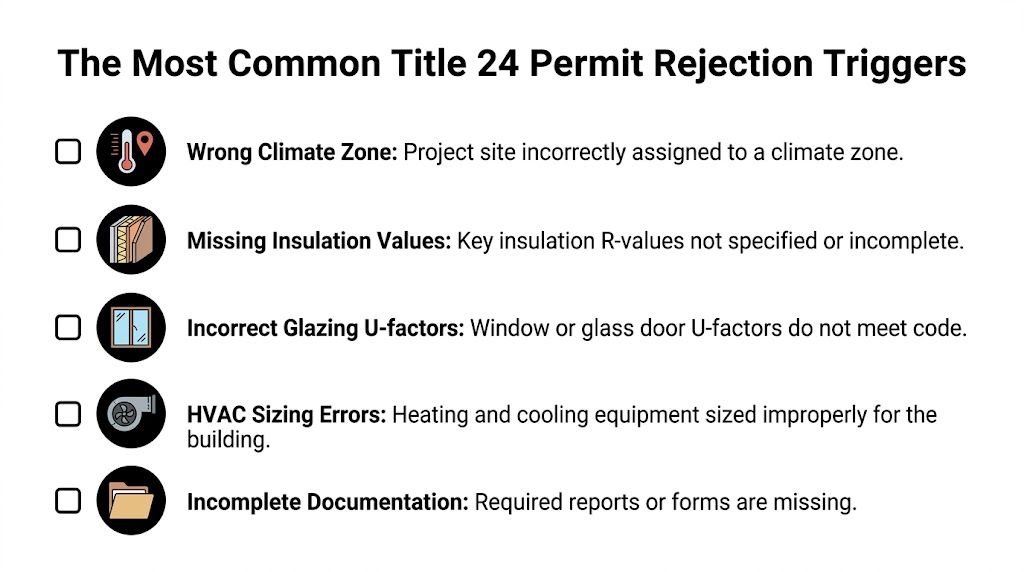
If your team produces permit drawings, these are the failure modes worth checking before anything leaves the office.
Wrong climate zone
California uses 16 climate zones under Title 24. A wrong zone can undermine the validity of the whole compliance package because the assumptions behind envelope, glazing, lighting, and mechanical requirements change by location.
This usually happens in one of three ways:
- The modeler uses the nearest familiar city instead of the actual project address.
- The architect starts with an old project template tied to a different zone.
- A project near a boundary gets carried forward with an unchecked early assumption.
Symptom: The compliance report looks polished, but the governing zone doesn’t fit the project address.
Cause: No one treated climate zone confirmation as a formal checkpoint.
Fix: Verify the zone from the address before modeling and again before permit issue. Don’t rely on memory, office lore, or whatever zone the last similar project used.
A wrong climate zone isn’t a minor typo. It tells the AHJ the entire compliance basis may be off.
The compliance report doesn’t match the drawings
This is the biggest one in practice.
The energy consultant models one version of the building. The permit set shows another. The difference may be small to the design team, but to plan check it looks like the package is unreliable.
Common mismatch areas include:
- Window schedules with different U-factors or SHGC values than the report
- Envelope notes that changed after design development
- Equipment schedules that reflect substituted units not carried into the compliance run
- Lighting layouts that moved, but the power assumptions didn’t
- Roof assemblies revised in the architectural set after energy review
A plan checker will compare. If those documents tell different stories, comments follow.
Mandatory measures aren’t shown on the plans
One of the easiest mistakes to make is assuming that if a requirement appears in the energy documentation, that’s enough.
It often isn’t.
Certain mandatory measures need to appear on the permit drawings where reviewers and inspectors expect to see them. A specific example is the HVAC Fan Energy Index requirement in the 2025 Energy Code. Fans over 1 hp must meet an FEI of at least 1.0 for constant volume systems and 0.95 for variable volume systems, and cool-roof provisions can require an SRI of 75 for low-sloped roofs in climate zones 2, 4, and 6-15, with those cool-roof measures capable of reducing peak cooling loads by 15% to 25%, according to this Title 24 compliance summary covering FEI and cool-roof requirements.
The practical permit lesson is simpler than the code language. If those specifications don’t show up clearly on the MEP or architectural sheets, the reviewer can tag the package as incomplete.
Residential and nonresidential path confusion
Mixed-use and edge-case project types create headaches because teams often think in terms of building form while the compliance path turns on occupancy and scope.
That confusion shows up on:
- live-work projects
- tenant improvements inside mixed-use buildings
- multifamily work with accessory spaces
- ADUs on unusual sites
- additions and alterations where the team assumes the base building logic controls everything
Symptom: The wrong forms, wrong assumptions, or wrong mandatory measures are applied.
Cause: Nobody paused early to define which compliance path governs each portion of the project.
Fix: Set the path at project kickoff and confirm it again when the permit sheet index and consultant scopes are finalized.
CF forms are missing, incomplete, or inconsistent
Even when the design is sound, the forms can sink the submittal.
Reviewers regularly catch things like:
- unsigned forms
- forms with project addresses that don’t exactly match the application
- form sets that don’t align with the current drawing issue
- missing attachments or certifications
- consultant-generated forms based on outdated backgrounds
This is pure production work. It’s not glamorous, but it’s where many Title 24 documentation failures happen.
A disciplined team treats forms like contract documents, not admin leftovers.
Solar and EV provisions are unaddressed or only half-addressed
Recent code cycles have pushed teams to pay much closer attention to solar, battery, electrification, and EV-related provisions. The problem at permit is often not that these issues were ignored completely. It’s that they were handled in one part of the package but not another.
That means:
- notes in the report without matching plan references
- roof layouts that don’t coordinate with required clear areas or obstructions
- electrical provisions noted generally but not shown in a permit-ready way
- assumptions about exemptions that aren’t documented clearly
A quick field table for pre-check
| Trigger | What the reviewer sees | What your team should check |
|---|---|---|
| Wrong climate zone | Compliance basis may be invalid | Confirm zone from project address |
| Report-drawing mismatch | Package is unreliable | Cross-check schedules, notes, and modeled inputs |
| Missing mandatory measures | Incomplete permit set | Put requirements on the correct permit sheets |
| Wrong compliance path | Forms and rules don’t fit scope | Confirm occupancy and scope early |
| Incomplete forms | Admin and legal gaps | Review signatures, addresses, dates, and issue status |
| Solar or EV gaps | Incomplete code response | Coordinate report assumptions with drawings |
Some permit rejections look technical on paper, but they come from basic coordination misses. The teams that avoid them don’t always know more code. They usually run a tighter review process.
Why Your Drawings and Energy Reports Never Seem to Match
The mismatch problem usually starts long before permit.
Architects are developing layouts. MEP engineers are sizing systems. An energy consultant is often working from a snapshot in time. Then the design evolves, as it always does, and nobody fully rebuilds the compliance package around the revised set.
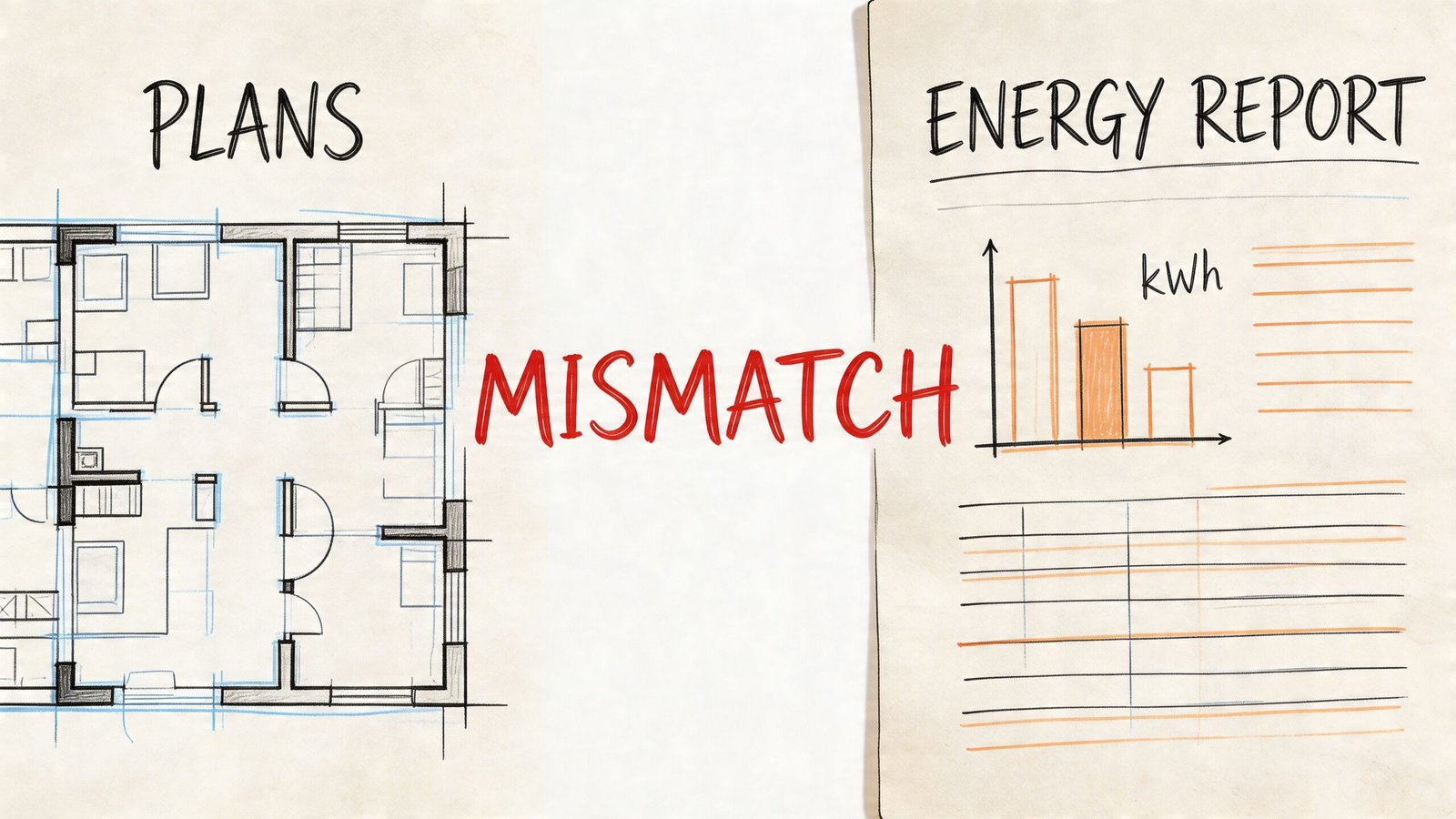
That’s why teams end up submitting documents that are each internally reasonable but collectively inconsistent.
The workflow breaks at handoff points
Most Title 24 drift happens at predictable handoffs:
Early assumptions go ungoverned
Someone starts modeling with placeholder windows, preliminary roof assemblies, or early mechanical selections.Design changes don’t trigger re-run decisions
The team swaps equipment, revises glazing, changes roof material, or updates lighting layouts without deciding whether the compliance docs need revision.No one owns the final reconciliation
The architect assumes the consultant updated the report. The consultant assumes the permit set still matches the last issued background. The PM assumes the discipline leads have already coordinated it.
That’s not incompetence. It’s a broken process.
BIM doesn’t solve this by itself
Plenty of teams assume Revit will keep everyone honest. It won’t, unless the model content and QA rules are built around compliance traceability.
The challenge gets sharper with cool-roof requirements. The 2026 code requires precise SRI inputs tied to climate zone and roof slope, yet many firms still lack parametric Revit families for CRRC-rated materials or automated checks that bridge the model and final HERS verification, as noted in this discussion of Title 24 BIM workflow gaps.
That gap matters because teams often believe the model contains enough intelligence to support permit. In reality, the model may still allow undefined or inconsistent material data, schedule fields, and note structures.
If your BIM content doesn’t carry compliance-critical properties in a usable way, the permit set becomes a manual reconciliation exercise at the worst possible time.
The real fix is a single source of truth
The energy report and drawing set only stay aligned when the team decides what controls.
Some firms manage this with a locked pre-permit milestone. Others use a formal issue log for every compliance-sensitive change. The best setups don’t rely on memory. They rely on checkpoints:
- any change to fenestration triggers review of report assumptions
- any HVAC substitution triggers MEP and compliance cross-check
- any roof assembly revision triggers cool-roof and envelope confirmation
- any late owner request triggers a permit-impact review before sheets are reissued
That’s production maturity. It keeps Title 24 from becoming a late-stage cleanup operation.
The Unspoken Rule of Title 24 The AHJ Factor
Title 24 is a statewide standard. Plan check is local. That distinction matters more than many teams expect.
One jurisdiction may have a reviewer who goes sheet by sheet through energy coordination items. Another may focus on a few recurring local problem areas. A third may use an outside reviewer who pays close attention to form completeness and exact notation.
So yes, California energy code compliance is about the code. But it’s also about reading the room.
The same package can get different scrutiny
A set that moves through one city with minor comments might draw a denser correction list somewhere else.
That doesn’t mean the code changed. It means the reviewer’s process did.
Some AHJs want mandatory measures easy to find in one location. Others will accept them if they’re distributed clearly across sheets. Some reviewers are strict about address consistency and sheet notation. Others zero in on system descriptions and schedule alignment.
You can’t control who reviews the package. You can control how easy you make their job.
What experienced teams do before submission
They don’t just ask, “Are we code compliant?”
They ask:
- What does this jurisdiction usually kick back?
- Do they publish local submittal notes or checklists?
- Do they expect forms uploaded separately or embedded in the set?
- Are there local naming conventions or sheet requirements that matter?
Those questions sound basic, but they prevent a lot of preventable comments.
The fastest way through plan check is giving the reviewer the package they’re used to approving, not the package your office happens to prefer producing.
Practical ways to de-risk AHJ variation
A few habits help:
- Review the jurisdiction’s current submittal instructions before final issue.
- Check whether local forms or upload conventions differ from your standard workflow.
- If possible, compare against a recently approved package in the same city.
- Keep permit notes and sheet references explicit rather than relying on broad general notes.
- Don’t assume a neighboring jurisdiction’s standards of review will transfer.
Out-of-state teams often lose time here because they approach California as one unified permitting culture. It isn’t. The code is statewide. The review behavior is local.
A Bulletproof Title 24 Submission Workflow
The firms that get cleaner approvals don’t treat Title 24 as a last-minute consultant attachment. They run it like a controlled production process.
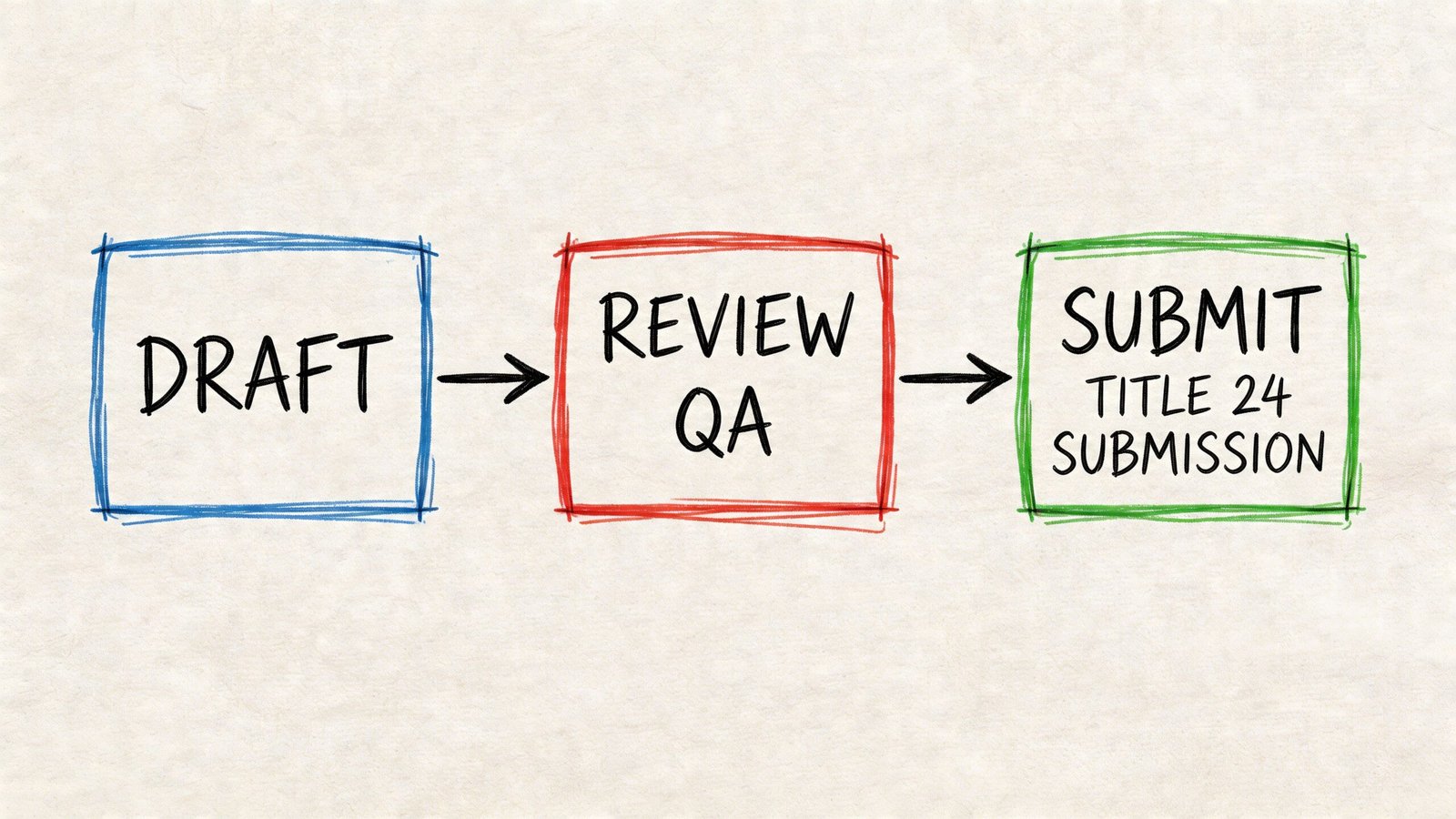
That matters even more on repeatable residential work. For ADUs, all new units require solar PV and must satisfy insulation and HVAC requirements tied to their climate zone, and a BIM-centered workflow that coordinates solar obstruction zones and standardizes models across zones can cut redesign costs by over 15%, according to this overview of Title 24 ADU workflow issues. The lesson applies beyond ADUs. Structured coordination protects margin.
Teams building repeatable permit packages often benefit from tightening their permit set workflow before the first submission, not after the first rejection.
Step one locks the compliance basis
Before the final energy run, freeze the inputs that affect compliance.
That includes:
- climate zone tied to the exact address
- window schedule values
- roof and wall assembly descriptions
- HVAC basis of design
- lighting assumptions
- occupancy and compliance path
This doesn’t mean design can never change again. It means any change after this point becomes a tracked compliance decision, not an informal drafting edit.
Step two runs a side-by-side QA review
At this stage, many teams save themselves.
Don’t review the energy report in isolation. Put the latest permit PDF beside the latest compliance documentation and compare line by line.
A useful review sequence looks like this:
Start with identity data
Confirm project address, unit identifiers, and scope description match across application, drawings, and forms.Move to envelope items
Check window tags, U-factors, SHGC values, insulation notes, roof descriptions, and any assembly references that affect compliance.Then review systems
Compare mechanical schedules, fan callouts, control notes, lighting information, and any equipment names or capacities used in the report.Finish with mandatory measures and forms
Make sure required items appear on the right sheets and that the CF forms are complete, current, and properly signed.
Step three assigns ownership, not group accountability
The phrase “the team reviewed it” usually means nobody did.
Assign clear responsibility:
| Task | Best owner |
|---|---|
| Climate zone confirmation | Project manager or code lead |
| Window and envelope cross-check | Architectural production lead |
| Mechanical schedule match | MEP lead |
| Form completeness and signatures | Permit coordinator |
| Final package reconciliation | PM before issue |
This doesn’t add bureaucracy. It removes ambiguity.
Field-tested habit: Treat Title 24 review like sheet indexing or dimension QA. It needs named owners, deadlines, and signoff.
What works and what doesn’t
What works:
- a locked milestone before energy modeling
- template-based schedules with compliance fields
- issue logs for any post-model design changes
- final PDF review rather than relying only on model assumptions
- standard comments library for mandatory measures
What doesn’t:
- waiting for plan check comments to reconcile differences
- assuming consultants update reports automatically
- burying energy-critical notes in general note blocks
- reusing old Title 24 forms without full project-specific review
- submitting as soon as “everything is mostly there”
A compact pre-submission screen
Before upload, ask five hard questions:
- Can we prove the climate zone is right?
- Do the drawings and report describe the same building?
- Are mandatory measures visible on the permit sheets?
- Are the forms current, complete, and signed?
- Would a reviewer need to make assumptions to approve this?
If the answer to the last question is yes, the package isn’t ready.
That’s the operational side of Title 24 compliance California teams should focus on. Better process beats heroic cleanup every time.
Conclusion Getting Title 24 Right Is a Coordination Task Not a Code Task
Most Title 24 permit problems don’t start with a bad building. They start with a package that can’t prove compliance cleanly.
That’s why teams get stuck after submitting work they believed was complete. The report may be valid. The design may be valid. But if the forms, sheets, schedules, and notes don’t line up, the AHJ has every reason to stop the review and send comments back.
For firms entering California or trying to tighten their current process, that’s the main shift in mindset. Title 24 compliance California work isn’t just an energy exercise. It’s a documentation control exercise.
The good news is that this is fixable with production discipline. Confirm the climate zone early. Lock the compliance basis before the final run. Cross-check the report against the actual permit set. Show mandatory measures where reviewers expect them. Treat forms like permit-critical deliverables, because they are.
Do that consistently and permit becomes more predictable. Not easy every time, but predictable. That’s the difference that protects schedule, fee, and trust inside the project team.
If your office is building a better internal process, a pre-submission Title 24 checklist is usually the best place to start.
If you need a second set of eyes on permit workflow, model coordination, or production QA, BIM Heroes is a practical resource for firms that want clearer systems, cleaner submissions, and fewer surprises at plan check.