


Meta title: Value Engineering Services: A Guide for AEC Firms
Meta description: What value engineering is, when it should happen, and how the process works, a complete guide for AEC teams.
Category: BIM Technology & Workflows
Most advice about value engineering services starts in the wrong place. It starts with savings.
That framing is exactly why so many VE efforts go sideways. Teams hear “value engineering” and think “find things to cut.” Owners expect budget rescue. Designers brace for finish downgrades. Contractors prepare a substitution log. By the time the meeting starts, the process is already pointed at the wrong target.
Real value engineering is a disciplined way to improve the relationship between function and cost. In formal terms, value = functionality / cost, and cost includes lifecycle cost, not just first cost, as outlined by Tensar's overview of value engineering. That changes the conversation. The right question isn't “what can we remove?” It's “what must this element do, and is there a better way to achieve it?”
That distinction matters in architecture, engineering, and construction because good VE protects design intent, operating performance, coordination quality, and margin at the same time. Bad VE creates rework, RFIs, and maintenance headaches that nobody priced in up front.
Introduction
On a healthy project, value engineering happens before the team is cornered. It shows up when the design is still flexible, the owner can still weigh trade-offs calmly, and the documentation team can still absorb changes without blowing up the set.
That's very different from the version many firms know. In practice, VE often gets triggered only after estimates come back high, permits are looming, or procurement starts exposing budget gaps. At that point, “VE” becomes shorthand for late-stage surgery.
A better approach treats value engineering services as a structured, cross-discipline process. Teams gather project data, define required functions, generate alternatives, evaluate them against cost, performance, schedule, and risk, then document decisions clearly. Done well, it improves predictability. Done poorly, it just moves cost and pain somewhere else.
What Value Engineering Is and Isn't
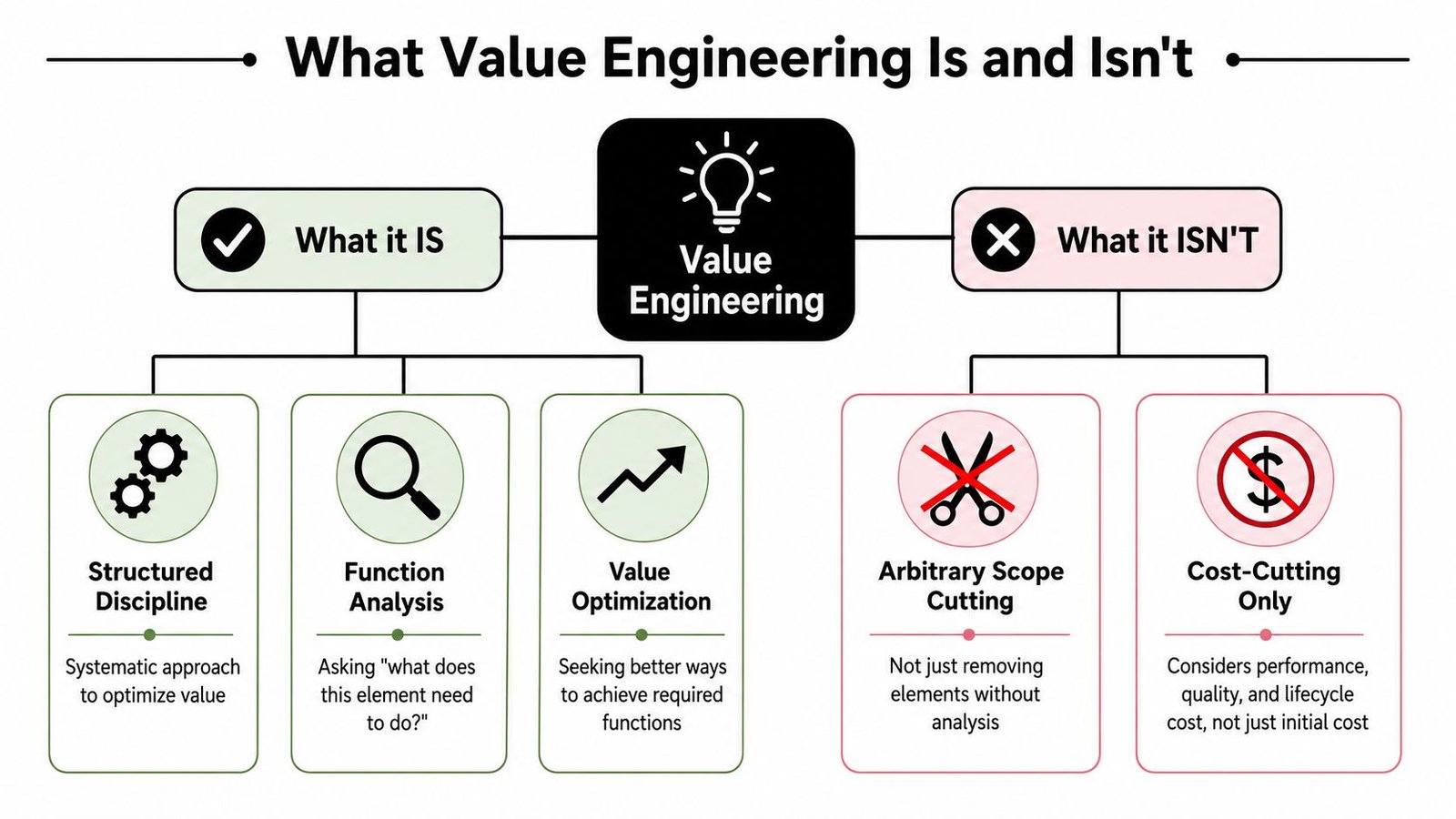
The cleanest definition is also the most useful in the field. Value engineering is function-based analysis. It asks what a system, assembly, or material needs to do, then tests whether another option can deliver that function more effectively across lifecycle cost, constructability, durability, and coordination.
What it is
A proper VE study follows a structured discipline. Teams identify cost drivers, define core functions, and test alternatives against explicit criteria. Function analysis sits at the center of that process. Nomitech's construction overview makes that point clearly by noting that engineering teams define the core functions of project elements and remove non-essential or overlapping features to prevent unnecessary costs.
In practical terms, that might mean revisiting a structural scheme. If a heavy steel framing approach and an engineered-timber approach can both satisfy span, loading, code, and schedule requirements, then comparing them is value engineering. The point isn't to make the building cheaper at any cost. The point is to meet the required function with a better value profile.
Field lesson: If the team can't state the function of the element in plain language, they aren't ready to evaluate alternatives.
What it isn't
VE is not arbitrary scope cutting. It isn't “the estimate is high, so downgrade the lobby finish and hope nobody notices.” It also isn't a one-party exercise where someone substitutes a product without checking maintenance demands, installation constraints, or downstream coordination impacts.
A late finish downgrade is the classic fake-VE move. It reduces visible cost, but it may also reduce wear performance, alter acoustics, weaken warranty alignment, or create owner dissatisfaction. That's not optimization. It's a budget reaction.
The difference sounds subtle until you've sat in enough sessions to see the outcomes. Real value engineering services preserve required function. Fake VE strips cost without proving equivalence.
When Value Engineering Should Happen
The best VE window is early. In schematic design and design development, the team still has room to test alternates without tearing up a mature drawing set or disrupting procurement logic. Decisions made in that window tend to be cleaner because they're integrated into the design instead of patched onto it.
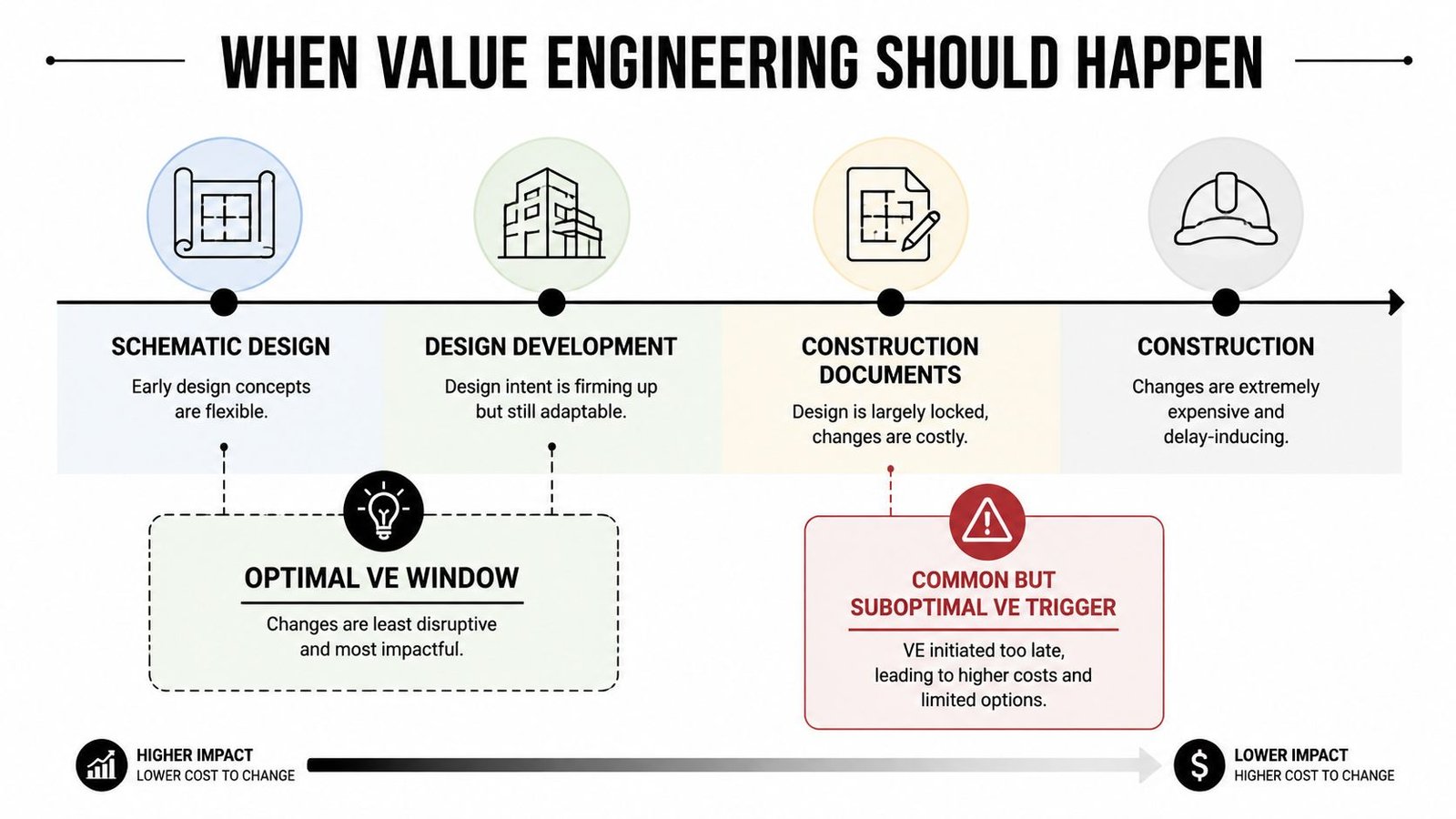
The early window is where VE works
Early-phase VE gives teams room to compare systems, not just products. That's a major difference. During early design, the team can still reconsider framing strategy, MEP distribution logic, facade build-up, equipment zoning, or repetitive unit standardization. Those are meaningful decisions with project-wide effects.
It also aligns better with preconstruction discipline. Teams doing rigorous preconstruction planning are usually better positioned to run VE well because the cost model, constraints, scope assumptions, and decision checkpoints are already visible.
Late VE is usually damage control
When VE starts during construction documents or later, options narrow fast. Drawings are more locked, consultant hours are already spent, and permit or bid timelines are tighter. At that stage, many “alternatives” are really substitutions layered onto an existing solution rather than true evaluations of best value.
That timing problem has a measurable cost. The University of Twente paper on VE timing notes that delaying VE until construction increases total project costs by 8–12% due to rework and missed early-phase efficiencies.
Teams don't usually lose a project on the idea of VE. They lose it on when VE starts.
One more point matters here. The same paper also separates proactive VE from reactive cost cutting. That distinction matches what seasoned project teams already know. Early VE expands options. Late VE narrows them and raises the odds of compromise.
Value Engineering Process Step by Step
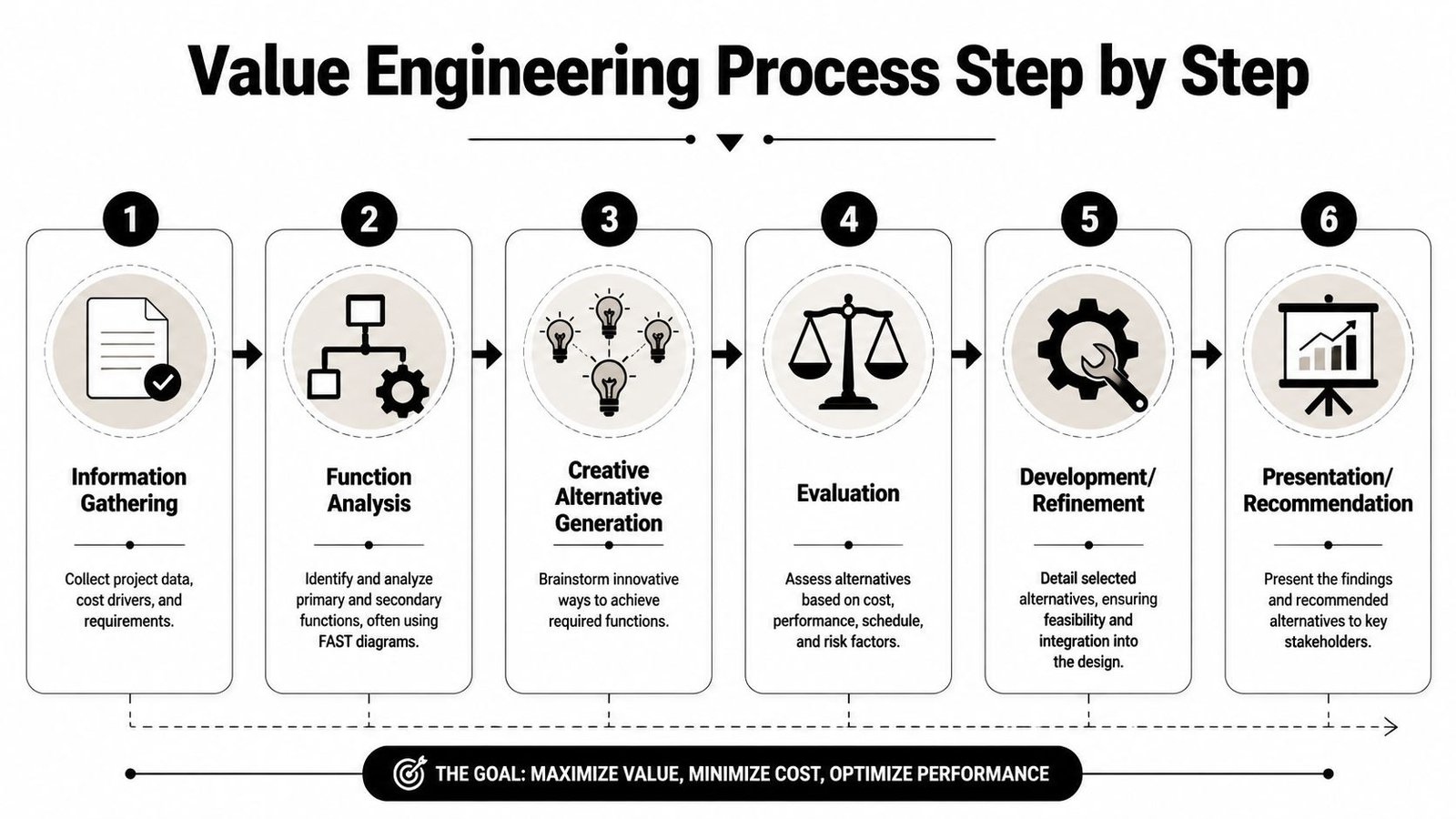
The value engineering process works because it gives a mixed team a repeatable way to challenge assumptions without turning the session into opinion tennis. Autodesk describes VE as a structured six-step process where teams gather information, analyze functions, brainstorm alternatives, evaluate options, develop proposals, and present recommendations to stakeholders in its construction guide to value engineering.
Information gathering
This phase is less glamorous than brainstorming, but it decides whether the rest of the study has any credibility. The team assembles the program, owner priorities, estimate basis, drawings, known constraints, code issues, schedule drivers, and procurement realities.
Good facilitators also identify where the cost concentration lives. You don't need a VE workshop for every low-impact item. You need it where cost, complexity, repetition, or risk are stacked.
Useful inputs often include:
- Cost breakdowns: System-level pricing, alternates, allowances, and escalation assumptions.
- Design maturity checks: What's fixed, what's still flexible, and what hasn't been coordinated enough to trust.
- Constraint logs: Site limits, permitting issues, owner standards, lead time concerns, and utility or phasing impacts.
For teams building a more disciplined estimating environment, tools like Exayard construction estimating software can help structure the cost side of the conversation so alternatives are compared against organized assumptions rather than gut feel.
Function analysis and idea generation
VE separates itself from generic cost review. The team defines what each element must do. Not what it is called. Not how it's currently drawn. What it must do.
A rooftop unit, for example, isn't just “the selected equipment.” Its function may include conditioning a defined area, meeting ventilation needs, supporting maintainability, fitting the roof plan, and aligning with control strategy. Once the function is clear, alternatives become easier to evaluate without getting trapped by the first design answer.
From there, the workshop opens up. Teams brainstorm options across disciplines. Some ideas are obvious. Others only appear when structural, architectural, MEP, and construction voices are in the same room.
Practical rule: Separate idea generation from criticism. Teams shut down good options when they evaluate too early.
Evaluation and development
This is the part many weak VE sessions skip or rush. Alternatives need to be compared across more than first cost.
Typical review criteria include:
- Performance fit. Does the option meet the required function and owner expectations?
- Coordination impact. Will it affect clearances, routing, detailing, or permitting?
- Schedule effect. Does it help procurement, sequencing, or fabrication, or create delays?
- Risk profile. Are there code, warranty, maintenance, or supply-chain concerns?
- Lifecycle cost. Does the cheaper option stay cheaper once operations and replacement are considered?
The strongest teams write this down. A VE study should leave behind function-cost matrices, option briefs, marked-up exhibits, and a decision log that records why an alternative was accepted or rejected.
When the model is reliable, digital workflows help. In 5D BIM, cost data is integrated into the model during pre-construction so teams can review constructability and pricing earlier, as described in this 5D BIM workflow overview. That doesn't replace the VE method. It makes the consequences of a change easier to see.
A detailed constructability review also strengthens this phase because many attractive alternates fall apart once sequencing, access, tolerances, and trade coordination are checked properly.
Who's Involved and Who Should Lead It
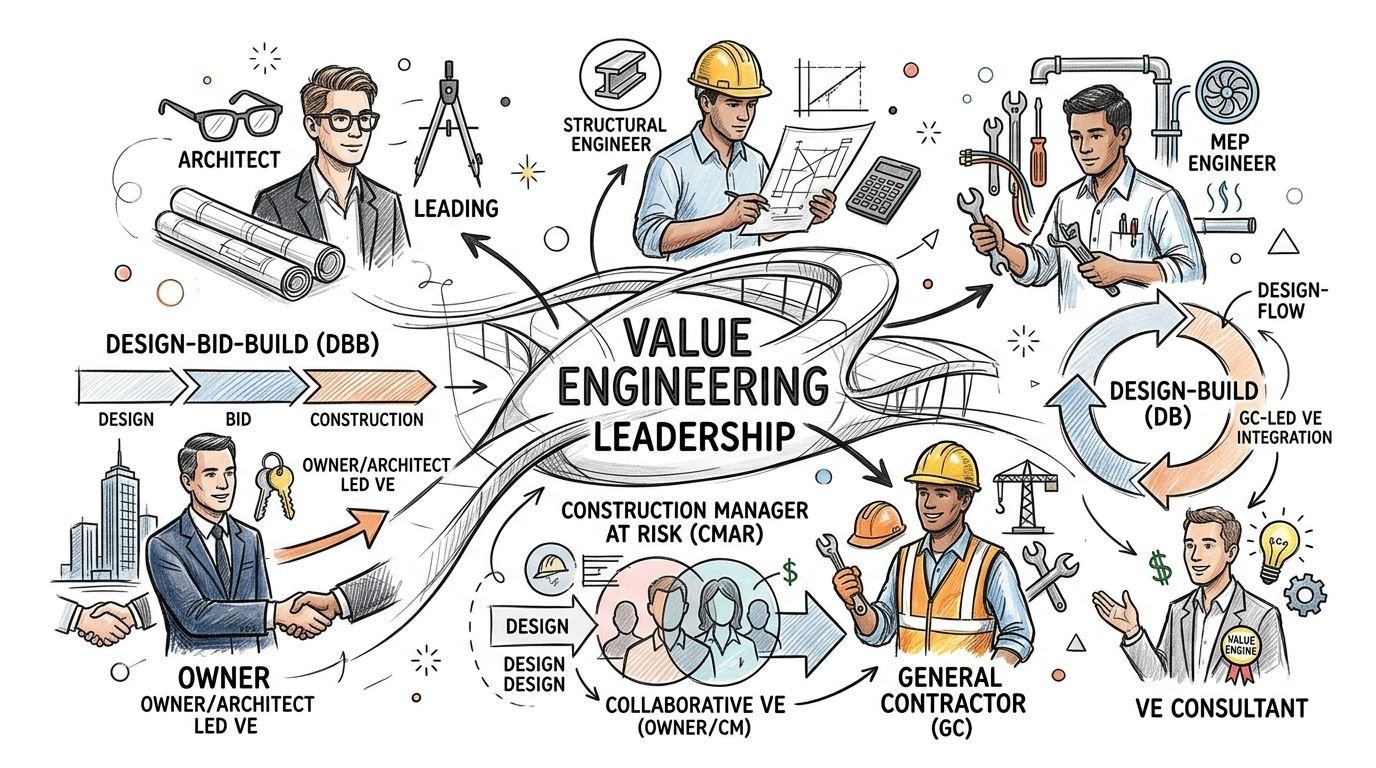
The team composition changes with delivery method, but the pattern is consistent. VE works best when the people who understand design intent, cost, means and methods, operations, and coordination are all in the room.
Who typically participates
A standard VE study usually includes the architect, structural engineer, MEP engineers, GC or preconstruction lead, and owner or owner's representative. On larger or more formal efforts, a dedicated VE consultant may facilitate the workshop and document recommendations.
Fees vary by scope and complexity. In commercial construction, value engineering fees typically range from 0.25% to 1% of construction value, depending on the disciplines involved and the depth of documentation required, according to Commercial Contractor's overview of VE services.
Who should lead
There isn't one universal answer.
In design-bid-build, the owner or design team may initiate VE when estimates come back high or when risk concentration becomes obvious during design. In CMAR, the preconstruction team often helps frame the effort earlier because cost feedback arrives sooner. In design-build, leadership is frequently more integrated because design and construction consequences sit under one delivery structure.
What doesn't work is one-party control. If VE becomes a unilateral cost drill by a single stakeholder, the process usually misses design intent, maintenance realities, or coordination effects. That's when “savings” on paper become friction in the field.
Specialized BIM teams can also help with the prep work behind a VE session. Model cleanup, quantity extraction, alternate-option visuals, and comparison packages are all useful support tasks. That frees internal design and precon leaders to spend their time on judgment, not formatting.
Common Value Engineering Targets
Not every project has the same VE profile. Some buildings have real opportunity in structure. Others have more room in MEP distribution, facade systems, or finish standards. The key is to target categories where function can be preserved while the delivery method, material choice, or assembly logic improves.
Where teams usually find options
Structural systems are common VE candidates because one change can affect steel tonnage, floor depth, schedule logic, and trade sequencing all at once. MEP systems are another strong target because equipment selection and distribution strategy influence space planning, energy use, maintenance access, and coordination density. Envelope and finishes also matter, but only when substitutions are checked for durability, detailing, code fit, and owner standards.
Digital consistency helps here too. When teams are comparing alternates across systems, the logic used to move data between estimating, modeling, schedules, and submittal workflows matters. This essential guide to application integration is a useful reference for firms trying to reduce disconnects between platforms during decision-heavy preconstruction work.
Value Engineering target examples
| Category | Substitution Example | Typical Savings |
|---|---|---|
| Structural systems | Steel framing concept reviewed against engineered-timber or other functionally equivalent framing approach | Varies by project |
| MEP systems | HVAC system type or distribution strategy reviewed against an alternative with equivalent performance intent | Varies by project |
| Envelope and finishes | Exterior panel, cladding, or interior finish substitution evaluated against maintenance, durability, and detailing needs | Varies by project |
The important part of that table is the last column. There's no honest universal savings number for these categories across all projects, and experienced teams know better than to promise one. A real VE review tests each option against the project's constraints, not a generic benchmark.
For firms focused on cost control more broadly, this guide on how to reduce construction costs is a helpful companion because it separates disciplined cost management from blunt cutting.
Where Value Engineering Goes Wrong
Most failed value engineering construction efforts don't fail because the team lacked ideas. They fail because the process was shallow.
Five failure modes that show up repeatedly
- Late-stage panic: The estimate is high, so the team rushes substitutions into a nearly finished set. Nobody has time to re-coordinate, and the project pays for the shortcut later.
- Function gets ignored: A cheaper option is accepted because it lowers first cost, even though it changes maintainability, service life, user experience, or operational flexibility.
- No model or drawing re-check: A system swap happens, but the design team never fully checks clearances, supports, equipment access, routing, or detail impacts.
- One-party decision making: The contractor, designer, or owner drives the call alone. Important trade-offs stay invisible.
- Weak documentation: The team leaves with verbal agreement but no decision log, revised assumptions, or ownership of follow-up actions.
What that looks like on real projects
A finish substitution can appear harmless until the cleaning protocol changes, the warranty alignment weakens, or long-lead trim details no longer match adjacent assemblies. An MEP system alternative can look efficient in estimate form but create access conflicts above ceilings once the trades lay out the work. A framing revision can reduce material cost while increasing detailing complexity in a part of the building that was already fragile.
Those aren't unusual edge cases. They're common outcomes when VE is treated as a pricing exercise instead of a function-and-coordination exercise.
The fastest way to create an RFI storm is to approve an alternate without checking what it does to the rest of the building.
Digital coordination helps prevent that. Coordinated BIM models can resolve 90% of RFIs before a contractor shows up on site, and fixing design gaps during planning costs far less than fixing them in the field, according to this Autodesk Construction Cloud LinkedIn post. That's not an argument for software as a substitute for VE. It's an argument for checking the consequences of a VE decision before it reaches the site.
The corrective habit
The best VE facilitators force one extra question before approval: “What else changes if we choose this?”
That question catches scope creep, hidden consultant work, permit impacts, owner training needs, and trade coordination issues. It also protects margin because it turns “savings” into net savings, not wishful savings.
Closing
Good value engineering services aren't about cutting cost for its own sake. They improve the function-to-cost ratio of a project decision, and they work best when the team applies them early enough to influence the design cleanly.
That's why strong VE supports more than budget alignment. It protects margin, improves predictability, reduces decision churn, and creates more consistent delivery across disciplines. It fits especially well in firms that already value template discipline, QA checkpoints, permitting readiness, and model-based coordination.
If you're tightening your own VE approach, start with the basics that teams often skip: a function-analysis template, a decision log, and a short checklist for re-coordination after every approved alternate. Those simple tools do more for production maturity than another round of vague “find savings” meetings.
If you want practical help building that kind of production discipline, BIM Heroes shares resources on BIM coordination, constructability, documentation workflows, and scalable delivery systems that make VE decisions easier to trust.