Meta title: Constructability Review vs. Clash Detection Explained
Meta description: Clash detection and constructability review aren't the same thing. This explains what each catches, and what gets missed when they're conflated.
WordPress category: BIM Technology & Workflows
A clean clash report is not proof that a project is buildable.
That assumption is common, especially on teams with mature BIM coordination routines, strong Navisworks habits, and disciplined model exchange cycles. The model federates cleanly. The hard clashes are down. The coordination log looks under control. Then the field starts asking better questions than the model ever did. How does that valve get installed? Where does the crew stand? What gets put in first? Can that assembly be lifted, braced, connected, inspected, and maintained as drawn?
That gap is where projects lose predictability.
Clash detection is an automated geometric conflict check between modeled elements. Constructability review services are a broader, human-led evaluation of whether the design can be built with real sequencing, access, tolerances, equipment, logistics, and trade workflow in mind.
Those are related processes, but they don't answer the same question. One checks whether objects occupy the same space in a model. The other checks whether people can deliver the work on site without improvising their way through RFIs, resequencing, and field fixes.
Introduction The Dangerous Gap Between Clash-Free and Buildable
The most popular advice on coordination jobs is still some version of this: run clash detection early and often, clear the report, and you'll prevent construction problems. That's only half true.
Running BIM coordination well absolutely matters. Teams should keep doing it. But a clash-free model can still produce bad field outcomes because many buildability failures aren't geometric collisions. They're installation failures, sequence failures, tolerance failures, or logistics failures. They live in the space between systems, trades, and temporary conditions that the model often doesn't represent.
The industry keeps proving that early review matters. Industry data shows that 84% of Departments of Transportation conduct constructability review meetings before design is complete, typically between 30% and 70% design stages, and first reviews at 90% to 95% completion result in costly schedule delays according to the North Carolina DOT research report on constructability review timing.
Practical rule: If the first serious buildability conversation happens after the model looks polished, it's already late.
The problem isn't software quality. The problem is scope. Teams ask clash detection to answer questions it was never built to answer.
What BIM Clash Detection Actually Does
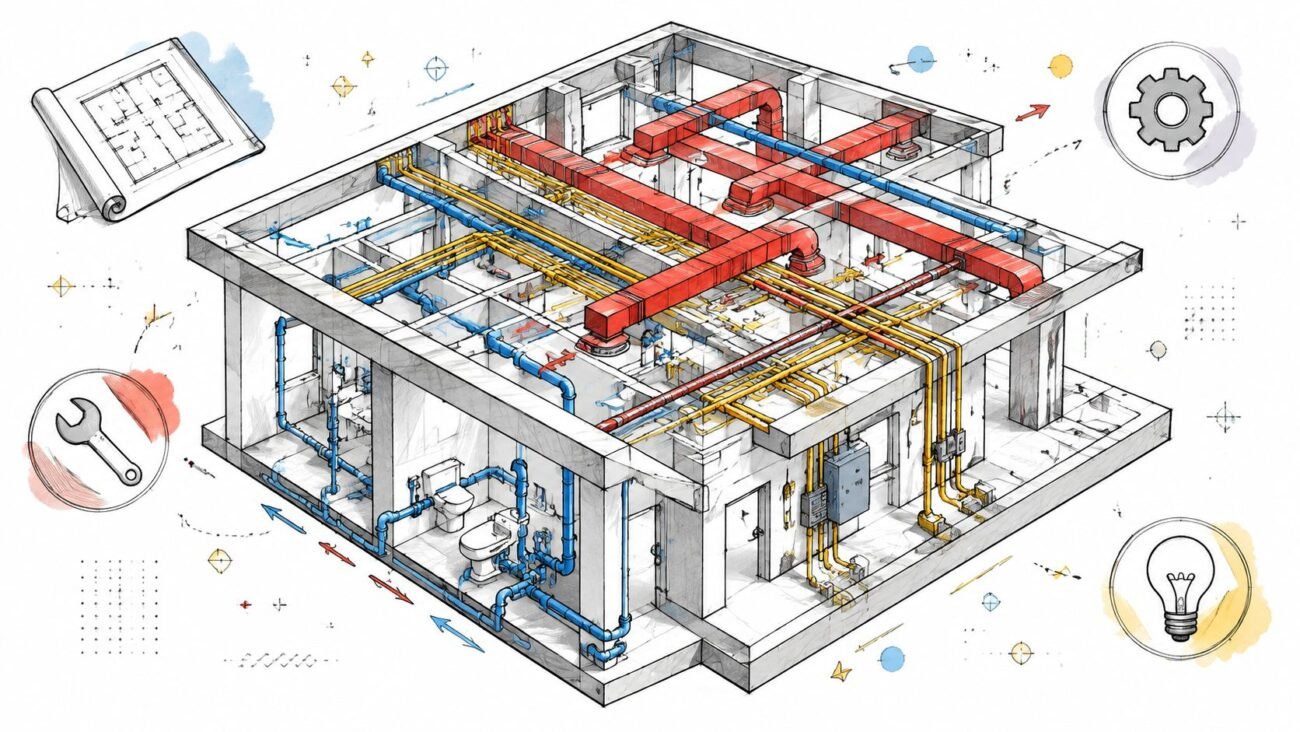
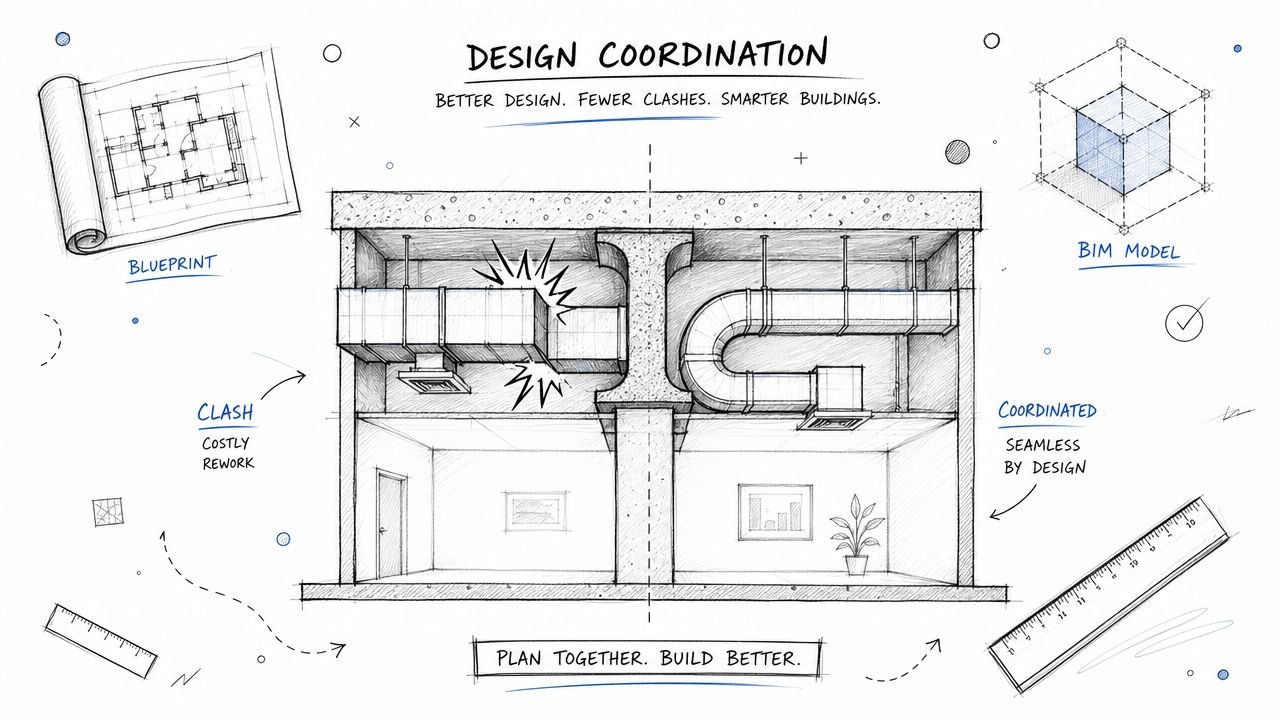
Clash detection is a software-driven comparison of modeled elements across disciplines. In practice, that usually means federating architectural, structural, and MEP models in tools like Navisworks Manage, Solibri, or model-based coordination environments and running rule sets to identify interferences.
A disciplined team will use it to catch obvious geometry problems early. Duct through beam. Cable tray through wall. Pipe crossing a structural brace. Ceiling equipment colliding with framing. At that scale, automation is invaluable. No one should try to manually inspect a federated hospital, airport, plant room, or multifamily tower for every hard clash.
Where clash detection earns its keep
Clash detection is strongest when the question is simple and spatial.
- Hard clash checking: Two solid elements occupy the same space.
- Rapid comparison: Large model sets can be checked far faster than any manual overlay.
- Repeatable QA: The same tests can run on every model issue cycle.
- Coordination hygiene: Teams can keep design development cleaner before it hardens into construction documentation.
Used well, it supports better production maturity. It helps teams enforce decision checkpoints, keep template-driven model outputs consistent, and reduce preventable noise before permit or bid sets go out. A strong primer on that workflow is this overview of BIM clash detection in coordination practice.
What clash detection can't judge
Clash detection only evaluates what has been modeled, and only as geometry.
That means it usually won't tell you:
| Question | Clash detection answer |
|---|---|
| Can the installer reach the connection point? | Usually no |
| Can this assembly be built in the required order? | No |
| Is the clearance realistic once field tolerances show up? | No |
| Is there room for tools, scaffolding, lifts, or temporary works? | Rarely |
| Is the detail practical for fabrication and site conditions? | No |
A model can be geometrically coordinated and still be operationally blind.
That's why teams who rely on automated conflict checks alone often feel surprised by field RFIs. The software did exactly what it was supposed to do. It just wasn't reviewing constructability.
What A Constructability Review Actually Does
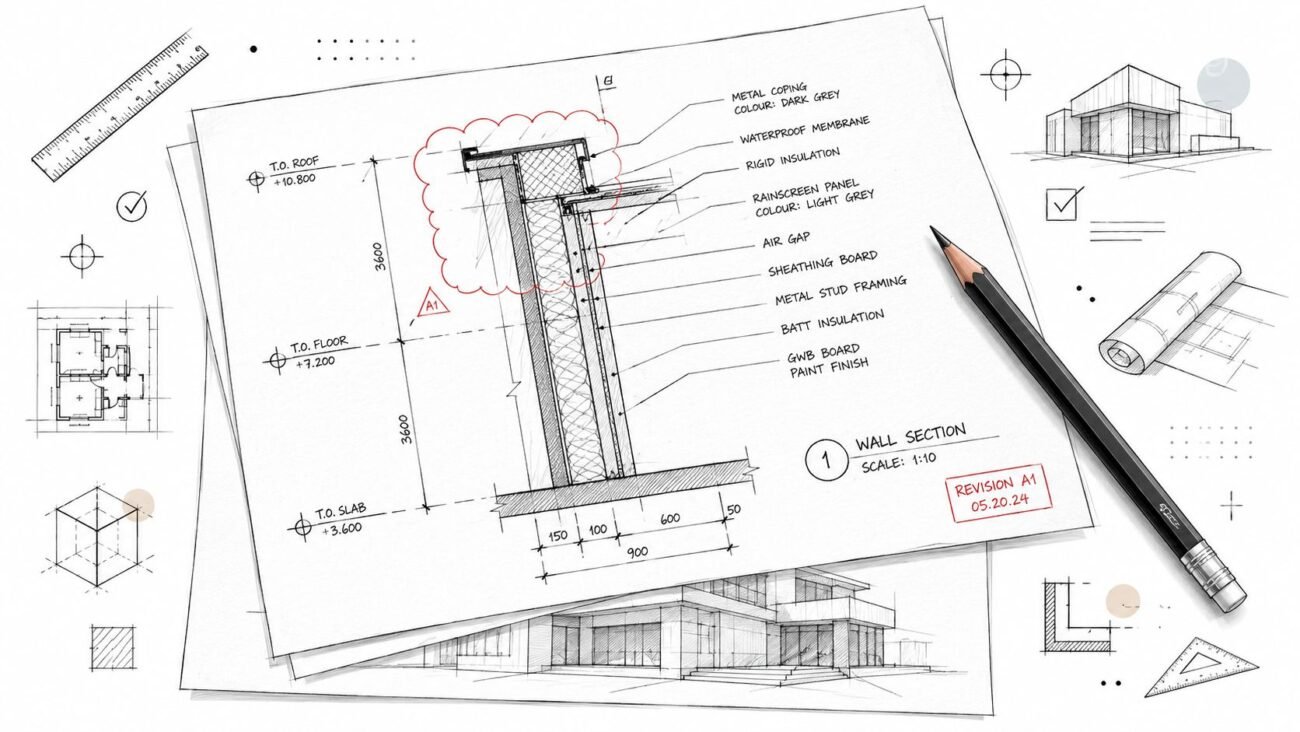
A constructability review asks a tougher question: can this design be built as intended, by real trades, on a real site, using realistic means and methods?
Formally, a constructability review is an independent, structured analysis of draft bid documents, including plans, specifications, and schedules, by construction professionals to ensure work requirements are clear and documents are coordinated before bidding according to the CMAA constructability review guidance. That definition matters because it moves the discussion beyond the model. This isn't just a 3D coordination exercise. It's a construction document review tied to execution reality.
It reviews more than modeled space
Good constructability review services pull from the model, yes, but also from sheets, details, schedules, notes, phasing assumptions, logistics constraints, and site conditions. The review isn't limited to what a coordinator can isolate in Navisworks. It includes what a superintendent, fabricator, trade foreman, or commissioning-minded reviewer sees when they ask how the work gets done.
That distinction gets missed on production teams that are very strong digitally but still light on field feedback loops.
A mature review usually tests questions like these:
- Access and handling: Can crews physically move, lift, stage, and install the component?
- Sequence and dependencies: Does one trade need another to finish first, and is that reflected in the detail?
- Document consistency: Do plan, section, detail, and specification requirements align?
- Maintainability: Can the owner access the item after turnover without demolition-level effort?
- Logistics: Does the site support the intended approach?
It depends on human judgment
At this point, automated checks stop and experience starts.
A reviewer with field depth doesn't only spot errors. They recognize risk patterns. Tight access around rooftop units. MEP racks that fit in the final state but can't be brought through the path available. Ceiling zones that are clean on screen but impossible once hangers, supports, insulation thickness, seismic requirements, and trade working space are considered together.
That same kind of thinking shows up outside vertical building work too. For example, anyone planning circulation-heavy industrial space should pay attention to layout logic, movement paths, and use patterns, which is why Virtual Tour Easy's guide to warehouse design is a useful reference even for AEC teams thinking about logistics and operational fit, not just geometry.
A broader explanation of the discipline itself is covered in this overview of what a constructability review involves.
Field lesson: If a reviewer can't picture the crew, the tools, the lift path, and the order of work, the review is still incomplete.
Real Examples of What Clash Detection Misses
The easiest way to separate clash detection vs constructability review is to look at what fails in the field after the clash report looks clean.
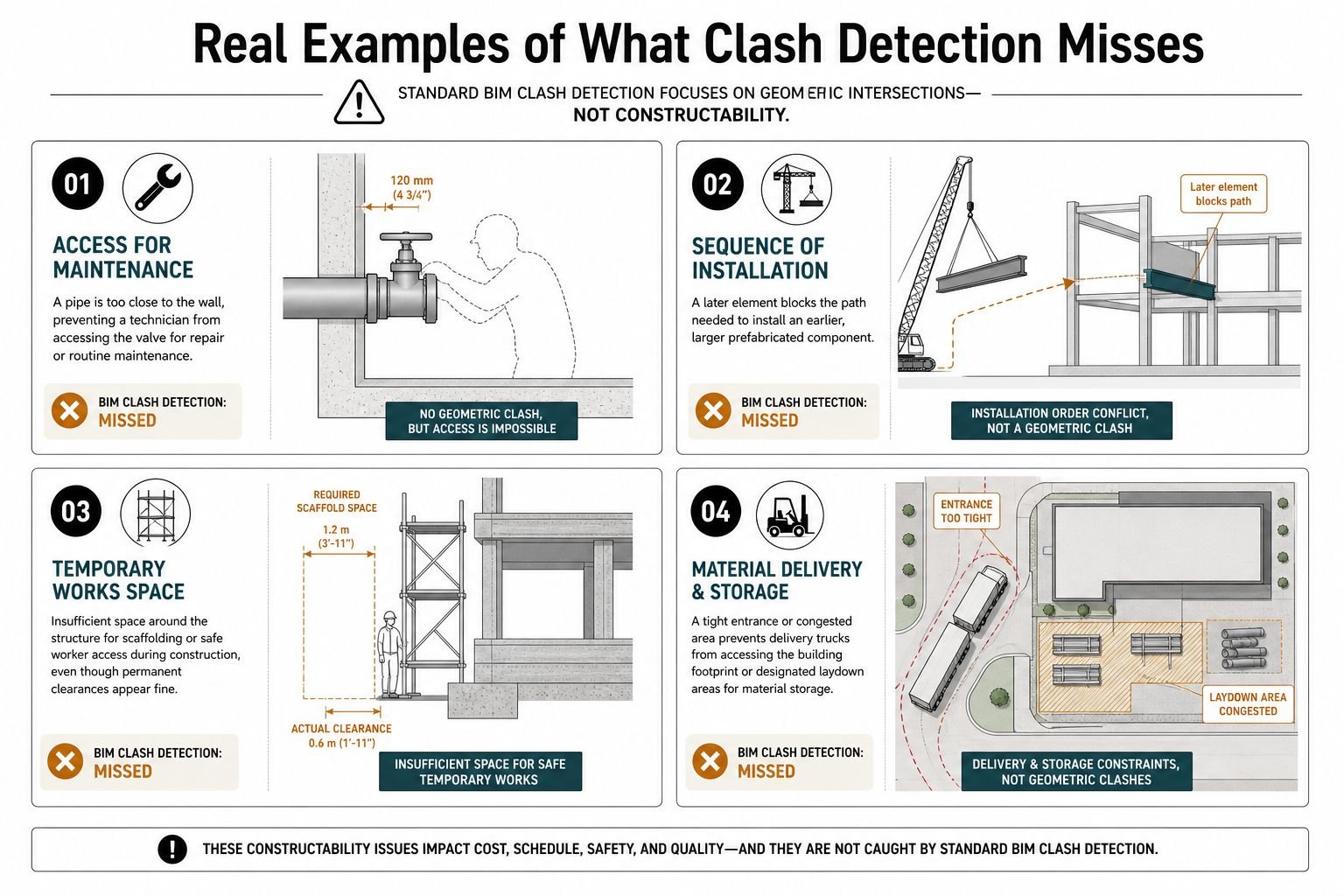
Installation access that doesn't exist
A common example is a valve bank, VAV box, cleanout, damper actuator, or control assembly placed in a space that is technically unclashed but physically unworkable.
The duct clears the beam. The pipe clears the wall. The modeled objects don't intersect. But the installer still can't get hands, tools, fasteners, or test equipment into the opening. Then the field cuts an access panel, shifts adjacent work, or asks for a redesign.
This is especially common above hard ceilings and in dense risers. The model shows permanent conditions. The field needs installation space.
Sequencing that breaks the job
Final position isn't the same as buildable order.
A pipe spool may fit perfectly once everything is in place, but maybe it can only be installed before a neighboring brace, or before the adjacent duct run closes the path, or before curtain wall framing eliminates material handling access. Clash detection usually checks the end state. Construction happens as a sequence of temporary states.
Reviewers with site experience look for path-of-installation problems, not just final-location compliance.
Tolerance stack-up that kills the clearance
Models are idealized. Field work isn't.
A designer may leave a narrow modeled clearance between duct insulation, cable tray, and a structural edge. On screen, it passes. In fabrication and installation, tolerances accumulate. Hanger placement varies. Insulation jackets aren't abstract linework. Connections need wrench room. Supports consume space the base model didn't emphasize.
What looked coordinated can become a near miss or a direct conflict once real-world variation shows up.
Means and methods that don't pencil out
Some details are geometrically correct and still poor construction choices.
Think about a connection that requires awkward welding access in a congested overhead zone. Or equipment that can only be installed with a lift setup the site can't support. Or a prefabricated assembly too large to bring through the available route without major disruption. The model may validate position. It doesn't validate whether the chosen method is safe, efficient, or commercially sensible.
The weak spot is often not inside one system. It's where systems meet. The Whole Building Design Guide notes that while 80% of review efforts target discrete system components, over 65% of field issues originate at interface zones between systems and trades, which helps explain why standard checklist reviews and automated clash checks miss so much at those boundaries in the WBDG guidance on constructability reviews.
A short comparison from the field
| Issue type | Clean clash report possible | Buildability still at risk |
|---|---|---|
| Valve has no service access | Yes | Yes |
| Large spool has no install path | Yes | Yes |
| Tight ceiling zone fails with tolerances | Yes | Yes |
| Lift, scaffold, or temporary support space missing | Yes | Yes |
The field doesn't care that the model was clean. The field cares whether the work can be performed.
That's the heart of constructability analysis. It tests the work as installed, not just as represented.
How The Two Processes Work Together
The right workflow isn't choosing one over the other. It's using each process for the job it does best.
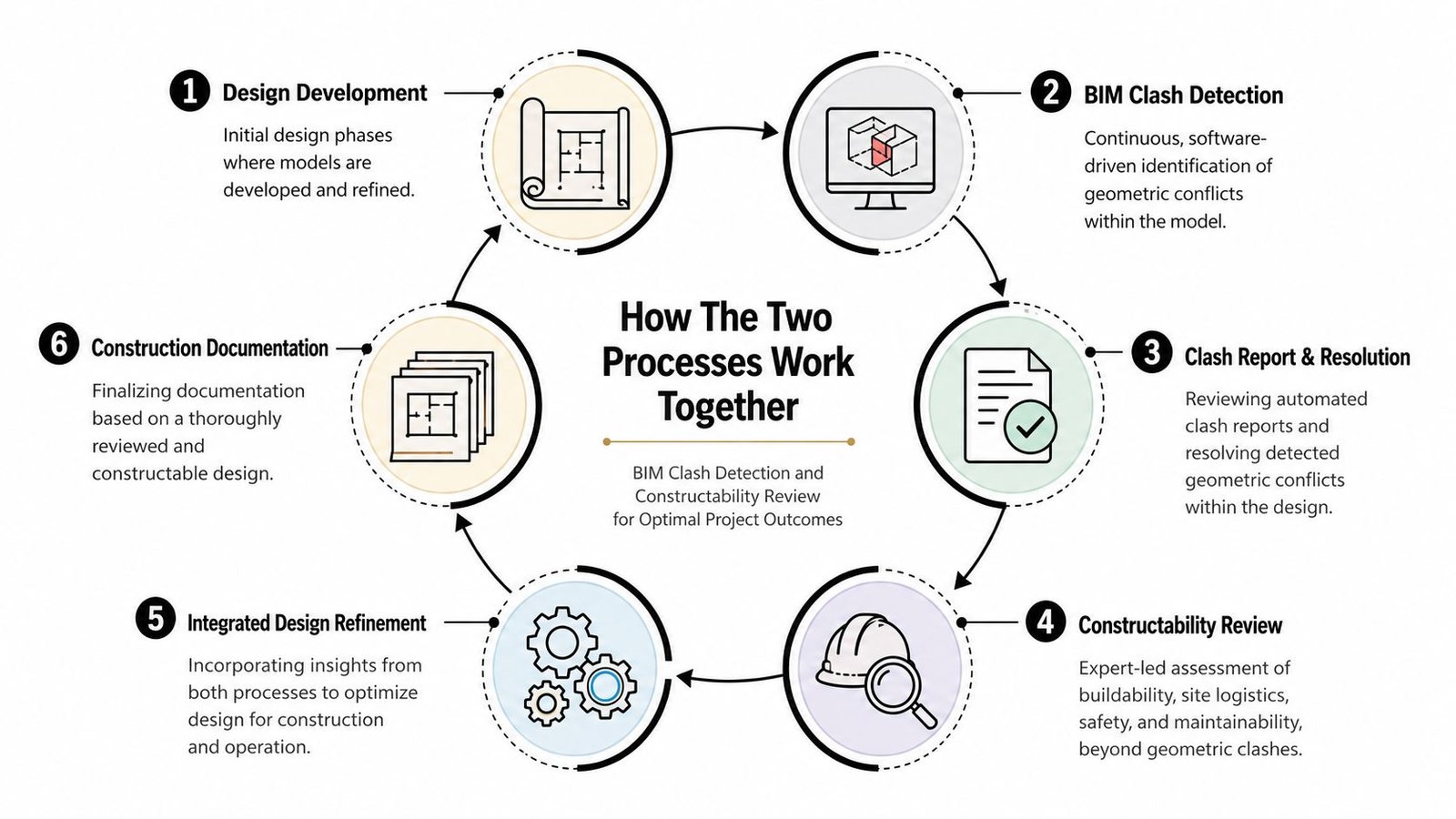
Clash detection should run continuously as the model matures. It keeps coordination noise under control, protects model quality, and gives teams a cleaner baseline before key decisions get locked. That's operationally important. If teams spend every meeting reviewing obvious hard clashes, they burn expensive coordination time on problems software could have surfaced earlier.
Automation first, judgment second
A stronger production system usually looks like this:
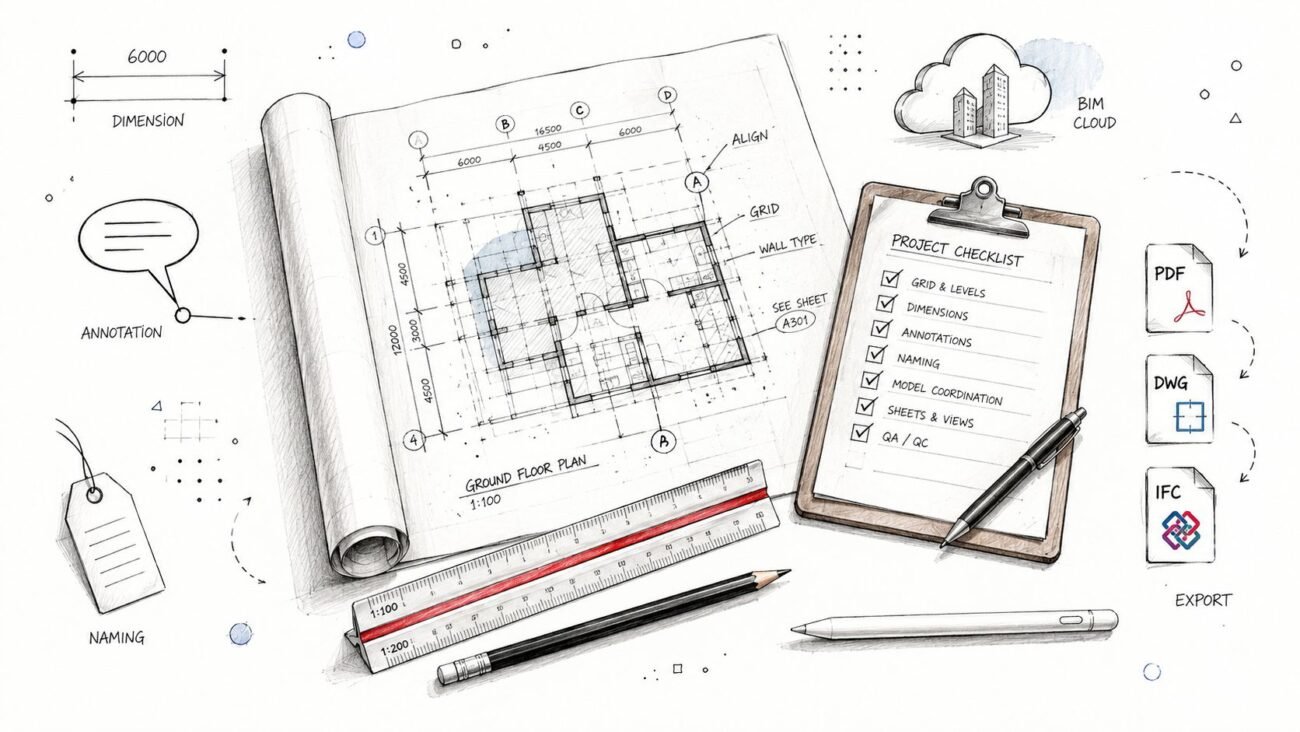
- Model development stays disciplined. Naming, templates, view logic, and issue tracking are standardized.
- BIM clash detection runs routinely. The team resolves obvious geometry conflicts early.
- Constructability review follows with context. Reviewers examine logistics, sequence, access, tolerances, and drawing consistency.
- Design refinement is integrated. Findings are pushed back into the model and the documents before they become field problems.
That handoff matters. Once geometry is reasonably clean, senior reviewers can spend their time on harder questions that protect margin and schedule. That's a better use of expertise than asking experienced construction people to sit through avoidable beam-vs-pipe cleanup.
What a mature coordination process looks like
The best teams treat clash detection as tactical QA and constructability review as strategic QA.
One keeps the digital asset clean. The other keeps the project executable.
For firms refining scalable delivery pods, repeatable review gates matter. A model check can be delegated and systematized. A buildability review needs broader perspective. It benefits from structured workshops, issue logs that connect to sheets and details, and decision checkpoints that prevent unresolved field assumptions from drifting into construction documents.
Teams building that kind of process maturity usually see the difference quickly in fewer ambiguous handoffs and more predictable coordination outcomes. This is the same logic behind stronger BIM coordination services workflows, where software outputs support decision-making but don't replace it.
Coordination rule: Use automation to find collisions. Use experienced reviewers to find consequences.
When to Perform Each Review and Who to Involve
Teams usually wait too long.
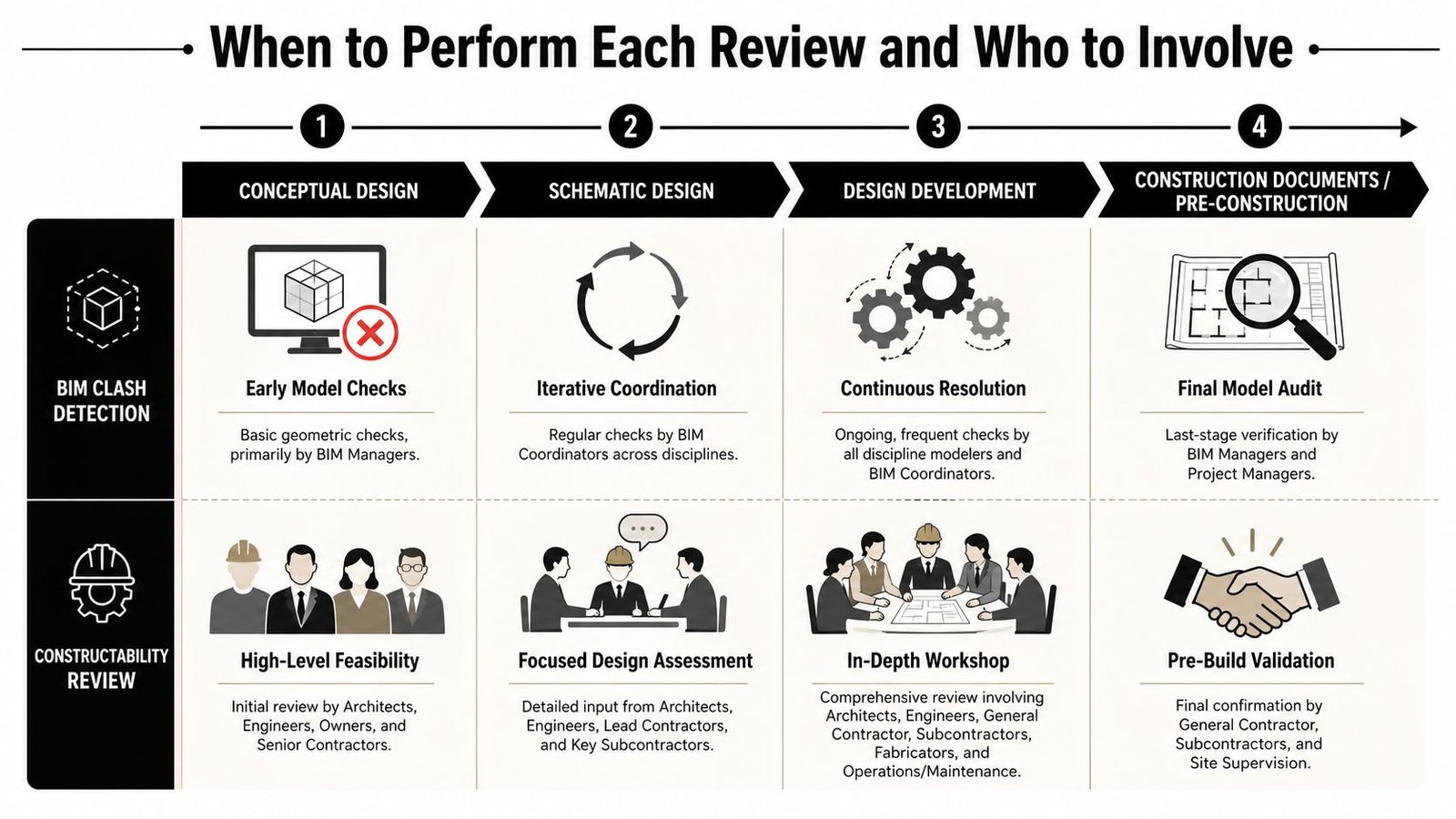
A clash report can run every week and still miss the moment when the project stopped being easy to build. That happens when layout decisions harden before anyone tests access, tolerances, trade sequencing, or how the work will be installed. By the time the model is clean, the bad assumptions are often buried in approved details, equipment selections, and sheet notes.
Clash detection belongs on a recurring cycle throughout design development and coordination. Any meaningful model change should trigger another pass. That is standard model QA.
Constructability review should follow project milestones, not just model updates. It has the most value before the design locks in, while teams still have room to shift shaft sizes, rework equipment clearances, adjust support strategy, or change the order of installation without tearing through multiple disciplines.
Transportation owners have been disciplined about this for years. Industry data shows that 84% of DOTs hold constructability review meetings before design is complete, commonly around the 30% to 70% stages, because late first reviews tend to drive redesign and schedule loss, according to DOT constructability timing research. The lesson applies well beyond transportation. A first serious buildability review at 90% usually means the team is reviewing consequences, not choices.
A practical sequence looks like this:
- Early design review: Test major concepts before details harden. This is the time to question riser sizes, equipment replacement paths, structural opening strategy, prefabrication assumptions, and whether one trade's ideal layout blocks another trade's install.
- Mid-development review: Bring in trade and field voices while there is still flexibility. Review sequencing, hanger zones, access for welders and electricians, tolerance stack-up, inspection space, and whether the sheets still reflect how crews will build the work.
- Pre-issue review: Confirm the documents are ready to release. Check that model decisions match details, field clearances are still valid, and unresolved installation assumptions are not hiding behind general notes.
Who should be in those reviews matters as much as timing.
A BIM coordinator can identify intersecting geometry fast. That does not mean the coordinator should be the only person deciding whether a corridor is buildable. A six-inch gap between duct and steel may pass a clash rule. It may still leave no room for insulation, no tool access for installation, and no tolerance for real field conditions.
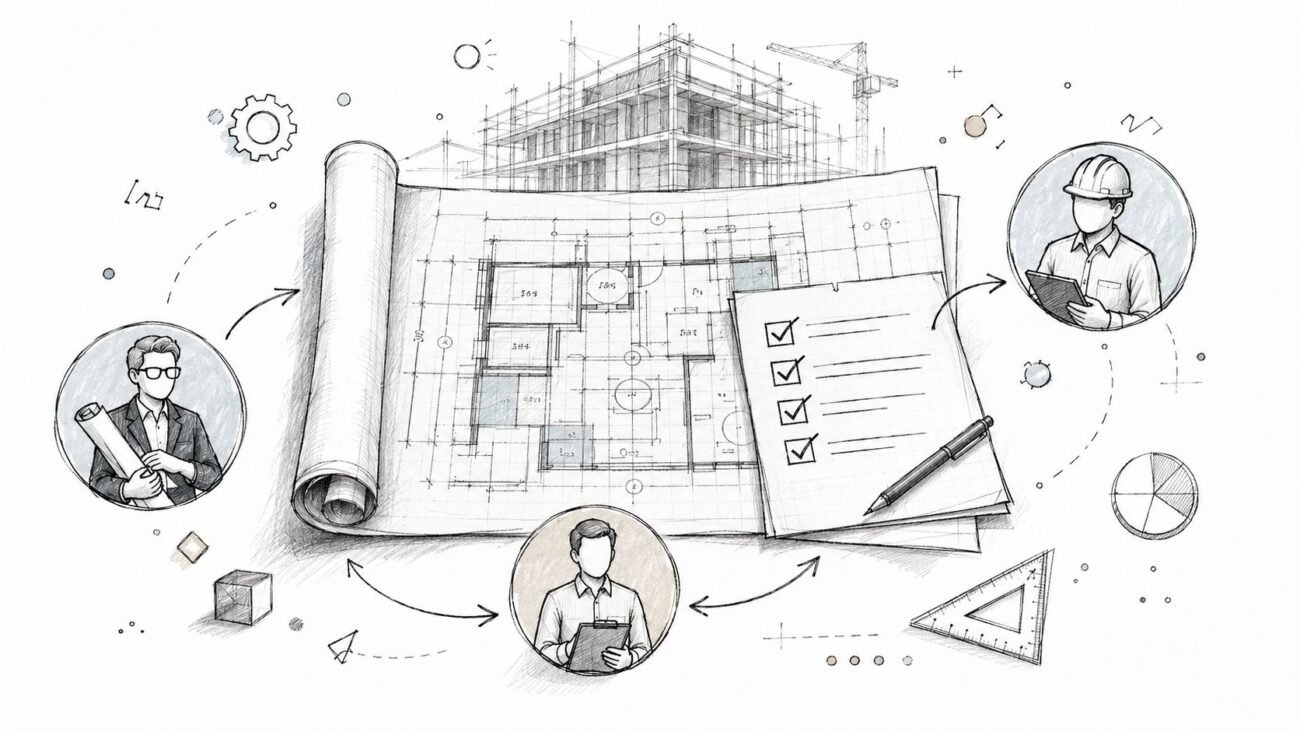
Buildability reviews need people who know how the work gets done. That usually includes the design lead, discipline coordinators, a superintendent or construction manager, senior trade input, someone with fabrication awareness, and a reviewer who can track model issues into sheets, details, and specifications. Owners also need a seat when operations, maintenance access, shutdown planning, or phasing constraints affect the answer.
The review format matters too. A screenshot log sent around by email rarely resolves the hard issues. Working sessions do better because the team can look at the model, the details, and the sequence together, then assign a decision and a due date.
A simple split works well:
- Coordinators identify geometric conflicts and document them clearly.
- Field-experienced reviewers test installation logic, access, tolerances, and sequence.
- Design and document leaders push the decisions back into the model, sheets, and specs before the next issue set.
That is how teams avoid false confidence. A clean model helps. A buildable project takes the right review at the right time, with people who understand what the field will punish.