Here’s one of the most expensive mistakes a design or construction firm can make on a small- to mid-sized project: assuming the wrong building code applies. You've designed a sleek accessory dwelling unit (ADU) or a small mixed-use building, assuming the straightforward International Residential Code (IRC) applies. Then, the permit office kicks it back.
Your project, they inform you, falls under the much more stringent International Building Code (IBC). It’s a gut punch.
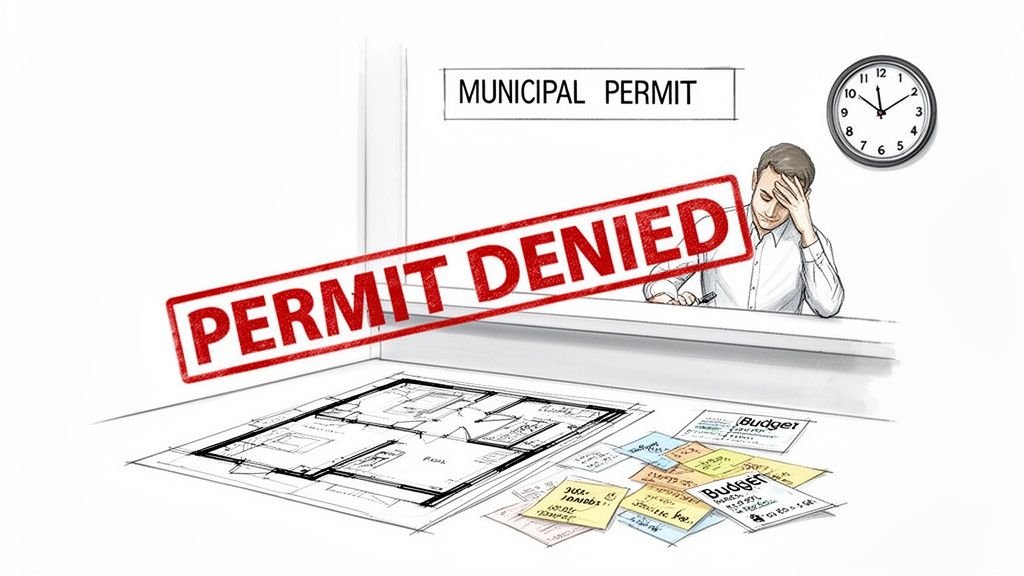
Suddenly, you’re looking at rejected permits, forced redesigns, and a budget that's gone up in smoke. This isn’t just a paperwork problem; it’s a direct hit to your margin, timeline, and firm’s credibility. Getting the IRC vs IBC decision right isn't a minor detail to sort out later. It’s a foundational decision that dictates your entire design and documentation path.
The Short Answer: What Separates IRC from IBC
At its core, the distinction is simple. The International Residential Code (IRC) is the rulebook for one- and two-family dwellings and townhouses up to three stories high. It’s a prescriptive, follow-the-recipe guide. The International Building Code (IBC), on the other hand, is the comprehensive beast that governs everything else—from multifamily apartments and mixed-use buildings to all commercial structures.
The line is drawn based on risk. The IRC assumes a low-risk scenario: a family living in a home they know well. The IBC is designed to protect larger groups of people, including tenants, employees, and the general public, who may be unfamiliar with the space. This principle is fundamental to project delivery and ensuring code compliant construction for commercial modular buildings, which have their own specific regulatory hurdles.
Get the code right, and you have a clear roadmap for production. Get it wrong, and you introduce massive risk and unpredictability right from the start.
Where It Gets Complicated: The Edge Cases
On paper, the line between the IRC and the IBC seems clear. But as any production-focused firm knows, the real headaches—and the biggest risks—are found in the grey areas where a project doesn’t fit neatly into one box. Make the wrong call here, and you’re looking at serious rework and permitting delays. This is where you stop quoting code sections and start applying some hard-won field experience.
Live/Work Units and Small Mixed-Use Buildings
Live/work units are a classic point of confusion. If you're designing a home with an attached art studio for the owner's personal use, you’re still in IRC territory. It’s an accessory use to the primary residential function.
But the moment that studio becomes a public-facing business—say, a small retail shop or an office where employees come to work—the entire building gets pushed into the IBC. Why? Because you’ve just introduced a non-residential use. Once you have a "Business" (Group B) or "Mercantile" (Group M) occupancy alongside the residential (Group R) use, you've created a mixed-use building. The IBC is now required to handle the more complex life safety and fire separation rules between those different uses.
The lesson from the field: The nature of the work dictates the code. Private, work-from-home activity is an IRC issue. A commercial business open to the public, no matter how small, is an IBC problem you have to solve from day one.
ADUs, Duplexes, and Short-Term Rentals
Accessory Dwelling Units (ADUs) are another modern building type that can blur the lines. A standard ADU on a single-family lot, built for a family member or a long-term renter, will almost always fall under the IRC. The same goes for a standard duplex.
Things get tricky when the plan is to use any of these units as a short-term rental, like an Airbnb. Many jurisdictions will reclassify buildings used for transient lodging (typically defined as less than 30 days) as an R-1 (Residential) occupancy under the IBC. This move triggers tougher rules for egress, smoke detection, and sometimes even sprinklers, since the occupants aren’t familiar with the layout. The decision checkpoint is simple: ask about the intended rental term before you start design.
Group Homes and Three-Story Townhouses
Group homes and other shared living arrangements are another complex area. A single-family home with a few unrelated people living together will likely remain under the IRC. But as the occupant count grows, the project can quickly get reclassified as an R-2, R-3, or R-4 occupancy under the IBC, especially if occupants require special care.
Three-story townhouses are another classic edge case. While the IRC applies to townhouses "not more than three stories," you must be careful. If each townhouse has its own separate egress and is separated by a 2-hour fire wall from foundation to roof, it can be treated as an individual building under the IRC. But if they share a common corridor or exit, the entire structure becomes an IBC project.
What Actually Changes Between the Two Codes
Moving a project from the IRC to the IBC is more than just a paperwork switch. It's a fundamental shift that reshapes your entire production workflow, impacting your scope, budget, and timeline. Understanding these differences isn't an academic exercise—it’s about protecting your margins and ensuring predictable delivery.
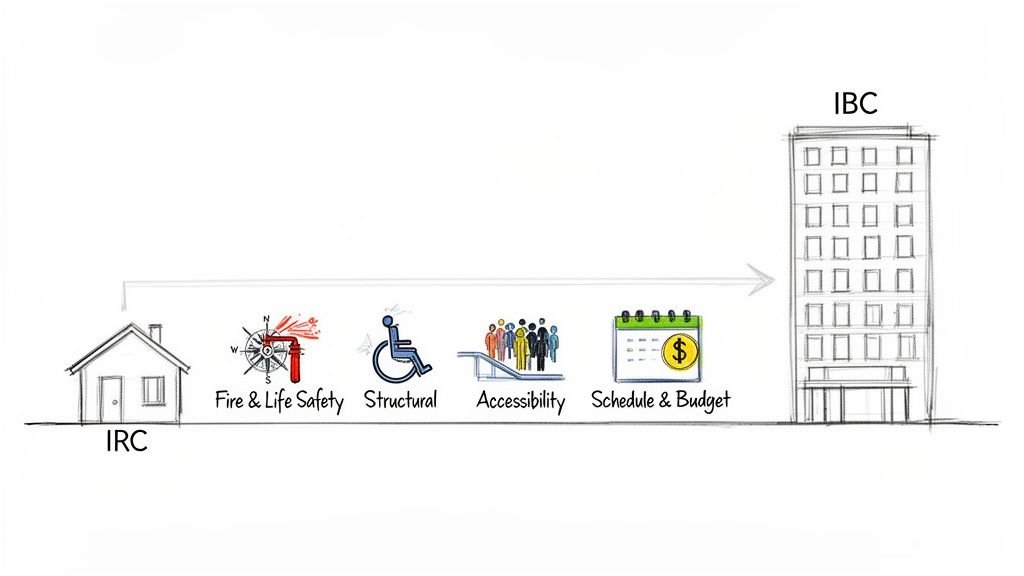
Occupancy Classifications: The IBC's Guiding Principle
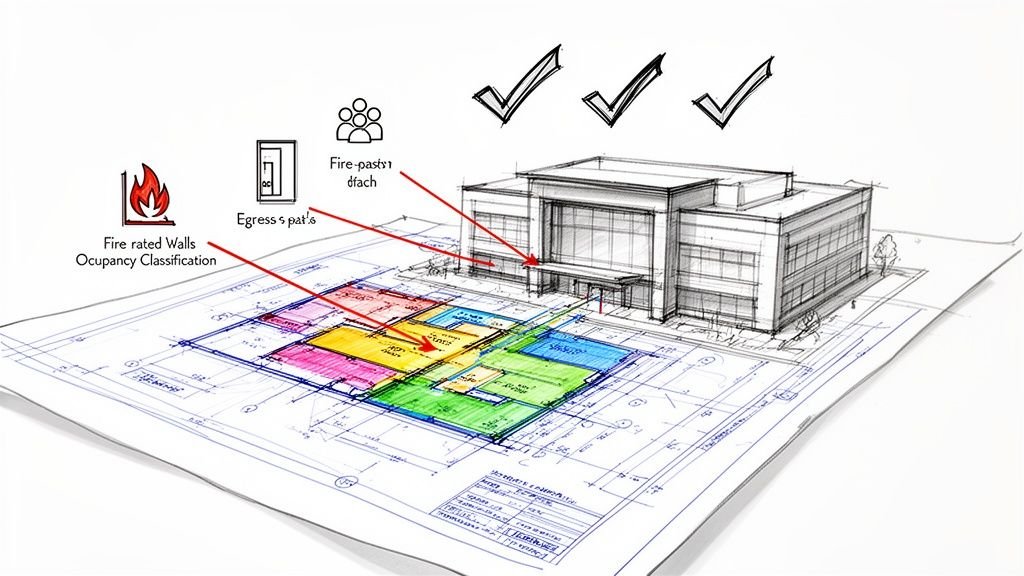
The concept of occupancy classification is the backbone of the IBC but is mostly absent in the IRC. Under the IBC, every square foot of a building gets classified based on its use—Assembly (A), Business (B), Residential (R-1, R-2, R-3), Mercantile (M), and so on. This isn't just a label; it’s the primary driver for almost every other code requirement, from fire protection to egress. Get the occupancy classification wrong at the start, and you’ve baked a fatal flaw into your design that will require a costly redesign.
Fire and Life Safety Demands Escalate
This is arguably the biggest and most expensive leap. The IRC focuses on basic life safety for a family in a space they know well. The IBC is built to protect larger, more diverse groups of people who might be completely unfamiliar with the building.
- Fire-Rated Assemblies: Under the IRC, a simple fire separation like ½-inch drywall between a house and garage often suffices. The IBC demands robust, tested fire-rated assemblies for walls, floors, and ceilings separating different uses or creating protected corridors. That means UL-rated designs and more rigorous inspections, which add labor and material costs.
- Egress Systems: A front and back door might be all you need in an IRC home. The IBC, however, demands complex egress systems with minimum corridor widths, a maximum travel distance to an exit, and often two or more protected exit paths.
- Sprinkler Systems: Many IRC projects don't require sprinklers. The IBC, however, often mandates much more involved systems like NFPA 13R for low-rise residential or the full NFPA 13 for commercial and larger buildings. This is a major cost and coordination driver.
Structural Requirements: From Prescriptive to Engineered
The IRC is known for its prescriptive structural paths. Its handy span tables and connection details allow a solid structure without hiring a structural engineer for every project. This is a huge time and money saver for standard residential work.
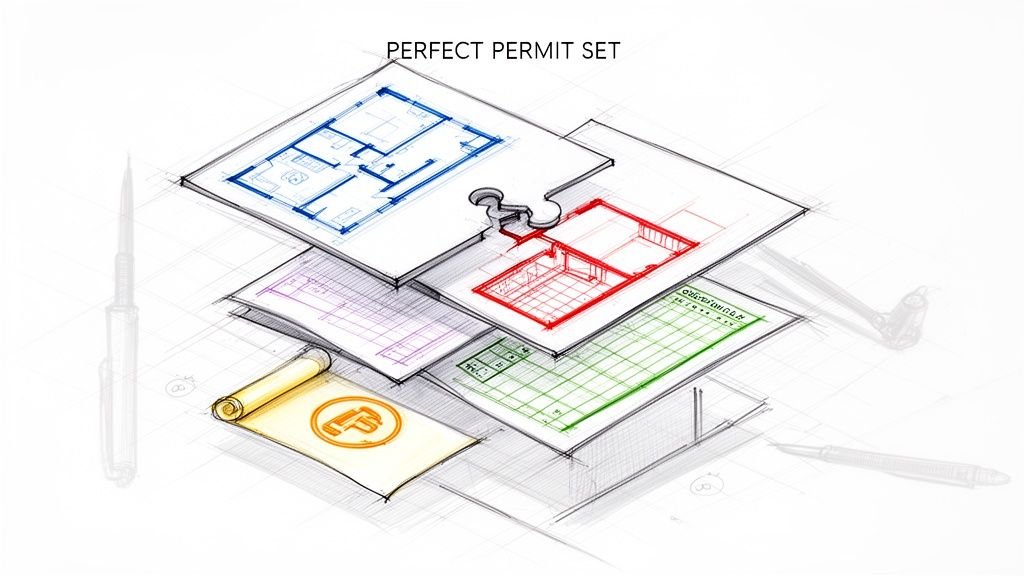
The IBC plays by different rules. Since it governs larger, more complex buildings with heavier loads, it almost always requires a licensed structural engineer to design and stamp the plans. This means a full structural analysis, more robust foundations, and a complete set of structural drawings and calculations—a significant expansion of your deliverable set.
Accessibility Becomes Non-Negotiable
For most single-family projects under the IRC, federal accessibility laws like the Americans with Disabilities Act (ADA) and the Fair Housing Act (FHA) don't apply. That changes completely in the IBC world.
IBC projects, especially multifamily residential (R-2) and public accommodations, must comply with federal accessibility standards. This means your design must incorporate accessible routes, wheelchair-accessible kitchens and bathrooms, and proper clearances. Building these features in from schematic design is a critical QA checkpoint. Trying to shoehorn accessibility into a nearly finished design is a surefire way to trigger expensive RFI cycles and redesigns.
Energy Code Compliance Path
Both codes reference the International Energy Conservation Code (IECC), but the path to compliance differs. The IRC often allows for simpler prescriptive paths or software-based REScheck™ reports. IBC projects typically require a more detailed COMcheck™ analysis, which involves a more thorough accounting of lighting, mechanical systems, and the building envelope, demanding greater coordination between architectural and MEP disciplines.
The Permit and Jurisdiction Layer
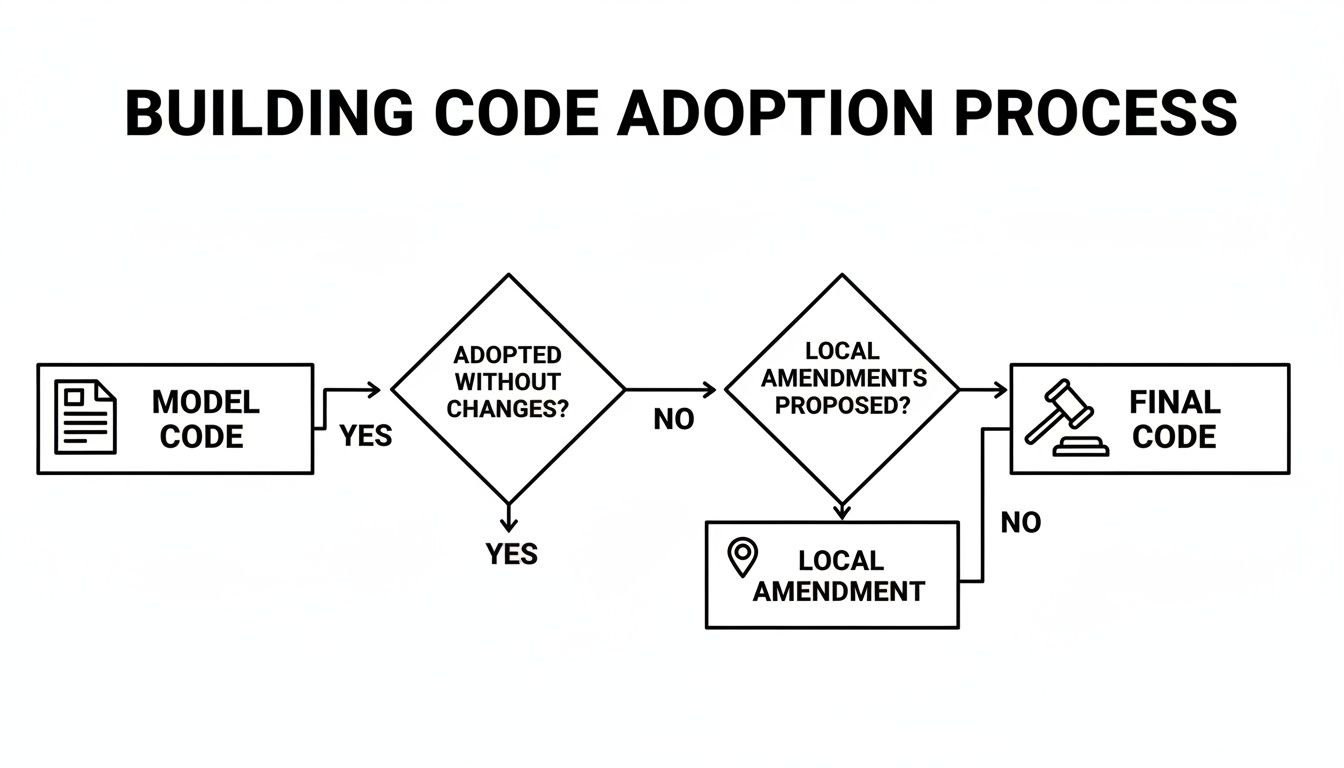
Just knowing the difference between the model IRC and IBC isn't enough. The real complexity comes from the local Authority Having Jurisdiction (AHJ). The IRC and IBC are model codes. They are templates, not law, until a city, county, or state formally adopts them.
That adoption process is where projects get derailed. A jurisdiction almost never adopts a model code as-is. They add, delete, or rewrite sections to create local amendments, tailoring the rules to address regional issues like high-wind zones, seismic activity, or local housing policies.
Furthermore, jurisdictions adopt new code cycles on their own timelines. A town might be on the 2021 code, while its neighbor is still on the 2018 edition with heavy amendments. A project that's IRC under the 2021 model might be treated differently under an older local adoption. This is why a pre-design call to the local building department is a non-negotiable step in a mature production workflow.
For a deeper look at the history, you can read about the International Code Council's development on Wikipedia.
What Happens When You Get It Wrong
Getting the governing code wrong isn't an academic error; it has real, costly consequences that ripple through the project lifecycle. This isn’t about alarmism—it's about the realistic outcomes of misidentifying the code at project start.
- Permit Rejection: This is the most immediate impact. The plans are kicked back, halting the project before it even begins and demanding immediate rework.
- Redesign Mid-Stream: Even worse, if the error is caught during construction, you face redesigns that affect already-built components. This can lead to costly demolition, change orders, and significant schedule delays.
- Budget Overruns and Margin Erosion: Adding an engineered structural system, a full fire sprinkler system, or fire-rated assemblies late in the game can destroy a project's budget and your firm's profitability.
- Liability Exposure: Designing to a less stringent code than required creates a significant liability risk for the designer of record. In the event of a fire or structural failure, failing to apply the correct code is a serious professional misstep.
These outcomes undermine operational consistency and damage the trust you’ve built with your client.
How to Determine Which Code Applies on Your Next Project
Let’s get practical. You stop the IRC vs IBC decision from becoming an afterthought by building a system for it. Mature firms run on checklists to stamp out unforced errors. This is a perfect candidate. Ask the right questions upfront, and you turn a huge point of failure into a predictable step that protects your schedule and profit margins.
Your Pre-Design Due Diligence Checklist:
- Occupancy Type: What is the building actually used for? Get specific about every activity. "Personal art studio" (IRC) and "retail art gallery" (IBC) are two very different things.
- Number of Units: Is it one or two dwelling units (likely IRC), or three or more (almost certainly IBC)? This is a bright-line test.
- Building Height: How many stories is it, and what is the absolute height in feet? The IRC has strict limits—typically three stories—and exceeding that kicks the project to the IBC.
- Mixed-Use Elements: Does it contain any non-residential or commercial use? As soon as you add a separate business, the IBC is required to govern fire separation and egress.
- Local Amendments: What code edition and amendments has the local jurisdiction actually adopted? A ten-minute call to the AHJ before design begins is the most valuable QA check you can perform. It's the difference between guessing and knowing. For more detail, see our guide on determining occupancy load.
Get It Right in Schematic, Not in Permit Review
The choice between the IRC and IBC is a front-end decision with massive back-end consequences. It's a critical checkpoint that defines your entire production process, from the initial CAD-to-BIM strategy to the final permit submission.
By embedding a clear decision-making framework into your project kickoff, you replace ambiguity with clarity. This discipline protects your margins, ensures predictable delivery, and prevents the kind of late-game surprises that can cripple a project. It’s a hallmark of firms that understand production maturity and are built to deliver results at scale.
If you’re looking to build more robust QA processes, you can learn more by understanding building codes and how they impact every stage of design.
At BIM Heroes, we believe predictable project delivery starts with getting these foundational decisions right. If your team is looking to build more robust QA processes and eliminate costly rework, our production expertise can help you establish the systems needed for scalable success. Explore our architectural production and BIM consulting services.