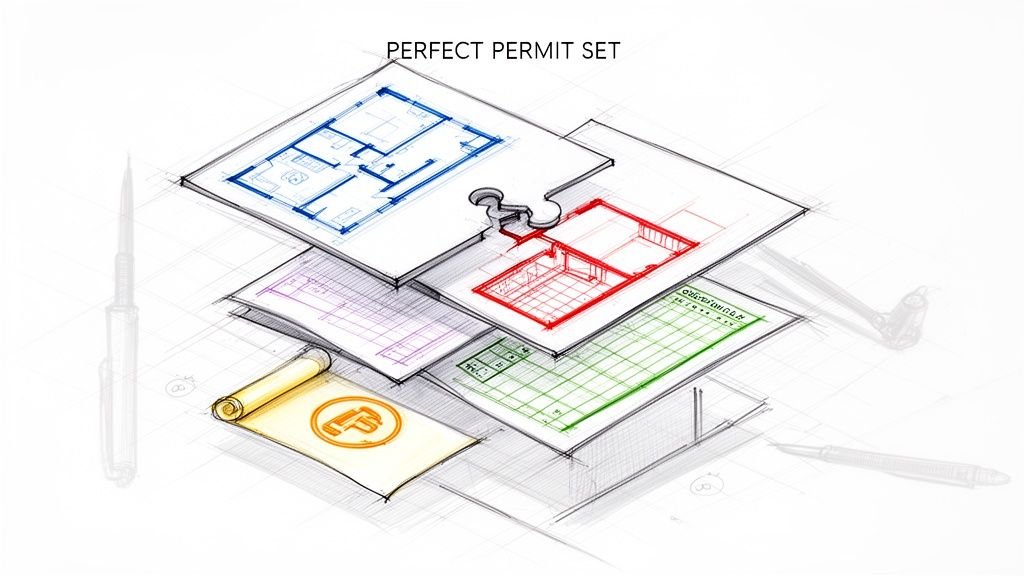
You submit a commercial permit set that would have sailed through on a residential project—well-organized floor plans, clean elevations, complete dimensions—and it comes back rejected. Not for sloppy drafting. For a missing a UL design number on a fire-rated corridor wall. Or for an egress analysis that shows occupant loads but doesn't trace the egress paths to discharge. Or for an energy compliance report submitted as a separate PDF that the building department flagged as incomplete because it wasn't coordinated with the mechanical drawings in the set.
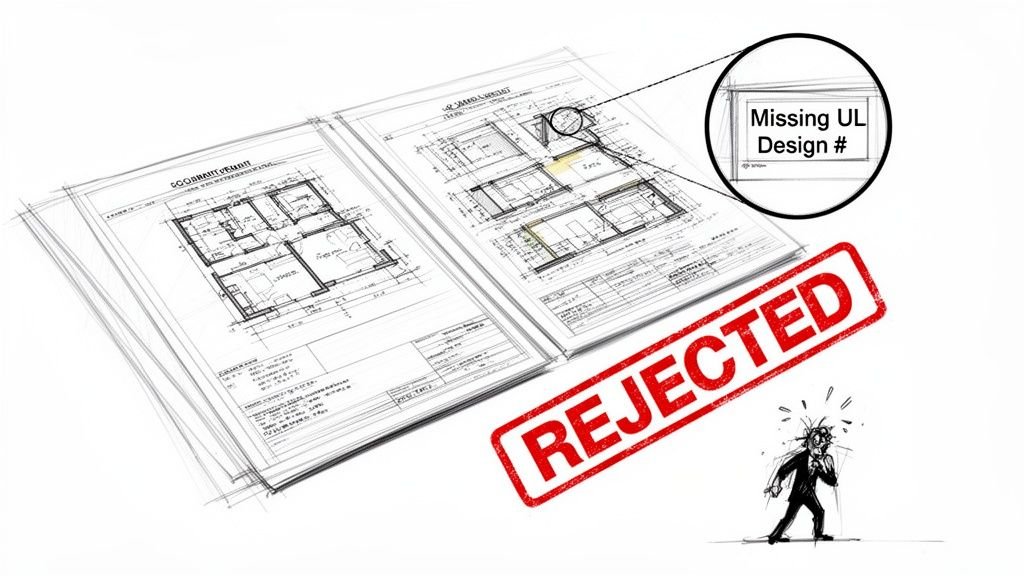
The underlying reality: commercial permit review is structured around a fundamentally different code framework than residential. The IRC governs houses; the International Building Code (IBC) governs everything else. And the IBC's permit review process is layered, multi-agency, and evaluates things residential review never touches. The cost of a rejection isn't just a bruised ego; it's blown timelines and eroded margins, which is exactly why permit set gets rejected. This article walks through what each reviewing agency is looking for and what the set must contain to satisfy all of them.
Why Commercial Permit Review Is Structurally Different from Residential
To produce commercial permit drawings that pass, you first need to internalize two structural differences from the residential world. First, the code framework itself. Residential projects fall under the International Residential Code (IRC), a prescriptive code that tells you exactly what to do. A reviewer checks that you did it. Simple.
Commercial projects, however, fall under the International Building Code (IBC), a performance-based code. The IBC establishes objectives—life safety, structural integrity, accessibility, energy efficiency—and your permit drawings must demonstrate that the design achieves those objectives. The difference in what the set has to prove is significant.
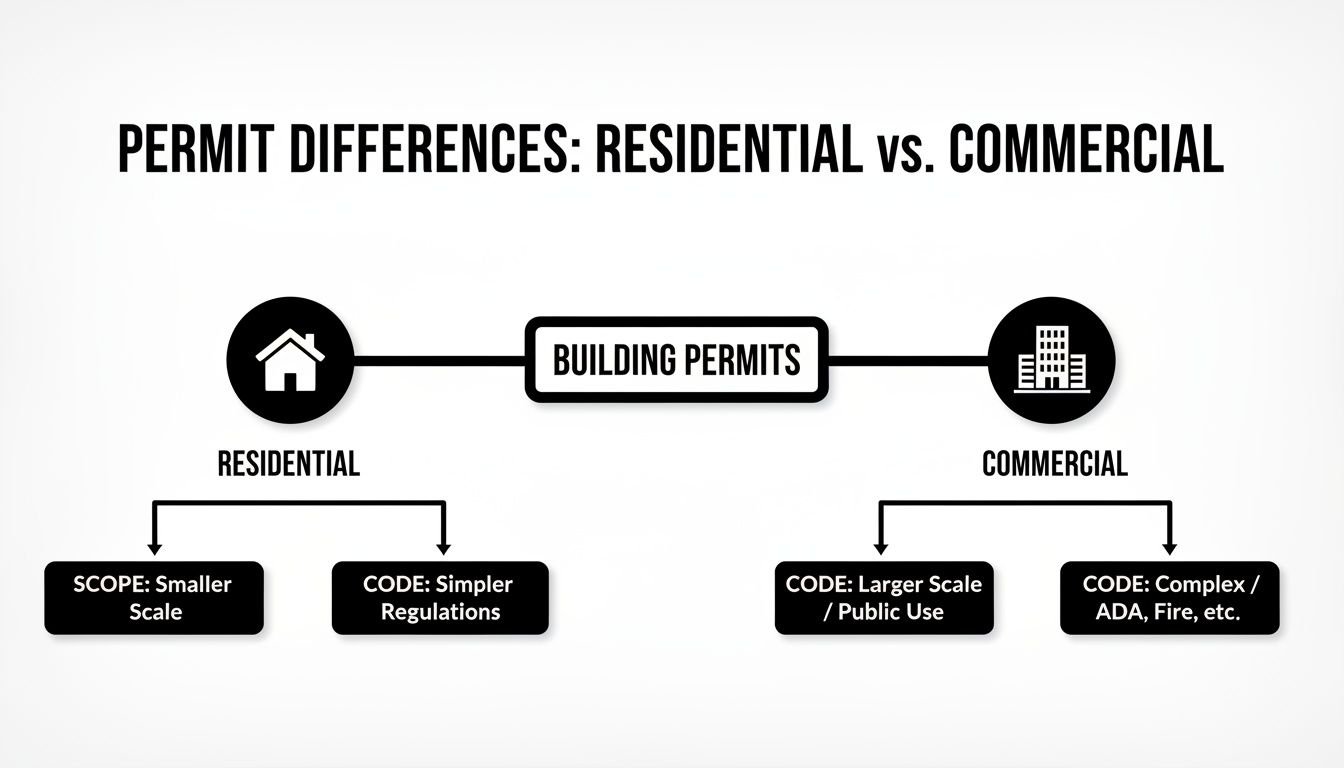
The second structural difference is multi-agency review. A residential permit set typically goes to one building department. A commercial permit set routinely triggers parallel review by multiple agencies: the building department, the fire marshal, an accessibility reviewer, and often an energy compliance office. Each agency checks different things, and a set that satisfies the building department may still be rejected by the fire marshal. Producing a successful commercial building permit drawing set means answering every agency's questions simultaneously, not just the building department's.
Occupancy Classification—The Decision That Drives Everything Else
Occupancy classification is the foundational IBC analysis that determines almost everything your permit set must show. Architects newer to commercial work often treat it as a formality. Plan reviewers see it as the lynchpin of the entire submission.
Under the IBC, every building and every space is assigned an occupancy group (e.g., Assembly, Business, Mercantile). This classification determines the required fire-resistance ratings for structural elements, the allowable construction type, the egress requirements, sprinkler mandates, and maximum allowable area and height. A plan reviewer cannot evaluate whether the design is code-compliant without knowing the occupancy classification. If the set doesn't make it explicit, it gets flagged.
What the permit set must show is not just a label. The occupancy classification for each area must be clearly marked on the floor plan or on a dedicated code analysis sheet. For a deeper dive into the numbers, our guide on determining occupancy load can be a useful resource. For mixed-occupancy buildings, the drawings must detail how separation is handled—rated fire barriers or applying the most restrictive rules throughout. That code analysis sheet should also identify the construction type, sprinkler status, and the allowable building area and height calculation under IBC Table 506.2. This isn’t optional documentation; it’s the analytical foundation the entire review depends on.
What the Building Department Is Checking—Structural, Zoning, and IBC Compliance
From the building department's perspective, your commercial permit drawings are a series of questions that need definitive answers. Their review is methodical and starts before they even look at your architectural plans.
Zoning compliance comes first. The reviewer verifies that the proposed use is permitted, setbacks are met on the site plan, parking satisfies local ordinance, and building height and lot coverage are within zoning limits. A zoning rejection is particularly frustrating because it can stop the process cold before any architectural review begins.
Next is a high-level structural adequacy review. The plan checker isn't re-engineering the building, but they are confirming that gravity and lateral loads are addressed, the foundation type is appropriate, and—most critically—that the structural drawings are perfectly coordinated with the architectural plans. A column in one spot on the architecture plan and another on the structural plan is an immediate rejection flag.
The core of their review is IBC compliance. They are verifying the construction type against IBC Table 601, confirming occupancy classifications, ensuring means of egress complies with Chapter 10, and checking accessible routes and elements per Chapter 11. Your job is to make their job easy. The code basis for every significant design decision should be stated directly on the drawings, leaving nothing for the reviewer to look up. It’s about building a case, not just presenting a design.
What the Fire Marshal Is Checking—And Why It's a Separate Submission
Fewer architects understand that the fire marshal's review is often a completely separate submission with its own checklist and timeline. Your architectural permit set must contain enough information to initiate that review, even before a fire suppression contractor prepares shop drawings. Failing here is a common and costly mistake.
Egress analysis is the most frequent source of fire marshal rejection. The permit set must show occupant load calculations for every space per IBC Table 1004.5, egress capacity calculations, the required number of exits, maximum travel distance in commercial buildings per IBC Table 1017.1, and the complete egress path to a point of safe discharge. This analysis must be graphically shown on the floor plan—not just stated in a table. The reviewer must be able to trace the path from any point in the building.
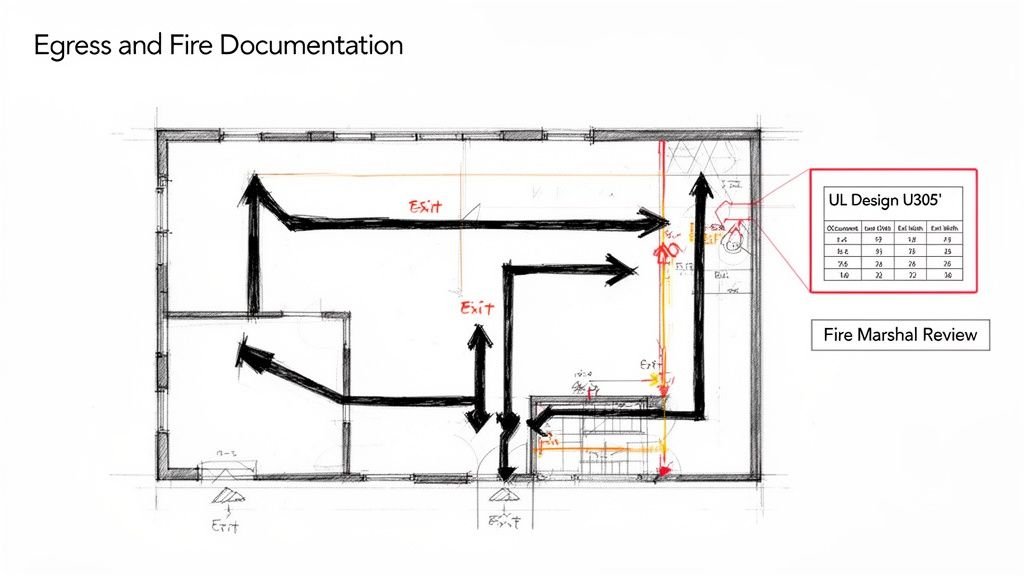
Fire-rated construction documentation is the other major trigger. Every rated assembly must reference a UL design number (or equivalent) that confirms it achieves the required rating. "1-hour rated wall" is not sufficient. "UL Design U305—1-hour rated wall" is. This applies to corridor walls, stair enclosures, shaft walls, and occupancy separations. The sprinkler and fire alarm scope must also be clearly defined, confirming whether the building is fully sprinklered or not, as this changes dozens of other code requirements.
Accessibility Documentation—What ADA Plan Review Requires
Accessibility review is the third critical checkpoint, and "ADA compliant" as a general note on the cover sheet is a statement the reviewer cannot verify. It's an automatic flag. Your commercial permit set must provide the proof.
The plan reviewer needs to see the accessible route graphically shown on the site plan and floor plans, from the public way to the entrance and through to all accessible spaces. This route must confirm no barriers—no step changes, no cross-slopes over 2%, and compliant door hardware.
The drawings must also show:
- Accessible parking counts and van-accessible stalls per IBC Section 1106 and ADA Standards on the site plan.
- Fully dimensioned accessible toilet rooms, including turning radii, fixture centerlines, grab bar locations, and door clearances.
- Details for accessible service counters, seating in assembly areas, and routes to stages or platforms.
Even things like sign permit requirements often have accessibility components. This documentation cannot be deferred to construction. The plan reviewer is checking at the permit stage to ensure the design itself is accessible, not taking your word for it. An integrated production workflow ensures these details are baked in, not bolted on.
Energy Compliance—COMcheck and What the Set Must Show
Energy compliance is frequently the last item prepared and the first flagged as incomplete. In most US jurisdictions, commercial projects demonstrate compliance with ASHRAE 90.1 or the IECC using COMcheck, the DOE's compliance software. The COMcheck report must be submitted with the permit set, not as an afterthought.
However, the report alone isn’t enough. The permit set must show the data the COMcheck report is based on. If the report and the drawings show different values, the reviewer flags it as a coordination failure—which means rejection.
Your commercial building permit plans must show:
- Wall, roof, and floor assembly R-values or U-values on wall sections or an envelope schedule.
- Fenestration U-factors and SHGC values on the window and door schedule.
- Lighting power density calculations on the lighting plans.
- HVAC system efficiency specifications on the mechanical drawings.
A disciplined BIM workflow is the best defense against this kind of coordination error, ensuring the model data used for the COMcheck report is the same data shown on the drawings. It’s about creating a single source of truth that satisfies the reviewer.
Turning Questions into Clarity for First-Pass Approval
Commercial permit review isn't harder than residential because the drawings are more complex—it's harder because the commercial permit drawings have to simultaneously satisfy multiple agencies, each with a different evaluative framework. A set that satisfies the building department but omits UL design numbers fails the fire marshal. A set with correct occupancy loads but an unclear egress path fails that same review. A set with a COMcheck report that doesn't coordinate with the drawings fails energy review.
The common thread is that permit sets get rejected when they create questions. A successful IBC permit set makes every agency's approval decision as easy as possible by leaving nothing open to interpretation.
For architecture firms that need to produce fully coordinated, code-annotated permit sets that are ready for multi-agency review, BIM Heroes provides commercial construction documentation services as a production partner. We deliver the systems and predictability required for obtaining a building permit without the costly delays of rework and resubmission.