Have you ever had the same building design sail through approvals in two weeks, only to have an identical project rejected three times over two months by a neighboring jurisdiction? The difference wasn't the design; it was the quality of the permit set. A permit set that gets approved quickly isn't lucky—it's intentionally organized to succeed.
Those that get stuck in endless review cycles, plagued by correction letters for missing information, are a symptom of a production process that fails to see the documents from the plan reviewer's perspective. A successful submittal isn't just a set of construction drawings submitted early; it’s a purpose-built package designed to demonstrate code compliance and anticipate every question a building official will ask.
The difference between a permit set that sails through review and one that cycles repeatedly often comes down to three things: organization, completeness, and clarity.
Why Permit Set Organization Matters as Much as Content

The pain of a permit stuck in review is a direct hit to your margins and schedule. Plans get kicked back for missing occupancy load calculations that seemed obvious, correction letters list dozens of items because sheets were incomplete, and permit timelines blow project schedules apart. This isn't bad luck; it’s a failure of production discipline.
A well-structured permit submittal isn’t just about ticking boxes; it’s about protecting your margin, ensuring predictability, and building operational consistency. It demonstrates professional competence that builds credibility with building officials, making them allies in the approval process.
Well-organized permit sets deliver tangible outcomes:
- Information flows logically from general to specific, so reviewers find what they need without hunting.
- Code compliance is demonstrated clearly on every relevant sheet, preventing RFIs before they're written.
- Corrections are minimal and easily addressed, leading to approval on the first or second review.
- Scalable delivery is possible because even junior staff, guided by disciplined templates, can produce review-ready documents.
The core philosophy is simple: stop thinking like a designer and start thinking like a plan reviewer. Your goal is to sell clarity and systems, not just design intent.
Understanding the Permit Review Process

To create a permit set that moves efficiently through plan review, you must understand what plan reviewers actually do. They are not your adversaries; they are professionals under immense time pressure, tasked with one primary job: verifying code compliance. They aren't paid to critique your design, only to confirm it meets the legal requirements for health, safety, and welfare.
How Reviewers Navigate Your Drawings
Reviewers navigate your permit drawings with a specific methodology. They expect information to flow from a high-level project overview to specific, detailed proof of compliance. This logical sequence allows them to methodically verify requirements against a checklist.
If they can't find information quickly, your submittal goes to the bottom of the pile with a correction notice. A messy, disorganized set doesn't just slow them down—it erodes their confidence in your competence and invites scrutiny.
Building Reviewer Goodwill Through Clarity
Every element in your building permit documents should be placed with the reviewer in mind. Your submission should be a focused argument for its compliance.
- Logical Sheet Order: Follow the standard G, A, S, M, E, P discipline sequence. A reviewer expects to find the code analysis on a "G" sheet, not buried in the architectural notes.
- Consistent Symbols and Legends: Don't make a reviewer flip back ten pages to figure out a symbol. Put a legend on every sheet or clearly reference a master legend sheet.
- Clear Cross-Referencing: When a wall section is called out on the floor plan, the reference must be accurate and easy to find.
By organizing your permit submittal to align with their workflow, you give them a clear, efficient path to approval. You aren't just submitting drawings; you're demonstrating professional competence.
Permit Sets vs. Construction Documents: Key Differences

One of the most expensive mistakes a firm can make is treating a permit set and a full set of construction documents (CDs) as the same thing. They are not. Confusing their purpose leads to wasted hours and painful delays.
The permit set has one job: to prove to a plan reviewer that your design complies with all applicable codes. It’s a purpose-built package focused on life safety, structural integrity, accessibility, and energy requirements. Think of it as making a legal argument for your building.
Construction documents, by contrast, are a detailed instruction manual for the contractor. They contain a much higher level of detail—installation instructions, finish specifics, and assembly sequences—that a plan reviewer does not need to see. For more on this, check out our guide on construction documentation services.
What to Include vs. What to Hold for the CD Phase
The key is tailoring the Level of Detail (LOD) from your BIM model for the plan review process. Resist the urge to pack your permit drawings with information that belongs in the CD phase.
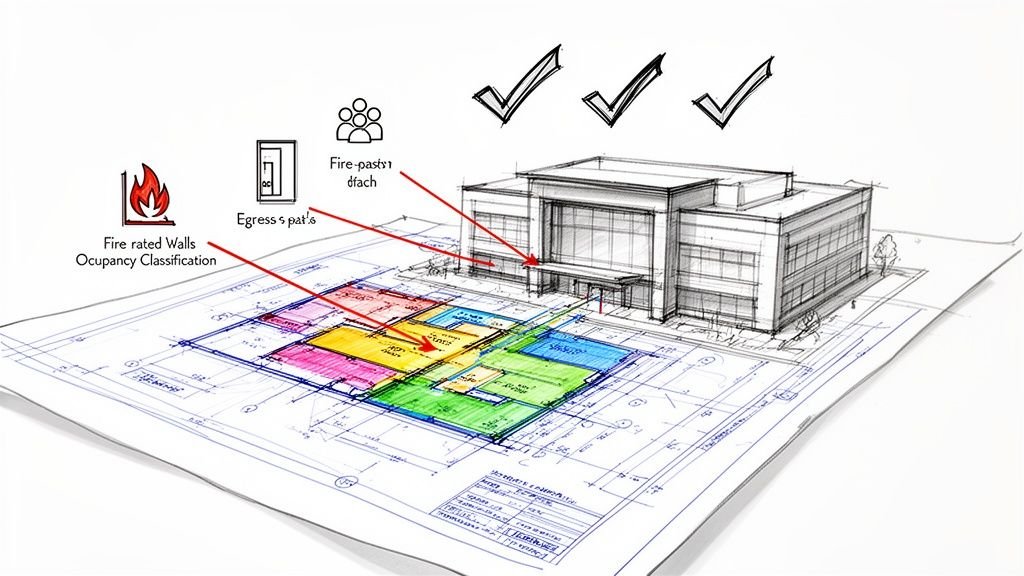
For example, your permit set must show a fire-rated wall with its UL reference, clear egress path dimensions, and accessibility clearances. What it doesn't need is the tile grout color or the mounting hardware for cabinetry. Adding that information just clutters the drawings and forces reviewers to sift through irrelevant details.
Your permit submittal is an argument for compliance, not a manual for construction. Give reviewers only what they need to say "yes." Clarity beats complexity every time.
This disciplined approach is also what enables phased submittal strategies, like getting a foundation permit while the tenant fit-out is still being finalized. A lean, focused building department submission saves time by preventing your team from detailing elements that may change after permit issuance.
The Logic of Sheet Organization
A permit set that sails through review follows a strict logic that reviewers are trained to expect. This organization isn't arbitrary; it builds confidence and streamlines verification.
- General to Specific Flow: The set starts with high-level project data (Cover Sheet) and gradually drills down into specific assemblies (Details).
- Discipline Sequence: Drawings are grouped by discipline, typically in this order: General (G), Architectural (A), Structural (S), Mechanical (M), Plumbing (P), Electrical (E).
- Sheet Numbering Conventions: A consistent numbering system (e.g., A-100s for plans, A-400s for sections) helps reviewers navigate intuitively.
- Cross-Referencing: Every callout for a section, detail, or elevation must be accurate. Broken references stop a review cold.
This consistency signals professionalism and makes the reviewer's job easier, which translates directly to faster approval times.
Sheet G-001: Cover Sheet
Purpose: To provide a complete project overview, code summary, and sheet index. This is the first checkpoint for any plan reviewer.
A reviewer starts here. Missing or incomplete information is the fastest way to get an immediate correction notice without them ever looking at a floor plan.
Required Elements:
- Project Identification: Official project name, full address, and legal description/parcel number.
- Team Information: Contact info for the owner, architect, and all engineering consultants.
- Sheet Index: A complete and accurate list of every drawing in the submittal.
- Location Map: A vicinity map showing the project site in context.
- Code Analysis Summary: The data block proving compliance. This must include:
- Applicable building code (e.g., 2021 IBC).
- Occupancy classification(s).
- Construction type.
- Building area calculations (allowable vs. actual, by story and total).
- Height calculations (allowable vs. actual).
- Occupancy load summary.
- Required fire protection systems (sprinklers, alarms).
- Referenced accessibility and energy codes.
Common Deficiencies: Incomplete code analysis (e.g., "Per Code"), missing occupancy load summary, or an outdated sheet index that doesn't match the drawing set.
Sheet G-002: Life Safety Plan
Purpose: To graphically demonstrate compliance with all egress and fire/life safety requirements. This is the most scrutinized part of any permit set.
Life safety is a primary concern for every building department. Incomplete or unclear information on this sheet guarantees rejection.
Required Elements:
- Occupancy Load: Show the calculated occupant load for every room and space, with the math shown directly on the plan.
- Egress Paths: Clearly draw and dimension all exit access paths, from the most remote point to the public way.
- Travel Distances: Dimension the total travel distance, common path of travel, and any dead-end corridors.
- Exit Signage & Emergency Lighting: Show locations to prove full coverage.
- Fire-Rated Construction: Clearly indicate all fire barriers, smoke barriers, and fire-rated walls, floors, and openings.
- Fire Protection: Show fire extinguisher locations, fire alarm devices, and indicate sprinkler coverage.
Common Deficiencies: Missing travel distance dimensions, unclear egress paths that are not dimensioned, or occupancy load calculations not shown.
Sheet G-003: Accessibility Plan/Analysis
Purpose: To demonstrate compliance with ADA and local accessibility codes in one consolidated place.
Accessibility review is often performed by a dedicated specialist. Providing a dedicated sheet streamlines their process and prevents them from having to hunt for information across the entire set.
Required Elements:
- Accessible Route: A continuous, unobstructed path from the site arrival point (parking, public sidewalk) to and throughout the building.
- Clearances: Show required maneuvering clearances at doors, in restrooms, and at controls.
- Parking & Signage: Document accessible parking counts, locations, and signage.
- Restrooms: Show accessible restroom locations, counts, and clear floor space at fixtures.
- Ramps & Slopes: Indicate all ramp slopes, landing dimensions, and handrail information.
Common Deficiencies: Unclear accessible route, missing door maneuvering clearances, or ramp slopes not explicitly dimensioned.
Sheet A-001: Site Plan
Purpose: To show the building's placement on the property and its relationship to zoning and site-related code requirements.
The site plan is where zoning compliance is verified. Many jurisdictions require site plan approval before architectural review can even begin.
Required Elements:
- Property Lines & Setbacks: Fully dimensioned property lines and all required building setbacks.
- Building Footprint: The dimensioned footprint of the proposed structure.
- Fire Department Access: Clearly marked fire lanes and hydrant locations.
- Parking & Accessible Route: Show the full parking layout with accessible spaces and the route to the building entrance clearly marked.
- Zoning Data Table: A summary showing required vs. provided values for lot coverage, FAR, setbacks, and parking.
- North Arrow and Scale.
Common Deficiencies: Missing setback dimensions, unclear property lines, or zoning compliance data absent from the sheet.
Sheet A-101 (and following): Floor Plans
Purpose: To show the building layout, room functions, and core code-related information. This is the heart of the building permit documents.
Reviewers spend most of their time on floor plans, cross-referencing information to verify room uses, dimensions, and egress components.
Required Elements:
- Room Labels & Dimensions: Every room must be labeled with its use/function and have clear overall dimensions.
- Wall Types: All walls should be identified by type, with fire-rated walls clearly indicated (e.g., with a bold linetype and note).
- Egress Components: Mark all exits, show door swings, and dimension corridor widths.
- Plumbing Fixtures: Show fixture locations for code and count verification.
- Cross-References: Accurate and legible callouts for building sections, wall sections, and details are mandatory.
Common Deficiencies: Rooms not labeled with their specific use, critical dimensions missing, or fire-rated walls not clearly identified.
Sheet A-201: Reflected Ceiling Plans
Purpose: To document ceiling construction, heights, and the coordination of overhead life safety and MEP systems.
Ceiling space coordination is critical, and this is where reviewers verify the integrity of fire-rated ceiling assemblies and check for required clearances.
Required Elements:
- Ceiling Heights: Explicitly note all ceiling heights, especially at changes and in accessible routes.
- Fire-Rated Assemblies: Identify any rated ceiling assemblies with a clear note and a reference to a UL design number.
- System Components: Show locations for lights, exit signs, emergency lights, sprinkler heads, and HVAC diffusers to demonstrate coordination.
Common Deficiencies: Ceiling heights missing, or fire-rated assemblies identified without a corresponding UL design number.
Sheet A-301: Exterior Elevations
Purpose: To show the building's exterior appearance, verify height compliance, and check exterior wall requirements.
Reviewers use elevations to confirm the building doesn't exceed height limits and that exterior walls have the proper fire resistance based on their proximity to property lines.
Required Elements:
- Overall Building Height: A clear dimension from the established grade reference to the highest point of the roof structure.
- Exterior Finishes: Label all materials.
- Openings: Show all window and door locations.
- Grade Lines: Show both existing and proposed grade to establish the datum for height measurements.
Common Deficiencies: Building height dimension is unclear or missing, materials are not labeled, or the grade reference datum is absent.
Sheet A-401: Building Sections
Purpose: To illustrate vertical relationships, construction assemblies, and provide another point of height verification.
Sections are essential for verifying vertical code compliance, including floor-to-floor heights, shaft construction, and the integrity of rated floor/roof assemblies.
Required Elements:
- Vertical Dimensions: Show all floor-to-floor heights, ceiling heights, and the overall building height.
- Construction Assemblies: Call out floor, roof, and wall assemblies with references to their type and fire rating.
- Stairs & Shafts: Show stair sections and the construction of all vertical shafts (e.g., elevators, mechanical chases).
Common Deficiencies: Key heights are not dimensioned, assemblies are not identified, or fire ratings are absent from callouts.
Sheet A-501: Wall Sections and Details
Purpose: To provide detailed proof of how construction assemblies meet code requirements for fire resistance, energy, and weatherproofing.
This is where you prove how your assemblies work. For a plan reviewer, a detail of a 2-hour fire-rated wall is incomplete without a direct reference to its UL design number (e.g., U411). The reference is the proof.
Required Elements:
- Assembly Identification: Clearly label each assembly with its type and fire rating.
- Component Layers: Show insulation, weather barrier, and other critical layers.
- Key Connections: Detail the connections at the foundation, roof/parapet, and openings.
- Fire-Rated Assembly Details: Must include a reference to a specific UL, GA, or other tested assembly number.
Common Deficiencies: Fire-rated assemblies shown without a UL number reference, or incomplete assembly information.
Schedules: A-601, A-602, A-603
Schedules for doors, windows, and finishes are not just data tables; they are tools for systematic code review.
- A-601 Door Schedule: Must include fire ratings, hardware information (for egress and accessibility), and sizes for every door. Common Deficiency: Fire ratings are missing or hardware is not specified for accessibility compliance.
- A-602 Window Schedule: Must include safety glazing locations, energy performance values (U-value, SHGC), and egress information for residential projects. Common Deficiency: Energy values are missing or do not match the energy compliance report.
- A-603 Finish Schedule: Must include interior finish class ratings (for flame spread and smoke development) in required locations like exit corridors. Common Deficiency: Flame spread ratings are not indicated.
Engineering and Compliance Documents
A complete permit set depends on coordinated engineering. Structural (S), Mechanical (M), Electrical (E), and Plumbing (P) sheets are either included or submitted as a separate, coordinated package. Any discrepancy—a different room name, a misaligned structural grid—is a red flag. This coordination transforms a collection of drawings into professional construction permit drawings.
Energy Code Compliance Documentation
Most jurisdictions now require a dedicated energy code compliance package. This is not optional.
Required Elements:
- Compliance Path Identified: State clearly whether you are using the prescriptive, trade-off, or performance path.
- Compliance Report: Include the official COMcheck or REScheck report.
- Matching Values: The R-values, U-values, and SHGC values on the drawings and schedules must perfectly match the values in the compliance report.
Common Deficiencies: Missing compliance report, or values on the drawings that do not match the report.
Fire Protection Documentation
Often a deferred submittal by the contractor, your architectural plans must still show that the system has been accounted for. This includes indicating sprinkler coverage, fire alarm device locations, and the location of the fire department connection.
Your Pre-Submittal Audit Checklist
The single most valuable step is the one you take right before submittal: a rigorous internal audit. Catching your own mistakes is always cheaper and faster than learning from a rejection letter.
High-Level Checks:
- Is every sheet listed in the index present and accounted for?
- Is the code analysis on the cover sheet complete and correct?
- Are professional seals and signatures applied where required?
- Are all application forms complete and fees calculated?
What NOT to Include in Permit Sets:
- Excessive construction detail beyond what's needed for code verification.
- Pricing or bidding information.
- Design alternatives or schematic-level information.
Run through every sheet, thinking like the reviewer who will see it for the first time. Is the egress path clear? Are the dimensions present? Does the cross-reference work? This QA process is your last line of defense in protecting project margins and schedules.
A perfect permit set is the foundation of a predictable, profitable project. It demonstrates production maturity and a commitment to clarity that building officials recognize and reward with faster approvals.
If your team is ready to move beyond the cycle of rejections and build operational consistency, a disciplined documentation process is the key. For a more detailed framework, download our Complete Permit Set Checklist—a tool designed to help you deliver clarity and consistency on every project.