Meta title: Outsourcing MEP Engineering Services: A Vetting Guide
Meta description: What to expect when outsourcing MEP engineering services, and a practical framework for vetting a potential partner.
Category: MEP Engineering
A lot of firms don't start looking at MEP engineering services because they want a new vendor. They start because a live project is getting tight, a bid opportunity is worth pursuing but there's no in-house MEP bench, or a coordination package is weaker than the field team can safely absorb. That's usually the key tipping point. Capacity breaks first. Then process gaps become visible.
That's why outsourcing MEP support works best when it's treated as a production decision, not a purchasing exercise. The external team typically supports modeling, coordination, documentation, and design-development execution. It usually does not replace the licensed Engineer of Record for final review, code responsibility, or stamped deliverables where jurisdiction and scope require that line to stay clear.
The Tipping Point for Outsourcing MEP Support
The pattern is familiar. An architecture firm wins a project that needs stronger building systems coordination than its internal team can cover. A GC moves from schematic intent into active coordination and realizes the MEP subs aren't giving the model depth needed to avoid downstream noise. A smaller MEP firm lands enough work to strain production, but not enough to justify permanent hiring in every discipline.
Those situations are getting more common as project demand expands. The global MEP services market reached approximately USD 165.16 billion in 2025 and is projected to grow to USD 301.10 billion by 2035 at a 6.9% CAGR, driven by infrastructure renewal and green building initiatives, according to this MEP market projection.
What matters on the ground is simpler. Teams need predictable output, not extra management burden.
A weak external production setup doesn't remove pressure from your team. It relocates that pressure into reviews, redlines, and late clarification cycles.
Good outsourcing can help with exactly that. It can also support broader efforts around reducing inefficiency in business operations, especially when bottlenecks come from handoff friction, inconsistent file standards, and avoidable rework. The value isn't “cheaper drafting.” The value is delivery control when your internal capacity or discipline coverage isn't enough.
Understanding the Scope of Outsourced MEP Services
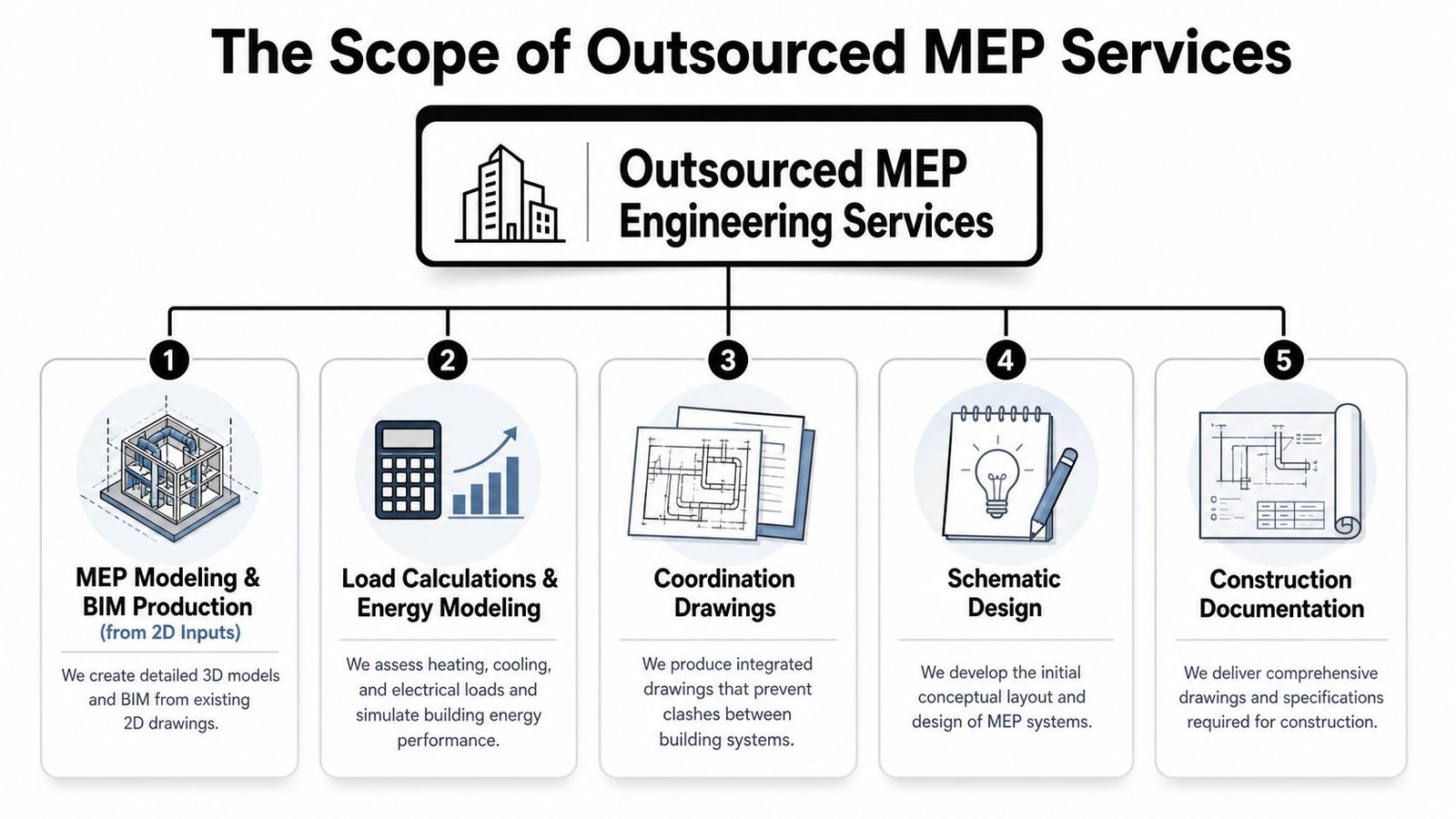
When firms say they're outsourcing MEP, they often mean very different things. Some need Revit production from consultant markups. Others need coordination drawings, sheet setup, model cleanup, family management, or permit-oriented documentation support. Some need help pushing 2D CAD work into a cleaner BIM workflow.
What usually sits inside the outsourced scope
A capable partner can usually support work such as:
- MEP modeling and BIM production from 2D backgrounds, sketches, PDFs, or redlined sets in Revit or AutoCAD
- Coordination drawings that align ductwork, pipework, cable trays, equipment clearances, and access zones
- Design development support where layouts evolve through review cycles and consultant feedback
- Construction documentation including plans, sections, schedules, annotations, and sheet organization
- Permit preparation support where documentation needs to be assembled in a consistent, reviewable format
MEP BIM outsourcing is particularly advantageous, as it increases production capacity without requiring your core team to absorb every modeling task themselves. If you want a broader picture of discipline coverage, this overview of MEP design services is a useful reference point.
What usually stays with the licensed Engineer of Record
This distinction matters. In many engagements, the outsourced team supports production, coordination, and documentation. The licensed Engineer of Record typically remains responsible for final engineering judgment, code compliance sign-off, and any stamped documents required by the project or jurisdiction.
That doesn't make outsourced support less valuable. It just defines the boundary correctly.
Practical rule: If a partner talks as if modeling support and engineering liability are the same thing, slow the conversation down.
The best teams are precise about this line. They know how to build models, organize decisions, and prepare coordinated deliverables so the Engineer of Record can review efficiently. That handoff is part of the service, not an afterthought.
Why BIM maturity changes the value
The old CAD-only overflow model was mostly about drafting throughput. Today, the stronger model is built around coordination intelligence. MEP design requires the integration of computational design with BIM to enable early clash detection and reduce design-phase errors, as noted in Budlong's discussion of MEP engineering challenges. That's why template discipline, family standards, and model structure now matter as much as drafting speed.
Choosing the Right MEP Outsourcing Engagement Model
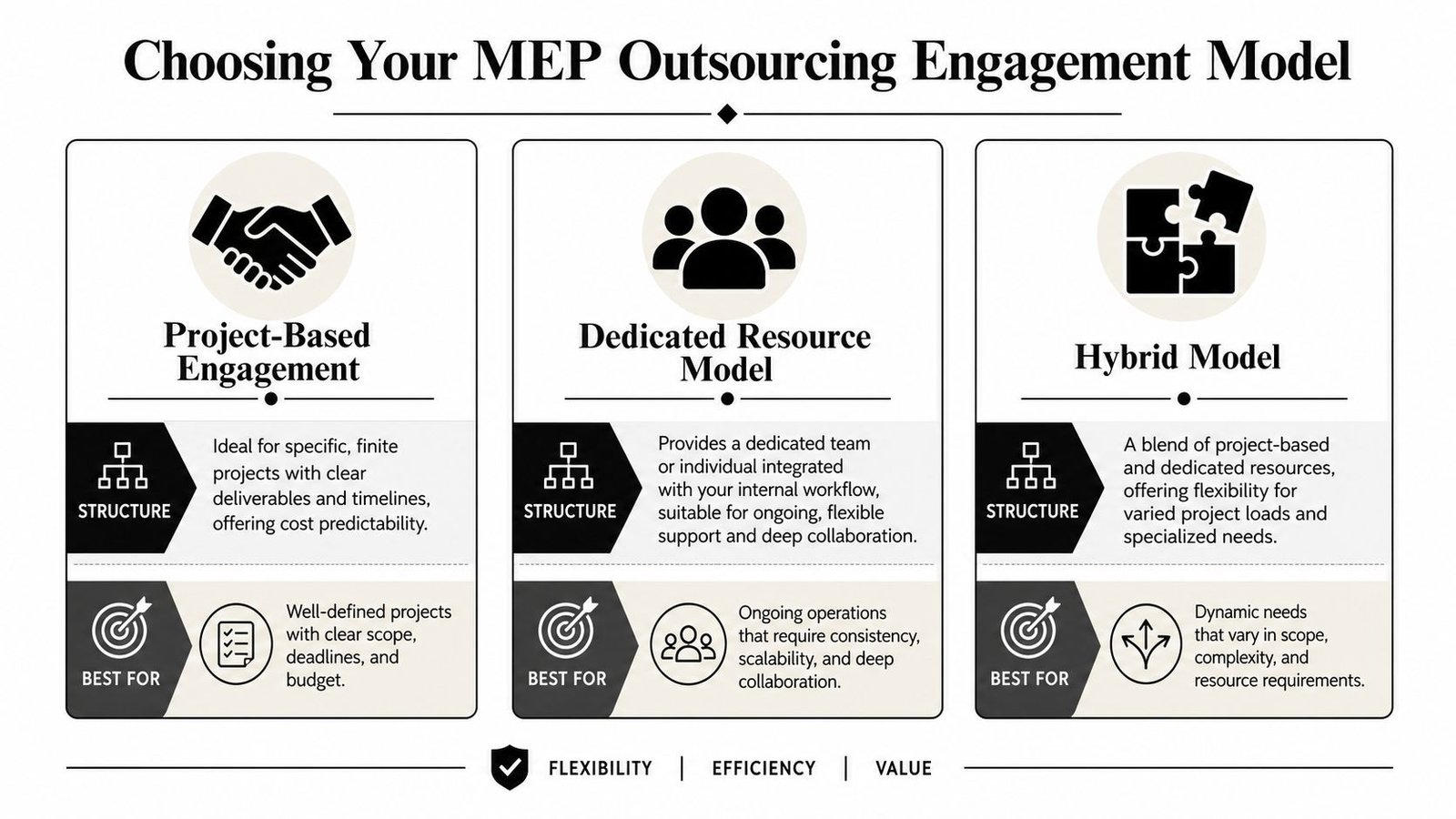
The engagement model shapes everything that follows. It affects budget visibility, review load, responsiveness, and how well the outside team learns your standards. A mismatch here causes more pain than most firms expect.
The three common models
| Model | Best fit | Main strength | Main limitation |
|---|---|---|---|
| Ad hoc or hourly support | Unpredictable overflow, revisions, short bursts of work | Flexibility | Harder to build deep process alignment |
| Project-based fixed scope | One project with defined deliverables | Clear boundaries and cleaner budgeting | Scope drift can create friction fast |
| Dedicated team or retainer | Ongoing pipeline and repeated standards | Stronger integration and consistency | Needs onboarding discipline to pay off |
When ad hoc support works
This model fits firms that don't know what next month looks like. You may need a few sheets updated, coordination help during a busy submittal window, or temporary production relief while internal hires ramp up. It's flexible and easy to start.
The trade-off is continuity. The team may not learn your title blocks, annotation habits, view templates, Revit families, and review expectations sufficiently to reduce management load over time.
When fixed-scope delivery is the better call
For a defined package, fixed scope is often cleaner. If the deliverables, file format, milestone dates, and discipline boundaries are stable, project-based outsourcing keeps expectations tighter. It also forces both sides to define assumptions early, which is healthy.
This model breaks down when the scope is still moving. If the architect is still shifting layouts, if consultant input is incomplete, or if field coordination will drive repeated revisions, a rigid scope can become expensive in management time.
When a dedicated model earns its keep
If you have repeat work, recurring standards, or a backlog that rises and falls but never really disappears, a dedicated production pod is usually the most stable setup. That team learns your naming logic, QA expectations, and revision behavior. Over time, fewer instructions are needed.
For firms exploring related production support structures beyond MEP, this guide on outsource CAD drafting services helps frame how a dedicated model differs from one-off production buying.
The right model isn't the cheapest one on paper. It's the one that creates the least operational drag once live project pressure hits.
Hallmarks of a Mature MEP Production Partnership
At 4:30 p.m. on a permit week deadline, the difference between a workable outsourcing setup and a costly one is obvious. One team sends a coordinated package with open items clearly tagged for review by your licensed engineer. The other sends files that still need basic checking, forcing your PM, discipline lead, and Engineer of Record to spend their evening sorting out production issues they should never have received.
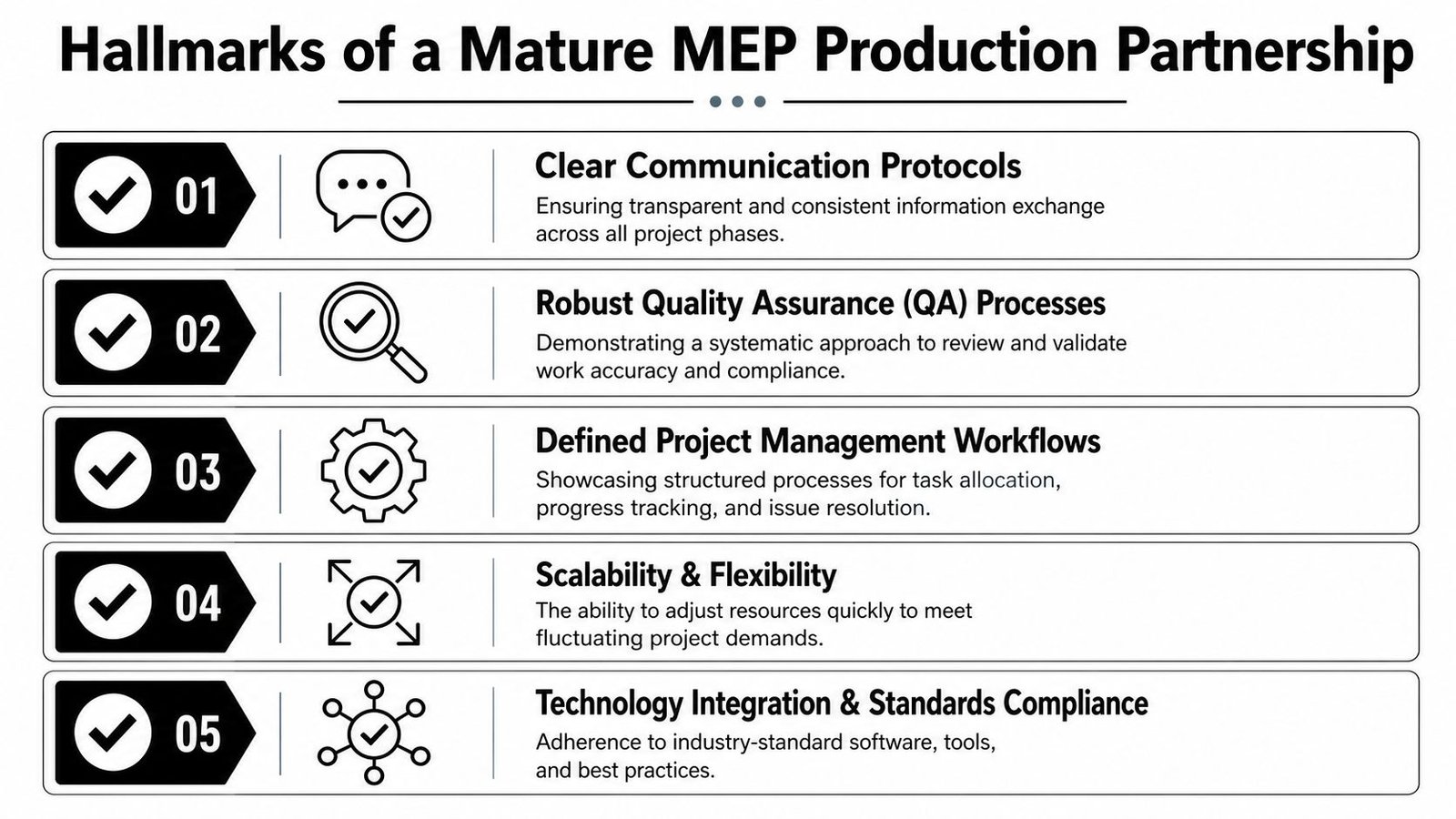
Scope clarity before production starts
A mature partner starts by pinning down where production support stops and where engineering responsibility stays with your firm. That distinction protects everyone. The external team may model, draft, annotate, route systems, build sheets, and incorporate redlines. Your licensed Engineer of Record still owns design intent, code judgment, final review, and any stamped deliverable.
The scope document should reflect that line clearly. I look for model platform, version, discipline boundaries, expected level of development, sheet list, file exchange rules, review dates, clash handling protocol, and named exclusions. If those items are vague, the job usually starts fast and slows down later under revision churn, missed assumptions, and change requests that no one priced correctly.
Good scope language also defines decision rights. The production team should know which issues they can resolve from standards, which require a written RFI, and which must wait for direction from the engineer in responsible charge.
Real QA before your team sees the files
Internal review should catch production errors before they reach your staff. That sounds obvious, but it is where weak vendors create hidden cost. If your engineers are finding broken tags, mismatched schedules, stray view templates, disconnected systems, or inconsistent sheet setup, you are paying twice for the same work.
A useful QA routine usually includes:
- Model checks at each submission stage with discipline-specific review, not just a final pass before issue
- Sheet and annotation checks for tags, keynotes, schedules, callouts, and view references
- Standards compliance checks for families, naming, browser organization, shared parameters, and title block use
- Coordination checks that confirm the package is reviewable, even when some design decisions are still pending
- Handoff checks for the Engineer of Record so comments focus on engineering decisions, not drafting cleanup
That last point matters. A production partner supports the EOR. It does not replace the EOR.
Coordination judgment shows up in the questions
Software skill gets a team into the job. Judgment keeps the job on schedule.
Strong partners do not force duct, pipe, or cable tray through impossible zones just to make a clash report look cleaner. They flag congestion early, explain what they see, and present workable options with the right level of detail for your team to decide. On a good team, questions come with context, screenshots, references to the agreed standard, and a recommendation.
That is especially important on multi-discipline work where production support can outrun engineering direction. Firms that want a clearer view of how MEP systems coordinate across building disciplines should keep that systems-level interaction in mind during onboarding, because many production mistakes start as coordination assumptions.
Communication has an operating rhythm
Mature partnerships run on a repeatable cadence. There is a kickoff with standards and file access confirmed. There is a standing review cycle. There is one log for RFIs and pending decisions. There is a rule for after-hours changes and a named person who triages them.
Without that structure, teams mistake message volume for progress.
The best external teams also know how to communicate uncertainty. If backgrounds are incomplete, architectural shifts are still coming, or site information is weak, they say so early and mark affected areas in the model or sheets. That keeps your PM from promising certainty to the client before the package is stable.
Margin protection is the real test
A mature production partnership reduces management drag. Your team spends less time restating standards, cleaning up avoidable errors, and explaining who owns what. Reviews get shorter. Revisions are easier to trace. Forecasting improves because production output becomes more predictable.
That is the standard worth using. If the relationship saves hourly cost but adds review time, coordination noise, or EOR risk, it is not mature. It is just cheaper labor with a larger downstream bill.
A Practical Framework for Vetting an MEP Outsourcing Partner
A vendor can sound capable in a sales call and still create expensive review churn once live work starts. The test is simple. Can they produce coordinated MEP documents inside your standards, with clear limits on what they own and what stays with your project team and Engineer of Record?
That distinction matters. An external production partner can support layout, modeling, drafting, redline incorporation, and sheet development. They do not replace licensed engineering judgment unless you have separately contracted for that responsibility under the right legal structure.
Ask questions that expose how they actually deliver
Start with the mechanics of delivery. General answers are a warning sign because production risk usually hides inside assumptions.
Ask:
- How do you define the scope before kickoff? Look for discipline boundaries, design inputs, software versions, excluded tasks, and who approves assumptions.
- What is reviewed internally before a package reaches us? The right answer names review stages, who checks the work, and what gets verified at each stage.
- How are coordination conflicts handled? You want to hear when they resolve issues independently, when they log them, and when they stop and ask for direction.
- How are revisions tracked? Ask how they manage superseded backgrounds, markups, version history, and turnaround commitments for urgent changes.
- What is your handoff process to our Engineer of Record? A serious team can explain how production output is packaged for licensed review without blurring responsibility for final engineering decisions.
A weak partner usually stays at the software-and-headcount level. A mature one can describe the path from input files to reviewed output.
Ask for proof from live production, not portfolio pieces
Renderings and clean sheet samples do not tell you much. Ask for evidence from actual working files and review cycles.
Useful samples include:
- coordinated sheets with comments resolved
- model views that show congestion and trade interaction
- redline sets with responses
- examples of revision logs
- a package that shows how they handled incomplete or changing inputs
Review those samples like a PM, not like a marketer. Check whether tags are consistent, whether equipment access and service space were considered, whether ceiling zones were treated seriously, and whether comments were closed with judgment instead of cosmetic drafting.
If a sample looks polished but gives you no visibility into how conflicts were handled, you still do not know how that team performs under pressure.
Use a pilot to test fit under real constraints
A pilot should do more than confirm drafting speed. It should test whether the team can work inside your actual project conditions without consuming your margin in management time.
Pick a contained scope with real complexity. A dense riser area, a repeatable tenant floor, or a permit set segment under active review usually tells you more than a simple cleanup task.
Set the pilot up with clear pass-fail checkpoints:
- standards adoption by the first submission
- redline accuracy on the second pass
- response time for open questions
- coordination discipline when inputs change
- package readiness for internal or EOR review
Many firms get false confidence when they assign a low-risk drafting exercise, the partner performs well, then they expand the scope into coordination-heavy work that was never tested.
Press on boundaries until the ownership line is clear
The process of vetting an MEP outsourcing company should end with a written understanding of who owns production, who owns design intent, and who carries licensed responsibility.
Ask direct boundary questions. Will they size systems or only model from marked-up design criteria? Will they select equipment or only place scheduled equipment? Can they respond to AHJ comments, or do they only revise documents based on your team's direction? If they support calculations, who reviews and seals them?
Clear answers protect schedule and liability. They also protect fee. If scope language is loose at the proposal stage, your PM will end up negotiating every gray area during delivery, usually when the deadline is already tight.
Good outsourcing relationships are built on explicit limits. Production support can be extremely effective. It works best when the partner is strong at execution and equally clear about where execution stops and licensed engineering responsibility begins.
Red Flags to Watch For and Your Next Steps
You can learn a lot from what a provider avoids answering. Most delivery problems show up as small warning signs long before they become project risk.
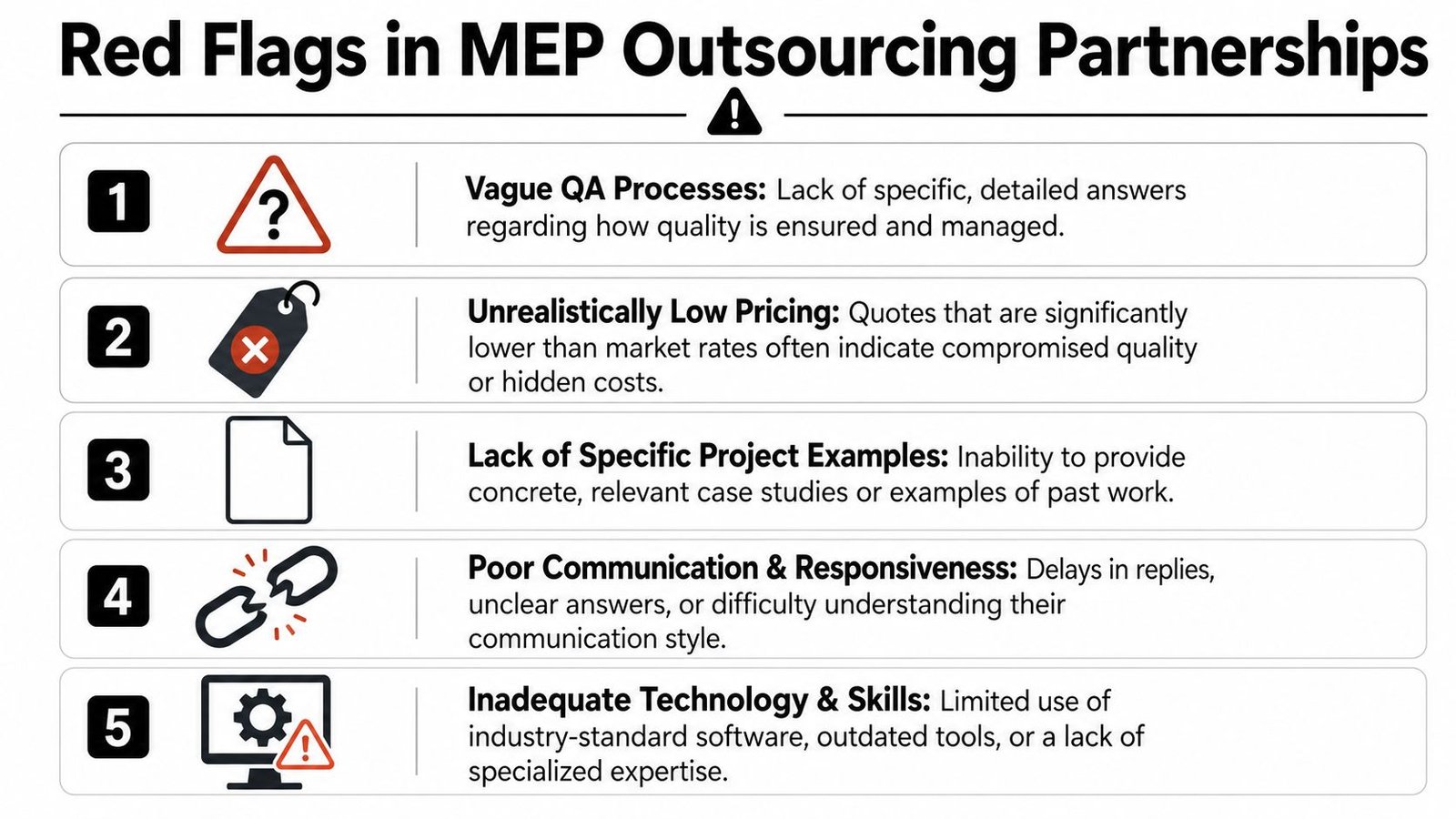
The red flags that usually matter most
- Vague QA language. If the partner can't explain how work is checked before it reaches you, your team becomes their QA department.
- Pricing that feels detached from the scope. Cheap proposals often hide missing review steps, lighter coordination effort, or unclear assumptions around revisions.
- No real sample work. If they can't show coordinated production examples, you're buying a promise.
- Unclear delivery ownership. You should know who's doing the work, who's reviewing it, and whether any part is being subcontracted again.
- Weak communication habits during the sales stage. Slow responses, partial answers, and inconsistent follow-up usually continue after kickoff.
Why partner stability matters
The US MEP engineering services market reached $28.4 billion in 2023, and the industry also faces a 15% annual turnover rate in plumbing trades, according to these US MEP industry statistics. Even if your outsourced scope is mostly digital production, that kind of labor instability is a useful reminder. Stable partners matter because continuity matters. Every reset in people, standards, and context adds friction.
The next move should be practical
If you're evaluating outsourcing MEP engineering, don't start with a long-term commitment. Start with a defined test. Build a short checklist. Review sample work. Confirm handoff expectations to the Engineer of Record. Decide how communication, QA, and revisions will work before a single model element is created.
That's usually the difference between extra capacity and extra cleanup.
If you're building your own evaluation framework for MEP engineering services, BIM Heroes is a good place to explore deeper production resources. Their content and service pages are useful if you want examples of dedicated production support, BIM workflows, and practical delivery structures that help teams standardize coordination, documentation, and scalable project execution.