Meta title: Revit Outsourcing Services for Design-Build GCs
Meta description: How design-build GCs use outsourced Revit production to keep bid cycles, permit sets, and construction schedules on track.
A design-build GC can absorb a lot of pressure. A delayed submittal, an owner revision, a coordination miss. But when production inside Revit stalls at the wrong moment, the problem moves fast from the VDC team to the whole job. Permit dates slip. Procurement decisions wait. Field teams start asking for answers before the drawings are ready to support them.
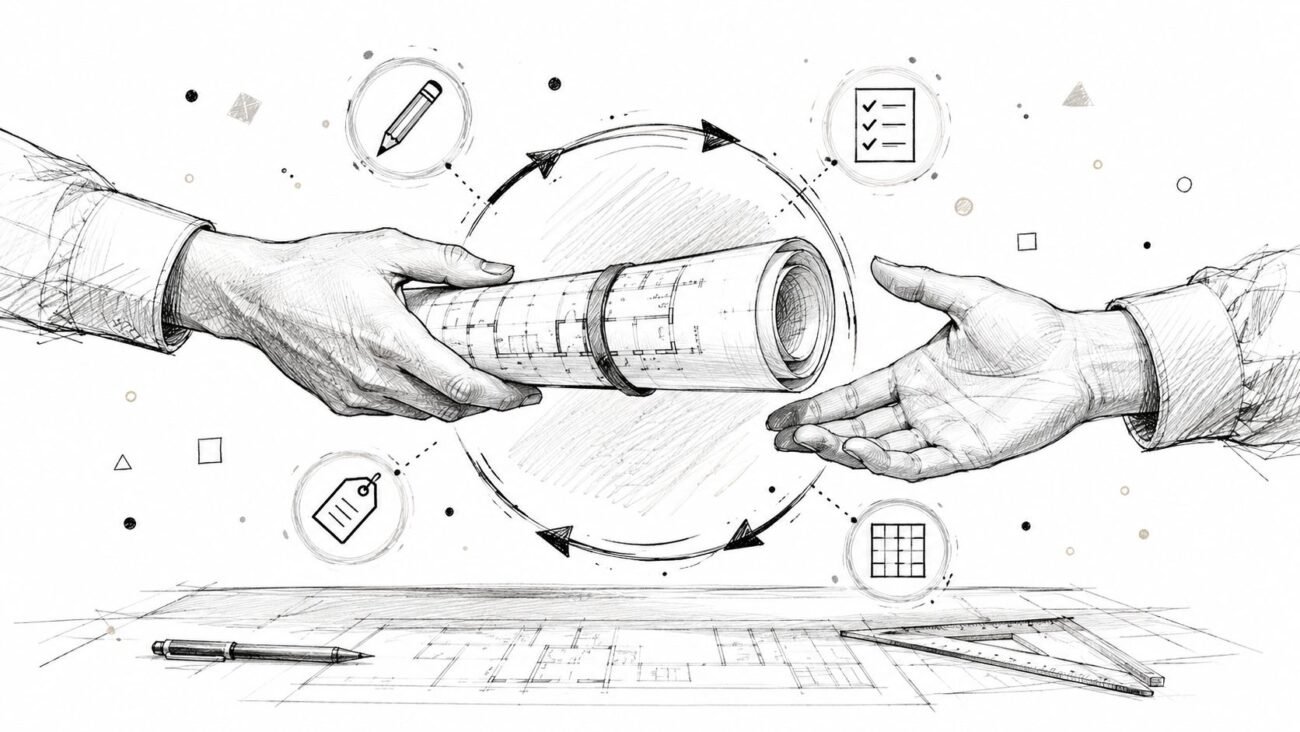
That's the actual context for Revit outsourcing services in design-build. This isn't about handing off design intent. It's about adding disciplined production capacity for modeling, documentation, and coordination support when your internal team gets squeezed by bid deadlines, fast-track packages, and construction-driven revisions.
For design-build teams, schedule pressure rarely arrives in a steady line. It shows up in bursts, usually at the exact point where float is already thin. That's why many contractors are rethinking how they cover production demand. The broader market is moving the same way. The Revit Modeling Outsourcing Services market is projected to grow from USD 1.85 billion in 2025 to USD 3.76 billion by 2032 at 11.2% CAGR, a sign that firms are treating flexible production capacity as an operating model, not a temporary patch, according to Worldwide Market Reports.
Keeping Your Entire Project On Schedule
When your firm owns both the design path and the construction commitment, production delays hit differently. An architecture firm might feel the pain as an internal deadline miss. A design-build GC feels it as risk against the entire delivery sequence. The model isn't just a design artifact. It feeds estimating, coordination, permit prep, procurement logic, and field communication.
That's why schedule-minded teams treat outsourced Revit production as a control measure, not a staffing shortcut. The right support gives your internal leads room to protect decisions while someone else carries defined production tasks forward under clear standards.
Where the pressure lands first
Three situations show up over and over:
- Bid response windows where you need enough modeled intelligence to support scope clarity, visuals, or pricing confidence
- Permit set crunches where drawing output has to move faster than your base staffing plan allows
- Live project changes where field conditions force updates back into the model before confusion spreads
A lot of teams try to solve that with overtime. Overtime can help for a week. It's a poor operating system for a quarter.
Field lesson: If your production capacity depends on everyone staying late, your schedule is already more fragile than it looks.
The better approach is to match labor structure to workload shape. Teams already doing that in other parts of preconstruction tend to make better use of tools that support construction scheduling software workflows, because the model and the schedule stay aligned instead of drifting apart under deadline pressure.
The Bursty Workload of Design-Build Delivery
Design-build demand doesn't arrive in a smooth curve. It spikes.
One week the in-house team is building proposal graphics, updating DD content, and answering pricing questions for a pursuit that might not even convert. Two weeks later, that same group is asked to push a permit package while another project needs construction revisions folded into the current model. Then there's a lull. Then another spike.
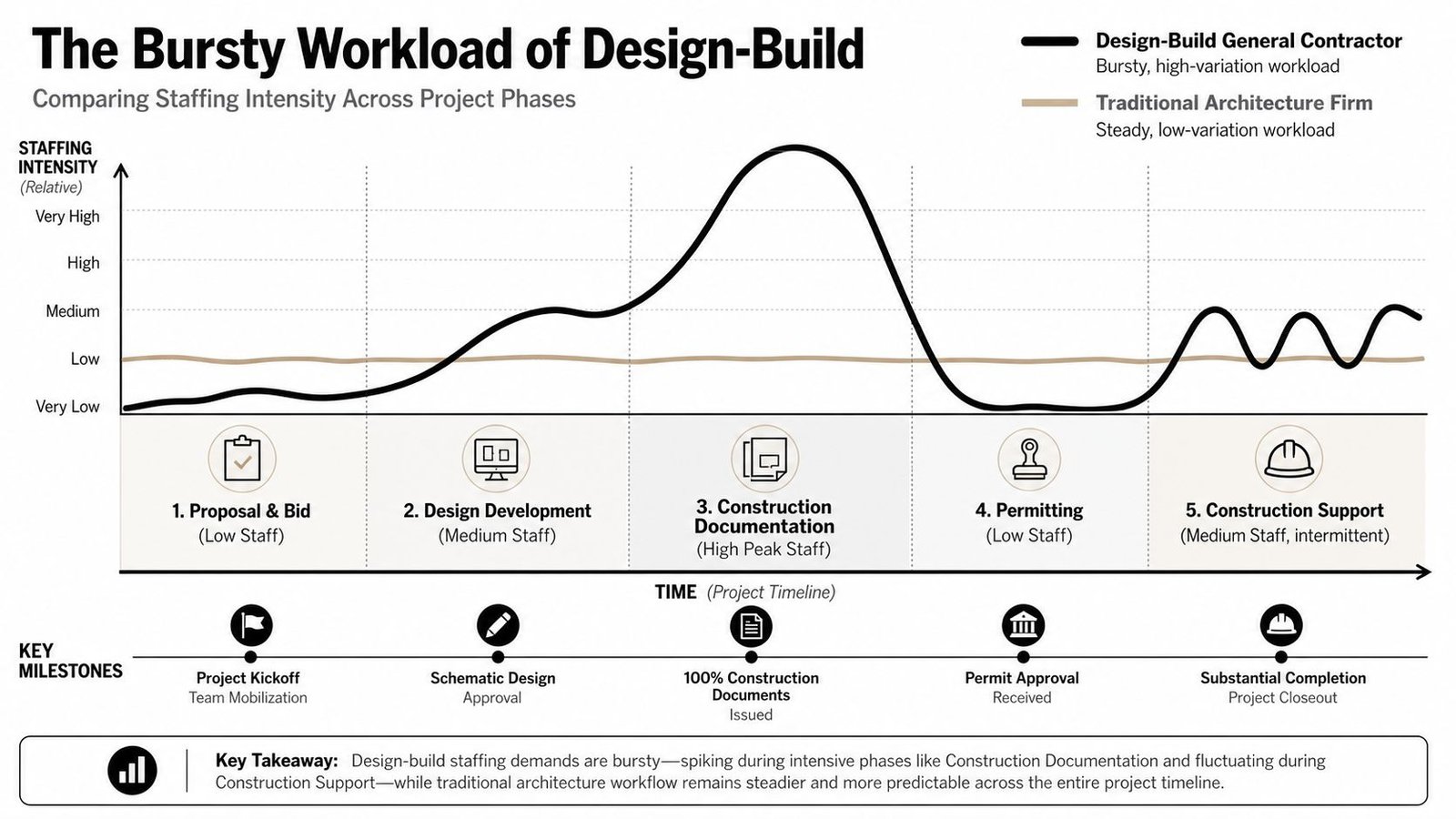
A traditional architecture practice often has a more predictable rhythm across phases. Design-build GCs usually don't. They're carrying pursuit work, active delivery, and construction support at the same time. Those streams overlap, and they rarely peak politely.
Why steady-state staffing fails here
If you size your internal team for average demand, you'll be short during the moments that matter most. If you size for the peaks, you'll carry expensive idle capacity during the valleys. Neither choice is wrong in principle. It just means the labor model and the project reality don't line up.
That mismatch creates familiar symptoms:
- Proposal teams borrow production staff from active jobs and create downstream slippage
- Permit deadlines compress review time, which raises the odds of avoidable misses
- Construction support starts reacting instead of leading, because model updates lag behind field needs
Design-build staffing breaks when leaders assume linear workload and then act surprised by deadline clusters.
What design-build teams actually need
They need a production layer that expands and contracts without forcing a permanent headcount decision every time the calendar gets ugly. That's what design-build GC Revit support should do. It should absorb overflow without creating confusion about ownership, standards, or approvals.
The mistake is treating outsourced help as a generic drafting pool. That rarely works on complex contractor-led delivery. Bursty work needs a team that can plug into existing BIM workflows, honor template discipline, follow naming and sheet conventions, and turn around scoped tasks without becoming another management problem.
A good external production pod reduces turbulence. A bad one creates it.
Where Revit Production Bottlenecks Threaten GCs
The bottlenecks usually aren't mysterious. They show up at predictable points where decisions, drawings, and construction timing collide.
Bid and proposal windows
Pursuit work creates one of the hardest staffing problems in design-build. You need enough modeled information to support pricing, visuals, options, and scope understanding. But the job isn't won yet, so loading permanent payroll for every opportunity doesn't make much sense.
That's where outsourced Revit production can be useful if the scope is tightly framed. Conceptual massing clean-up, DD-level plan and elevation development, quantity-supportive modeling, and presentation-ready views are all production-heavy tasks that can move externally while the internal team protects design strategy and client-facing decisions.
The bottleneck starts when proposal effort competes with live jobs for the same modelers and documentation staff.
Fast-track permit packages
Fast-track work rewards teams that can split authority from production without losing control. The architect or engineer of record still owns design responsibility. The GC still owns schedule pressure. The model and sheet production still have to move.
Permit packages are where backlog gets expensive. Not always because the work is technically difficult, but because review cycles tighten and parallel activities keep moving. If drawing output falls behind, procurement and field planning start making assumptions without current information.
A disciplined external team can carry redline implementation, view setup, sheet composition, annotation under house standards, and repetitive documentation tasks. That keeps internal leads focused on coordination decisions and permit-facing review.
Mid-construction revisions
Many teams often experience significant pain in this regard. Field-driven changes, RFIs, sketch responses, owner adjustments, and trade coordination updates all need a path back into the model. If they don't, the job starts operating with split realities.
The practical impact isn't abstract. Superintendents, PMs, and trade partners begin working from different versions of the truth. The model says one thing. The latest PDF says another. A marked-up site sketch says something else.
A production bottleneck during construction isn't just late drafting. It's delayed decision communication.
For design-build GCs, that's why Revit BIM outsourcing for contractors works best when it supports current-state documentation, not just front-end modeling. Keeping the production record aligned with what the field is building is part of schedule protection.
What Revit Outsourcing Services Actually Deliver
The useful version of Revit outsourcing is narrower and more valuable than most vendor pages make it sound. It's production support with process. Not a substitute for project leadership. Not a transfer of design liability. Not a free-form handoff where the GC hopes someone “figures it out.”
What a good external team should own
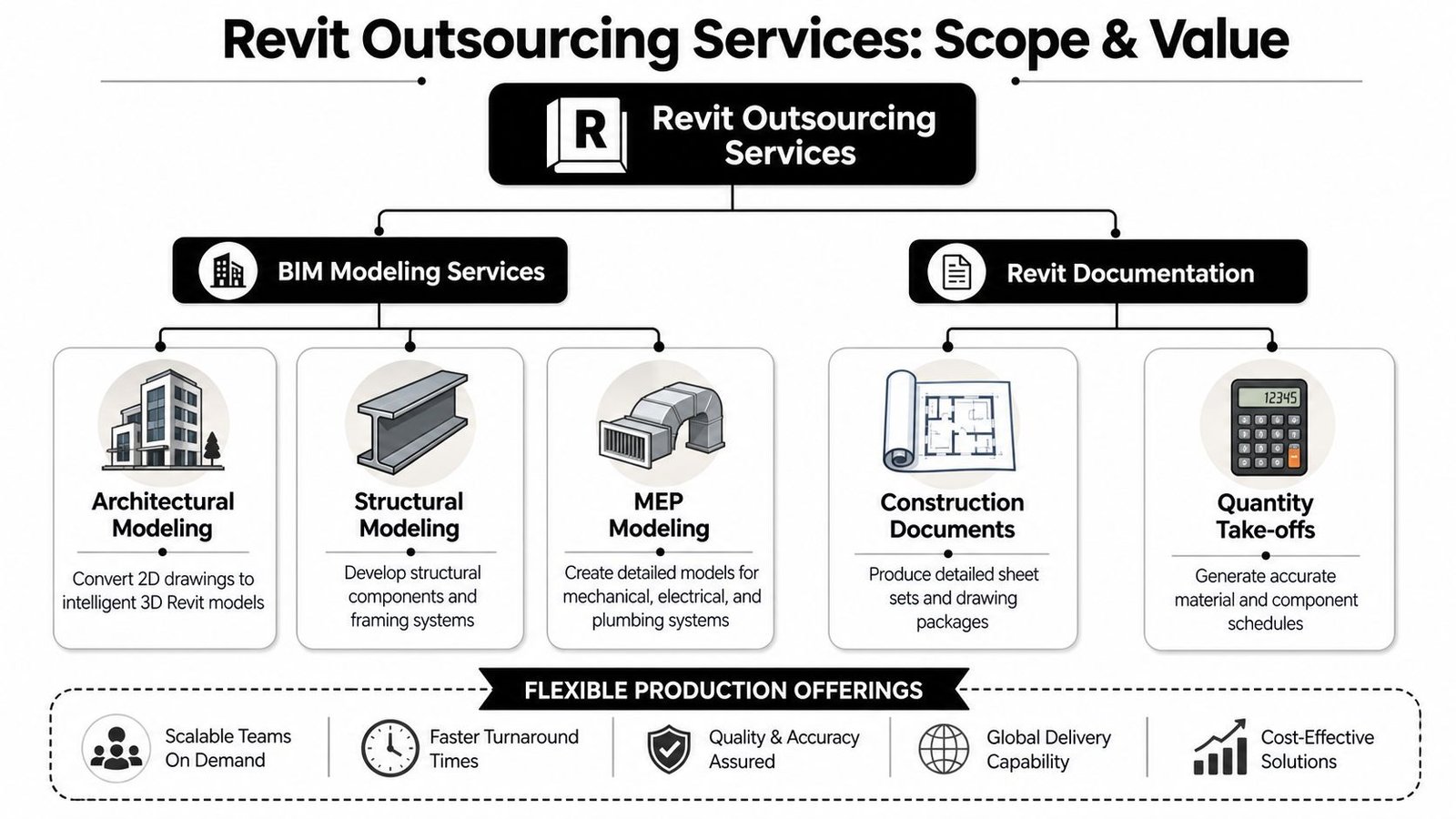
For a design-build GC, the production scope usually lands in a few repeatable buckets:
- Model development work such as architectural modeling, background clean-up, family placement, and scope-specific element buildout
- Documentation production including sheet setup, detailing under standards, annotation, schedules, and permit package assembly
- Coordination support through model updates tied to resolved issues, issued revisions, and field-directed changes
- Backlog relief during CD pushes, proposal cycles, and deadline clusters
Those are the areas where capacity matters most and where work can be measured against clear standards.
What they should prove before touching a live project
Technical competence is not just “we know Revit.” A credible partner should already work inside structured information-management practices such as ISO 19650 or equivalent workflows, use Autodesk-certified staff, and run QA/QC checks with tools like Navisworks or Dynamo to catch clashes and model issues before they reach the field, as outlined by Virtual Building Studio's review of Revit MEP drafting outsourcing.
That matters because production speed without model integrity creates fake progress. The sheets move. The risk stays.
A practical GC should also ask for a paid pilot. Not because trust is impossible, but because approval cycles tell the truth faster than sales language does. If a team needs too many review rounds to meet your standards, that cost lands on your schedule.
The line that should stay clear
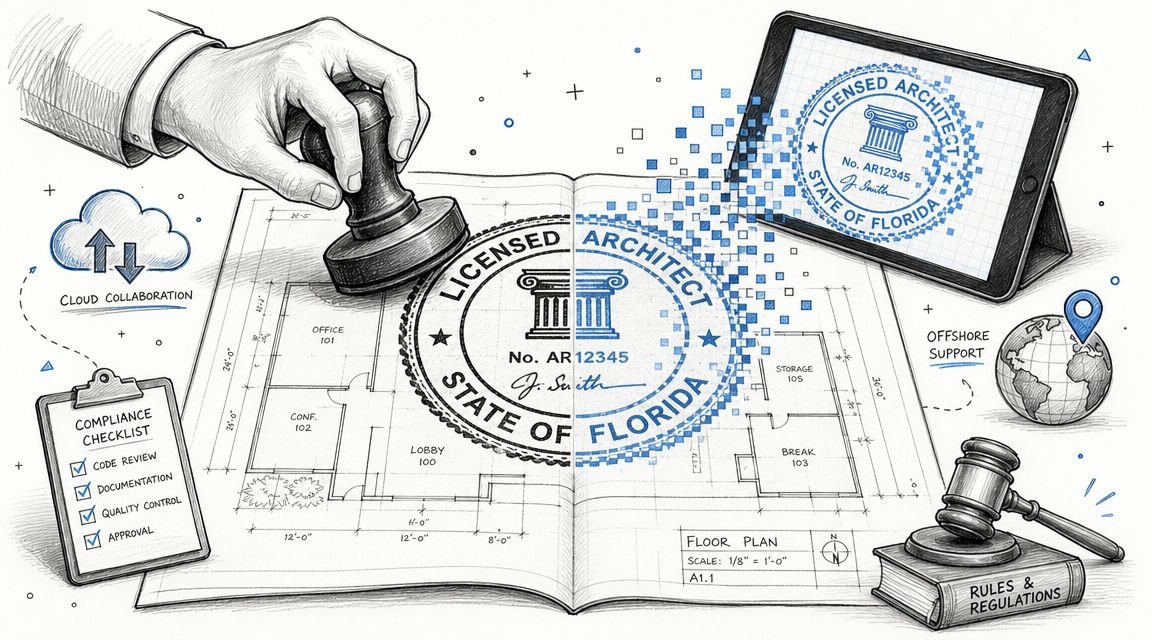
External production support does not replace the architect or engineer of record. It does not replace internal design authority. It should not make code interpretations, scope decisions, or contractual judgments that belong to licensed or designated project leaders.
That boundary is healthy. It lets your team delegate production while keeping judgment where it belongs.
Non-negotiable boundary: Outsource task execution. Keep design accountability and approval authority in-house.
When that split is clear, GC BIM production capacity becomes a controllable lever instead of a governance risk.
Finding an Engagement Model That Fits Your Schedule
The commercial model matters almost as much as technical skill. Plenty of outsourcing arrangements fail because the labor structure doesn't match the contractor's workload pattern.
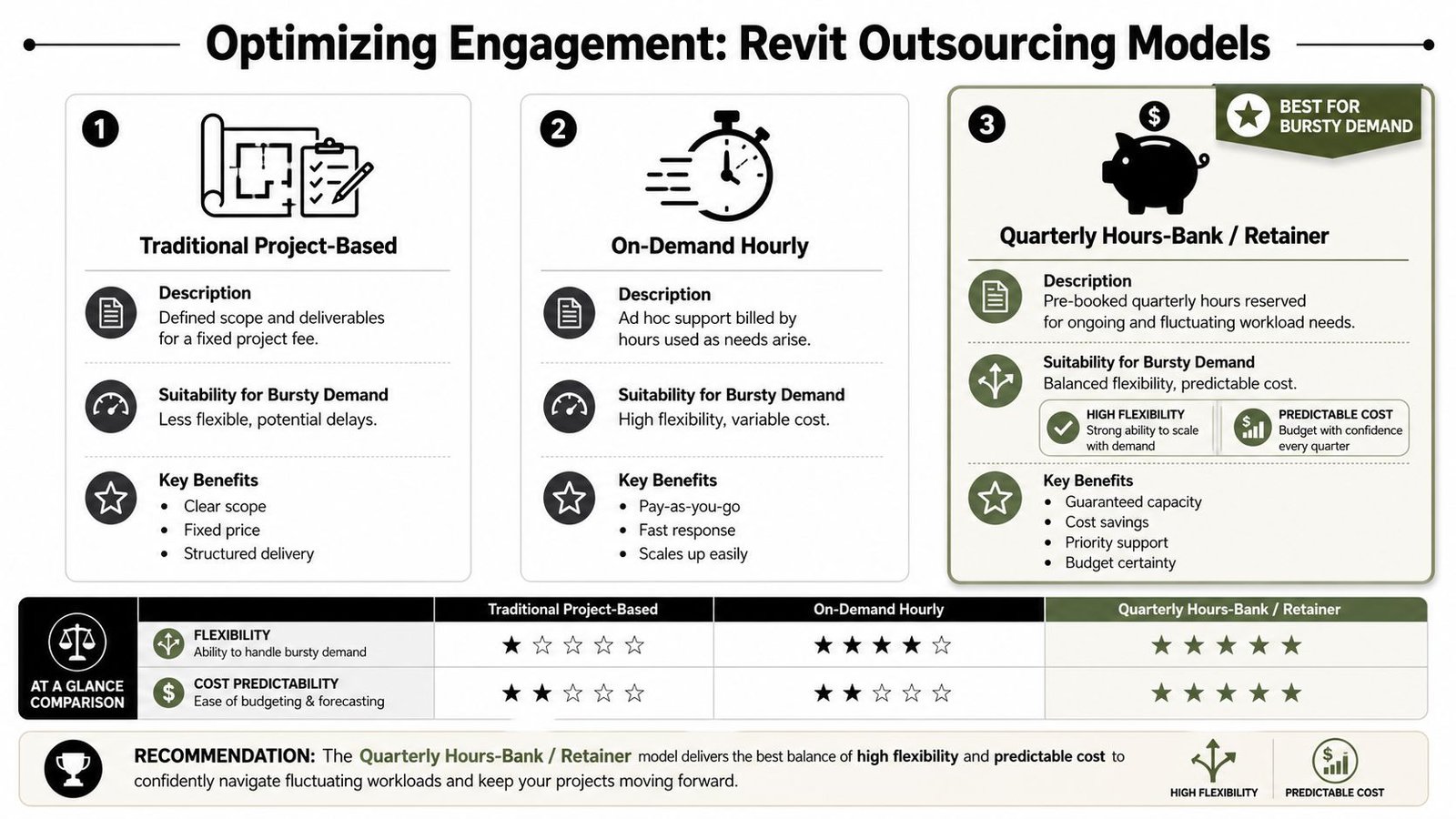
Three common ways to buy capacity
| Model | Where it works | Where it breaks |
|---|---|---|
| Project-based | Defined scope, clean handoff, stable deliverables | Struggles when priorities shift midstream |
| On-demand hourly | Short bursts, urgent fixes, overflow tasks | Can become reactive and fragmented |
| Quarterly hours-bank or retainer | Mixed bids, active jobs, uneven demand | Needs discipline in allocation and forecasting |
For design-build GCs, the quarterly hours-bank model usually is ideal for the workflow. It gives leadership a pool of production capacity they can direct across pursuits, permit pushes, and live project needs without renegotiating every small request.
That doesn't mean dedicated teams are wrong. They're often the better fit for firms with stable volume and predictable throughput. But many contractor-led groups don't have that pattern. They have calendar compression, uncertain win rates, and sudden documentation surges.
Why flexibility matters financially
Revit outsourcing can convert fixed overhead into variable project cost. Verified pricing data places outsourced rates at $15 to $50 per hour, which is one reason firms use external production to scale up during documentation peaks without carrying the full overhead of salaries and software licenses, according to PowerKH's review of outsourced Revit pricing.
That fact matters less as a “cheap labor” story and more as an operating story. The gain is flexibility. You buy capacity when deadlines demand it instead of staffing every possible spike in advance.
For some contractors, that same thinking also extends to adjacent support models. If you're comparing broader hiring options for operational flexibility, resources on how firms hire LATAM talent can be useful context when evaluating timezone coverage, communication overlap, and variable-capacity staffing.
How to choose between retainer and dedicated support
A simple rule works well:
- Choose a quarterly hours-bank if your demand moves with bid cycles, permit deadlines, and intermittent construction support
- Choose a dedicated team if the same production tasks show up every week with roughly similar volume
- Avoid pure ad hoc buying if your internal managers are already overloaded, because fragmented requests create coordination drag
If you want a practical benchmark for what production-heavy scope usually includes, reviewing examples of Revit drafting services for architectural production can help frame what belongs in overflow support versus what should stay with your internal leads.
An Onboarding Checklist for Protecting Your Timeline
The fastest way to lose schedule benefit is to start without rules. The second fastest is to discover your standards only after the first delivery misses them.
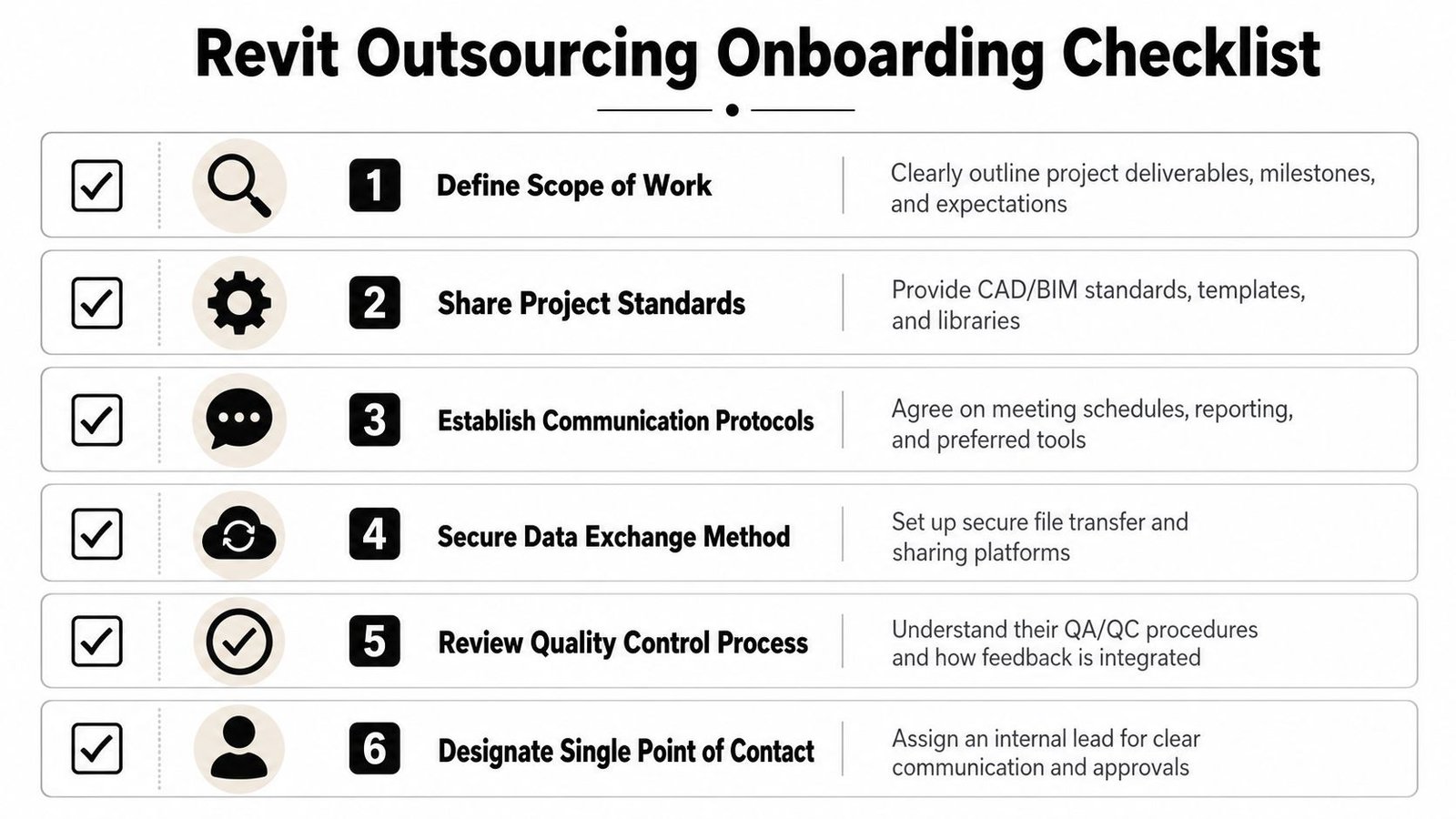
Quality control is the main risk area in outsourcing. Verified data shows 68% of US AEC firms cite model accuracy errors from external partners as their primary outsourcing risk, which is why onboarding and QA checkpoints can't be treated as admin work, according to Lynx Professional Services.
The checklist that should be in place before production starts
Define escalation paths early
Set response expectations for bid deadlines, permit pushes, and construction-driven revisions. If an urgent issue lands at noon, everyone should already know who can assign it, who reviews it, and what turnaround band is realistic.Issue your standards package
That should include templates, title blocks, view naming rules, shared parameters, annotation standards, family rules, sheet organization, and export expectations. Good outsourcing teams don't want vague freedom. They want clean standards.Set decision checkpoints
Review outsourced work at 30% CD, 60% CD, and 90% CD, which gives your team a model audit, a drawing review, and a final review before rework gets expensive, based on guidance from Sonora BIM's Revit outsourcing review process.
The best time to catch a production mismatch is before it spreads across sheets, schedules, and linked files.
What often gets overlooked
The missing piece on many design-build jobs is the field-change loop. Teams define how work goes out. They don't define how site reality comes back in.
Use a simple workflow:
- One intake point for RFIs, sketches, and field-directed revisions
- One owner of model update assignment
- One review path before revised content reaches the broader team
That structure prevents “someone already updated that” confusion.
For firms managing production across architecture-heavy scopes, it also helps to align external contributors with the same expectations used in broader architectural services workflows, especially around documentation consistency and permit readiness.
From Production Bottleneck to Predictable Delivery
For design-build GCs, the value of Revit outsourcing services isn't generic efficiency language. It's schedule control. It's the ability to meet a bursty workload with a production system that doesn't fall apart when bids overlap, permit sets compress, or field changes start stacking up.
The firms that use external support well don't outsource judgment. They outsource repeatable production under clear standards, with checkpoints that protect model integrity and deadlines. That's what preserves margin. That's what keeps the construction schedule from waiting on the drawings.
If you want a clearer framework for building scalable production support, BIM Heroes shares practical resources on dedicated production desks, BIM workflows, and contractor-focused delivery models that help teams handle burst demand without losing control.