Meta description: A practical guide to offshore architecture production licensing, architect of record responsibility, seal review workflows, state stamp rules, and contract guardrails for US firms using offshore teams.
The first question every principal asks before engaging an offshore team is the right one: who stamps the drawings, and what does that mean legally?
That question usually sits underneath a few others. Does offshore production create licensing exposure? Does the architect of record lose control? Does using an external team change who is professionally responsible if the documents miss something important? The short answer is no. The longer answer is where firms either protect the license or create avoidable risk.
In practice, offshore architecture production licensing is less mysterious than many firms expect. The legal framework is already familiar. Architects routinely stamp documents that were drafted by junior staff, contract drafters, consultants, and production support teams. Offshore production changes the staffing model and the workflow. It does not change the licensed architect's obligation to supervise, review, direct, and take responsibility for the final documents.
That's why the actual issue isn't whether offshore production is allowed. The fundamental issue is whether your firm has a review system, a documentation standard, and a contract structure strong enough to support it. Firms that treat offshore production as an operational system do well. Firms that treat it as a handoff tend to struggle.
If your team is evaluating outsourced architectural services, the safest starting point is simple: define the architect of record role clearly, define responsible charge operationally, and make the seal process part of your standard operating procedure.
Introduction
Most anxiety around architectural stamps comes from one mistaken assumption. People assume the risk begins when the work crosses a border. It doesn't. The risk begins when a licensed architect seals work they haven't controlled.
That distinction matters because it changes how a principal should evaluate an offshore model. This isn't primarily a geography problem. It's a process discipline problem. If your production team is offshore, your architect of record still has to understand the documents, direct the work, review the content, and approve what goes out for permit. If those things happen consistently, the arrangement can be structured cleanly. If they don't, the problem exists whether the drafter sits in your office or overseas.
Architectural stamps also carry more historical weight than many people realize. The postage stamp itself became a standardized, mass-produced communication object when the Penny Black entered circulation in England on 1 May 1840, and the United States followed with government-issued postage stamps on 1 July 1847 after congressional authorization on 3 March 1847, as outlined in this history of postage stamps. That matters because stamps have long signaled authenticity, origin, and official responsibility. In architecture, the same idea survives in a more serious form. The stamp is a professional act, not a graphic mark.
Practical rule: The stamp is never the process. The stamp is the last visible act in a process of supervision, judgment, and accountability.
The Architect of Record Relationship Does Not Change
The licensed architect who signs and seals the permit set is still the architect of record offshore production depends on. That relationship does not change because an offshore team drafted sheets, modeled in Revit, or assembled details.
What stays with the AOR
The architect of record remains responsible for the technical adequacy of the documents, code compliance, and the professional decisions reflected in the set. If a life safety diagram is wrong, if envelope detailing is incomplete, or if consultant coordination breaks down, the answer is not “the offshore team drew it.” The answer goes back to the architect who reviewed, directed, and sealed the work.
That's not unique to offshore production. It is how architecture practice already works. In-house teams rely on junior staff every day. Firms use contract production help. Some projects split design and documentation functions across offices. In every case, the licensed architect who seals the work carries the professional responsibility.
What offshore production actually changes
What changes is how the work is managed. Time zones change. Communication protocols matter more. Markups have to be clearer. Template discipline becomes imperative. Your BIM standards need to be explicit, not implied.
A mature firm treats offshore production as a controlled extension of the production bench. That means:
- Defined authorship flow so the AOR knows who produced what and when
- Decision checkpoints at DD, permit, and issue milestones
- Documented review logs tied to sheet progression
- Clear escalation paths when code, coordination, or design intent gets ambiguous
The legal relationship stays the same. The operating system has to get stronger.
If the architect of record wouldn't be comfortable defending the document set in front of a board or claims counsel, the set isn't ready to stamp.
Why principals should frame this correctly
Principals get into trouble when they frame offshore production as a separate legal category. It isn't. It is a resourcing strategy sitting inside the same professional duty structure your firm already works under.
That framing helps internally too. Teams stop asking “Can we stamp outsourced drawings?” and start asking the better question: “What review standard do we need before any licensed architect seals this set?” That question leads to better QA, cleaner permit packages, and fewer surprises during CA.
What Responsible Charge Actually Requires
The phrase firms need to operationalize is responsible charge. It sounds abstract until you convert it into daily project controls.
What it means in practice
Responsible charge requires more than access to the files and more than a final glance before issue. The architect has to direct the work, understand the content, review it in enough detail to make professional judgments, and retain authority to change it.
Physical proximity isn't the test. Control is the test.
A project architect in Chicago can maintain responsible charge over a production team in another country if the workflow supports real supervision. A project architect in the same office can fail that standard if they're just passing PDFs through and sealing at the end.
What the law is trying to prevent
Ohio is a useful example because the rule is stated plainly. All architectural work must be sealed by the architect, and the seal is valid only when applied by the architect who prepared or directly supervised the work under a written client contract. Ohio also prohibits sealing drawings prepared by others except in limited circumstances involving written permission and complete review, which is why improper plan stamping is a licensure-risk issue, not an administrative slip, according to the Ohio Architects Board guidance on seals and sealing.
That is the line firms need to respect. The architect does not need to have drawn every line. The architect does need to have supervised, reviewed, and approved the work being sealed.
What works and what doesn't
A useful way to test your process is to separate legitimate review from false comfort.
| Review approach | Works | Fails |
|---|---|---|
| AOR reviews coordinated model and sheets with markups returned for revision | Yes | |
| AOR joins regular production calls and resolves technical decisions | Yes | |
| AOR signs after a PM says the set is “basically done” | Yes | |
| AOR seals sheets assembled by others without sheet-level review | Yes | |
| AOR can explain why key code and detailing decisions appear in the set | Yes |
The phrase stamp and seal outsourced drawings only makes sense when that review standard is real. Otherwise, the stamp is exposed.
How US Firms Structure the Offshore Review Process
Review structure is where a firm either proves responsible charge or undermines it. Good offshore teams can produce fast. That does not remove the need for disciplined sign-off. It increases it.
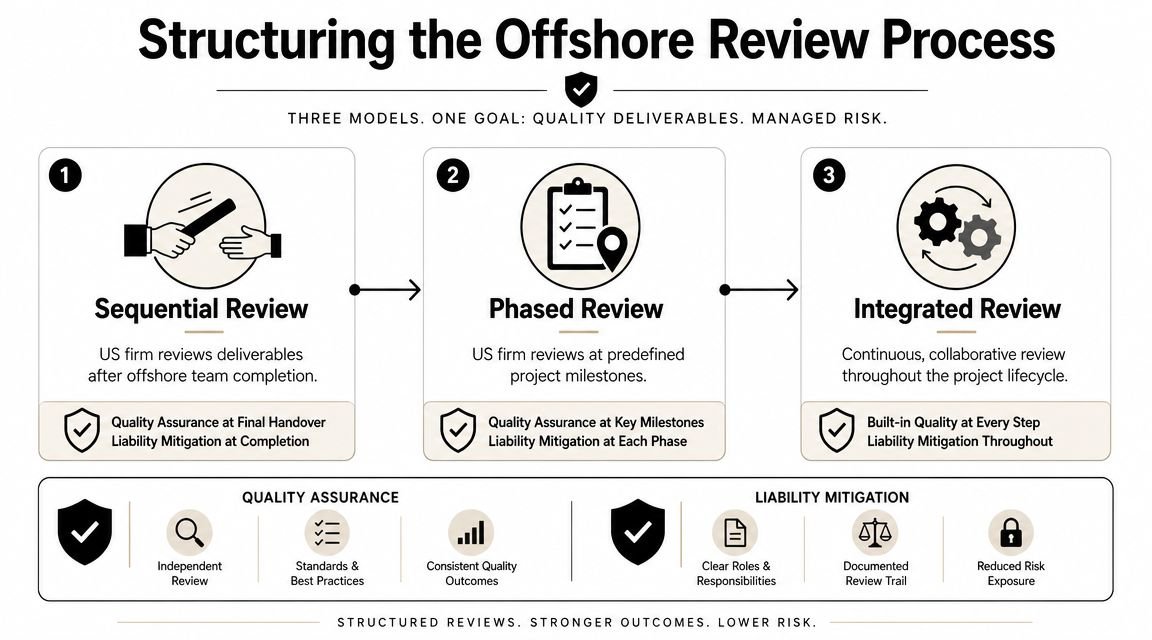
Many firms build this around a repeatable production model supported by architectural production workflows and internal BIM standards. The key is choosing a review structure that fits project complexity, not just staffing availability.
Three review models that actually work
Milestone review fits firms that want clear decision gates. The offshore team develops to a defined package milestone such as DD or permit issue. The licensed architect then performs a structured review before the set moves forward. This works well when the scope is stable and the checklist is mature.
Iterative markup cycles are closer to how strong in-house teams operate. The offshore group issues a batch. The architect reviews in Bluebeam or directly in the model. Revisions come back quickly, and the architect checks again. This is usually the safer model for projects with frequent design movement, consultant changes, or jurisdiction comments.
Sheet-by-sheet sign-off is the most controlled and usually the slowest. It creates a stronger audit trail because the project architect or AOR approves sheets individually as they reach issue condition. For healthcare, multifamily, and technically dense permit sets, this often produces cleaner outcomes.
The trade-offs firms should expect
- Milestone review protects senior time, but errors can accumulate between checkpoints.
- Iterative cycles reduce drift, but they require tighter communication habits.
- Sheet-by-sheet sign-off gives the best traceability, but it can slow throughput if roles aren't clearly assigned.
The right answer is often hybrid. A firm may use iterative review during DD, then shift to sheet-by-sheet sign-off for permit release.
Field lesson: If review is informal, responsibility is hard to prove later.
Digital stamp risk in PDF and BIM workflows
Most public explanations of architectural stamps still focus on the physical act of stamping. Daily practice doesn't. In offshore BIM production US architecture firm workflows, the harder question is how to prove authorship, prevent image reuse, and preserve an audit trail across PDFs, cloud folders, and model exchanges. Even older CAD-era discussions show that practitioners have long worried about raster stamp images being copied into files, as discussed in this AUGI thread on architectural stamp image security.
That has direct operational consequences. A stamp image stored in a shared folder is not a seal protocol. What works better is controlled digital signing, limited access permissions, issue logs, and a release process where the final sign action sits with the licensed architect after formal review.
Navigating State-Specific Licensing and Stamp Rules
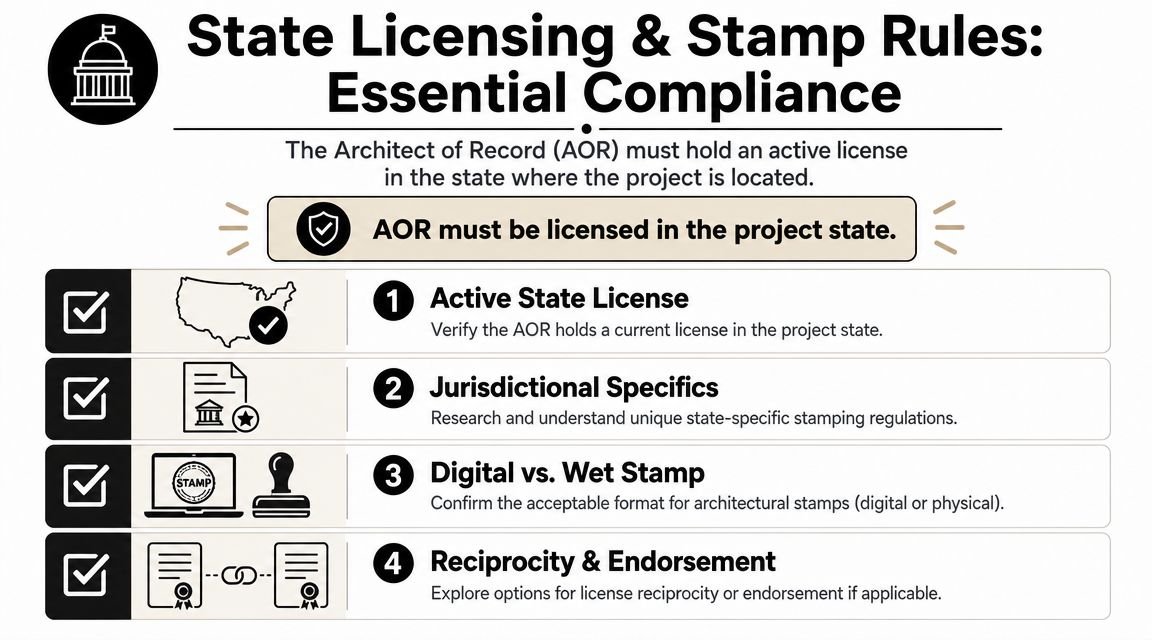
A firm can have a strong review process and still create exposure if it gets the jurisdiction wrong. Licensing and stamp rules are state-specific. Your workflow has to respect that reality at the start of the project, not the end.
The non-negotiable rule
The architect sealing permit documents must hold an active license in the state where the project is being permitted. The offshore production team does not need US licensure to produce drawings under supervision. The licensed architect does.
For a multi-state practice, that means licensure planning is part of pursuit strategy. If no principal is licensed in the project state, the firm needs a locally licensed architect of record or a clear path to licensure before sealable documents are issued.
Why generic advice fails
A lot of public guidance stops at “an architect's stamp is required.” That doesn't help firms build a reliable multi-state operating model. Public content often misses that rules differ by jurisdiction, including stamp content requirements and what qualifies as proper supervision, which is exactly the compliance gap described in this discussion of architect stamping requirements across jurisdictions.
For firms using distributed production teams, that gap becomes a workflow problem. Someone has to own the jurisdictional checklist. Someone has to confirm what the seal must contain, what form is accepted, and how the review record will support the architect's responsible charge.
California as a good example of detail
California shows how specific these rules can get. An architect's seal must be a circular stamp 1" to 2" in diameter, include “State of California,” “Licensed Architect,” the architect's name, license number, and a method to note renewal. California also specifies that the stamp must not be embossing type, per the California Architects Board stamp requirements.
That level of specificity should shape production setup. If your team serves multiple states, don't leave stamp compliance to individual habit. Build a jurisdiction matrix, assign ownership, and keep it tied to your permit release checklist.
Key Contract Terms for Offshore Production Partners
If the licensing framework answers who is responsible, the contract answers how the relationship is controlled. A weak contract leaves too much to memory, goodwill, and assumptions. That is exactly where offshore engagements start to drift.
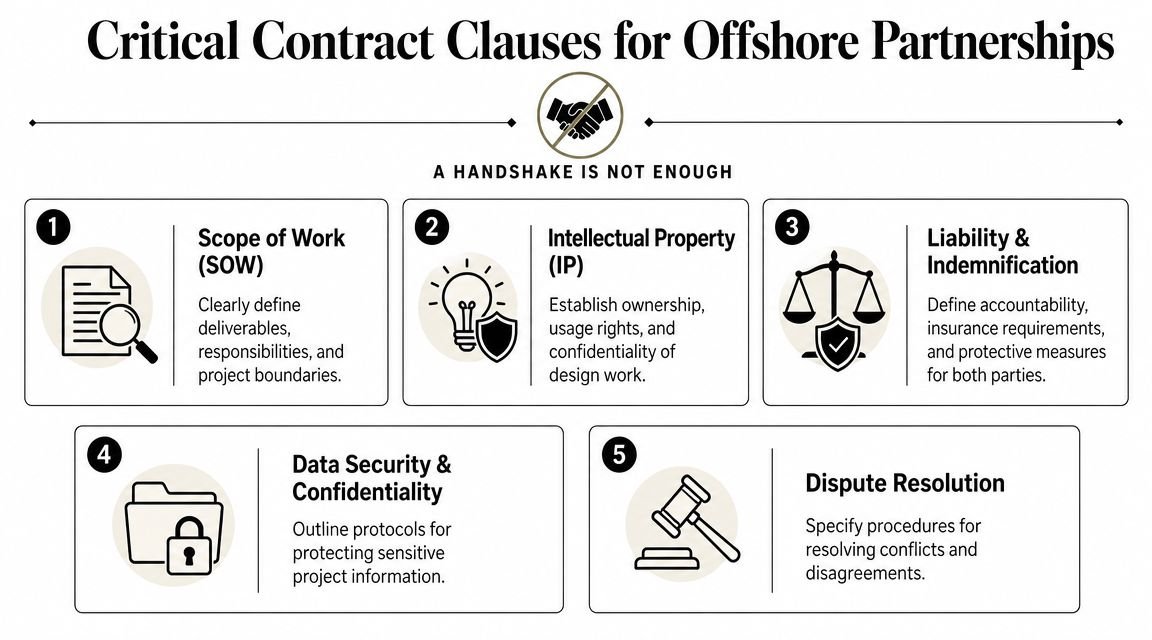
A more mature delivery model usually treats the offshore team as part of a controlled production system, not a loose drafting resource. That's why many firms formalize these terms alongside broader delivery standards for a global center for development.
Terms that need to be explicit
Scope of work should define exactly what is being produced, in what format, to what standard, and through how many review cycles. If the team is modeling in a specific Revit version, issuing PDFs for permit, maintaining sheet indexes, or coordinating consultant backgrounds, write that down.
Intellectual property ownership should state that all work product belongs to the US firm. Not after payment approval. Not after final issue. From creation, subject to the contract terms your counsel recommends.
Confidentiality has to match your client obligations. Construction documents often contain sensitive program information, tenant layouts, security details, and proprietary standards. Your offshore agreement should not be weaker than your prime agreement.
Liability language firms need to understand
The offshore production partner is not carrying the architect's professional seal responsibility. The licensed architect is. The contract should reflect that reality clearly, without pretending the production team is assuming architectural licensure obligations it does not hold.
That does not mean the contract is soft on accountability. It means accountability is allocated correctly. The offshore team can be responsible for delivery standards, data handling, turnaround commitments, and compliance with firm procedures. The professional liability attached to the sealed documents remains with the licensed architect and the firm.
A good offshore contract doesn't blur responsibility. It sharpens it.
A short contract check before signature
Before signing, have counsel review these points:
- Work product ownership and reuse rights
- Security obligations for file access, storage, and transfer
- Named deliverables and excluded services
- Review cycle limits and revision assumptions
- Dispute process and governing law
That review is cheap compared with untangling a failed engagement during permit or construction.
Communicating Your Production Model to Clients and Contractors
Clients rarely care about offshore production in the abstract. They care about whether the set is coordinated, whether the team is responsive, and whether their information is protected. Contractors care about whether the documents are buildable and whether questions get answered quickly.
So the best communication approach is direct.
Tell clients the drawings are issued under the authority of a US-licensed architect of record. Tell them the firm controls production through documented review checkpoints, internal standards, and QA sign-off. If they ask whether some drafting or BIM work is produced offshore, answer plainly and connect it to the process controls that protect the project.
What clients usually want to hear
A simple framework works well:
- Quality control: The licensed architect reviews and approves the work before issue.
- Responsiveness: The firm owns communication, direction, and turnaround.
- Confidentiality: Project information is controlled contractually and operationally.
That keeps the conversation on outcomes, where it belongs.
What contractors need from you
Contractors don't need a staffing narrative. They need a reliable set and timely clarification. If your process produces a complete permit package, coordinated details, and disciplined addenda, the location of the production team becomes secondary.
Mature firms differentiate themselves. They don't hide the model. They explain it in a way that shows control. That usually lowers concern rather than increasing it.
Common Mistakes in Your First Offshore Engagement
Most first-project failures aren't licensing failures. They're process failures that later become licensing risk because the architect of record has to absorb the consequences.
Mistakes that create rework fast
Insufficient onboarding. If the offshore team starts without your Revit template, sheet standards, title blocks, typical details, and naming rules, they'll fill the gap with assumptions. That almost always means rework.
Skipping formal review because the team looks capable. Capability is not the issue. The review process protects the license. Even excellent production teams need controlled sign-off.
Vague deliverable definitions. If the scope doesn't specify file formats, family standards, plot settings, sheet organization, and issue expectations, production quality becomes inconsistent.
Mistakes that usually show up later
Treating the team like a black box. Sending a program, a few PDFs, and a target date is not management. Strong offshore delivery depends on active communication, decision checkpoints, and visible ownership on the US side.
Assuming the team knows US code requirements. Brief every project. Occupancy assumptions, accessibility interpretations, local amendment issues, and permit conventions need to be explained, not presumed.
A good first engagement is usually boring in the right way. The standards are clear. The markups are disciplined. The architect reviews early, not just late. That's what keeps outsourced production from turning into cleanup work for senior staff.
Build a Predictable Production System
A predictable offshore production system starts with one rule. The US architect controls the work from setup through final issue, with documented reviews, recorded decisions, and clear release authority.
That discipline protects more than the stamp. It protects fee, schedule, and staff time. Firms that run offshore production through a fixed review workflow catch coordination problems earlier, keep BIM files cleaner, reduce permit comments tied to preventable drafting issues, and keep senior architects focused on design judgment instead of late-stage cleanup.
The operating model should be repeatable. Use the same kickoff package, the same model setup standards, the same sheet progress milestones, and the same review gates on every job. Assign one US-side reviewer for scope alignment, one for code and technical review, and one release point before anything leaves the firm. If a decision affects life safety, code interpretation, or the design intent presented under the firm's name, it stays with the architect in responsible charge.
That is how firms keep offshore support useful instead of unstable.
Architectural stamps belong at the end of a controlled chain of authorship, review, correction, and approval. If that chain is weak, the seal becomes the point where unmanaged risk concentrates. If that chain is clear, offshore production gives the firm usable capacity without blurring responsibility.
If your firm is working through offshore architecture production licensing, architect of record workflows, or how to structure review and document control with external teams, contact BIM Heroes. A clear checklist, review framework, or production standard usually solves the operational problem faster than another staffing debate.