The popular advice is to choose an offshore partner based on hourly rate, timezone coverage, and a convincing sample portfolio. That advice misses the core failure point. Offshore architectural production becomes unpredictable when the engagement has no phase gate, no agreed LOD checkpoint, and no defined acceptance process.
A lower rate can't protect a construction-documentation schedule if drawings arrive late, families are inconsistent, or coordination issues surface only at the end. A phase-based model changes the buying decision from “How many hours can you give us?” to “What verified production milestone will we receive, and when?” That shift protects design intent, margin, and control without pretending that outsourcing has no risks.
Why Traditional Offshore Production Feels Risky
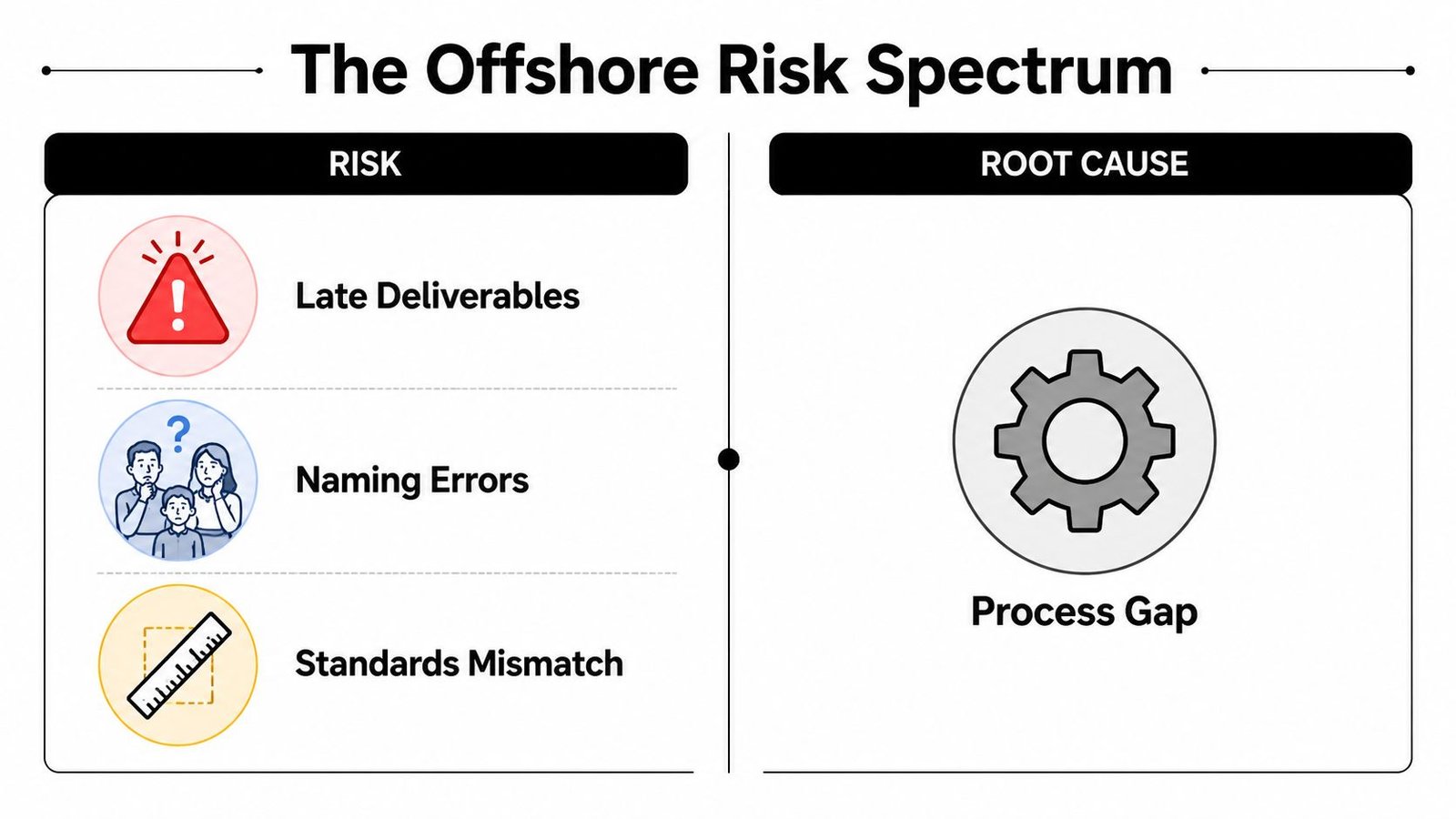
Every principal who has survived a bad offshore engagement remembers the same sequence. A model comes back late. A family has the wrong name. A sheet set doesn't follow the firm's standards. Someone discovers clashes during construction documents, and the schedule suddenly depends on a rushed correction cycle.
The instinct is to blame geography. That diagnosis is usually wrong. The country isn't the operating model. Black-box handoffs, hourly task buckets, undefined LOD targets, and informal file transfers create the conditions for failure regardless of where the production work happens.
The failure patterns are predictable
A firm using unstructured BIM outsourcing services typically encounters several problems at once:
- Scope drift: Small requests accumulate because the original scope never defined what “complete” means.
- Version confusion: Email attachments, duplicated folders, and unclear naming make it difficult to identify the current model or drawing set.
- Standards mismatch: The offshore producer works from assumptions instead of the firm's Revit template, family standards, sheet conventions, and code-aware documentation rules.
- Late coordination exposure: Clashes remain hidden until a major milestone, when the cost of correction is highest.
- Time-zone finger-pointing: The US PM sees a delay, the offshore producer sees an unanswered question, and neither has a shared escalation record.
IP protection, professional liability, data residency, and communication latency are legitimate concerns. A serious partner must address them contractually and operationally. But a nondisclosure agreement won't fix an undefined LOD target, and a daily call won't fix a missing acceptance gate.
The risk sits in the handoff
Ad-hoc outsourcing asks the client to discover quality at the end. That puts schedule risk in one concentrated point, when the project has the least room for recovery. Phase-based production distributes control across the work, so a US firm can inspect progress before errors spread through sheets, views, families, and linked disciplines.
Production director's rule: If the first meaningful quality review happens at final delivery, the engagement is already late.
The right question isn't whether an offshore producer can model. It's whether the producer can work inside a system that makes incomplete scope, standards deviation, and coordination risk visible early.
What Phase-Based Production Actually Means
Phase-based production is a delivery system, not a pricing label. The producer doesn't receive a vague request for “Revit support” and disappear into a monthly hour allocation. The work is divided into defined production stages, each with an LOD target, a review date, an owner, and an exit artefact.
The system starts with scope. A project needs a clear target such as LOD 200, LOD 300, or LOD 350, connected to the intended use of the model and the project phase. That target must also identify what isn't included, which views and sheets are required, what standards apply, and what information the client must provide.
Four controls define the model
Scope and LOD gate: The US firm and offshore producer agree on the model's required development level, discipline boundaries, families, sheets, and exclusions.
Milestone delivery: Work is tied to schematic design, design development, construction documents, or another named stage. A milestone means a reviewable package, not an hour bucket.
Structured redlines: The client returns consolidated comments through a controlled redline cycle. Acceptance criteria distinguish a correction from a new scope request.
Gated handoff: The next phase begins after the prior package receives approval or documented conditional approval. Payment should follow accepted deliverables rather than unverified effort.
The division of responsibility must remain clear. The US firm owns design approval and professional judgment. The offshore pod owns execution, documentation, coordination support, and correction of agreed comments. That boundary preserves control without forcing the client to redraw every element.
Each gate should produce more than an updated model. A complete handoff should include the model files, sheet set, clash or coordination report where applicable, and a short risk log showing unresolved questions, assumptions, and items requiring client direction.
Anatomy of a phase gate in offshore BIM production
| Phase Gate | Owner | Acceptance Criteria | Exit Artefact |
|---|---|---|---|
| Scope and setup | US firm approves, offshore pod prepares | BEP, LOD target, standards, inputs, exclusions, and dates are documented | Approved scope record and production checklist |
| Initial modeling | Offshore pod executes, US firm reviews | Required elements are modeled to the agreed phase target, naming and template rules are followed | Model package and initial QA notes |
| Coordination review | Offshore pod runs checks, US firm directs decisions | Known clashes are reported, design decisions are recorded, and open risks are visible | Clash report, issue log, and coordinated model |
| Redline correction | US firm consolidates, offshore pod responds | Comments are resolved or classified as new scope | Revised model, sheet set, and response record |
| Phase acceptance | US firm signs off | Acceptance criteria are met and remaining exceptions are documented | Approved milestone package and next-phase brief |
A partner should be able to explain this process without hiding behind the word “team.” The useful language is scope, gate, review, correction, acceptance, and next action.
Ad-Hoc Handoffs Versus Phase-Gated Delivery
Ad-hoc outsourcing feels flexible because it avoids difficult decisions at the beginning. The PM sends a model, adds instructions in an email, and asks for progress as needed. That flexibility disappears when three people interpret the scope differently and the first complete review happens days before submission.
Phase-gated delivery is less casual by design. It forces the firm to define the package before production starts, but that discipline gives the PM something far more valuable than informal responsiveness, early visibility into whether the work is on track.
The operational difference
| Operating factor | Ad-hoc handoffs | Phase-gated delivery |
|---|---|---|
| Scope | Changes through messages and calls | Locked at each approved gate |
| Progress visibility | Based on status updates or hours used | Based on named deliverables |
| Quality review | Concentrated near final delivery | Performed at each phase transition |
| Redlines | Mixed with new requests | Consolidated and classified |
| Coordination | Often discovered late | Checked as part of the milestone |
| Schedule risk | Accumulates invisibly | Exposed while recovery remains possible |
| Commercial control | Effort is easy to bill, value is hard to verify | Payment follows accepted output |
The durable saving isn't the lowest hourly rate. It's the rework you prevent. A cheap engagement becomes expensive when the client must recheck every sheet, repair naming conventions, rebuild views, resolve preventable clashes, and explain the same standard repeatedly.
That logic applies beyond architectural modeling. In scan-to-BIM work, a point cloud isn't a finished BIM model. The workflow normally involves collection, registration, segmentation, cleanup, and building-element creation, as described in research on point-cloud-to-BIM workflows. A phase gate can separate scan registration from modeling, then modeling from QA, instead of treating “imported point cloud” as proof of progress.
The commercial test: Can the PM verify what was delivered without calculating how many hours were consumed?
An effective production report should show the milestone, completed scope, open decisions, QA status, redline status, and risks requiring client action. That record lets a principal intervene before margin disappears, not after the project team has absorbed the failure.
Why Dedicated Production Pods Protect Margins and Schedule
Rotating freelance pools and shared-resource benches are the significant margin killers. Every project retrains the producer on the firm's families, title blocks, view templates, naming rules, and review preferences. The vendor may have capable people, but the client keeps paying the coordination cost of starting over.
A dedicated production pod creates institutional memory around the account. A practical pod can include several modelers, a BIM lead, and a QA reviewer, with named responsibilities, defined coverage, and a monthly retainer. The point isn't to buy a block of labor. It's to reserve production capacity around the firm's standards and pipeline.
What the pod owns
The pod should maintain a controlled production playbook covering:
- Template discipline: Approved Revit templates, families, shared parameters, sheet standards, and naming conventions.
- Queue management: A prioritized list of milestones, redlines, RFIs, and coordination issues.
- Review ownership: A named BIM lead and QA reviewer who know when work is ready for client review.
- Continuity: Documented procedures so an individual absence doesn't erase project knowledge.
- Capacity planning: Advance allocation for upcoming packages instead of reactive staffing after a deadline moves.
This structure matters for US firms facing persistent labor pressure. The Associated General Contractors of America and NCCER reported that 92% of companies had trouble hiring in 2025 in their construction labor market coverage, while Oxford Economics reported that 28% of European construction firms were already limited by lack of personnel in the cited industry data. HBI and NAHB-related research estimated a need for more than 60,000 adjusted net hires per month through 2026. These conditions make scalable production capacity a business requirement, not merely a labor-arbitrage experiment. Construction labor market report
Dedicated pod versus shared resource bench
| Metric | Dedicated Pod | Shared Bench |
|---|---|---|
| Standards learning | Builds account-specific knowledge | Repeats onboarding across projects |
| Capacity | Reserved around planned milestones | Assigned according to changing availability |
| Accountability | Named production and QA ownership | Responsibility can shift between resources |
| Redline handling | Uses established response patterns | Reinterprets comments repeatedly |
| Schedule response | Queue is prioritized for the account | Work competes with unrelated accounts |
| Continuity | Procedures survive individual turnover | Knowledge often remains personal |
A phase gate without stable ownership can still collapse under reactive resourcing. The producer misses a milestone, adds an unfamiliar modeler, and creates the very inconsistency the gate was meant to catch.
For firms evaluating GDC services, the useful question is whether the center provides an operating layer around the pod, including QA, escalation, documentation, and continuity. That is the difference between buying temporary labor and building a dependable extension of production.
The Workflow Stack Behind Predictable Offshore Delivery
A phase plan only works when the digital environment preserves the evidence. The workflow stack should show what the producer received, what was changed, who reviewed it, which issues remain open, and why the package passed the gate.
Start with requirements, not software
The first layer is the requirements layer. It includes the BIM Execution Plan, an LOD matrix tied to each phase, file naming rules, model coordinates, discipline responsibilities, and the host firm's code-aware documentation standards.
For US-facing work, the standards package should identify the applicable IBC, IECC, IMC, ADA, and NFPA requirements, along with project-specific amendments and the engineering or architectural authority responsible for interpretation. The ICC I-Code family is described as the base commercial building code adopted in all 50 states, while IECC and IMC provisions reference ASHRAE standards, making code-aware coordination relevant for US deliverables. US model-code reference
The producer should receive the firm's approved standards as controlled project inputs. An offshore modeler shouldn't be expected to infer whether a local convention is mandatory, preferred, or obsolete.
Build the production and collaboration layers
The production environment may include Revit, Archicad, Civil 3D, Tekla, or OpenBuildings, depending on the discipline and contract. The project needs a single source of truth in an approved environment such as BIM 360, Autodesk Construction Cloud, Trimble Connect, or Bentley iTwin.
The collaboration layer turns requests into traceable work. Azure DevOps or Jira can manage tickets, Git-backed content can control reusable assets, and Monday.com or Asana can track milestones. The exact products matter less than the rule that every task has an owner, due date, source file, acceptance condition, and status.
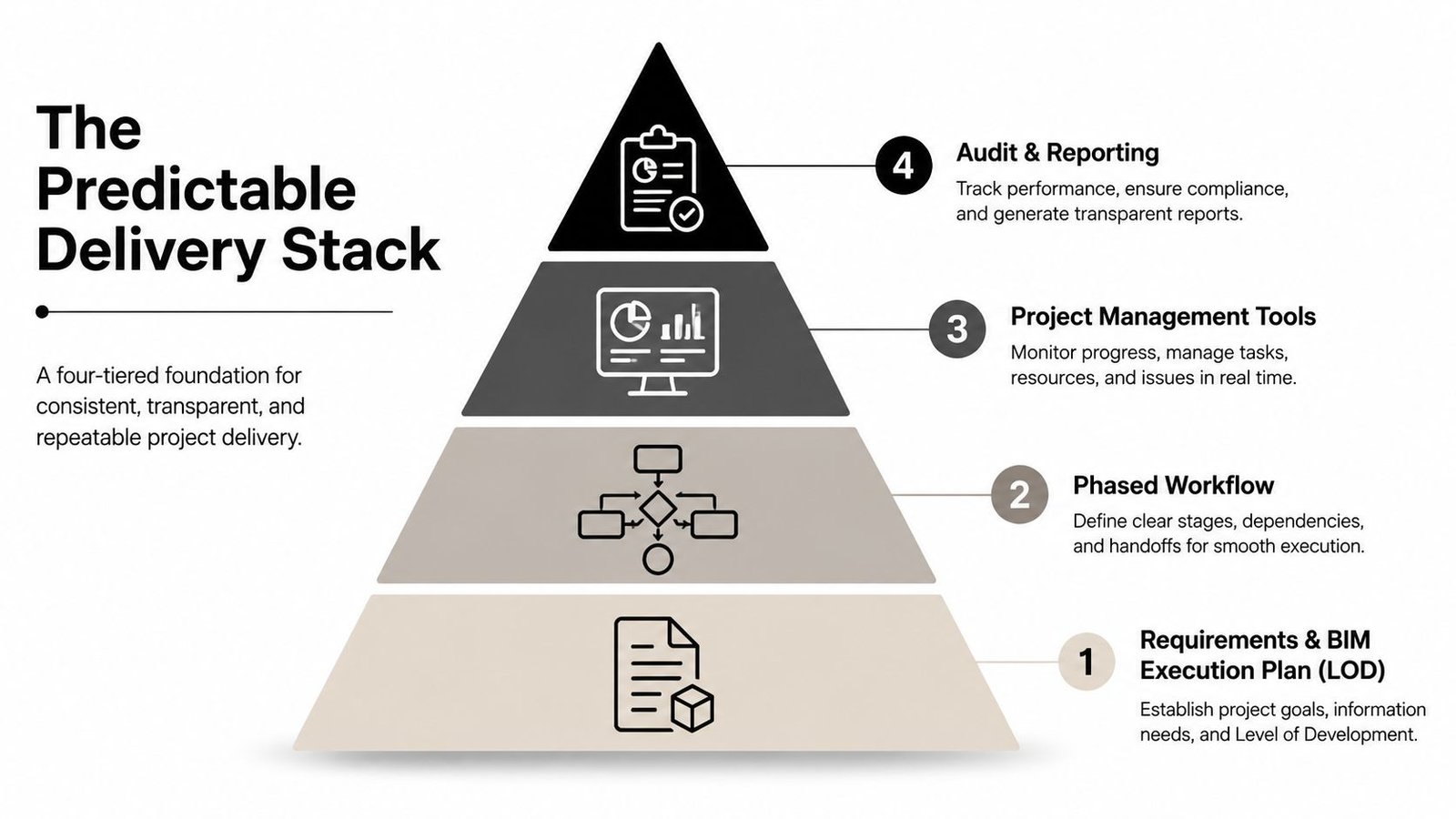
The audit layer closes the loop. Navisworks clash reports, Solibri model checks, weekly LOD compliance reviews, redline response logs, and issue histories create a defensible chain from requirement to delivery. For firms that need broader CAD drafting support, the same governance should apply to DWG standards, transmittals, revision clouds, and sheet-level QA.
Before signing a statement of work, require these minimum artefacts:
- Approved BEP and LOD matrix
- File and folder protocol
- Named QA and escalation owners
- Milestone calendar
- Redline and acceptance procedure
- Security and access-control plan
- Issue, risk, and revision logs
This stack isn't administrative decoration. It lets a US firm defend a deliverable to a client, reviewer, insurer, or court.
Selecting an Offshore Partner Without Losing Control
A polished portfolio doesn't prove production maturity. A vendor can show attractive models and still fail when asked to follow a client's template, document assumptions, report capacity, or accept a structured pilot.
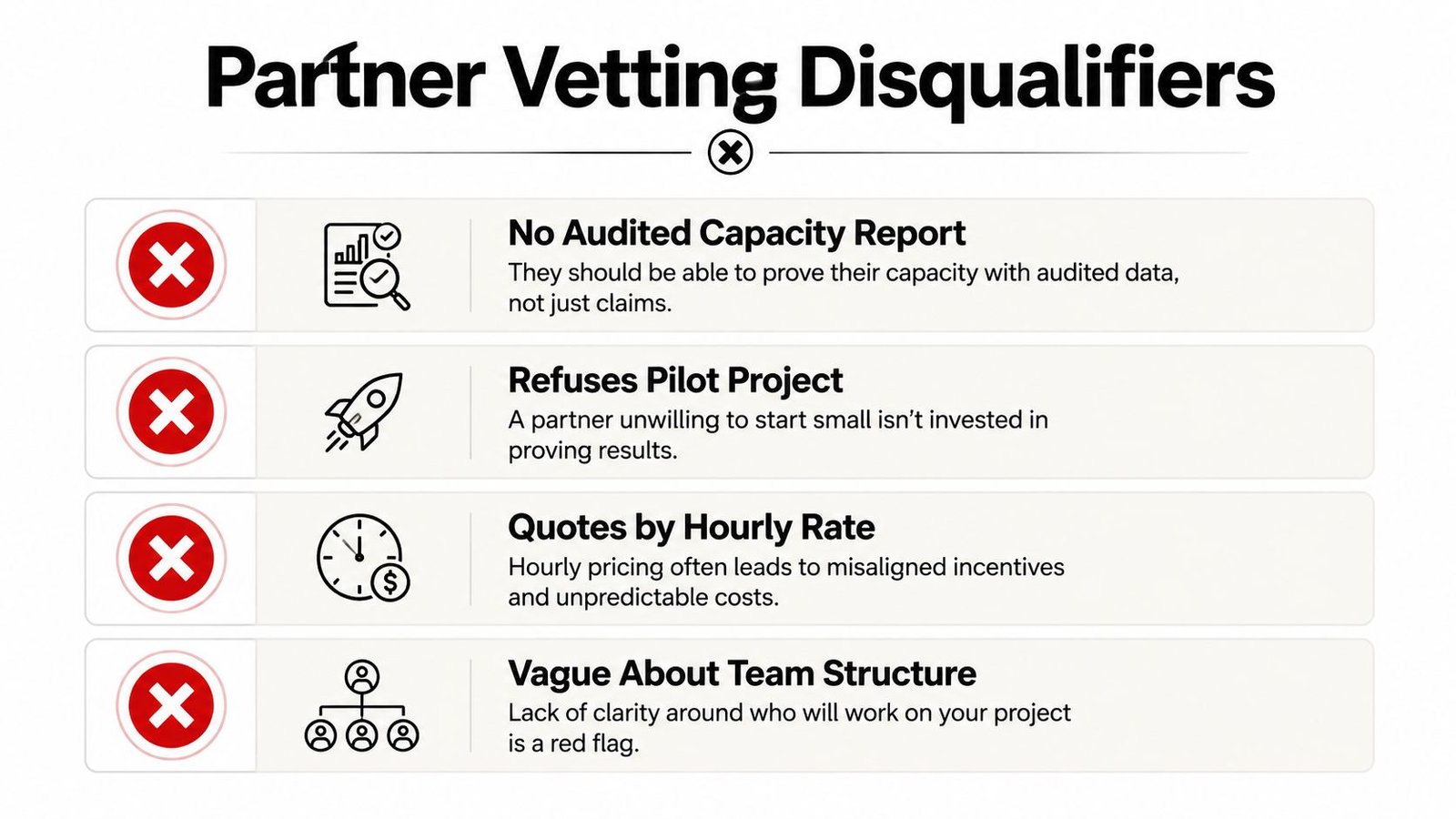
Start with disqualifiers. If a vendor can't show audited capacity, refuses a pilot, quotes only by the hour, or can't name the person responsible for QA, the engagement is already carrying avoidable risk.
Vet controls, not sales language
Ask for evidence in the following areas:
- Relevant delivery depth: Confirm experience with the same building types, disciplines, and documentation stages your firm sells.
- Comparable LOD work: Review reference packages at the same level of development you expect, including construction documentation and coordination outputs.
- Standards capability: Request a sample BEP, QA checklist, model health report, and explanation of how the producer follows client templates.
- Security controls: Establish how the partner handles access, data residency, IP assignment, US-governed NDAs, GDPR-ready processing, and any required security attestations.
- Escalation ownership: Get the names of the account lead, BIM lead, QA reviewer, and executive escalation contact.
- Communication design: Define overlap windows, standup records, response expectations, and what happens when a blocker remains unresolved.
The buyer should also test whether the partner understands regional compliance. A firm serving US projects needs a workflow for IBC, IECC, IMC, ADA, NFPA, and project-specific requirements. That doesn't transfer professional code responsibility away from the licensed design firm, but it does establish what the production partner must document and flag.
Use a paid pilot with an exit
A paid pilot should have a defined scope, acceptance criteria, security terms, milestone-based payment, and an exit clause. The pilot must be large enough to expose real coordination and redline behavior, not so large that a failed engagement traps the client.
The contract should make clear that the client buys controlled capacity and accepted production, not anonymous hours. A firm evaluating architectural production services should ask for a documented escalation matrix before assigning live project work.
Control is something you buy into the engagement. It comes from access rules, named owners, acceptance gates, and a record of decisions.
A 90-Day Phased Pilot Roadmap With KPIs
A pilot should prove the operating system, not just the producer's ability to complete an isolated modeling task. Use three thirty-day sprints, each with a different purpose and a clear decision about whether the relationship should expand.
Sprint one covers setup and a narrow test
During the first thirty days, establish the BIM Execution Plan, file handoff protocol, project credentials, naming rules, LOD target, and review calendar. Run a small single-discipline modeling test at LOA-200 or LOD-200, using representative project inputs rather than a polished sample.
The client should verify whether the producer asks useful questions, follows the template, records assumptions, and returns a reviewable package. Measure the milestone-hit rate, initial rework, open issues, and response behavior. The first sprint isn't a speed contest. It's a test of whether the operating model makes problems visible.
Sprint two tests production under review pressure
From days thirty-one through sixty, move to LOA-300 or LOD-300 deliverables and introduce weekly milestone reviews. Add clash-detection thresholds, redline turnaround expectations, and a formal response log.
Set pilot targets of a milestone-hit rate above 90%, rework hours below 12%, clash counts within the agreed tolerance, and RFI cycle time under 48 hours. Each target needs a defined measurement method in the pilot agreement. Otherwise, the KPI becomes a debate after the fact.
Sprint three tests coordination and continuity
During the final thirty days, expand into multi-discipline coordination. Run Navisworks or Solibri QA checks, review model compliance, and conduct a formal retrospective with the US PM, BIM lead, and production pod.
Address the common failure modes directly:
- Scope drift: Lock the SOW at each gate. Treat new requests as change items with a documented effect on schedule and deliverables.
- IP exposure: Use project-scoped credentials, least-privilege access, controlled downloads, and watermarked issue sheets where appropriate.
- Communication lag: Establish three to four hours of overlap, record standups, and log blockers rather than relying on private messages.
A successful pilot should convert into a recurring engagement with quarterly business reviews, an annual rate-card review, and a documented escalation matrix. The review should examine capacity, QA trends, upcoming project demand, standards updates, and decisions needed from the client.
The right next step isn't to send every project offshore. It's to expand only the phases the pilot proved reliable, then add disciplines through the same gates.
BIM Heroes can structure a phased pilot around your Revit production, scan-to-BIM, shop drawing, coordination, or construction-documentation needs, with defined LOD gates and review checkpoints. Visit BIM Heroes to discuss a dedicated production pod or send your scan and project requirements for a free LOD recommendation and pricing within 24 hours.