Meta description: A direct look at the financial case for a global delivery center for architecture firms, including true hiring cost, margin impact, BIM workflow control, and how to evaluate ROI before you commit.
Growing AEC firms hit the same wall. Work lands fast, deadlines tighten, and production capacity becomes the bottleneck. You can hire in-house, but fixed payroll is hard to carry when the pipeline softens. You can use freelancers, but then you inherit inconsistency, rework, and more coordination than anyone budgeted for.
That's where a global delivery center for architecture firms becomes worth serious attention. Not as a cheap labor play. As an operating model.
If you're weighing another salaried production hire against a more controlled offshore setup, the core question isn't whether offshore talent exists. It does. The key question is whether a dedicated offshore production team can protect margin, improve predictability, and fit cleanly into your BIM standards, template discipline, QA process, and permitting workflow. Firms already using architecture outsourcing services are usually trying to solve exactly that problem.
The Staffing Trap Every Growing Firm Faces
A principal lands two new projects in the same month. Suddenly the team needs more Revit production, more documentation support, and tighter turnaround on redlines. Everyone feels the pressure. The obvious fix is another full-time hire.
Then the pipeline shifts.
One project stalls in DD. Another gets delayed in permitting. A third moves ahead but needs less production support than expected. Now the firm is carrying fixed headcount against variable demand, and the operations lead is stuck trying to keep utilization healthy without forcing the team into the wrong work just to fill time.
Freelancers look like the middle path, but they usually create a second problem. They can help on a deadline, yet they rarely plug neatly into your template standards, BIM execution plan, naming logic, sheet setup, family controls, or QA checkpoints. Someone on your side still has to manage the work closely.
That's why the GDC model AEC firms should care about sits between those two extremes. It gives you dedicated capacity without locking you into the same employment burden as an in-house hire, and without handing the whole production process to a black-box vendor.
Calculating The True Cost of an In-House Hire
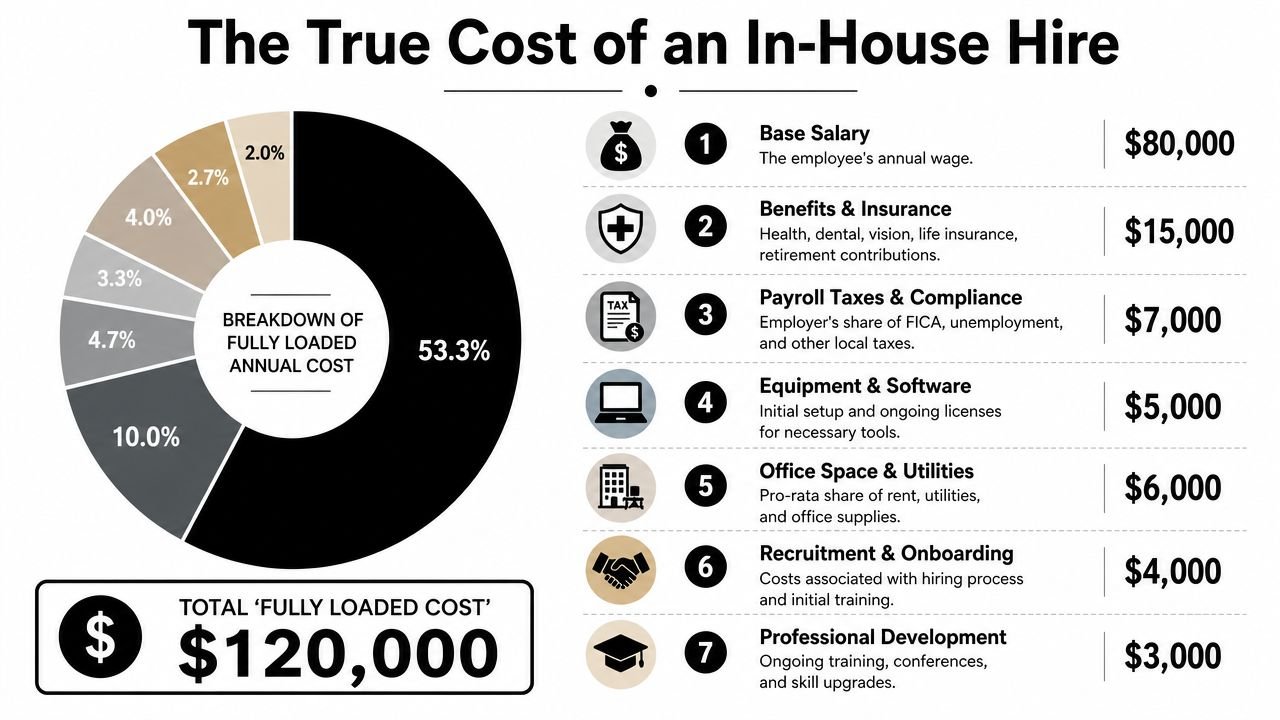
The base salary is never the actual number. It's the number firms talk about because it's visible. It's also the number that distorts every staffing decision.
Once you add benefits, payroll tax, software, hardware, office overhead, recruiting time, onboarding drag, and the slow ramp from “new hire” to “trusted project contributor,” the cost per productive hour climbs fast. If that person sits idle during slow periods, the economics get worse. If they leave within a year or two, you pay the cycle again.
What firms usually forget to include
The obvious line items are easy enough to list: salary, taxes, medical coverage, retirement contributions, a workstation, and software. In an architecture environment, that software stack often includes Revit, AutoCAD, Adobe tools, cloud collaboration platforms, and whatever internal systems your team uses for markups, model sharing, and document control.
The softer costs matter just as much:
- Recruiting friction means partner time, interview hours, screening effort, and lost momentum while teams wait for help.
- Onboarding lag hits production first. A new hire needs time to learn your sheet standards, wall types, family library, QA expectations, permit set organization, and internal review cadence.
- Bench time exposure stays on your books. If work slows, payroll doesn't.
- Turnover resets the meter because architectural production knowledge is firm-specific, not generic.
Practical rule: Compare any outside model against your fully loaded cost, not the salary line on the offer letter.
Why the baseline matters
The wrong comparison is “employee salary versus offshore monthly rate.” The right comparison is “fully loaded in-house production cost versus managed external capacity that can produce work inside our standards.”
That's especially true if your current workflow still mixes older CAD habits with a gradual move toward BIM deliverables. Firms in that transition often underestimate the management time required to maintain consistency across model setup, annotation, view templates, and documentation output. If you want a better feel for where production labor sits inside your workflow, CAD drafting support is often the first place to map what is repeatable, what is billable, and what is consuming senior staff attention.
What a Global Capability Center Model Actually Is
Your project load jumps after two wins in one quarter. Deadlines tighten. Your project architects are redlining at midnight, your BIM manager is cleaning models instead of improving standards, and hiring locally will take months. This is the operating problem a GCC solves if you set it up correctly.
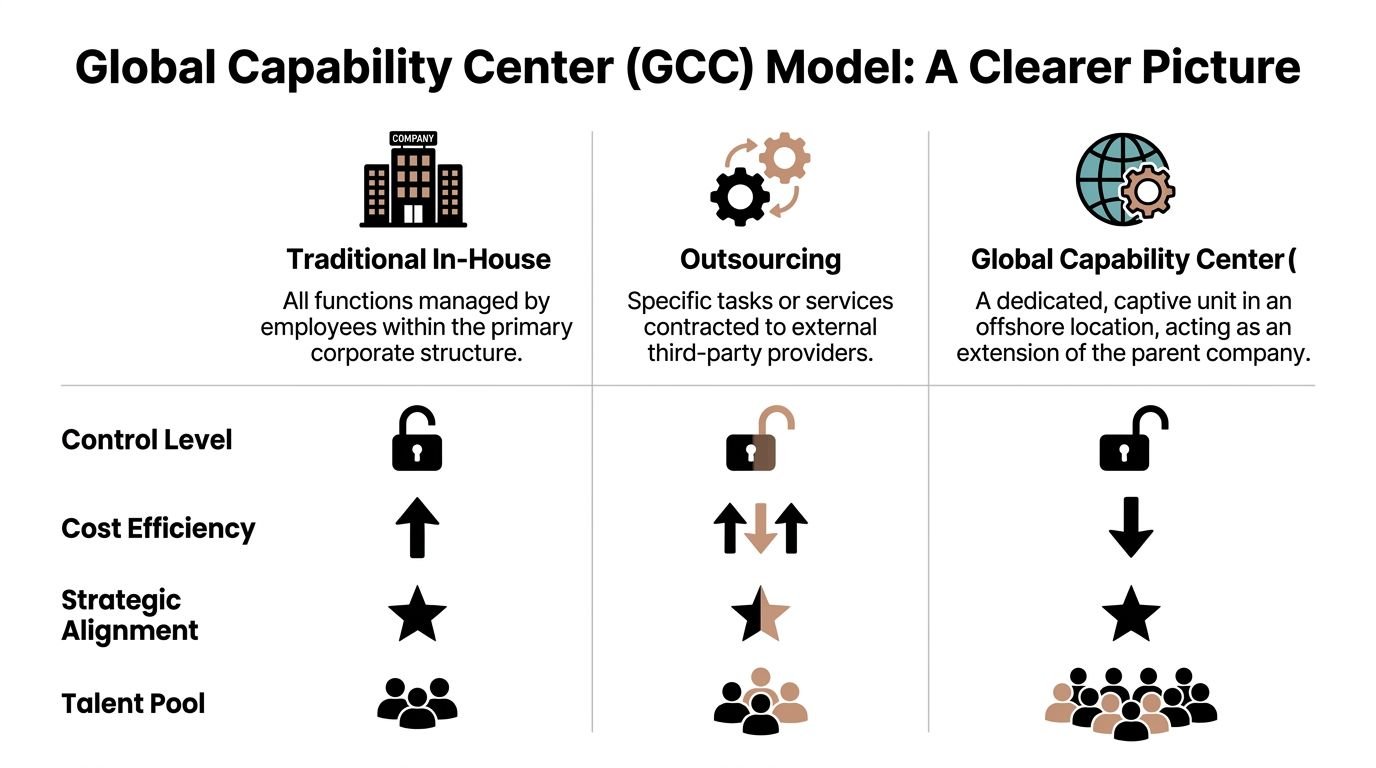
A global capability center in AEC is a dedicated production unit built around your standards, your workflows, and your delivery cadence. It is not generic outsourcing. It is not a freelancer bench. It is a managed team structure for repeatable design and documentation work such as BIM modeling, sheet production, clash support, CAD conversion, family creation, and QA-driven documentation. Firms that start with outsourced CAD drafting services for repeatable production work often use that as the first step toward a fuller GCC operating model.
Three models that look similar on paper but behave differently
| Model | What you gain | What you lose |
|---|---|---|
| In-house hire | Direct control, cultural closeness | Fixed overhead, slower scaling |
| Freelancer | Fast access, short-term flexibility | Inconsistent continuity, weak process integration |
| Global capability center | Dedicated capacity with management structure | Requires setup discipline and clear workflow ownership |
The distinction that matters is operating control. In a proper GCC, the team works inside your production system. They follow your Revit templates, naming rules, family logic, QA checkpoints, issue dates, and review cadence. The offshore provider handles local employment, HR administration, facilities, and day-to-day people management. Your firm keeps direction over output, priorities, and quality.
That is why a GCC performs better than ad hoc outsourcing for complex AEC production. BIM work breaks down fast when ownership is vague. Someone has to control model setup, sheet logic, clash response, annotation standards, and revision tracking. A GCC gives you a stable team and a defined management layer, which is what makes repeatable production possible across multiple projects.
India shows how established this model has become. By FY24, India hosted nearly 1,700 Global Capability Centres, employed approximately 1.9 million professionals, and accounted for over 53% of the global total, according to CEIPAL's GCC statistics overview.
Why structure matters more than geography
Geography matters less than production maturity. A weak workflow in another country stays a weak workflow. A strong GCC works because responsibilities are clear across your internal leads, the provider's operations team, and the offshore production staff. If review cycles, markups, escalation paths, and model ownership are unclear, the model fails no matter where the team sits.
The legal setup matters too. Firms comparing direct entity formation against partner-managed hiring should spend time understanding employer of record, because employment structure affects compliance, management responsibility, and how quickly you can put a dedicated team in place.
A GCC becomes an extension of your studio only when production standards, review ownership, and accountability are already defined.
Where the Real Cost Savings Come From
A principal signs off on a new local hire at a full salary, adds software, benefits, equipment, recruiter fees, and desk space, then waits to see if backlog holds. A GCC changes that equation. You are buying managed production capacity inside a defined operating system, not stacking more fixed cost onto the studio.
That is where the actual savings sit.
Lower wages matter, but they are only one line item. The bigger financial gain comes from changing how delivery capacity is funded, managed, and adjusted across project cycles. For AEC firms, that matters because BIM production is labor-heavy, deadline-driven, and vulnerable to margin erosion when staffing stays fixed but demand does not.
Cost savings come from a different cost structure
With a delivery center employing the team, your firm avoids a large share of the employer burden tied to each seat. That usually includes benefits, payroll taxes, local compliance administration, equipment setup, office overhead, and the recurring cost of recruiting and replacing staff. You pay for output capacity tied to production work, not for every administrative layer wrapped around an in-house headcount model.
The financial shift is practical:
- Recruiting cost stays with the provider instead of hitting your internal hiring budget every time you add production staff.
- Administrative onboarding is reduced because HR, payroll setup, and local employment compliance sit outside your U.S. or home-office structure.
- Idle capacity risk drops because slow periods do not hit your payroll in the same way.
- Resizing the team is faster and less disruptive than adding staff in a peak quarter and carrying them through a soft one.
Analysts at Zinnov report that well-structured Global Capability Centers can produce up to 60% cost reduction in markets such as India and up to 35% process efficiency improvement through consolidation and automation, as noted in Zinnov's GCC overview.
AEC firms only keep those savings if production is disciplined
Generic GCC content usually stops at labor arbitrage. That misses the point for architecture, engineering, and construction firms. In AEC, the true test is whether the offshore team can work inside your BIM standards, issue logs, sheet logic, model progression rules, and review cadence without creating rework.
A cheap hour that creates coordination errors is an expensive hour.
The firms that get real savings standardize the work first. They define what can move to the GCC, where reviews happen, how markups are closed, who owns model health, and which tasks stay with local technical leads. Then the lower-cost delivery engine starts showing up in actual project economics instead of disappearing into revision cycles.
If a large share of your workload still sits in repeatable documentation and production support, outsourced CAD drafting services are often the cleanest first test. They show quickly whether your standards are strong enough to convert lower production cost into better delivery economics.
The Direct Impact on Project Margin and Bidding
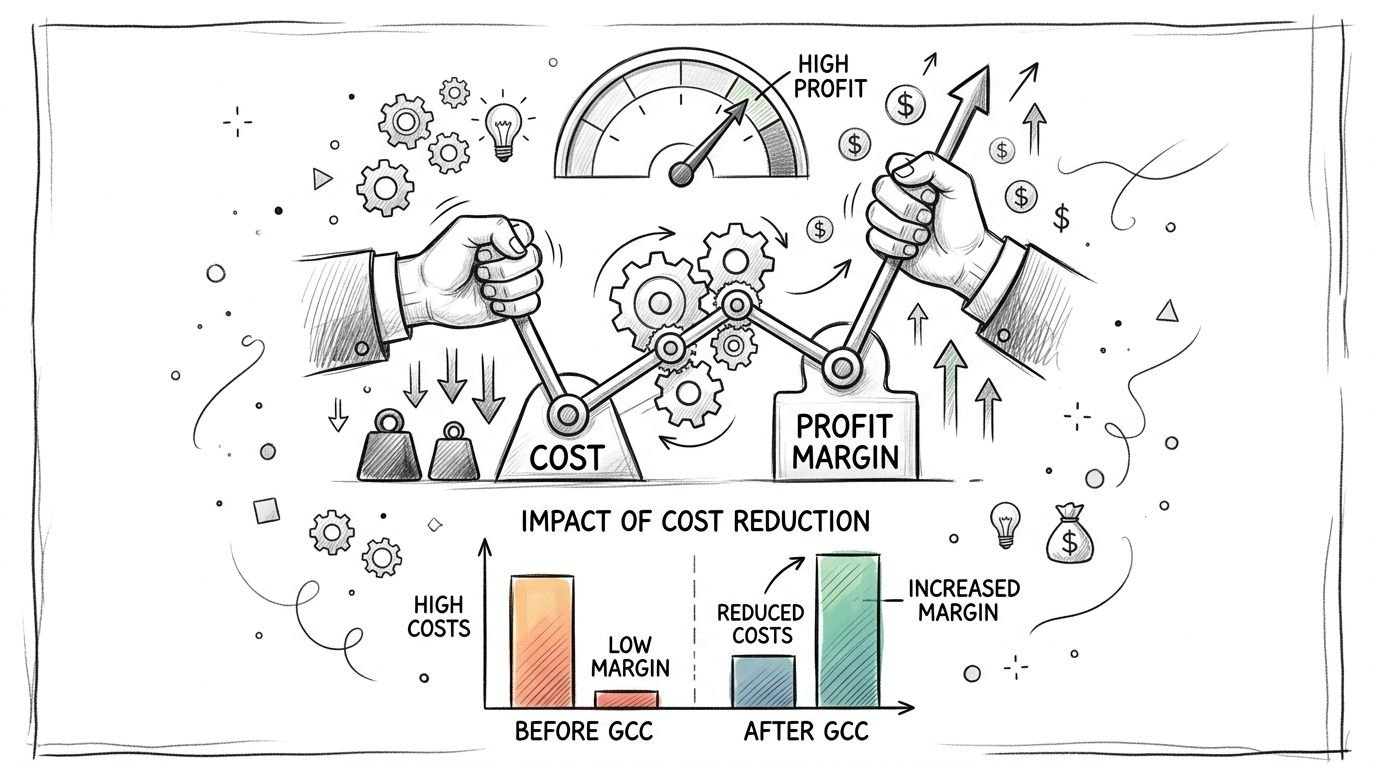
Project margin in an architecture firm is simple in theory and unforgiving in practice. Revenue is set by the fee. Margin lives in the spread between what it costs you to deliver and what the project pays.
If production cost drops and quality holds, margin improves. If production cost drops but rework rises, you gave the gain back.
Fixed-fee work rewards cost discipline
On lump-sum projects, every hour of production has to fit inside a predetermined revenue envelope. Lowering the delivery cost of BIM production, drafting, documentation, and model coordination creates more room inside that fee.
That matters most when the work is operationally mature:
- permit drawing production with stable standards
- DD and CD model progression with clear review checkpoints
- repeatable family use and view template controls
- disciplined redline execution
- issue tracking that prevents RFI-prone errors before they hit the field
If your documentation system is stable, lower production cost flows directly into margin protection.
Hourly work changes the bidding equation
On hourly or time-based work, a lower delivery cost gives you options. You can preserve your target margin while bidding more competitively, or hold your rate and improve profitability. Either way, the firm gains room to maneuver.
Offshore Revit production cost and BIM outsourcing cost matter less as standalone figures and more as inputs to project economics. Principals should model the spread using their own fee structures, expected production hours, internal review time, and rework assumptions. The mechanics are straightforward. What matters is whether the dedicated team can produce output that survives your QA process without consuming senior staff time you thought you had saved.
Achieving Capacity Flexibility Without Headcount Risk
AEC demand doesn't arrive in a smooth line. It comes in bursts. A school package gets accelerated. A multifamily client suddenly wants alternate unit studies. A permit set needs a push. Then two weeks later the pressure shifts somewhere else.
Permanent headcount is a blunt instrument for that kind of workload.
Elastic capacity is the real operational advantage
A dedicated offshore production team gives firms a way to expand capacity during heavy periods and reduce it more cleanly when work softens. That matters for firms that don't have a perfectly even backlog and don't want every staffing move to become a long-term payroll commitment.
When AEC firms can trust a GDC model, it becomes less about labor arbitrage and more about business resilience. You don't need to keep hiring for peak demand if your baseline team can be supported by scalable external production pods that already understand your standards.
It also protects the internal team
Layoffs carry a financial cost, but they also damage trust. Over-hiring creates management noise, distorts utilization conversations, and often pushes principals into weak forecasting decisions because they're trying to justify the headcount they already added.
A more flexible model gives operations leaders room to match production capacity to actual demand instead of the demand they hope will hold.
If your broader workforce strategy includes specialist technical support beyond standard documentation roles, it's worth looking at adjacent models too. For example, firms exploring automation or computational workflow support may find on-demand AI engineering talent useful as a parallel reference for how flexible expert capacity can be layered into a delivery system without expanding permanent staff too early.
The Hidden Factors That Determine Success
A principal approves an offshore team because the rate looks good. Ninety days later, the savings are gone. PMs are rewriting markups, senior staff are catching sheet coordination misses at the eleventh hour, and nobody can say who owns production quality.
That outcome is predictable. A GDC fails when firms treat it like extra drafting capacity instead of a production system.
The break point is governance. Mature GCC operators keep the offshore team aligned with headquarters on goals, delivery rhythms, quality standards, and security practices, as outlined in Plugscale's guide to GCC governance maturity. In AEC, that translates into production control, BIM standards discipline, and clear accountability for document quality.
For design firms, the management structure needs to be concrete:
- One production owner on your side who controls priorities, clarifies scope, and stops PM-by-PM chaos.
- One delivery lead on the offshore side who manages output, staffing continuity, and escalation.
- A defined BIM execution layer covering templates, families, view standards, annotation rules, shared parameters, file naming, and model handoff protocols.
- A review cadence for first-pass checks, redline closure, and pre-issue QA.
- Decision rules for ambiguous markups, code-sensitive details, scope drift, and consultant coordination conflicts.
- Performance tracking tied to rework, turnaround time, first-pass accuracy, and QA failure trends.
Cheap labor is not the win. Production maturity is.
A dedicated offshore production team should run like a controlled delivery pod inside your operating model. The team should know what a complete redline package looks like, when to escalate a clash, how to build sheets to your standards, and what can be issued without principal intervention. If those rules live only in the heads of your senior architects, the model will stay fragile and expensive.
Low hourly cost means nothing if your highest-billed people are still doing cleanup.
The firms that get margin from this model standardize the work before they scale it. They choose repeatable scopes, document the production rules, assign ownership, and measure rework hard. That is what turns a global capability center into a reliable AEC delivery engine instead of an offshore experiment.
How to Evaluate the Real ROI Before You Commit
A principal approves three new hires because backlog looks strong. Two quarters later, one project slips, another gets value-engineered, and payroll is locked in. That is the mistake to avoid.
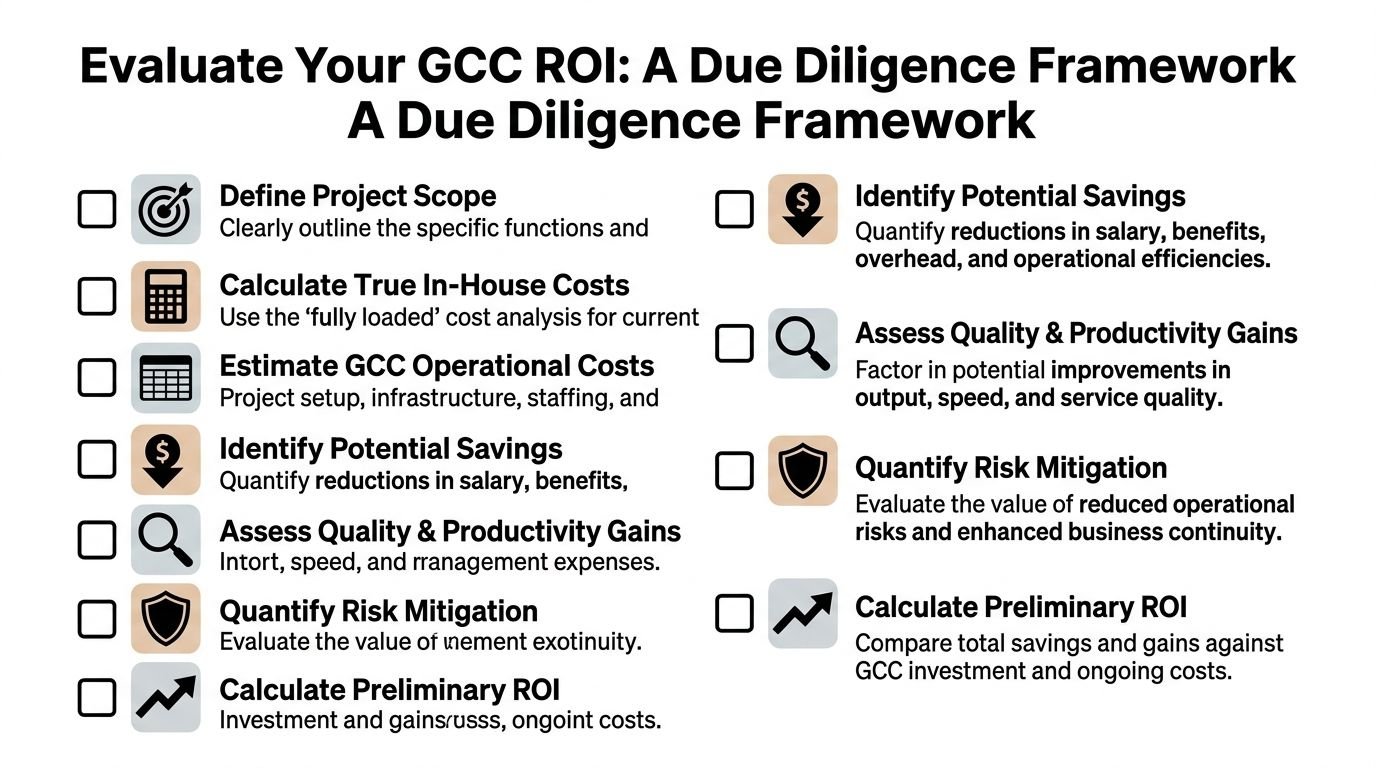
Evaluate ROI by testing whether a global capability center for architecture firms improves production economics without adding fixed headcount risk. Start with the financial baseline. Price the in-house option fully, including salary, benefits, software, hardware, recruiter fees, management time, PTO coverage, and the productivity loss that comes with vacancies and ramp-up. Then compare that number to the monthly cost of a dedicated offshore team built around the exact work you need done.
After that, price the transition thoroughly. Include onboarding, standards transfer, BIM setup, QA time, review cycles, communication overhead, and the time it takes before the team can produce usable output inside your production system.
Start with a pilot, not a headcount plan
Run a pilot that mirrors real delivery conditions. Do not test with random overflow tasks that no one owns and no one measures. Use a defined scope with clear output standards and a visible QA trail.
Good pilot scopes include construction document support, redline-based model updates, repeatable sheet production, family cleanup, and permit set drafting under established BIM standards.
Measure four things:
First-pass accuracy
Can the team interpret markups correctly, build sheets properly, and produce work that survives review without major rework?Communication efficiency
Are questions specific, timely, and tied to the right decision-maker, or does your PM team spend half the day clarifying basics?Internal review load
Is your senior staff approving work, or rebuilding it before issue?Standards compliance
Can the team work inside your file structure, naming rules, family standards, shared parameters, and coordination process without constant correction?
Questions every firm should ask before signing
AEC firms do not need a generic offshore vendor. They need an operating model that can support BIM production at scale.
Ask these questions directly:
- Who owns delivery every day? If there is no named delivery lead, expect missed handoffs and unclear accountability.
- What happens before work reaches our team? Ask for the provider's QA steps, review checkpoints, and error escalation path.
- How do you run BIM production? Ask about Revit templates, family libraries, annotation standards, worksharing discipline, clash coordination, and issue tracking.
- How do you add or reduce capacity? You need a staffing process, not a sales promise.
- How are production issues escalated? Delays in resolving model conflicts or unclear redlines will hit deadlines fast.
- What metrics do you track? Ask for first-pass accuracy, turnaround time, rework rates, and QA failure trends.
Use one more filter. If a provider talks mainly about lower hourly rates, keep looking. A serious global capability center partner should be able to explain staffing continuity, production controls, BIM governance, and how their team protects margin during deadline spikes.
The broader market is growing fast. The global GCC market is projected to grow from $649.16 billion in 2026 to $952.51 billion by 2031 at a 7.97% CAGR, and India is projected to reach 2,400 centres employing 2.8 million professionals by 2030, according to the Press Information Bureau's GCC market release. Growth does not equal fit. Your ROI depends on whether the provider can function inside complex AEC delivery, with disciplined BIM workflows and management structure that hold up under real project pressure.
Conclusion From Cost Center to Capability Center
A principal wins a large package, deadlines tighten, and the local hiring plan falls apart in two weeks. That is the moment many firms mistake labor access for operating capacity. They are not the same.
A global capability center works only when it is built as part of your delivery system. In AEC, that means defined BIM standards, clear production ownership, stable team structure, and management control that holds up under real project pressure. Firms that treat the model as a rate play usually get short-term output and long-term instability. Firms that treat it as a production platform get steadier margin, cleaner forecasting, and fewer surprises during deadline spikes.
This fundamental shift is operational. You stop viewing offshore support as overflow labor and start using it as a managed capability with repeatable output, documented workflows, and accountable leadership. That changes how you bid, how you plan capacity, and how confidently you take on work.
If you are evaluating a dedicated resource model, use a provider that can explain how the team will fit into your production system, not just what it costs per hour. BIM Heroes offers resources and service options built around production maturity, BIM workflows, and dependable delivery systems. Use that standard to pressure-test your own checklist, pilot scope, and ROI review.
Category: Architectural Production & Outsourcing