


Meta description: CAD drafting is still foundational to architecture production. Learn how a Global Delivery Center model helps small firms add reliable capacity, standardize output, and protect margins without building a larger in-house team overnight.
A small firm wins a project it has chased for months. Then a significant problem surfaces. The team is already full, the principal is still redlining sheets at night, and the next milestone is closer than anyone wants to admit.
The choices are familiar. Hire fast, which usually takes 60 to 90 days and still may not line up with project-based demand. Pass on the work and lose both the fee and the client momentum. Or find production capacity somewhere else and hope it doesn't create more management overhead than it solves.
That's where CAD drafting becomes an operations issue, not just a staffing issue. The question isn't whether someone can draft. The question is whether your firm can build dependable production capacity without resetting quality, standards, and review discipline every time workload spikes. For small architecture firms, that often points toward a Global Delivery Center model rather than ad hoc outsourcing.
The Small Firm's Capacity Problem
Most small firms don't have a labor problem first. They have a timing problem.
A new project lands while one team member is buried in permit sets, another is managing consultant coordination, and the principal is still carrying design decisions, client calls, and internal QA. In firms with 2 to 15 staff, that overlap is where schedules start slipping and margins subtly erode.
Hiring sounds like the obvious answer until you run the math against project timing. Recruiting, interviews, software setup, onboarding, and production ramp-up don't solve a deadline that's already on the calendar. A permanent hire can make sense when workload is stable. It makes less sense when demand comes in waves and the surge is tied to CDs, permitting, or consultant coordination.
Passing on the project isn't clean either. You don't just lose the fee. You risk losing the client's confidence the next time they have work. That's why many firms start looking at outside production support after they've already felt the pain of saying no.
A more mature response is to treat capacity as a system. That means deciding in advance how your firm will absorb production spikes, who owns reviews, what standards outside teams must follow, and how files move without confusion. Firms that get this right can say yes more often without wrecking delivery discipline.
Why CAD drafting still matters operationally
CAD drafting isn't some legacy side skill that disappeared when BIM arrived. It remains part of the backbone of production. In the broader history of CAD, AutoCAD's release in 1982, Pro/ENGINEER in 1987, and SolidWorks in 1995 marked major shifts from manual drafting to digital production, and by 1987 traditional CAD vendors had already sold about 100,000 seats with supporting hardware, showing industrial-scale adoption had arrived (Lifecycle Insights on the CAD historical arc).
That history matters because small firms still live with the result. Digital drafting replaced board work, but it also raised the bar for revision control, model coordination, standardization, and release discipline.
Practical rule: Capacity without standards is just outsourced confusion.
Understanding the Global Delivery Center Model
Conventional outsourcing and a global delivery center architecture model are not the same thing, even if both involve an offshore team.
In ad hoc outsourcing, a firm sends out a project, receives drawings back, marks them up, sends revisions, and repeats until the set is usable. The relationship is transactional. The production team may be serving several clients at once, and your firm may not see the same people on the next job. Every project starts with re-explaining templates, details, naming rules, and sheet expectations.
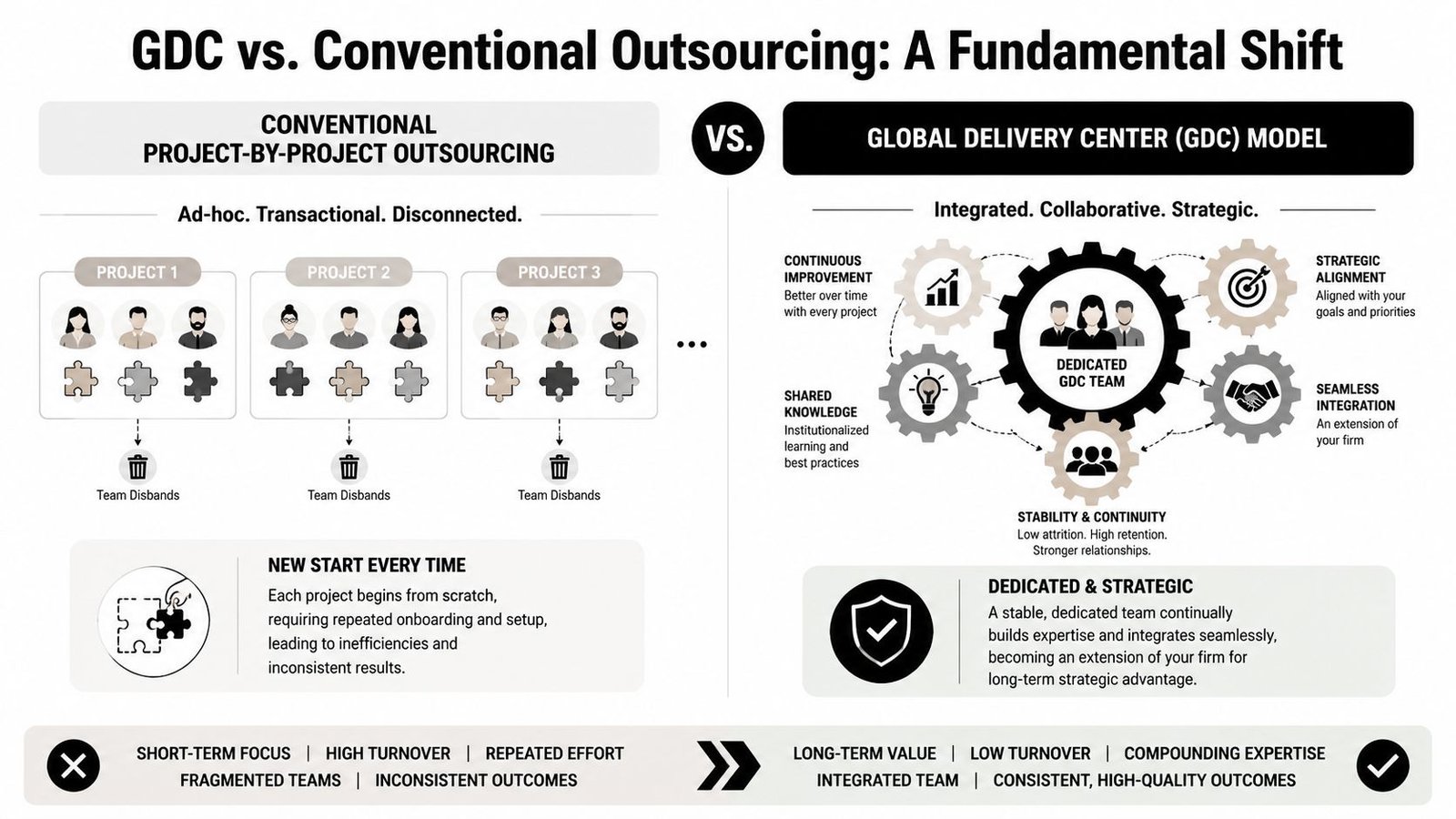
A GDC model works differently. The team is dedicated to your firm's work. Over time, they learn your Revit template, title block logic, detail library, view setup, annotation style, and sheet sequencing habits. They also start to recognize the things that never make it into a generic kickoff deck, such as which client always pushes for alternate layouts, which jurisdiction tends to ask for a certain notation, or which PM prefers decisions escalated early rather than buried in markups.
What improves over time
That continuity is the whole point. In a strong GDC setup, quality doesn't reset to zero with each project. It compounds because the team carries forward institutional knowledge.
Here's the practical difference:
| Model | What happens at project start | Quality pattern |
|---|---|---|
| Project-based outsourcing | Re-brief standards, re-explain scope, recheck setup | Inconsistent and review-heavy |
| GDC model | Team already knows standards and production rules | Improves as familiarity grows |
Standards stop being optional
This matters even more in CAD-heavy environments. Advanced drafting teams improve accuracy by standardizing reusable detail libraries and running automated QC checks on linework, text, dimensions, layering, and insertion points. Autodesk specifically notes the value of removing duplicate linework, converting connected lines to single polylines, normalizing text to MText, and reducing layer nomenclature to a minimum because it lowers clutter and misread risk (Autodesk University on developing CAD standards).
That kind of discipline is hard to sustain with a rotating external team. It becomes far more realistic with a dedicated offshore BIM team that sees the same standards every day.
Core Benefits of a Dedicated Offshore Production Team
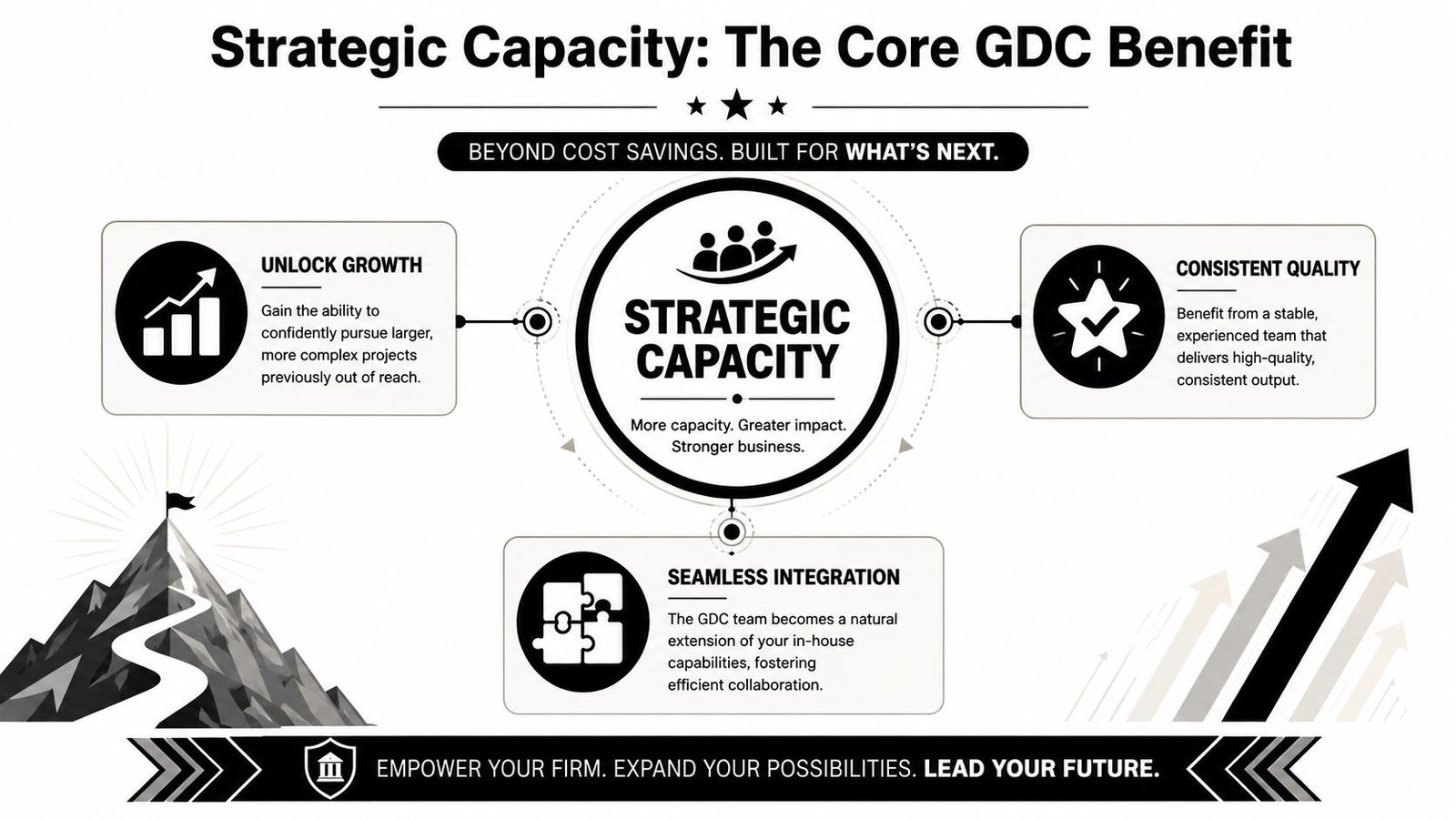
The true value of a GDC model for a small firm is strategic capacity.
It is not mainly about chasing a lower hourly rate. It is about giving the firm room to absorb production demand without expanding permanent headcount every time the backlog tightens. For a principal or project manager, that changes what kinds of work the firm can pursue and how much production risk it can carry.
Capacity without another full-time seat
A dedicated team gives a small office an advantage. The firm can add support during heavy documentation and reduce intensity during earlier design phases. That's one reason offshore BIM production small architecture firm searches have become more common. Small firms need elasticity more than they need another fixed salary commitment.
This is especially relevant because drafting remains a defined professional role, not a temporary market blip. The U.S. Bureau of Labor Statistics reports a median annual wage of $65,380 for drafters in May 2024, projects employment to show little or no change from 2024 to 2034, and still expects about 16,200 openings each year on average, mostly from retirements and turnover (BLS drafters occupational outlook).
That tells you something important. CAD drafting is established, technical work. The market may be flat in growth terms, but firms still need the function.
Principal time returns to higher-value work
In many small firms, the principal is the rainmaker, lead designer, escalation point, and late-stage redliner all at once. That's expensive labor doing work that should be standardized wherever possible.
A reliable production team changes that mix. When outside staff can handle model setup, sheet development, annotation, and drawing coordination inside the firm's standards, the principal gets time back for:
- Client management that protects repeat work
- Design oversight where judgment matters more than labor volume
- Business development that keeps the pipeline full
- Decision checkpoints before errors become RFIs or permit comments
The best production support doesn't make the principal disappear from the process. It keeps the principal focused on decisions only they should make.
Consistency protects margin
Rotating freelancers can finish tasks. They rarely build a stable production rhythm. A global delivery center architecture arrangement is stronger when your main concern is consistency across multiple projects, not just getting a single deadline over the line.
That's where outsourced CAD drafting architecture becomes useful only if it behaves like an extension of your own operation. If every project comes back in a slightly different graphic language, your team spends the savings in review time and correction cycles.
How a Global Delivery Center Engagement is Structured
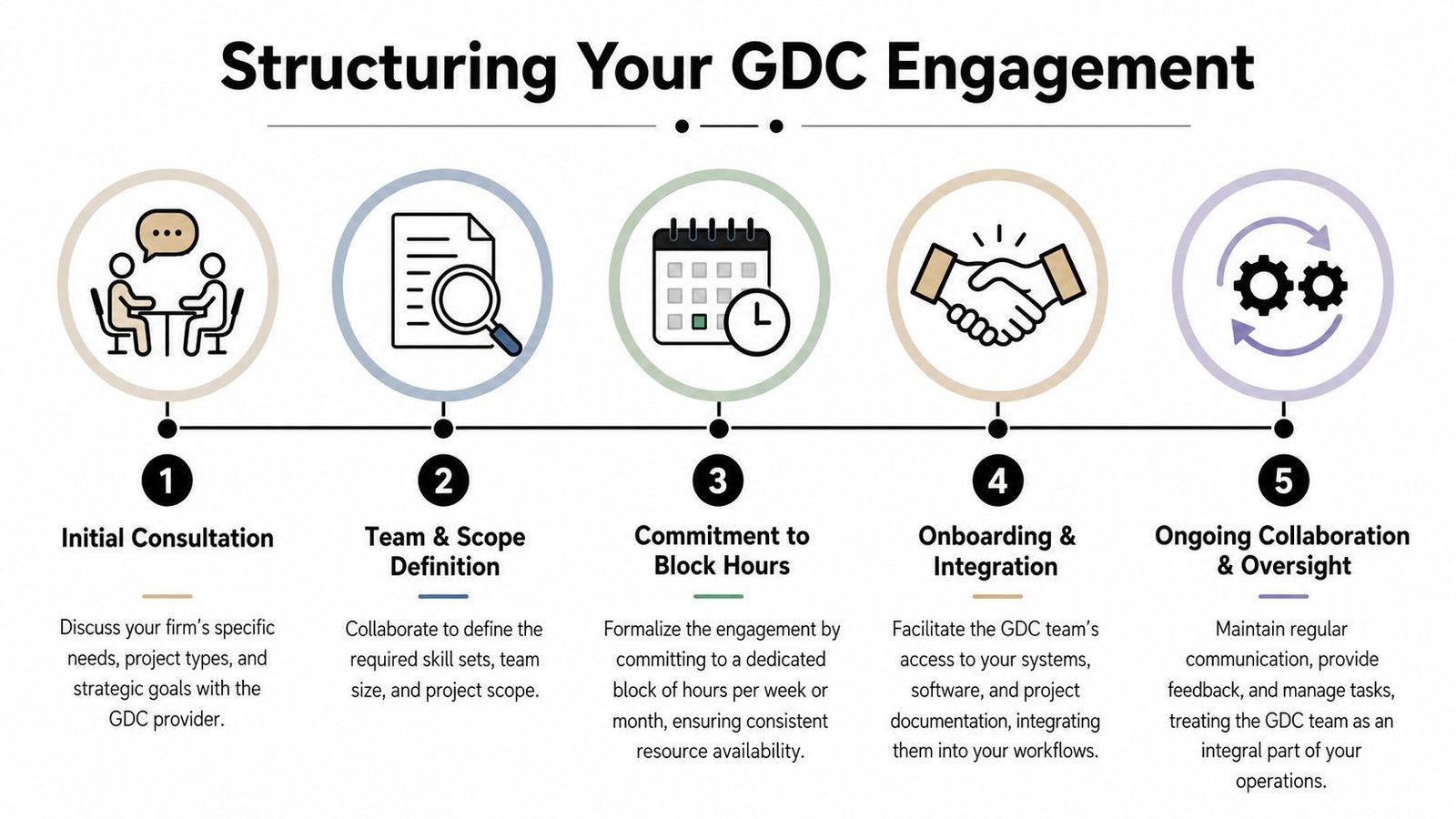
A proper GDC engagement should look more like production planning than vendor management.
The usual structure starts with a committed block of hours per month. That commitment reserves dedicated capacity for your firm. It tells the provider how to staff the team and tells your firm what level of production support is available without starting a new commercial conversation every time workload increases.
Retainer versus project fee
A retainer and a project fee produce different behaviors.
A project model is simple when the scope is narrow and the relationship is short. It's useful for one-off cleanup, overflow drafting, or a contained deliverable. But it encourages both sides to think transactionally. The external team completes the package and moves on.
A retainer model does something else. It creates an incentive for the team to learn your standards thoroughly because the relationship is expected to continue. That's the point of a dedicated offshore BIM team. The value isn't just labor availability. It's retained knowledge.
A simple comparison helps:
- Project model fits irregular, isolated scopes
- Retainer model fits firms with recurring production flow
- Hybrid approach can work when a firm wants a stable base with occasional surge capacity
The onboarding period matters
Most firms underestimate onboarding. The first 4 to 8 weeks should be treated as setup and calibration, not full-speed production from day one.
That period usually includes:
- Template transfer so the team works in your Revit environment, not a generic one
- Detail library review to identify what is reusable and what needs cleanup
- File naming and folder rules so handoffs don't become a scavenger hunt
- Pilot scope on a live project or contained test package to calibrate redlines, response expectations, and QC thresholds
Define review gates early
The firms that struggle with offshore production often fail at one basic step. They don't define review milestones.
You need explicit checkpoints such as SD output review, DD coordination review, permit set readiness review, and pre-issue QA. If everything is reviewed only at the end, your team is using a remote production arm as a black box. That's not scalable.
One option firms consider when they want this structure around BIM and architectural production is a Global Delivery Center engagement. What matters more than provider branding, though, is the operating model itself. Dedicated hours, defined review gates, and standards-driven onboarding are what make the arrangement work.
Your Firm's Responsibilities in a GDC Partnership
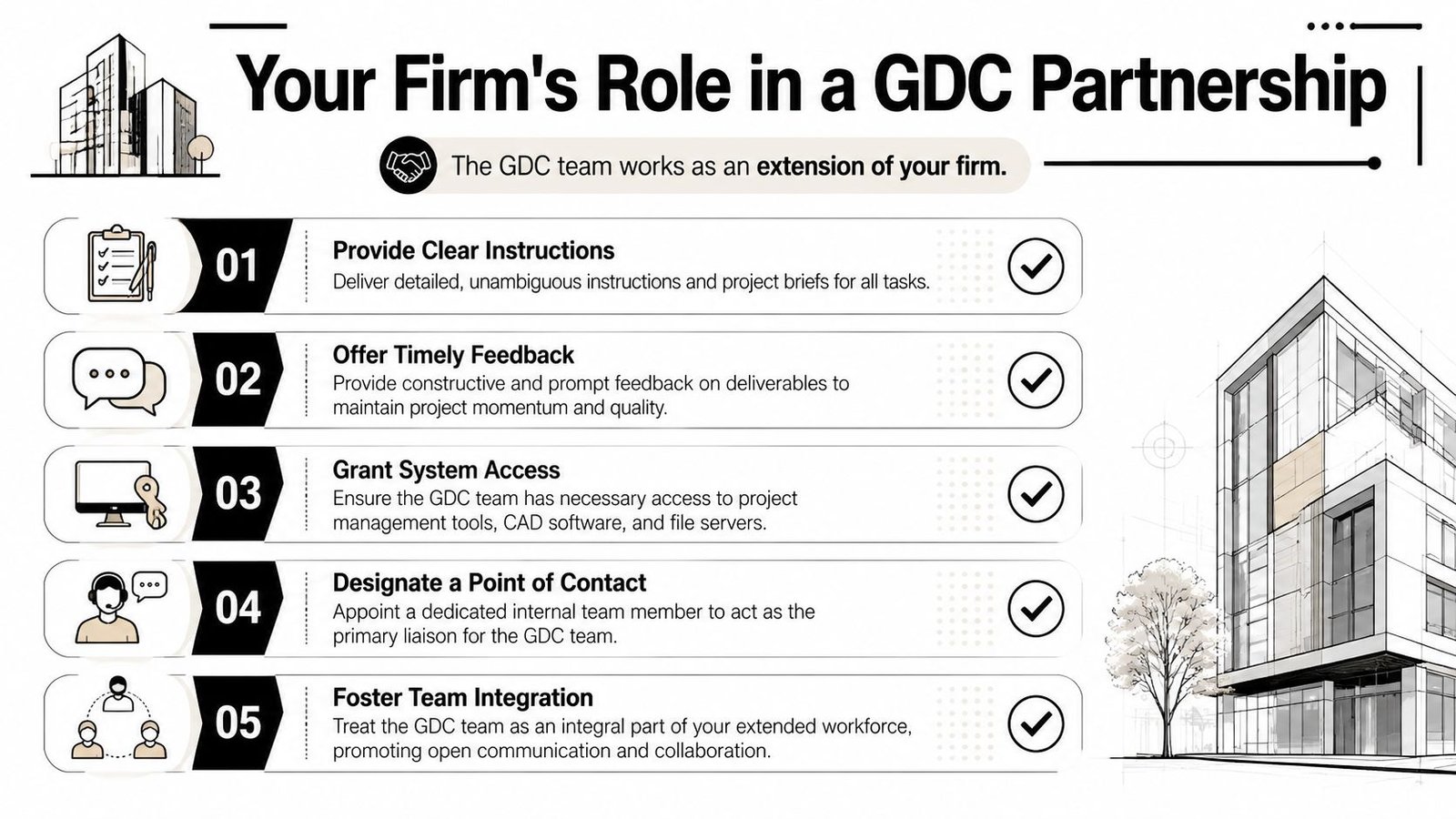
A GDC model is not hands-off. It amplifies the discipline your firm already has.
If your office has weak templates, undocumented drafting habits, and inconsistent reviews, a remote team won't solve that. It will expose it faster. The strongest offshore partnerships usually come from firms that already know how they want production to run, even if they need help carrying the load.
Start with standards, not hope
The team should work from your template, your title blocks, your family standards, and your documentation conventions.
That sounds obvious. In practice, many small firms discover they do not have a coherent standard. They have habits. Those are not the same thing.
A high-value technical control in CAD drafting is enforcing a company CAD standards manual with fixed templates, layer naming, symbols, tolerances, annotation rules, title block formats, and revision-control rules because those conventions reduce variation in sheet production and make downstream review and release more predictable across projects (Primaverse on CAD drafting standards).
If your standards still live only in one senior architect's head, fix that first.
Every project needs a brief
A dedicated team still needs context. At the start of each project, the U.S. side should provide a short written brief outlining the client, jurisdiction, code basis, scope boundaries, deliverables, milestones, and known risks.
That brief should also flag permit sensitivities, owner preferences, and any consultant coordination issue already visible. If a project has sealing or release constraints, those need to be explicit too. Firms dealing with document control around architectural stamps and release workflows already know how fast confusion spreads when ownership and issuance rules aren't spelled out.
Review bandwidth is not optional
The biggest failure point is delayed review.
A principal or project architect must review at defined intervals and return decisive markups. Not endless commentary. Not broad statements like “make it cleaner.” Decisive instruction. If the U.S. team cannot create consistent feedback loops, the offshore team will keep producing work, but quality will drift because no one is steering tightly enough.
Field lesson: Remote production doesn't reduce the need for management. It raises the value of good management.
A good GDC setup needs one internal owner. One person routes work, answers questions, consolidates markups, and controls scope. Without that, the team gets mixed direction from multiple voices and output quality becomes uneven.
Addressing Common Concerns About Offshore CAD Drafting
Most objections to offshore production are valid. They just tend to be process problems disguised as location problems.
Time zone differences can help
A team in India is typically 9 to 12 hours ahead of U.S. time zones, which changes the rhythm of delivery. If your office sends markups at the end of the U.S. day, the team can work while your staff is offline and return progress for morning review.
That doesn't work automatically. It works when questions are bundled clearly, priorities are ranked, and the handoff package is complete. If your internal team sends scattered comments across email, PDFs, and chat, the time zone advantage disappears.
Communication has to be designed
In-house teams rely on overheard conversations, desk drop-ins, and quick file checks. Remote teams can't.
The replacement is straightforward:
- Daily or scheduled check-ins for priorities and blockers
- Shared task tracking so nobody guesses what “urgent” means
- Markup discipline with one source of truth for comments
- Named points of contact on both sides
Firms that already use a structured workflow for architectural production support usually adapt faster because the communication habits are already partly in place.
Quality is a review issue
Poor offshore output is usually blamed on geography. More often, the core issue is that the firm sent weak standards, skipped calibration, or reviewed too late.
That doesn't mean every provider will perform equally well. It means quality control still sits with the firm's process design. If your markups are vague and your deadlines are compressed, in-house staff will struggle too.
IP and confidentiality are contractual
Confidentiality, file access, and ownership terms belong in the engagement agreement. Treat them with the same seriousness you would apply to consultant agreements or client confidentiality terms. If those protections are unclear, fix the contract before production starts.
Is a Global Delivery Center Right for Your Firm?
A GDC model fits some small firms extremely well. It fits others poorly.
The deciding issue is not whether your firm is “too small” for outside production. It's whether your workload and internal discipline are stable enough to support a dedicated production relationship.
A quick self-check
A GDC model is usually a stronger fit when these conditions are true:
- Your project flow is consistent. You don't need perfectly even demand, but you do need enough recurring work to justify reserved capacity.
- Production consumes a meaningful share of fee. If your bottleneck is CDs, permitting, and documentation, added drafting capacity offers real benefits.
- You already have basic standards. A usable Revit template, naming convention, and detail library shorten the ramp.
- Your PMs can manage remotely. That means clear assignments, regular reviews, and fast decisions.
- You want predictability more than casual overflow help. If you only need occasional drafting support, a simple project-based arrangement may be enough.
When it may not fit
If your backlog swings wildly, if your design work is highly bespoke but production is light, or if no one in the office can own the review process, a retainer model may feel heavy.
That doesn't mean offshore support is off the table. It means the firm may need to clean up standards first, test with a smaller scope, or stick with narrowly defined overflow work instead of building a full global delivery center architecture arrangement.
Good outsourced production makes a disciplined firm stronger. It won't create discipline on its own.
If you're weighing whether a GDC structure makes sense for your workload, templates, and review capacity, it helps to talk it through with someone who understands production, not just staffing.
If you want a practical conversation about whether this model fits your firm, contact BIM Heroes to discuss a Global Delivery Center engagement. A short discussion can help you assess standards readiness, review bandwidth, and whether a dedicated team or a lighter production model makes more sense.