


Meta title: Construction Document Management: A Complete Guide
Meta description: What construction document management involves, where it breaks down, and how AEC firms build a system that holds up across a project.
A superintendent opens a sheet on-site, the architect is looking at a newer PDF, the engineer revised a detail late, and the GC's team is still routing an old RFI answer through email. That's how avoidable mistakes get built. Not because people don't care, but because the project has no reliable way to keep drawings, specs, RFIs, submittals, and revisions aligned.
Construction document management is the operating system that keeps project information current, traceable, and usable from design through closeout. It's not just file storage. It's the discipline of controlling what gets issued, who acts on it, what changed, and what the field should trust.
This matters more as project complexity rises. The global construction industry is projected to grow by 3.4% in 2026, and 86% of infrastructure players expect larger deals according to Pelles.ai's construction document software overview. Bigger deals mean more disciplines, more approvals, and more ways for version confusion to hit schedule and margin. A good system protects predictability before it protects convenience.
Introduction
Most firms don't lose control of documents all at once. It happens in pieces.
A revised reflected ceiling plan gets uploaded, but the linked finish schedule doesn't. An RFI answer clears a conflict in the field, but nobody pushes that decision back into the model or the next bulletin. The permitting set, bid set, and construction set start to look similar enough that someone assumes they're interchangeable. They aren't.
That's why construction document management has to be treated as a production discipline, not an admin afterthought. In practice, it governs how teams create, review, approve, issue, supersede, and archive information across the full project lifecycle. If that lifecycle isn't controlled, delivery gets noisy fast.
Practical rule: If the field has to ask which set is current, your system already failed upstream.
What works is usually boring. Clear issue protocols. A real CDE (common data environment) or a tightly governed equivalent. Ownership that's explicit. Naming standards that don't drift by project team. RFI submittal management that feeds back into the live set. That's the difference between a project that feels predictable and one that burns hours in coordination calls.
What Counts as a Construction Document
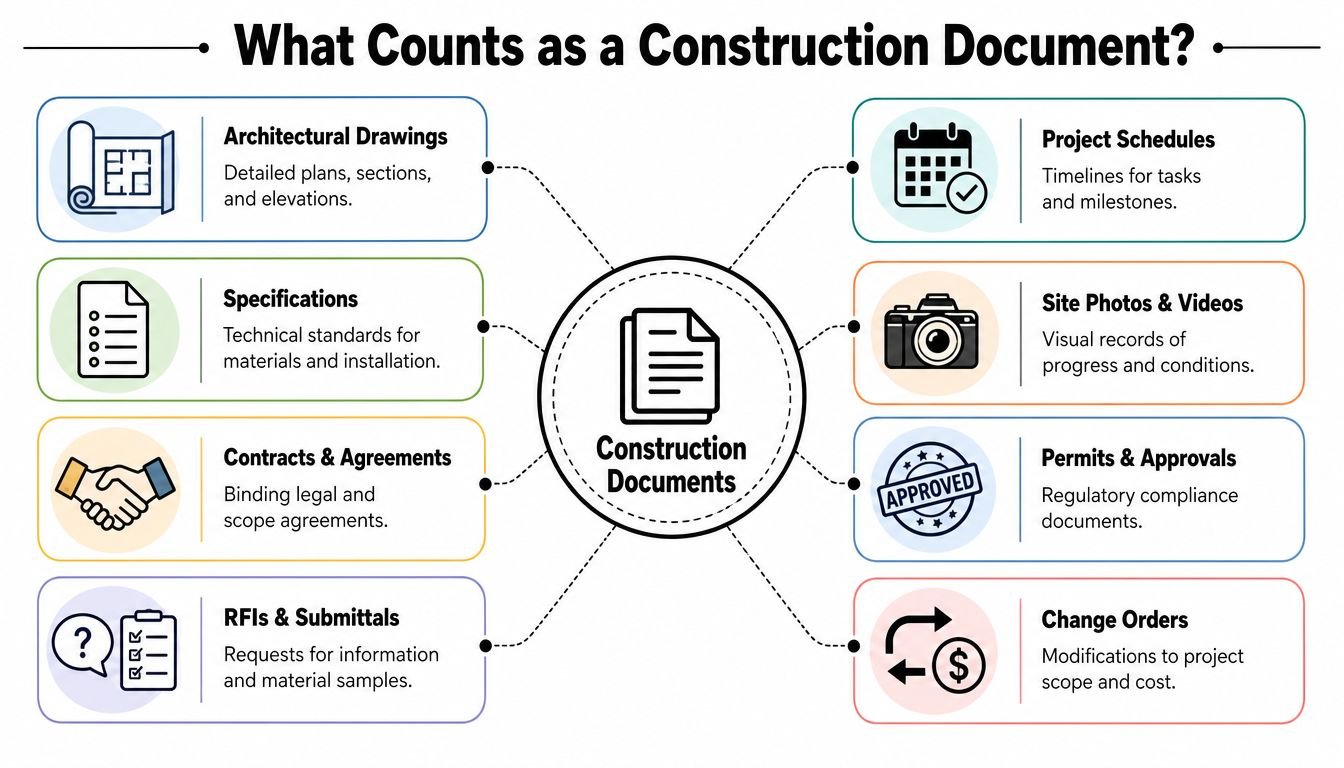
A lot of teams still talk about construction documents as if they mean only sheets and specs. On a live project, that's far too narrow. The actual construction documentation process includes every controlled information object that affects pricing, permitting, installation, coordination, compliance, or closeout.
The document set is bigger than the sheet index
At minimum, firms are managing:
- Drawing sets including permit sheets, bid sets, issued-for-construction packages, bulletins, addenda, and record drawings
- Specifications that define materials, systems, performance requirements, and installation criteria
- RFIs and responses that clarify incomplete, conflicting, or field-driven conditions
- Submittals and shop drawings that test design intent against actual products and fabrication
- ASIs and addenda that formally transmit revisions before and during construction
- Change orders that alter scope, cost, and often downstream documentation
- As-builts and O&M material needed for closeout and operations
- BIM models and model-derived sheets that often drive coordination and issue management
Contracts and agreements belong in that ecosystem too. If you're tightening front-end controls, practical guidance on AI-powered contract drafting advice is useful because scope language and document obligations often shape how disputes over revisions get resolved later.
File storage is not document control
A shared folder can hold all those files and still fail as a system.
Construction document control means each item has status, revision logic, ownership, and a path to approval. It also means one document type can't drift away from another. A revised door schedule without a matching sheet issue isn't controlled. A submittal approval that never reaches the affected detail isn't controlled. A model update that doesn't trigger a sheet review isn't controlled.
The job is to preserve a single source of truth, not just a larger pile of files.
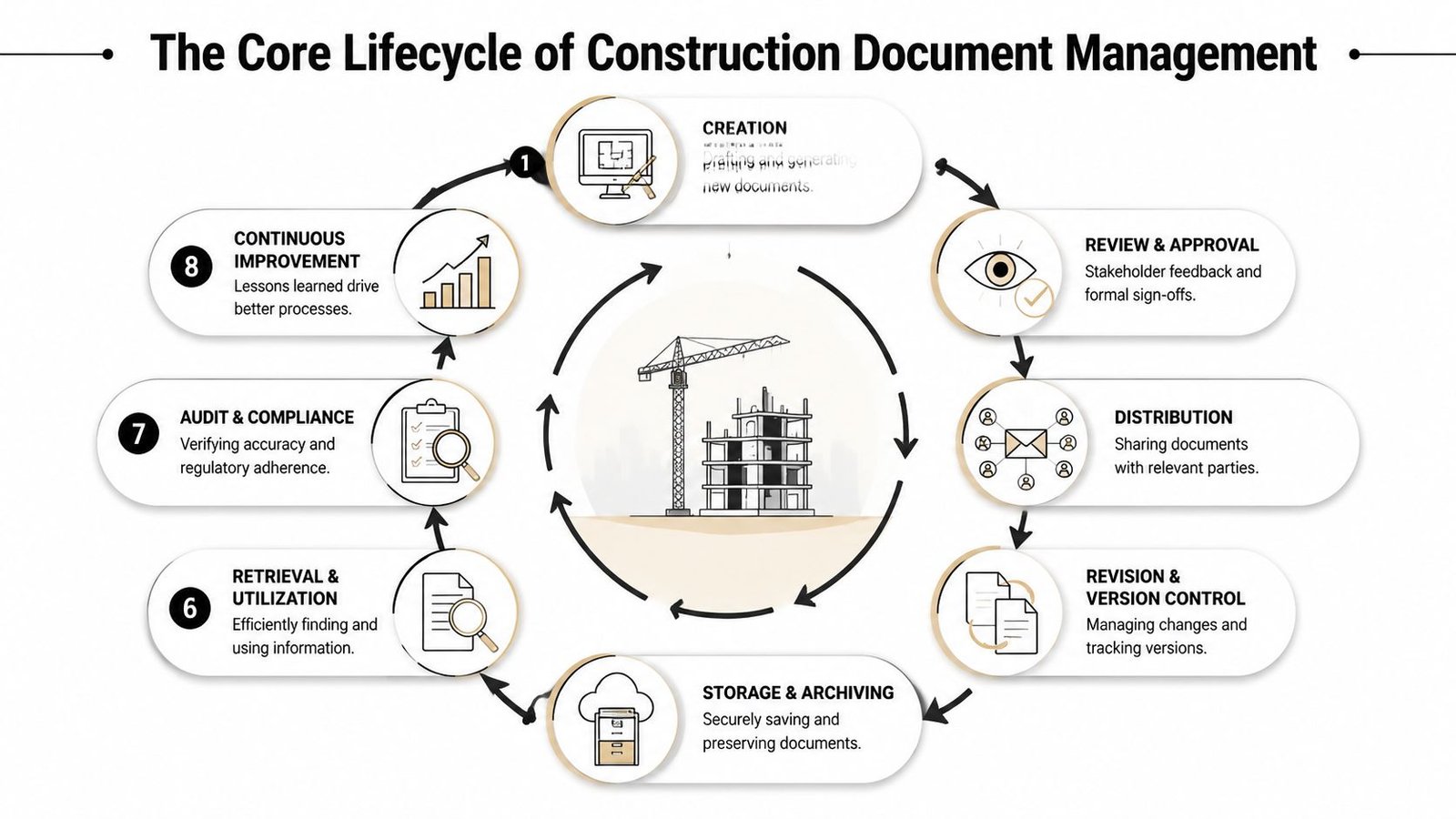
The Core Lifecycle of Document Management
Document control changes character as the project moves. Early in design, the risk is loose coordination. In construction, the risk is fast-moving decisions not making it back into the official set. By closeout, the risk is incomplete handover. Treating all of that as one workflow is where mature teams separate themselves.
From DD to CD handoff
The handoff from Design Development into Construction Documents is where loose authoring has to become controlled production. Details get locked. Sheet lists stabilize. Standards stop being optional. Model-to-sheet consistency matters because downstream consultants, estimators, and reviewers start treating the set as actionable.
This is also where template discipline pays off. Standard view naming, sheet packaging rules, keynote logic, detail libraries, and QA checkpoints reduce drift before it becomes a field issue. Teams that want a deeper look at production-side packaging can review architectural documentation workflows.
Bidding and permitting pressure points
Permitting and bid phases create a different kind of stress. Agencies return comments. Pricing questions surface hidden scope gaps. Alternate packages and clarifications start multiplying. If issue history isn't tracked tightly, people begin comparing PDFs by memory, and that's when bad assumptions slip in.
A strong system during this phase does three things well:
- Logs review comments so every response has an owner and a disposition
- Separates issue purposes so permit responses don't get confused with bid clarifications
- Maintains revision visibility so the team knows exactly what changed between packages
On healthy projects, the set gets quieter as it matures. On unhealthy ones, the team keeps making decisions without updating the documents that are supposed to carry them.
Construction and closeout realities
During active construction, RFI submittal management becomes the heartbeat of the AEC document workflow. Questions from the field, submittal reviews, substitution requests, sketch revisions, and bulletin packages all need controlled routing. The key isn't speed alone. It's making sure answers propagate back into the governed set.
Closeout has its own trap. Teams often treat as-builts, O&M manuals, attic stock records, and final record sets as an end-of-job scramble. That almost always creates missing links. The firms that close out cleanly build handover progressively, not all at once.
Common Failure Points That Cost Firms Real Money
Poor document practices aren't abstract. They hit labor, schedule, coordination effort, and rework. According to Kyro's analysis of construction document management issues, poor document practices fuel over $31 billion in annual rework globally. In the U.S., nearly 48% of rework costs stem directly from bad project data and miscommunication.

Outdated sets reach the field
This is still the classic failure. The architect issues a revised set. Someone downloads it, someone else forwards a prior package, and the subcontractor installs from the wrong background because no one clearly superseded the old issue.
I've seen this happen with framing plans and ceiling coordination more times than teams like to admit. The cost isn't just removal and replacement. It's the lost confidence that follows every later issue.
No single source of truth
When the architect's server, the engineer's share, the GC platform, and email attachments all act like semi-official records, the team stops trusting the system. Then people start keeping personal “known good” folders. That's where version conflicts multiply.
A short scenario says it all. The structural engineer updates embeds in one transmittal. The architect updates wall types in another. The superintendent is carrying both PDFs on a tablet, but nobody has confirmed whether those revisions were coordinated together.
RFI answers don't make it back into the documents
This failure is quiet and expensive. An RFI resolves a real conflict in the field, everyone moves on, and the base documents never catch up. Weeks later, another trade references the uncorrected sheet and builds to the older intent.
Discipline drift across architecture, structure, and MEP
Multi-discipline coordination rarely breaks because one team failed completely. It breaks because each team is partially right and differently current.
- Architecture issues a revision but doesn't alert MEP that room use changed
- MEP updates the model but the sheet note still references prior equipment assumptions
- Structure adjusts support framing and the linked detail set doesn't get republished
- The GC logs the answer but no one verifies that the next issue reflects it
The expensive part isn't the clash. It's discovering that the clash was already discussed, resolved, and never embedded into the controlled set.
What Good Construction Document Management Looks Like
Good systems feel disciplined, not dramatic. People know where to look, what status means, who can issue, and how revisions move. That consistency protects margin because teams spend less time hunting, rechecking, and rebuilding trust in the information.
According to CMiC's guidance on construction document management software, effective systems can reduce costly rework by up to 45% by enforcing version control and real-time access to a single source of truth.
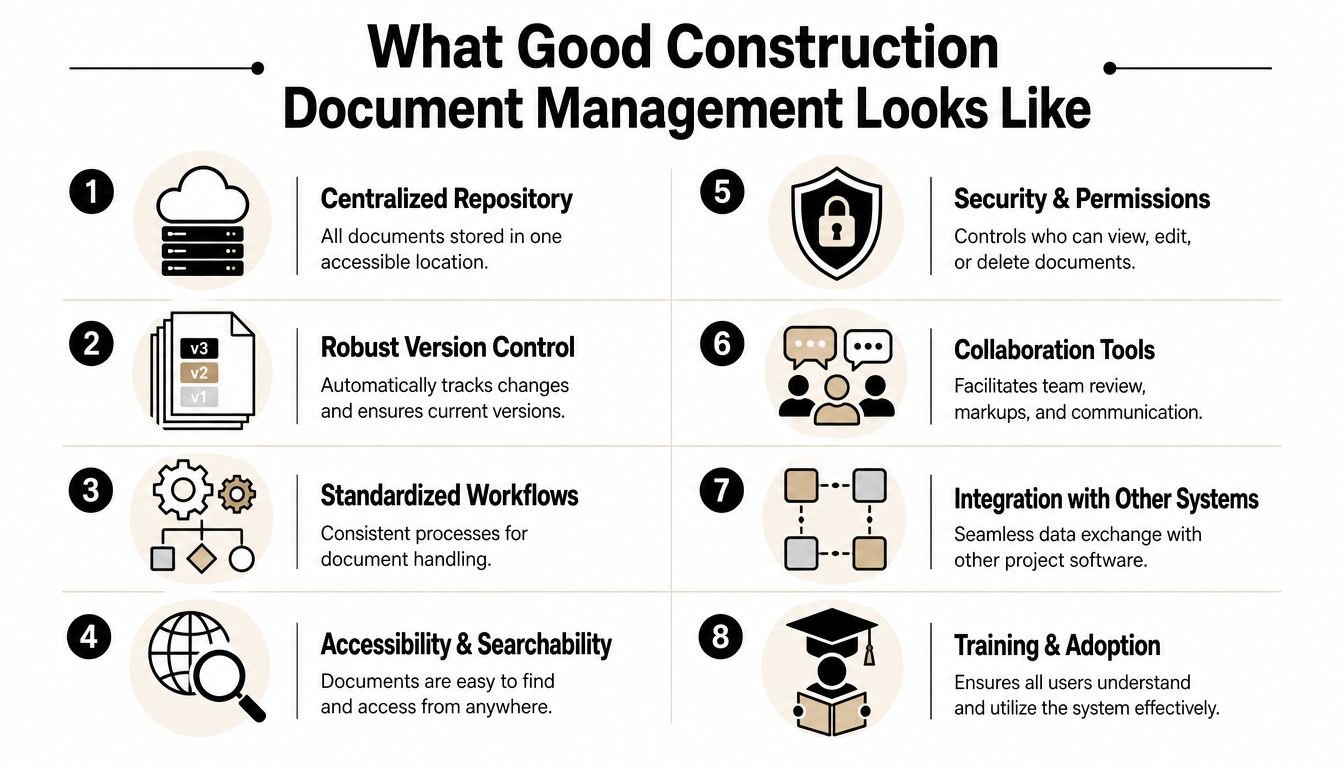
The operating basics that must exist
A reliable setup usually includes these core controls:
- One governed CDE where current documents live, superseded ones remain traceable, and permissions are role-based
- Naming and revision standards that don't change by PM or discipline preference
- A formal issue process for RFIs, submittals, addenda, bulletins, and record updates
- Model-to-sheet linkage so BIM changes trigger document review instead of living in parallel
- Defined authority over who can review, approve, issue, and supersede
If your team is formalizing naming structures and controlled workflows, guidance on Streamline ISO documentation automation is worth reviewing. Not because automation fixes weak process on its own, but because mature standards are easier to sustain when the repetitive parts are governed consistently.
What mature teams do differently
They build the system around real decision points.
Instead of saying “keep folders clean,” they define issue milestones. Instead of relying on email for approvals, they route comments where status is visible. Instead of assuming field teams will interpret revision bubbles correctly, they publish clear current sets with superseded records intact for audit purposes.
A practical checklist looks like this:
| Control area | What good looks like |
|---|---|
| Current information | One accepted live location for active project documents |
| Revision discipline | Every issue is dated, traceable, and clearly supersedes prior versions |
| RFI handling | Responses are logged, routed, and checked against affected drawings/models |
| Submittal control | Review status is visible and tied to specification intent |
| QA process | Decision checkpoints exist before issue, not only after conflicts appear |
Training matters more than teams think
Even strong systems slip if field adoption is weak. A process only works when users understand why the current set matters, how audit trails protect the job, and when an answer becomes official.
That's why the best firms treat document version control in construction as part of production training. Not software training alone. Production training.
Key Tools and Systems for Document Control
The toolset usually falls into two camps. Dedicated platforms built for construction document control, and general-purpose file sharing stitched together with email, spreadsheets, and good intentions.
Purpose-built CDE platforms
Systems like Autodesk Construction Cloud, BIM 360, Procore, and PlanGrid are designed to manage issue workflows, revisions, permissions, and field access in one environment. Their value isn't that they store files in the cloud. Their value is controlled status, auditability, and a cleaner handoff between office and site.
Shared drives and lightweight setups
Smaller firms often start with Dropbox, Google Drive, OneDrive, email logs, and spreadsheet trackers. That can work on simpler jobs with tight team discipline. It usually starts breaking once you add more consultants, permit cycles, parallel bid activity, and active field RFIs.
The failure point is predictable. Shared drives store documents, but they don't reliably enforce process. Email moves decisions, but it doesn't govern the current set. Spreadsheets track logs, but they don't automatically connect a logged answer to the sheet package the field is using.
Why Document Management Breaks Down at Scale
A small project can survive on team memory longer than it should. Large projects can't. More disciplines, more packages, more stakeholders, and more parallel decisions make manual control brittle fast.
A centralized single source of truth is essential to maintain version control and ensure 100% of stakeholders access the same current information, but enforcing that gets exponentially harder as the number of disciplines and documents grows, as noted in Webuild's document management best practices.
Complexity grows faster than most firms staff for
The hidden problem is resource load. PMs, architects, BIM leads, and discipline coordinators are already carrying production, client communication, meetings, and problem-solving. Once a project reaches a certain scale, tracking issue status, revision packaging, current-set publishing, and response closure becomes its own job.
That's where production maturity matters. Firms that standardize handoffs, naming, review gates, and CDE states usually hold up better. Firms that want a stronger backbone for that governance often work from ISO 19650 information management principles, because standards reduce variation when team size and project complexity climb.
Admin creep steals senior production time
The cost isn't just clerical burden. It's what that burden displaces.
Senior staff get pulled into file chasing instead of design decisions. BIM managers spend time reconciling issue history instead of improving model quality. Project architects become human routers for RFI traffic. That's how predictability slips. Not through one big miss, but through constant production interruption.
How External Support Bolsters Document Management
Some firms keep construction document management fully in-house and do it well. Others decide that controlled packaging, revision tracking, sheet issue prep, and model-to-document consistency need dedicated support so internal leads can stay focused on design judgment, coordination, and client-facing decisions.
That can be a smart move when the work is repetitive, timing-sensitive, and easy to neglect under deadline pressure. The key is still ownership. Autodesk's document management guidance makes a critical point: assigning a single, named document manager with full accountability is a decisive factor for success, and that role can be internal or external.
If everybody can issue, nobody is actually controlling the issue.
In practice, some firms use an external production partner to package CDs, maintain revision logs, support current-set publishing, and keep model-sheet coordination from drifting. A construction documentation support model is one example of that approach when internal PMs are getting buried in document control overhead.
Conclusion
A set goes out on Friday. By Monday, the site team is building from one revision, the consultant has marked up another, and the PM is answering questions that should have been closed before issue. That is not an IT problem. It is a production control problem, and it hits schedule, fee, and trust at the same time.
Construction document management is part of delivery operations. Firms that treat it that way protect margin better, recover less work in the field, and give project teams a more predictable path from design development to closeout.
The pattern is consistent. Clear ownership, controlled issue procedures, current-set discipline, revision logs that stay current, and standards that still hold when the job gets busy. None of that is glamorous. It works.
Good document control also scales judgment. Senior staff spend less time hunting for the right file or cleaning up issue mistakes, and more time resolving scope, coordination, and constructability problems before they become cost.
If your team is trying to make delivery more predictable, BIM Heroes shares practical frameworks around BIM production, documentation systems, and scalable coordination support. If you need a checklist, a workflow benchmark, or a second set of eyes on where your document process is drifting, that's a good place to start.
Suggested WordPress category: Construction Coordination & Documentation