Meta description: Common HVAC design coordination mistakes that trigger RFIs, delays, and rework before construction, with practical fixes for clash detection, service clearance, controls, dampers, and BIM-based review workflows.
Commercial HVAC sets can look complete at design review and still fail the first serious install check. A main duct clears in plan but hits a beam in the field. A rooftop unit fits on paper but leaves no room for a coil pull. A rated wall moves late, and the damper never makes it onto the mechanical sheets. None of that is rare. It's what happens when drawing completeness gets mistaken for coordination completeness.
These are the HVAC design coordination mistakes that burn schedule and margin because they surface after issue instead of before it. They generate RFIs, force redesign under pressure, and push trade partners into workaround mode. If you're also reviewing indoor air quality options during early design, teams sometimes pair that discussion with product research such as shop HVAC air purifiers, but the bigger production issue is still coordination discipline.
The pattern is process failure. Mechanical, architectural, structural, and life safety decisions move at different speeds, and the gaps between them are where rework starts. Good pre-construction review catches those gaps early, while change is still cheap.
Introduction
Most coordination failures don't start with a bad engineer. They start with a team working off different versions of the truth.
A mechanical layout may be developed on an early reflected ceiling plan while the structural model is still moving. Controls may be placed against a room layout that changes later. Damper requirements may depend on rated assemblies that don't make it into the mechanical background in time. The set still looks polished. The problem is that hvac system design only performs as intended when geometry, access, code, and controls stay aligned through CDs.
Field lesson: A clean plan set can still hide unresolved production risk if the backgrounds, loads, and coordination assumptions aren't synchronized.
The sections below focus on the recurring mechanical coordination errors that show up in pre-issue review on commercial projects, especially in dense ceiling and plenum conditions. The fix isn't more theory. It's tighter model governance, clearer review triggers, and better QA checkpoints.
Structural and Architectural Clearance Conflicts
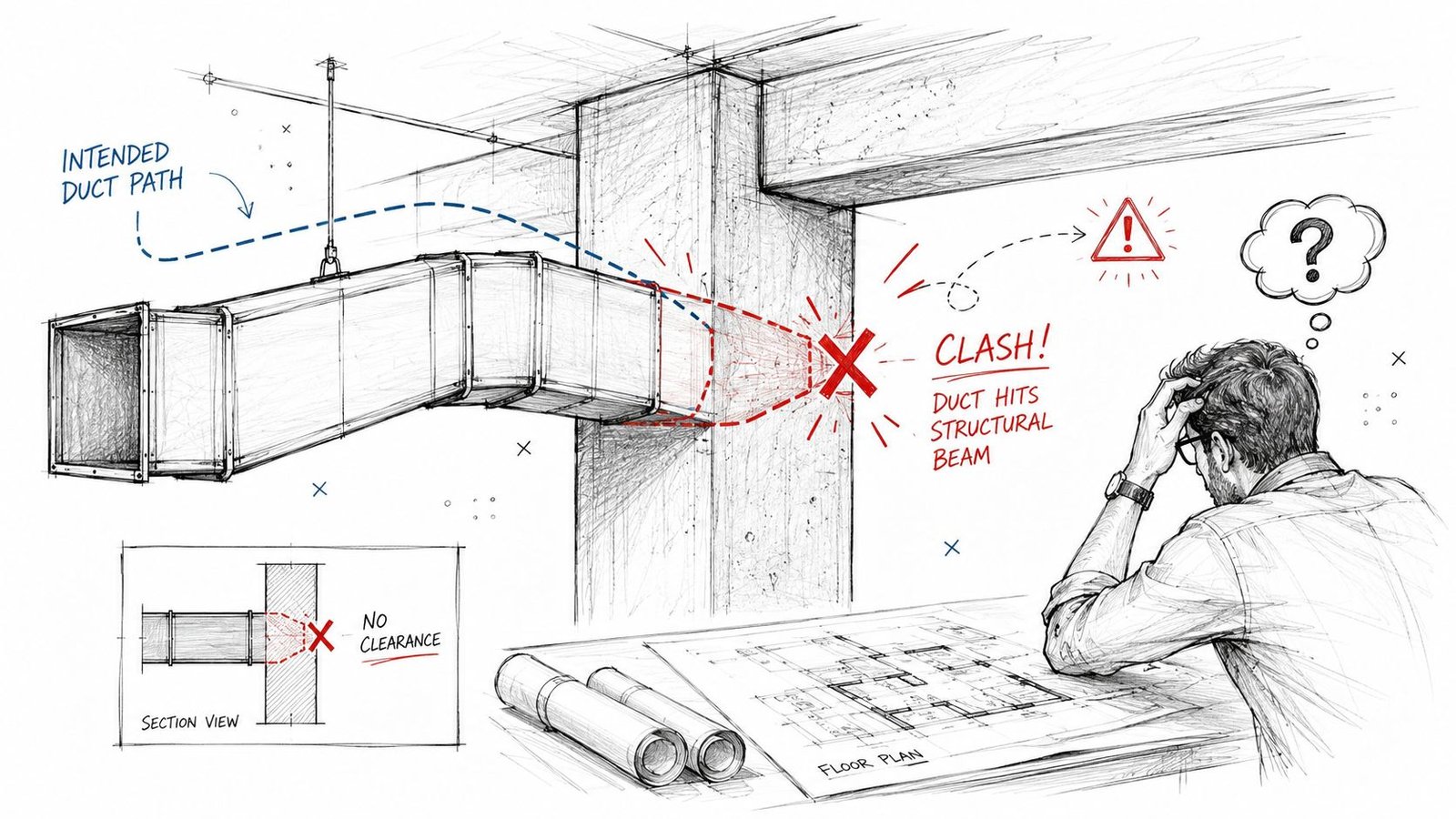
The first clash often shows up where a duct run was routed through space that never really existed. On an early background, the path looked open. By the time the structural engineer locked beam depths or joist geometry, the available zone had shrunk.
Why this happens
This usually comes from sequencing, not incompetence. Mechanical layout moves early because the project needs riser paths, shaft sizing, ceiling intent, and equipment relationships. But if that work advances against an architectural background before framing is stable, the duct is being designed against an assumption, not a verified envelope.
The common failure points are familiar:
- Early RCP dependence that ignores final beam depth or joist direction
- Ceiling height assumptions that don't account for real framing and hanger space
- Late structural revisions that never trigger a duct routing review
- CAD carryover habits where teams still think in plan overlays instead of federated model checks
What works in production
A disciplined team treats the structural model as a live coordination dependency, not a consultant attachment. The duct route should be checked against current framing before it gets embedded into branch logic, diffuser locations, and sheet annotations.
A simple review table helps catch this before CDs tighten:
| Review item | What to verify |
|---|---|
| Main duct corridors | Beam depth, joist orientation, and crossing points |
| Tight ceiling zones | Clear vertical stack from deck to ceiling finish |
| Shaft entries | Structural framing around openings and offsets |
| Transfer points | Whether reroutes affect downstream branches |
When this review doesn't happen, the field gets a reroute problem that should have been a model problem. That's why federated model discipline matters more than attractive sheets.
Overcommitted Ceiling Plenum Space
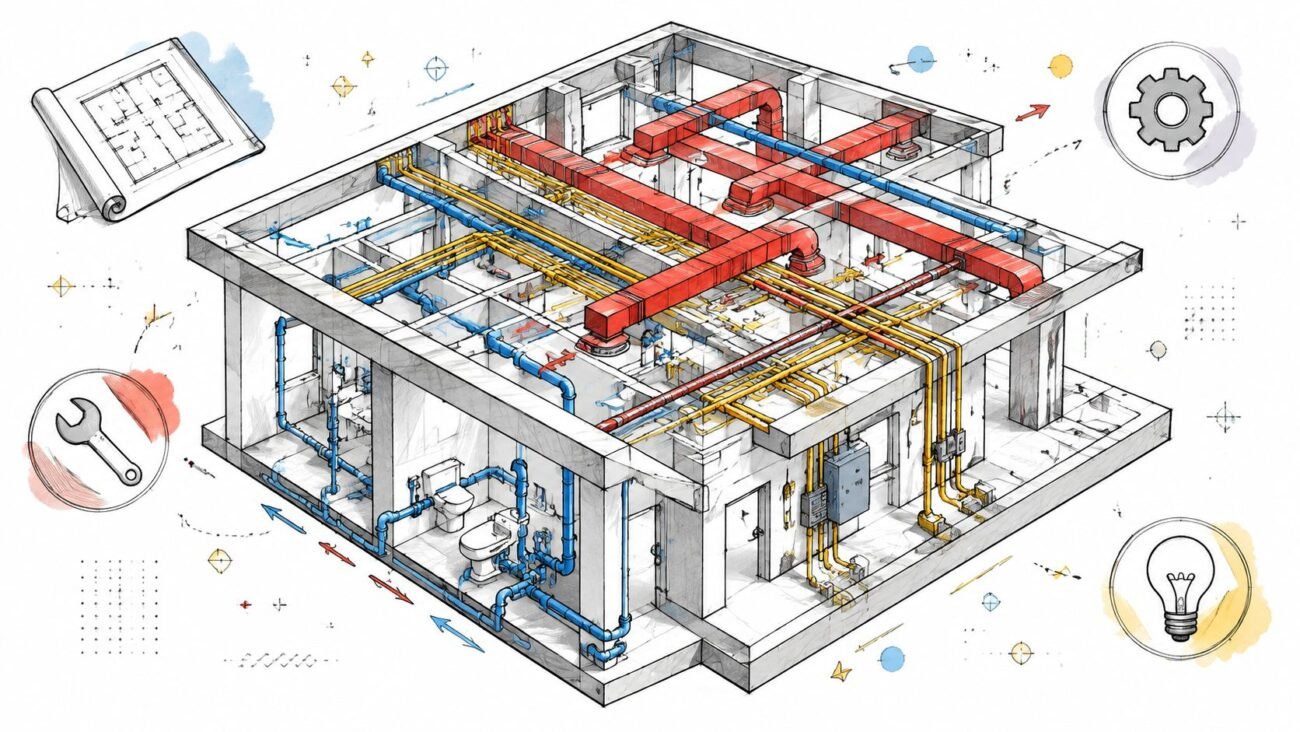
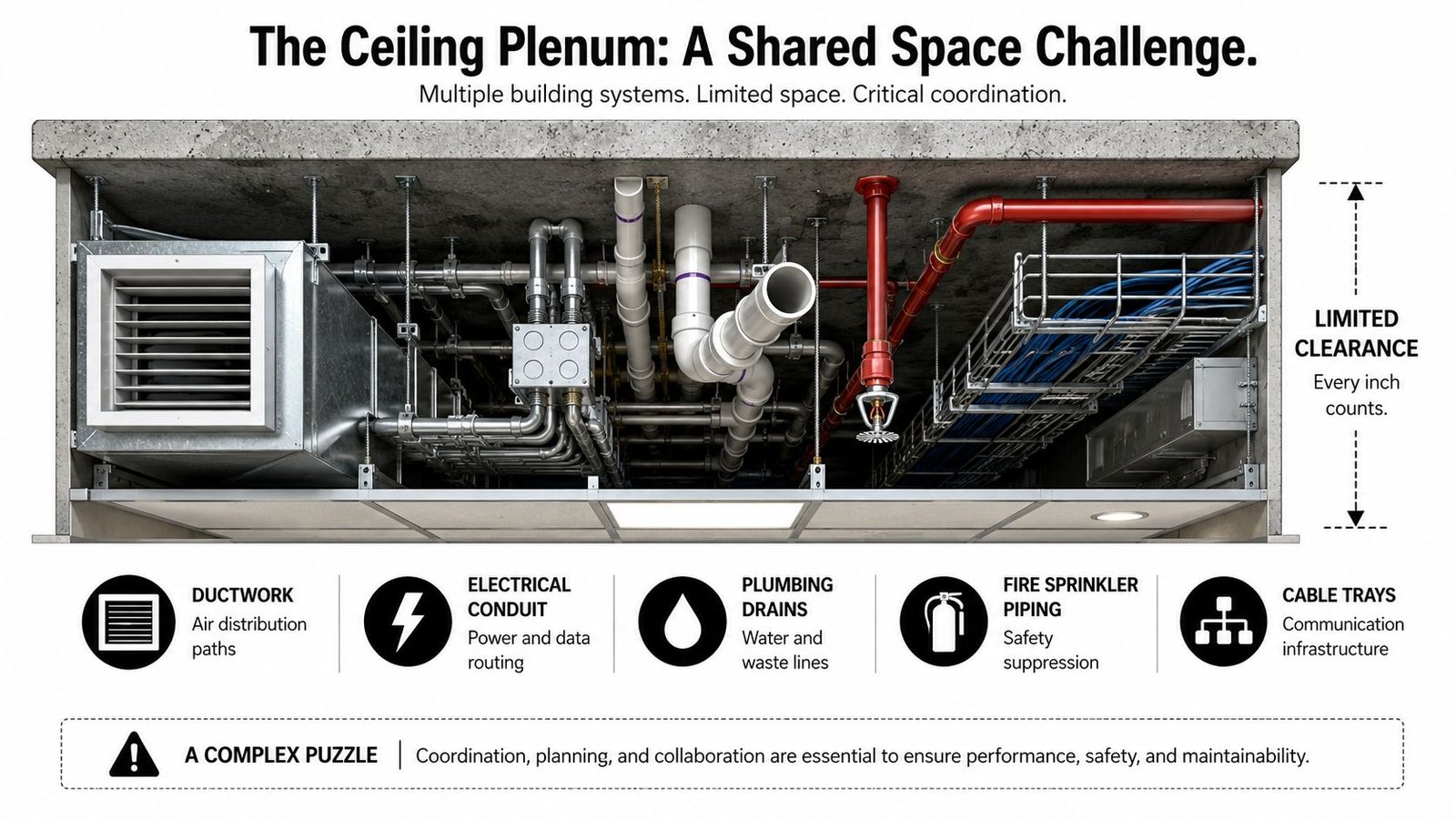
The plenum is where isolated trade logic breaks down. Mechanical can make its ductwork fit. Electrical can make conduit and cable tray fit. Plumbing can route waste and vent. Fire protection can maintain coverage. Each package looks reasonable on its own. Together, they can consume more depth than the ceiling has.
Why isolated drawings keep lying
This is the classic shared-space problem. A 2D package can look coordinated because each trade is only proving its own route. Nobody sees the combined vertical stack until the disciplines are brought together in one environment.
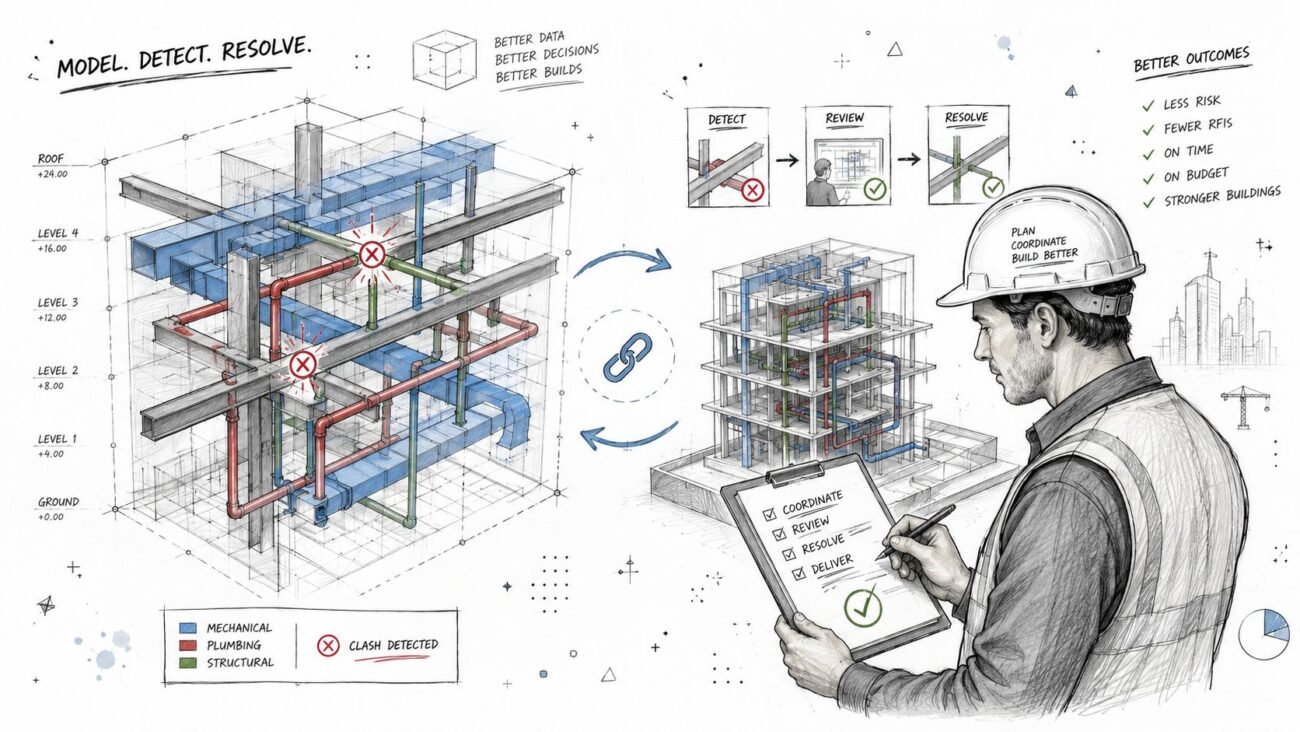
That's why HVAC clash detection and broader multi-trade review need to happen before the set is treated as mature. In practice, late discovery usually leads to one of three bad outcomes:
- The ceiling drops, and architecture absorbs the consequence
- Several trades redraw, and design hours get spent reactively
- The conflict is pushed to the field, where RFI volume goes up and installs slow down
For teams working through these spatial conflicts, this overview of plenum ceiling coordination is useful because it frames the ceiling zone as a managed system, not a trade-by-trade drafting exercise.
What a better review looks like
Good HVAC BIM coordination doesn't only check hard clashes. It establishes hierarchy. Which systems own the highest zone? Which routes are flexible? Which elements can flatten, offset, or shift bay-to-bay without performance damage?
The plenum only works when one coordinated model answers the question all trades are asking at the same time, which is whether the same cubic space has already been promised to someone else.
A practical pre-construction MEP review in dense ceilings should include:
- Primary route lock-in for main ducts, large pipe mains, and cable tray corridors
- Vertical zoning rules so every trade understands priority bands
- Late-change checkpoints whenever architectural ceiling intent shifts
- Constructability review for hanger space, access panels, and branch takeoff feasibility
Plenum conflicts surface late because teams let separate drawing sets masquerade as a coordinated design. They aren't the same thing.
Equipment Access and Service Clearance Gaps
The layout clears in plan review, the clash report comes back clean, and the problem still gets bought by the owner. Then the TAB contractor, service technician, or facilities team is the first group to point out that a panel cannot open, a filter cannot be pulled, or a coil has no removal path.
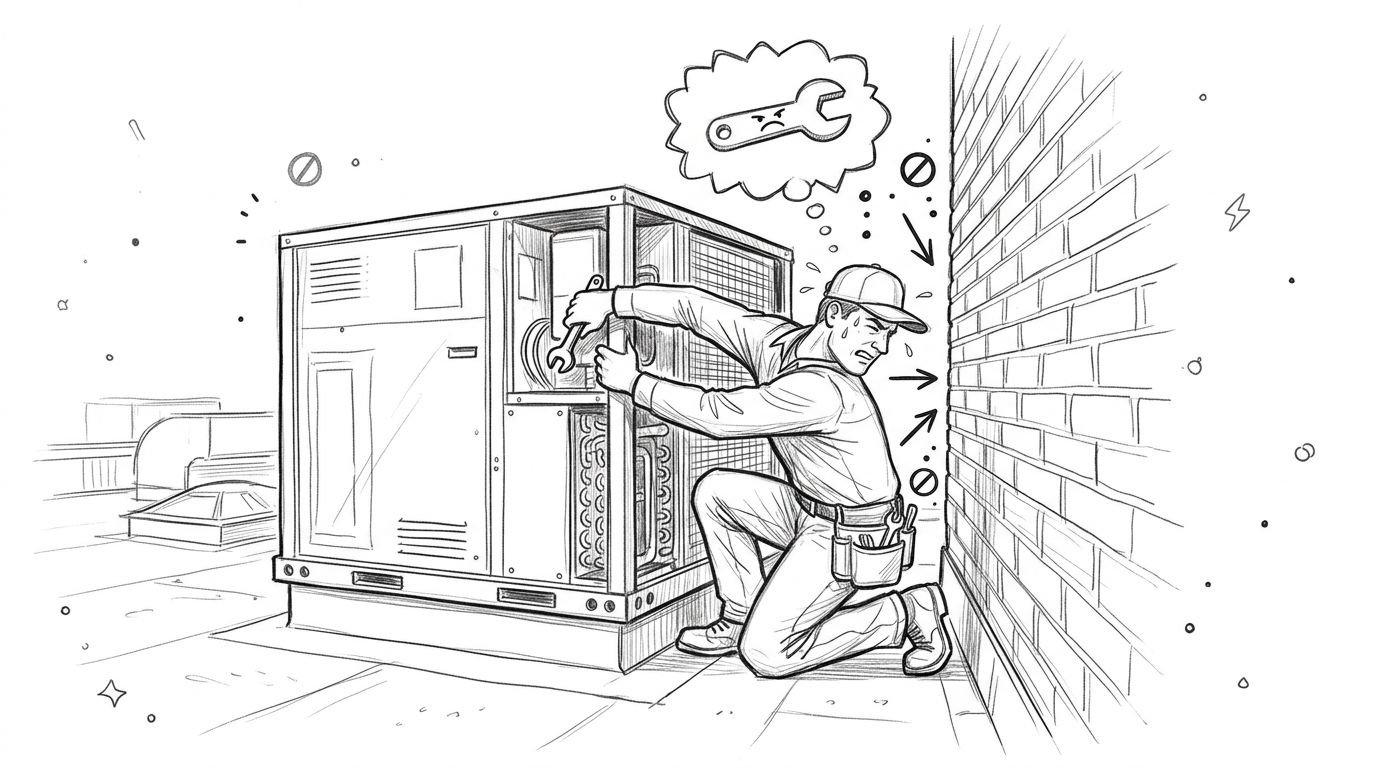
This happens because teams often coordinate for placement and stop short of coordinating for service. A rooftop unit can fit between the curb and parapet and still be wrong. An AHU can clear structure and still block access to the fan section. A VAV box above a hard lid can avoid every modeled clash and still require ceiling demolition for routine maintenance.
Those are production failures, not drafting misses. The design set handed off one geometry problem and created a long-term operations problem in its place.
Geometric fit does not prove maintainability
Standard clash detection misses this category because no solids intersect. The model shows legal placement. The field condition shows an unusable installation.
A disciplined review asks for the maintenance sequence, not just the footprint:
- Does the access door open to its full swing?
- Can filters, belts, and coils be removed without cutting adjacent work?
- Is there a clear path to reach valves, controls, and drain components?
- Can a technician get to the equipment safely with the ceiling, platform, or roof edge conditions shown?
That review needs to happen before issue for construction. Once framing, curbs, ceilings, and adjacent trades are locked, service clearance fixes become expensive and political.
What mature coordination teams actually model
Teams that avoid rework treat service space as modeled geometry. Clearance zones, access swing, pull space, and working room belong in the coordination model if they matter in the field. General notes are not enough. They do not stop another trade from filling the exact space maintenance needs later.
Practical rule: If a technician needs the space to inspect, remove, or replace a component, that space should be protected in the model.
This is also where discipline breaks down between design intent and production reality. The manufacturer requirements may exist in a submittal or cut sheet, but if nobody converts them into model objects and checks them against actual surroundings, the project carries hidden risk all the way to startup.
Well-run HVAC coordination reviews look for service conflicts with the same seriousness as hard clashes, because both can trigger field redesign. One stops installation. The other guarantees callbacks, access panel change orders, and owner frustration after turnover.
Duct Sizing and Static Pressure Recalculation Failures
A duct run clears structure on the coordination model, gets approved in a hurry, and then arrives in TAB with low airflow at the far terminals. The field crew installed what the drawings showed. The failure happened earlier, when the reroute changed system resistance and nobody pushed that change back through the calculation set.
That gap shows up in two places. Loads shift after early design and branch sizing stays frozen. Or coordination adds elbows, transitions, flex, and longer path lengths while fan static, terminal pressure drop, and balancing assumptions stay tied to an old route.
In residential work, the airflow math is easy to see. A room carrying more of the total load needs more of the total airflow, and that relationship should be checked against what was installed, as shown in this HVAC airflow and load calculation walkthrough. The same production rule applies on commercial projects. If room loads change or the duct path changes, the distribution needs to be recalculated, not inherited.
A useful plain-language refresher on why reroutes affect system performance is Purified Air on static pressure importance. It matches what coordination teams run into on jobs where geometric clearance gets resolved but pressure loss is left behind.
For teams refining mains and branch routing, this guide to HVAC duct layout drawing is relevant because layout decisions and pressure verification have to stay tied together.
The coordination miss is usually procedural, not theoretical. A model update gets treated as a drafting change even though it changed system behavior. An offset around steel, a tighter neck at a corridor, or a last-minute branch relocation may look minor in plan. In aggregate, those edits can move a system outside the fan's usable range or leave distant terminals short on air.
Experienced teams put a hard checkpoint on any duct revision that affects path length, fitting count, main size, or terminal runout geometry. The question is simple. Did the change alter external static, fan selection, terminal performance, or balancing strategy? If nobody records that answer, the project carries hidden risk into procurement, installation, and startup.
This is one of the clearest examples of a preventable workflow failure. The model can be clash-free and still drive rework because the review process stopped at fit instead of performance. Tight coordination protects margin only when routing changes trigger recalculation before the drawings go final.
Zoning and Thermostat Control Gaps
Controls go stale faster than acknowledged. A thermostat location that made sense on an early floor plan can become a bad control point after a wall shift, occupancy change, or furniture-driven layout revision.
Subtle coordination drift surfaces when an open office becomes enclosed rooms. A conference room divider moves. A sensor ends up in a dead corner or near a heat source the original layout didn't have. The controls sheets still look clean because nobody revisited them after the architectural revision cycle.
Why this slips through
Controls are often coordinated early because the team wants a sequence path and rough device locations. Later architectural changes get treated as harmless because they don't appear to affect the main HVAC design. But room boundaries are control logic. Once the room changes, the zoning assumptions may be wrong.
Typical symptoms include:
- One thermostat serving spaces with different use patterns
- Sensors located outside the true occupied zone
- Furniture layouts blocking intended air or sensor response
- Control drawings lagging behind final partition plans
What to check before issue
A solid pre-construction MEP review should compare the latest architectural room layout against thermostat locations, sensor placement, and sequence intent. That doesn't require a huge redesign effort. It requires one disciplined checkpoint during CDs and another before final issue.
A moved wall can break a control strategy without changing a single duct size.
This is one of the easiest coordination gaps to prevent because the review task is small. The cost of missing it shows up later as comfort complaints, balancing confusion, and owner distrust in a system that looks correct on paper.
Fire and Smoke Damper Coordination Blind Spots
A rated corridor wall shifts during a late architectural update. The duct route stays put in the mechanical model. Nobody reruns the penetration review against the life safety plans, and the missing damper shows up during permit comments or above ceiling in the field. That is not a one-off drafting miss. It is a workflow failure.
Fire and smoke damper coordination breaks down when life safety information and duct routing are reviewed on separate tracks. The architectural team updates wall ratings or shaft boundaries. The mechanical set still reflects the previous issue. By the time the discrepancy is visible, the project is paying for rework, resubmittal, or field changes under schedule pressure.
The risk gets higher on hospitals, labs, and mixed-occupancy buildings where the code path depends on how the space is classified. Requirements tied to NFPA 90A and related life safety provisions have to match the actual occupancy and the final rated assemblies, as discussed in this medical-space HVAC design reference. If that code basis is wrong or outdated, damper locations, tags, and details can all be wrong with it.
Why this slips through production
Damper coordination often falls into the gap between disciplines. Architecture owns the rated partition information. Mechanical owns the penetrations. The code consultant may own the life safety narrative. If nobody is assigned to reconcile those inputs at each milestone, the model can look coordinated and still fail review.
The expensive part is how late these misses surface. A missing damper is rarely an isolated fix. It can trigger revised sleeves, access panel changes, detail edits, control revisions for actuator wiring, and another pass through plan review.
What to verify before issue
Disciplined teams run a specific damper check before submission and again after any life safety revision.
| QA item | Verification target |
|---|---|
| Rated walls and floors | Latest architectural life safety plans |
| Duct penetrations | Current mechanical model and sheets |
| Damper tagging | Consistency across plans, schedules, and details |
| Occupancy assumptions | Correct code path for the space type |
That review protects more than code compliance. It protects margin. Catching damper coordination in the model is cheap. Catching it after fabrication, inspection, or ceiling close-up is not.
The Process Fix How to Catch These Mistakes Before Construction
The pattern is familiar. The model looks clean at 90 percent CDs, the clash count is down, and everyone assumes the hard part is over. Then one late routing change forces a redraw through structure, the fan static is no longer right, access clearance disappears above the ceiling, and the sheet set no longer matches the model.
That is not a software problem. It is a production control problem.
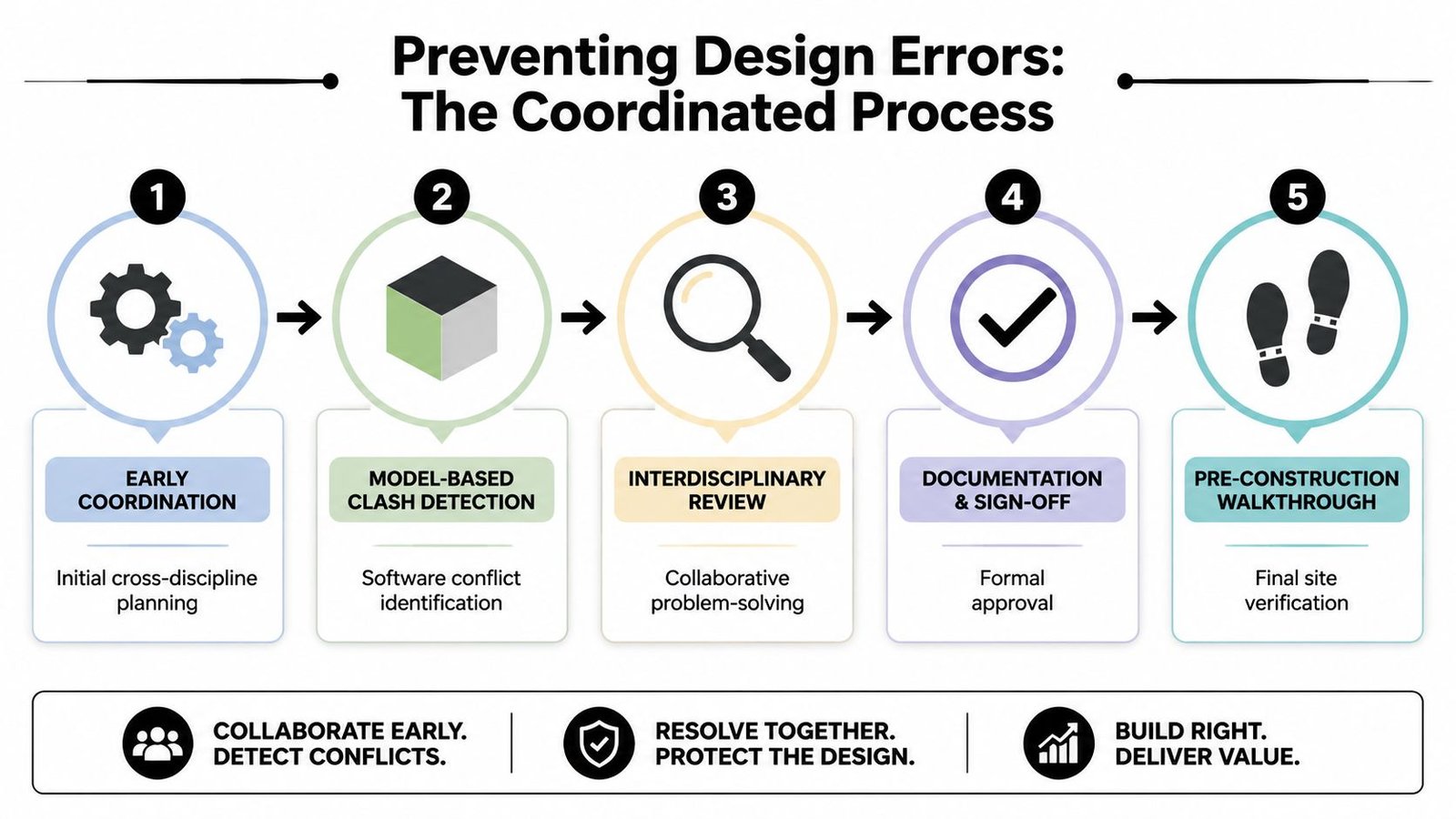
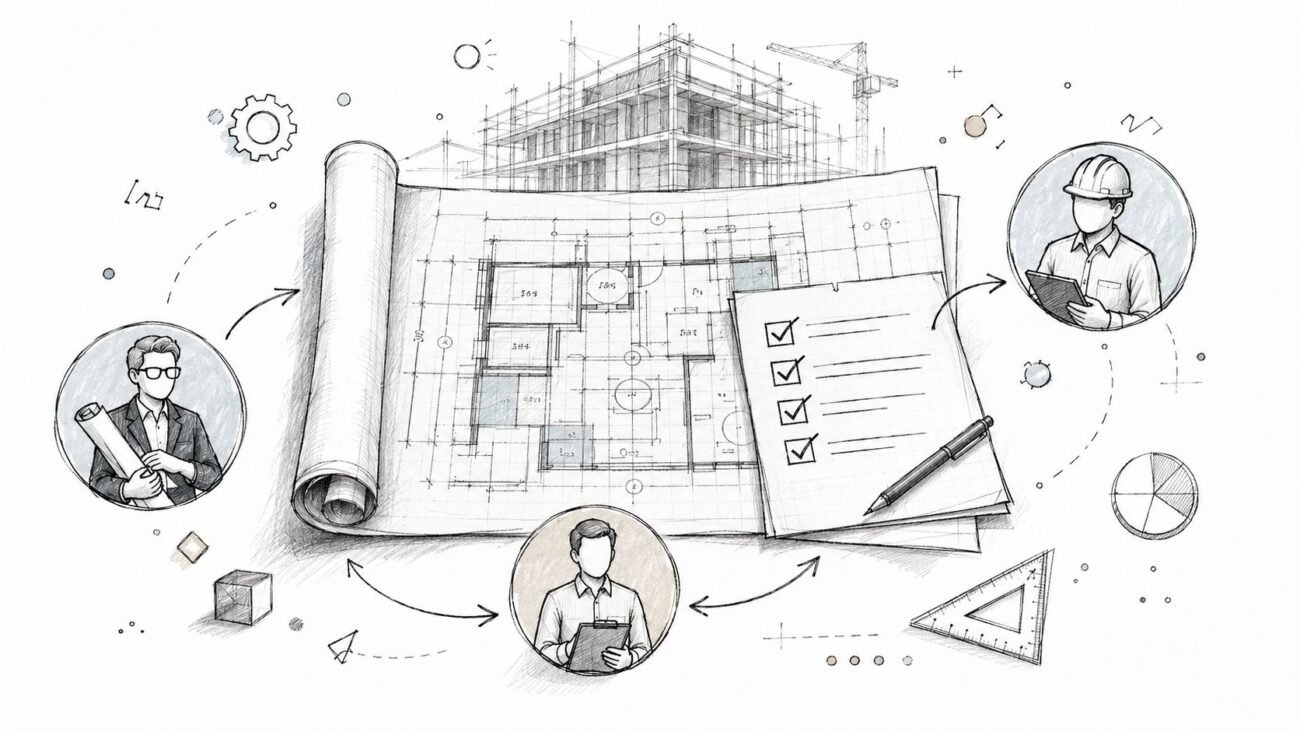
Teams that avoid those misses do not treat coordination as one late clash run. They run a federated model on a set cadence, assign ownership for each review category, and define the exact point where a geometry change becomes an engineering recheck. That is what keeps coordination tied to performance, constructability, and issue-set accuracy instead of turning into a visual model exercise.
What the workflow needs
A reliable HVAC BIM coordination workflow usually includes:
- Scheduled federation reviews with architecture, structure, and active MEP trades
- Hard-clash and soft-clash checks that include access zones, service paths, and code-sensitive penetrations
- Recalculation triggers so rerouted mains, fitting changes, and length growth go back through static pressure and performance review
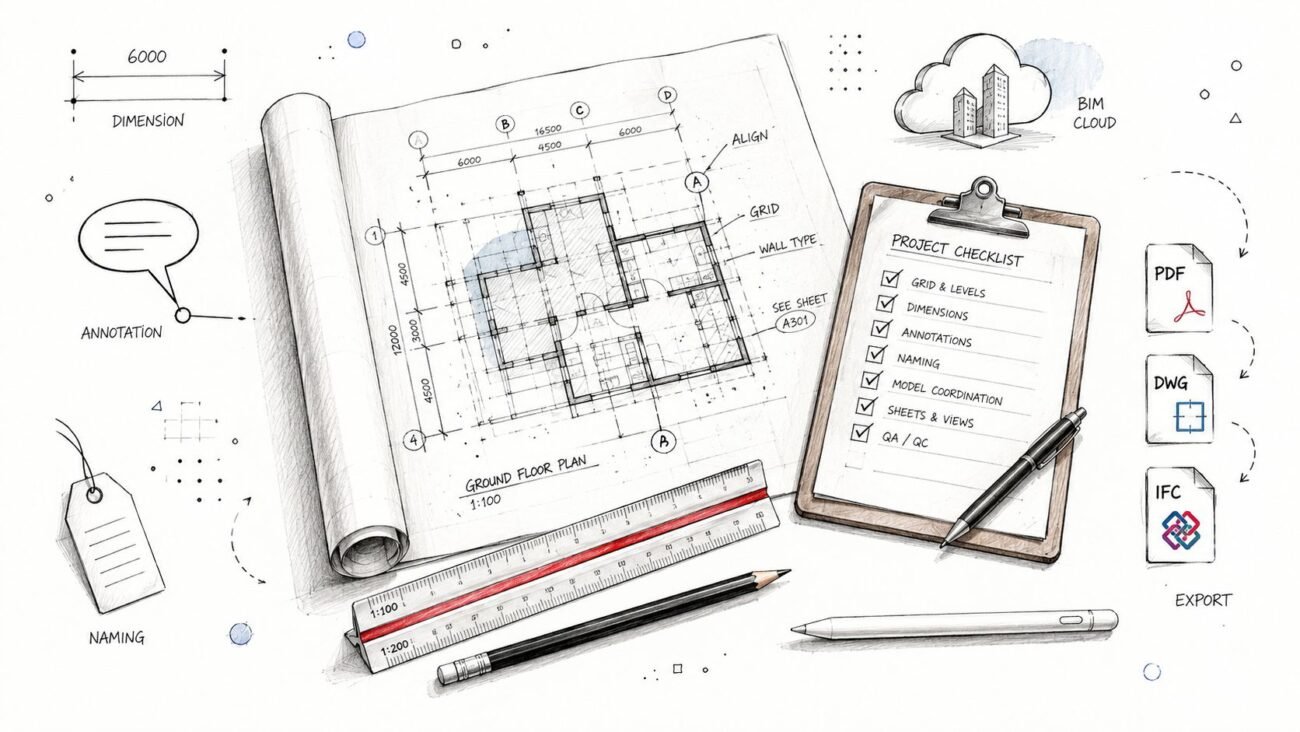
- Documentation control that pushes approved changes into plans, details, schedules, tags, and control notes
- CD-phase checkpoints at defined milestones instead of one sweep at the end
The piece that gets skipped too often is reachability. Teams should check, in the model, whether coils, dampers, valves, filters, and controls can be accessed with real ceiling conditions in place. If that review waits until submittals or field layout, the fix is usually expensive and spreads across multiple trades.
For firms formalizing that workflow, a strong BIM execution plan for model ownership, clash responsibility, and update cadence gives the team a practical baseline. And when early design decisions are still being sorted out, teams often review guidance like best HVAC system for new construction alongside coordination planning, because system selection drives shaft space, branch density, controls complexity, and maintenance access.
Why this protects margin
These issues rarely start as isolated design mistakes. They come from weak handoffs, unclear model ownership, and QA gates that do not force the right people to review the right changes at the right time.
A disciplined review process protects fee and schedule. It cuts RFIs, reduces redraw time, limits change propagation into other trades, and gives the field a set of documents that still matches the coordinated model. That is the essential process fix. Catch the failure in production, before it shows up in procurement, installation, or inspection.
If the same coordination misses keep reaching the site, the team does not need another clash report. The team needs a tighter workflow.