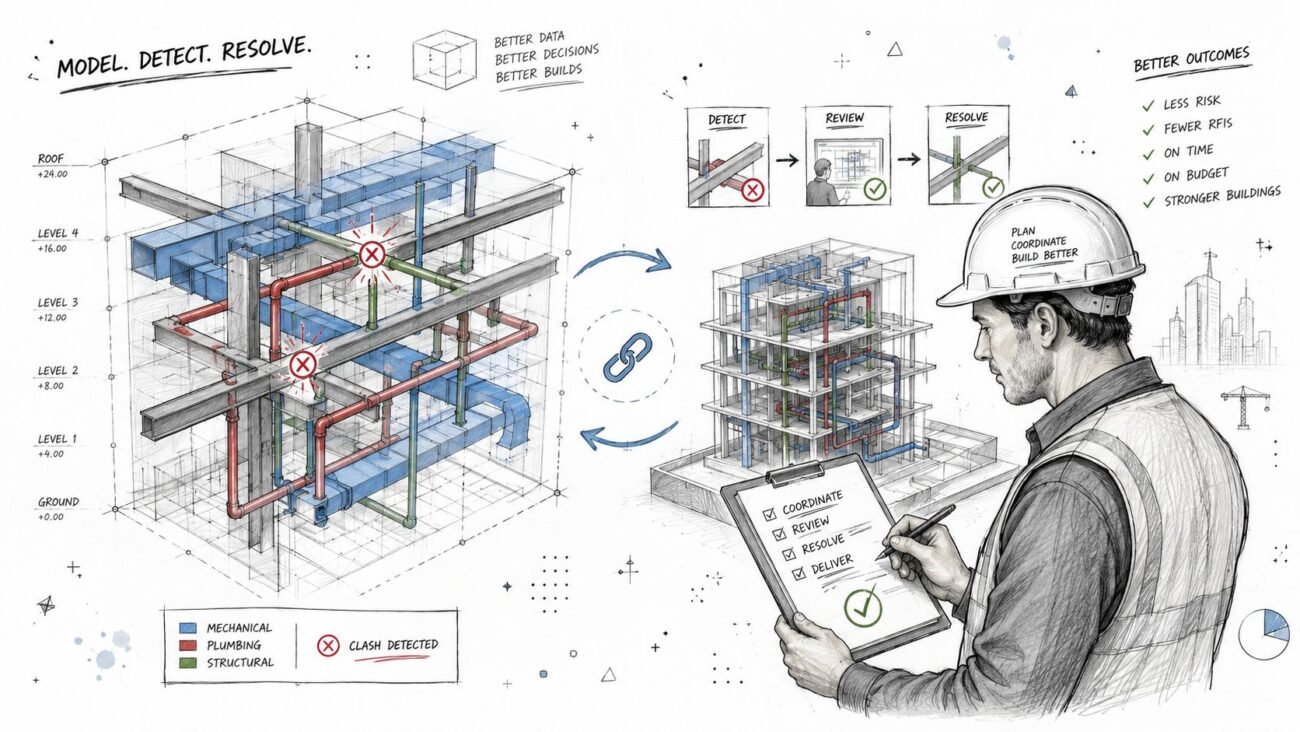
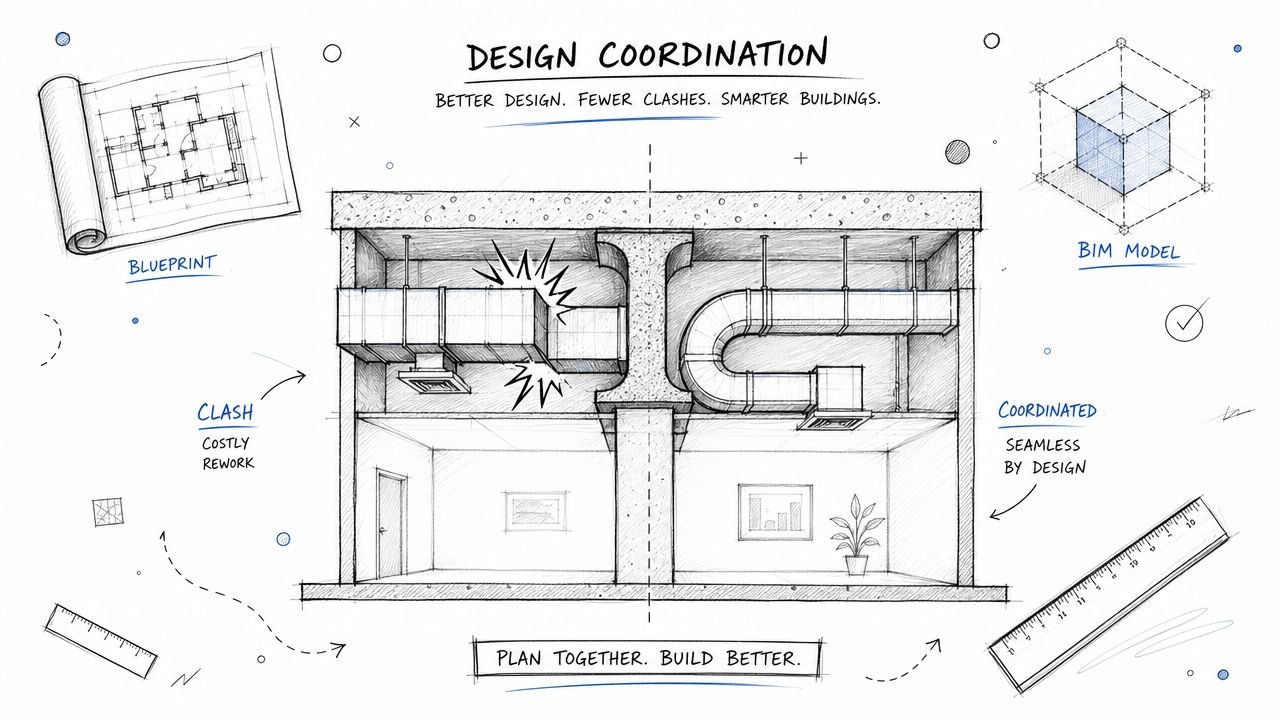
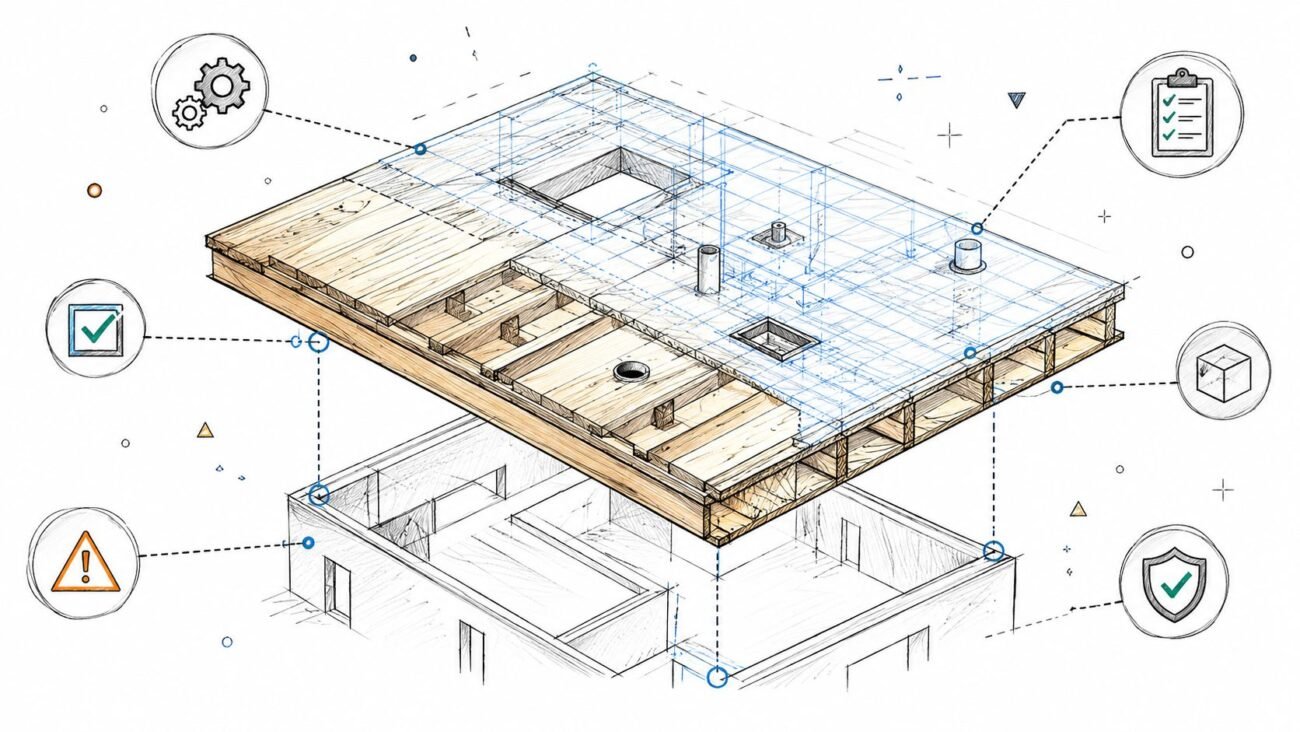
A foreman is standing beneath a crowded ceiling while three trades argue over the same corridor. The electrician has already installed a 4-inch conduit run. The mechanical contractor is trying to seat a 24-inch rectangular supply trunk. Plumbing rough-in is arriving at the same elevation, and fire protection still needs a route through the space. Nobody made a bad field decision that morning. The project exposed a coordination gap that existed in the models weeks earlier.
That pattern is common in multi-trade construction. Architectural, structural, mechanical, electrical, plumbing, and fire protection packages may each look reasonable on their own, yet fail when the systems occupy the same physical space. BIM coordination brings those systems into a controlled review process before fabrication and installation, where teams can resolve routing, clearance, access, and sequence conflicts without turning the field into the design office.
For US general contractors, architects, MEP engineers, and BIM managers, the value isn't a prettier 3D model. It's predictability, RFI prevention, margin protection, and reliable delivery. The firms that get those outcomes don't treat coordination as a one-time clash report. They manage ownership, tolerances, zones, deadlines, model updates, and verification until the issue is closed.
The Cost of an Uncoordinated Multi-Trade Job
The first response is usually practical. Someone asks the electrical crew to move the conduit. The mechanical contractor requests a revised route. The superintendent calls the BIM manager, the architect, and the affected subcontractors into a conversation that should have happened before material reached the ceiling.
Then the consequences spread. Installed work may need to be removed, access equipment may stay rented longer, inspections may be rescheduled, and follow-on trades may lose their planned installation window. A ceiling close-in or structural deck pour can slip while the team waits for a decision, revised detail, fabrication change, or field verification.
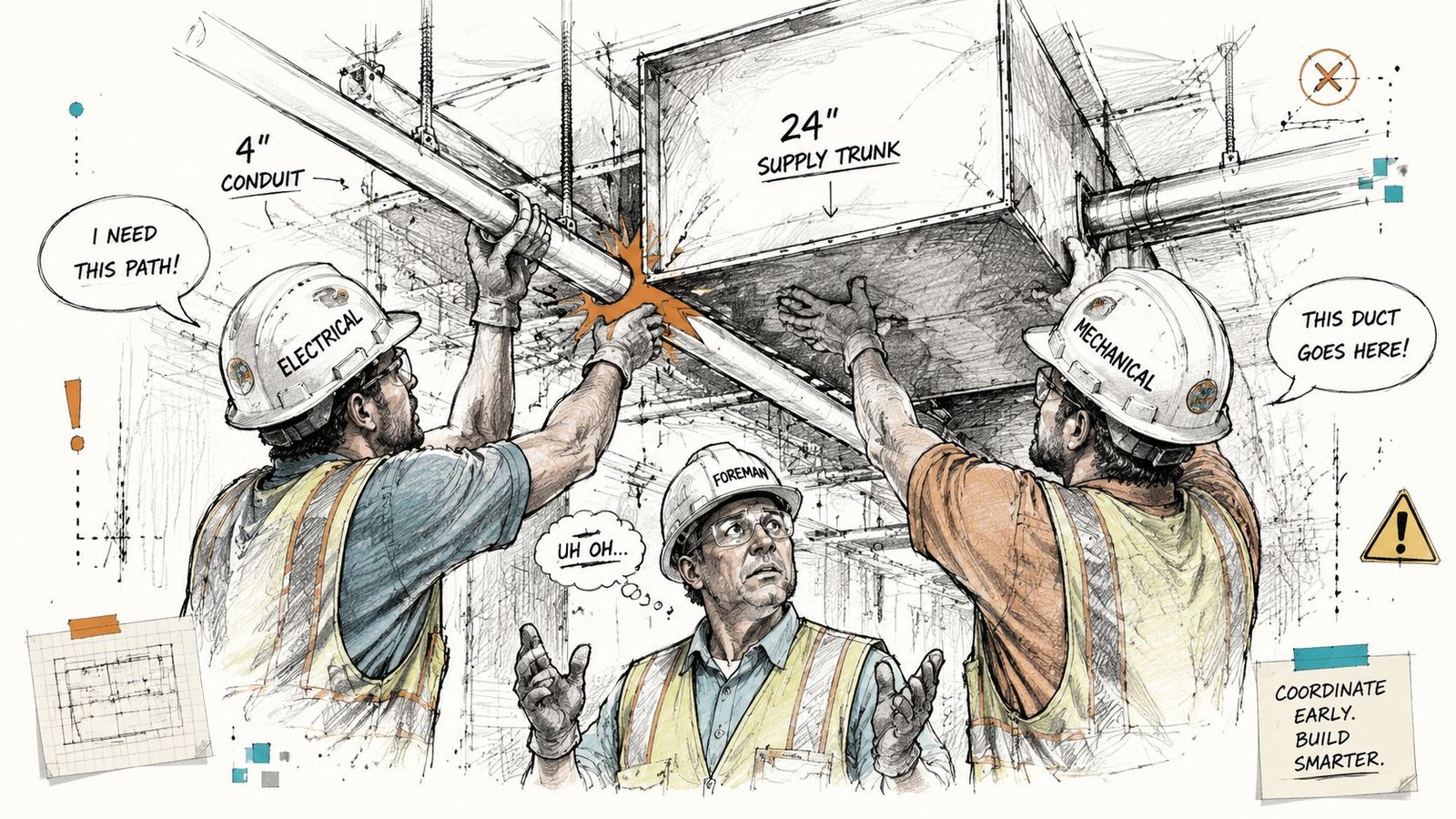
Why the field becomes the coordination room
Uncoordinated work usually starts upstream:
- Isolated design packages: Each discipline protects its own scope without testing the complete spatial relationship.
- Premature material takeoffs: Fabrication or material orders follow the first available design information, even when later systems need the same route.
- Unclear sequence ownership: Installation order gets decided by availability, trade preference, or field pressure rather than a coordinated zone release.
- Late model participation: Structural and architectural constraints may be missing when MEP routing decisions are made.
The resulting change order isn't always caused by a design error in one discipline. It can come from a conflict between individually correct systems. A duct may meet its airflow requirement, a beam may meet the structural design, and a cable tray may meet its access requirement. Together, they may not fit.
The benefits of BIM become tangible when the team uses the model to make those decisions before installation. A coordinated review can identify which system has the least flexible route, where access must be preserved, and whether the proposed sequence will allow each trade to work safely.
Field lesson: Every hour spent moving installed work is evidence that the project paid for a coordination decision twice, once in the model and again in the field.
Richmond Fed research describes US construction as a long-term productivity outlier. Labor productivity in the sector fell by more than 30% from 1970 to 2020, while overall US economic productivity doubled over the same period, and construction labor productivity in 2023 was unchanged from 1948 (BLS construction industry data). That context makes coordination-heavy work especially important. Modern software doesn't create efficiency when teams still discover spatial conflicts during installation.
What Multi-Trade Construction and BIM Coordination Actually Mean
Multi-trade construction describes a project where two or more building systems share physical space and must be installed in a defined relationship and sequence. The scope may include architectural and structural work, mechanical systems, electrical distribution, plumbing, fire protection, and specialty systems such as medical gases or data.
The difficulty isn't the number of subcontractors. It's the number of dependencies between their work. A mechanical route can affect ceiling heights, a beam can limit duct transitions, a fire protection main can constrain cable tray access, and an equipment replacement path can invalidate an otherwise clean model.
BIM coordination is the managed process of authoring, aggregating, reviewing, revising, and verifying those systems in a shared 3D environment before fabrication or field installation. The purpose is to make installation conditions visible while the team can still change the design and trade models efficiently.
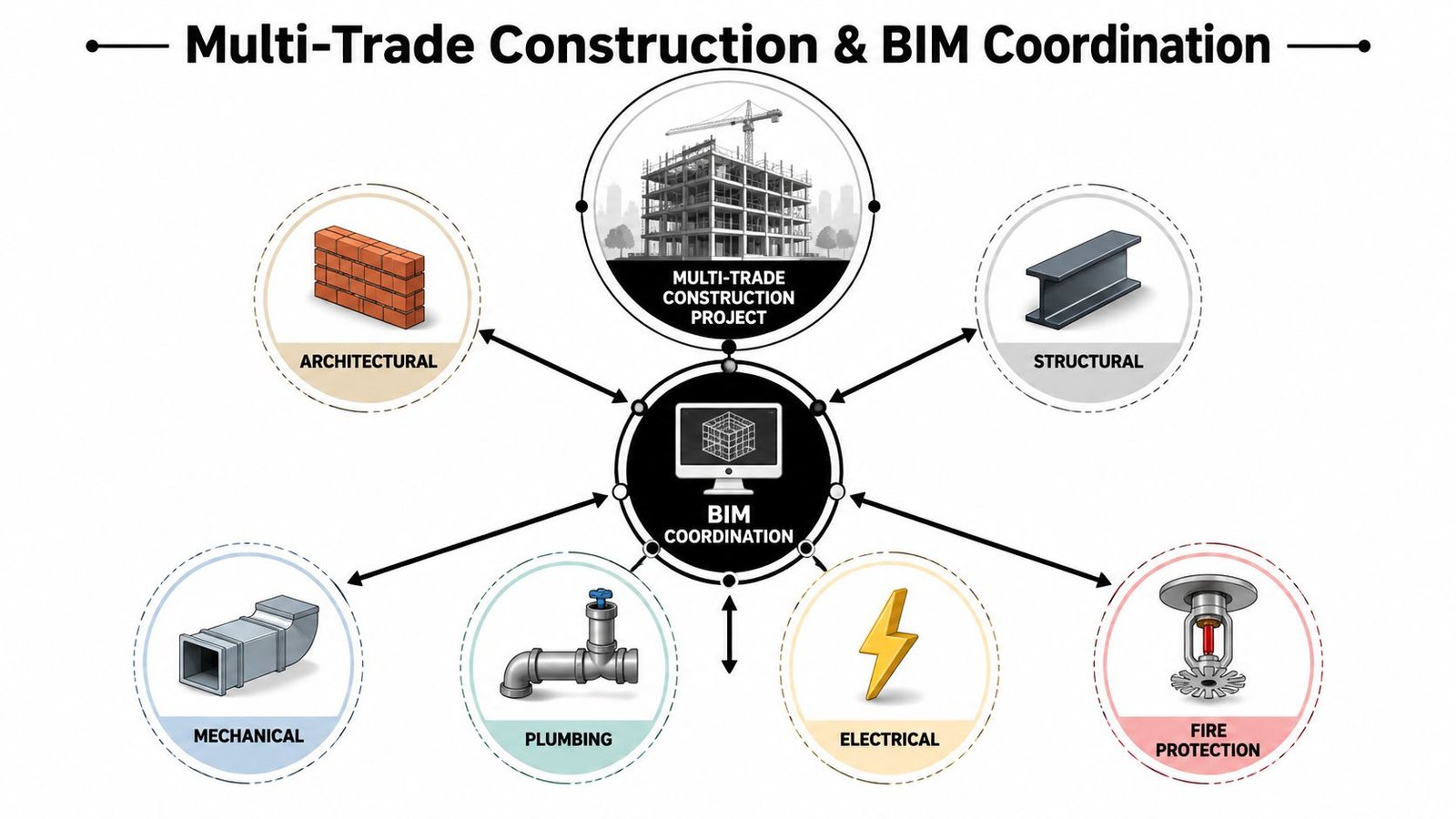
How a federated model works
Each discipline generally authors its own model. A Revit architectural model, structural model, and MEP or fire protection model can be linked into a coordination environment such as Navisworks Manage, Autodesk Construction Cloud, Trimble Connect, or Solibri.
The result is a federated model, not a single merged native file. Each trade retains ownership of its source model, while the coordination team references current versions in a shared environment. This distinction matters because trade authors must continue developing their discipline work without losing responsibility for design intent, calculations, or fabrication decisions.
A useful federation depends on basic controls:
- Shared coordinates: Models must align spatially, or clash results become unreliable.
- File naming and versioning: The team needs to know which model is current.
- Scope boundaries: Each trade needs a defined area of responsibility.
- LOD and LDM expectations: Models need enough geometric certainty to resolve coordination issues, but not every element requires fabrication-level detail at every stage.
- Review zones: Corridors, shafts, cores, equipment rooms, and congested ceilings deserve focused attention.
The Level of Development and Level of Model Definition should support the decision being made. A model may be sufficient for route coordination without containing every hanger, connector, or manufacturer-specific component. Requiring excessive detail too early can slow production, while insufficient geometry can hide the very conflict the team needs to resolve.
For commercial work, coordination also has a code dimension. The 2024 International Energy Conservation Code is the latest IECC edition published by the International Code Council, and ASHRAE Standard 90.1 is referenced by the IECC for commercial buildings. Energy and mechanical requirements must be reflected accurately in coordinated models and construction documentation, not treated as separate compliance paperwork.
Why Multi-Trade Projects Fail Without Coordination
A corridor can look ready for installation while still being impossible to build. The ceiling height is fixed, the structure limits the available volume, and every trade has a route, access requirement, and sequence to protect. Once several crews enter the same zone, an unresolved conflict affects more than geometry. It can block access, delay predecessor work, consume shared equipment, and force follow-on trades to wait or work around incomplete scope.
Trade stacking becomes expensive when the team manages dates without managing the work zone. Mechanical systems may need large-radius transitions and service clearance. Electrical and plumbing routes compete for the remaining space, while fire protection needs a compliant, maintainable path. Architectural finishes define the visible result, and structural framing sets hard limits above the ceiling. If those conditions are not reviewed together, the field team ends up negotiating the ceiling-to-deck space after materials and labor are already committed.
The productivity figures cited in Section 1 do not isolate BIM coordination as a cause of project performance. They do support a practical conclusion: firms need project-level controls instead of expecting broad industry modernization to resolve site-specific conflicts. A planned zone review has a defined owner, decision date, and release condition. A late clash has uncertain effects on fabrication, inspection, close-in work, labor, and supervision.
Coordination also fails when nobody owns the issue after detection. A clash report can identify an intersection, but it does not decide which system moves, confirm the design remains acceptable, or verify that the change reaches fabrication and field teams. Assign each issue to a named trade owner, record the proposed resolution, set a due date, and keep it open until the revised condition is reviewed. That issue-to-resolution trail protects the schedule more effectively than a one-time clash count.
| Control area | Managed coordination | Unmanaged coordination |
|---|---|---|
| Work zones | Access, sequence, and trade interfaces are reviewed before release | Crews negotiate conflicts after installation begins |
| Issue ownership | Each conflict has a responsible trade, due date, and status | Items remain in reports without a decision owner |
| Field impact | Source models and affected details are updated before work proceeds | Installed work may be removed, revised, or worked around |
| Schedule control | Releases depend on verified conditions and closed issues | Follow-on trades wait for decisions or incomplete scope |
| Margin protection | Coordination is planned as production work | Labor, equipment, and delay costs appear reactively |
The trade stacking guidance supports zone-based planning and active daily coordination for access conflicts, sequence dependencies, shared equipment, and safety interfaces. The practical distinction is governance. A schedule lists when crews should work. Managed coordination establishes who can release the zone, which issues must be closed first, and how the team proves the condition is ready.
The Coordination Workflow From Federated Model to Issue Resolution
A reliable coordination cycle starts before the first clash test. The BIM Execution Plan or equivalent project standard should define model ownership, LOD expectations, file standards, publishing dates, coordination zones, issue classifications, and meeting cadence. Without those controls, the coordination team spends its time debating process instead of resolving construction conditions.
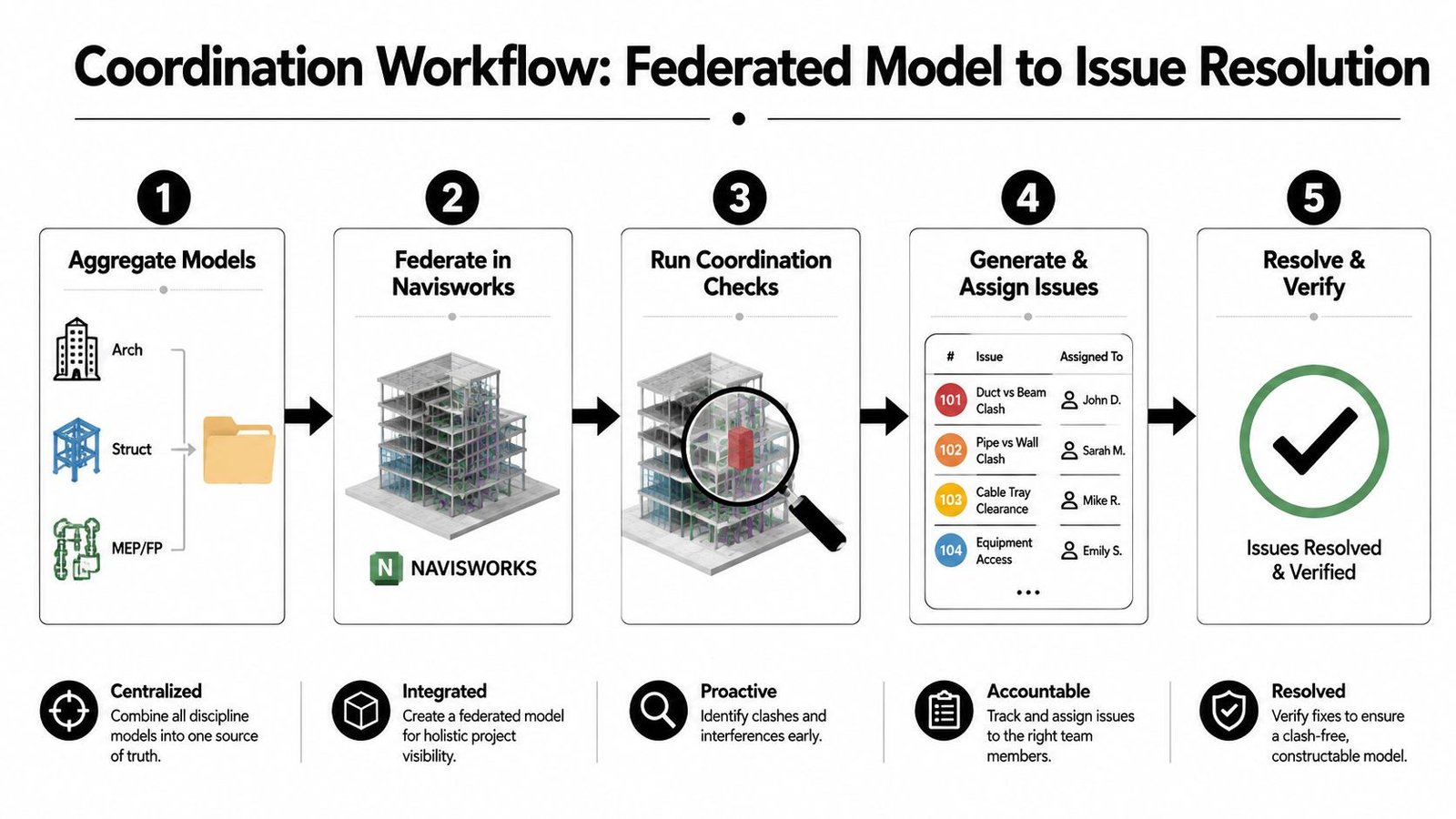
1. Aggregate current discipline models
Collect the architectural, structural, mechanical, electrical, plumbing, and fire protection models required for the review. In Navisworks Manage, the coordinator can append the current files into a controlled review set. In Autodesk Construction Cloud, the team can manage published versions and coordinate access through a common data environment.
The federation should include a quick integrity check. Confirm coordinates, model units, file dates, linked references, levels, and scope boundaries before interpreting any clash result.
2. Build the clash matrix
A clash matrix defines which systems should be tested against one another and how the team will classify the result. It prevents the coordinator from treating every intersection as equally urgent.
A practical matrix separates:
- Hard clashes: Physical intersections that can't be installed as modeled.
- Soft clashes: Required clearance, access, maintenance, insulation, or code separation violations.
- Workflow checks: Sequence conflicts, incomplete predecessor work, access paths, and equipment replacement requirements.
The matrix should identify the responsible trade, priority, tolerance, review zone, and required response. A clearance issue around a serviceable valve may require a different response from a direct duct-beam intersection, even when both appear as geometric conflicts.
3. Run zone-based tests
Run checks by floor, room, corridor, shaft, or equipment area. Zone-based reviews make meetings actionable and expose the areas where several trades must make a coordinated routing decision.
4. Assign issues during coordination meetings
Each accepted issue needs a named owner, a due date, a proposed resolution, and enough location context for the trade to act. A meeting is productive when representatives decide who changes what, rather than reviewing a growing list of red markers.
5. Re-run and verify
A clash is not closed because a subcontractor says it moved an element. The coordinator must publish or retrieve the updated source model, re-run the relevant test, confirm that the original issue is resolved, and check that the change didn't create a new conflict elsewhere.
The final deliverables should include the federated model, clash matrix, issue log, clash reports, back-check model, and field-facing installation packages. That record gives the GC and BIM manager a defensible connection between model decisions and field release.
Clash Detection Is Not the Same as Managed Coordination
A federated model can produce a polished clash report while crews still arrive at an unresolved condition. Software identifies intersections. Project controls determine which trade revises the work, whether the conflict falls within the approved tolerance, how the change affects access and sequence, and whether the revised model has been checked against adjacent systems.
That distinction affects cost. Unresolved coordination issues can cost up to 10 times more to correct during construction than during design, according to the industry guidance cited in the verified coordination reference (multi-trade coordination guidance). The return comes from making the decision upstream and controlling it through closure, rather than producing a longer PDF.
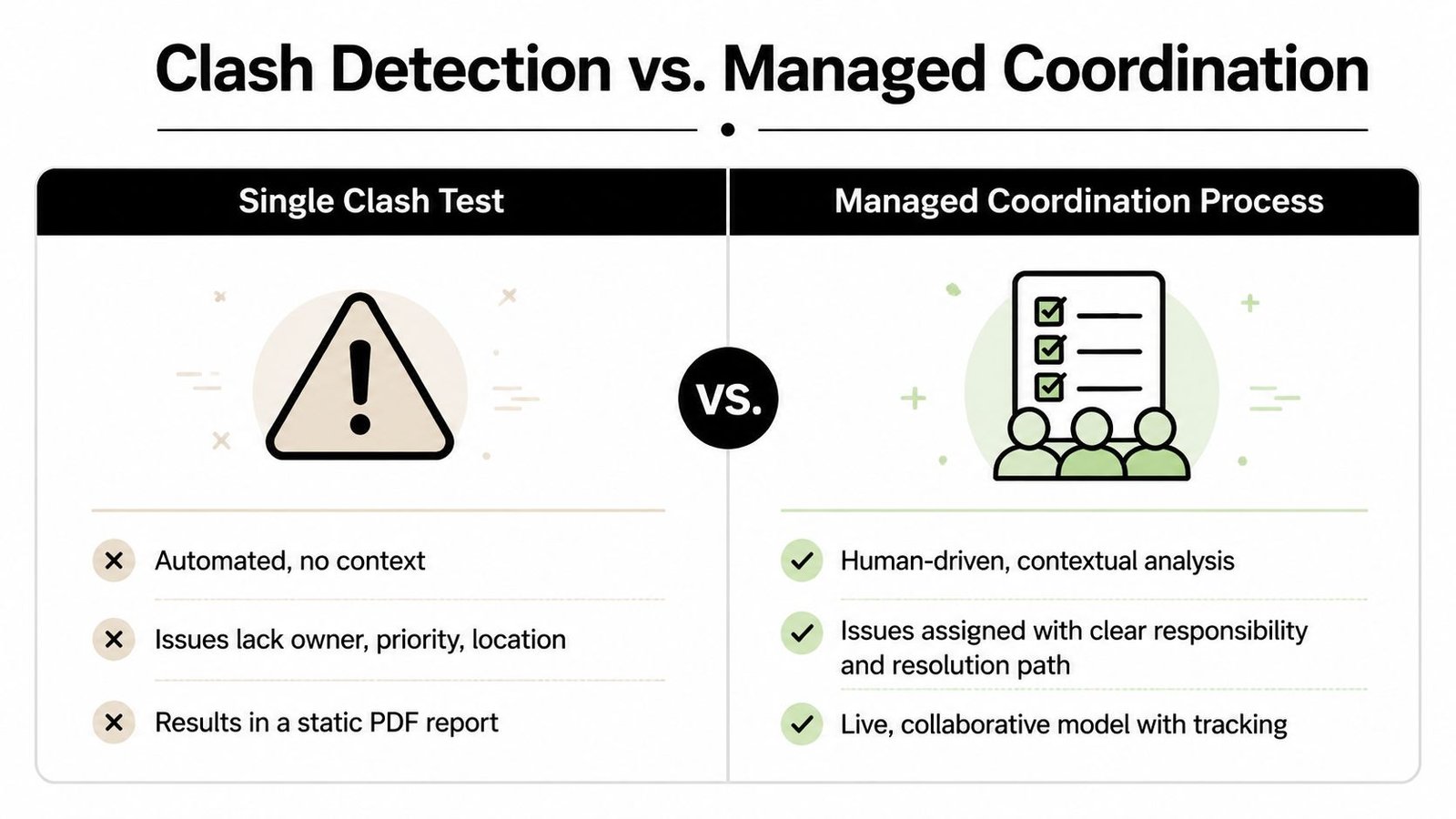
The checkbox approach
A weak process usually follows a short sequence:
- One model export: The team federates models once, often with inconsistent update dates.
- One clash run: Automated tests generate results without a clear matrix or zone priority.
- Static reporting: Issues sit in a PDF or spreadsheet with no accountable owner.
- No source-model feedback: The report does not establish who revises the native model.
- No verification: The team treats a reported fix as resolved without rerunning the relevant test.
The result looks controlled but leaves installation decisions exposed. As the list grows, teams begin accepting unresolved conditions because nobody has assigned the work or set a review path. Tolerance then becomes an informal excuse instead of a documented project decision.
What managed coordination adds
Managed coordination uses the model as a live production control. A standing team reviews conflicts by zone, assigns responsibility, records the decision, and verifies each revision. The coordinator tracks the physical conflict alongside the selected route, required clearance, installation sequence, and effect on neighboring systems.
The clash detection BIM workflow should include a shared issue log with statuses such as open, assigned, in progress, submitted for review, verified, and closed. Each record needs a location, screenshot or viewpoint, priority, owner, due date, and resolution note. Named ownership matters because a trade cannot act on an issue that has no assigned decision-maker.
Coordination rule: An issue is closed only after the updated model passes the relevant check.
BIM coordination guidance recommends named owners and deadlines in a shared issue log, zone-based reviews of congested areas, and a defined cadence for publishing and retrieving the latest federated model (BIM coordination issue management guidance). Those controls connect model decisions to field release and help reduce RFIs and rework.
Clash detection surfaces conflicts. Managed coordination closes them through governance, ownership, and verification. The difference is what the team does after the report.
A Practical Multi-Trade Coordination Workflow for US Firms
A mechanical room can be fully modeled and still fail in the field if ownership, release timing, and installation decisions remain unclear. A mid-sized US GC needs a defined workflow more than an elaborate one. Clarity on responsibility and review cadence protects production better than process complexity.
Start with a BIM Execution Plan and trade scope matrix before fabrication begins. Name the people responsible for architectural, structural, MEP, fire protection, specialty, and field-installation decisions. The plan should identify who publishes each model, who reviews issues, and who accepts a coordinated zone for release. The BIM Execution Plan resource should connect these rules to the project decision calendar. Without publish dates and field release gates, the coordination process remains detached from schedule control.
Establish the production rules
Set the model-sharing standard before the first exchange:
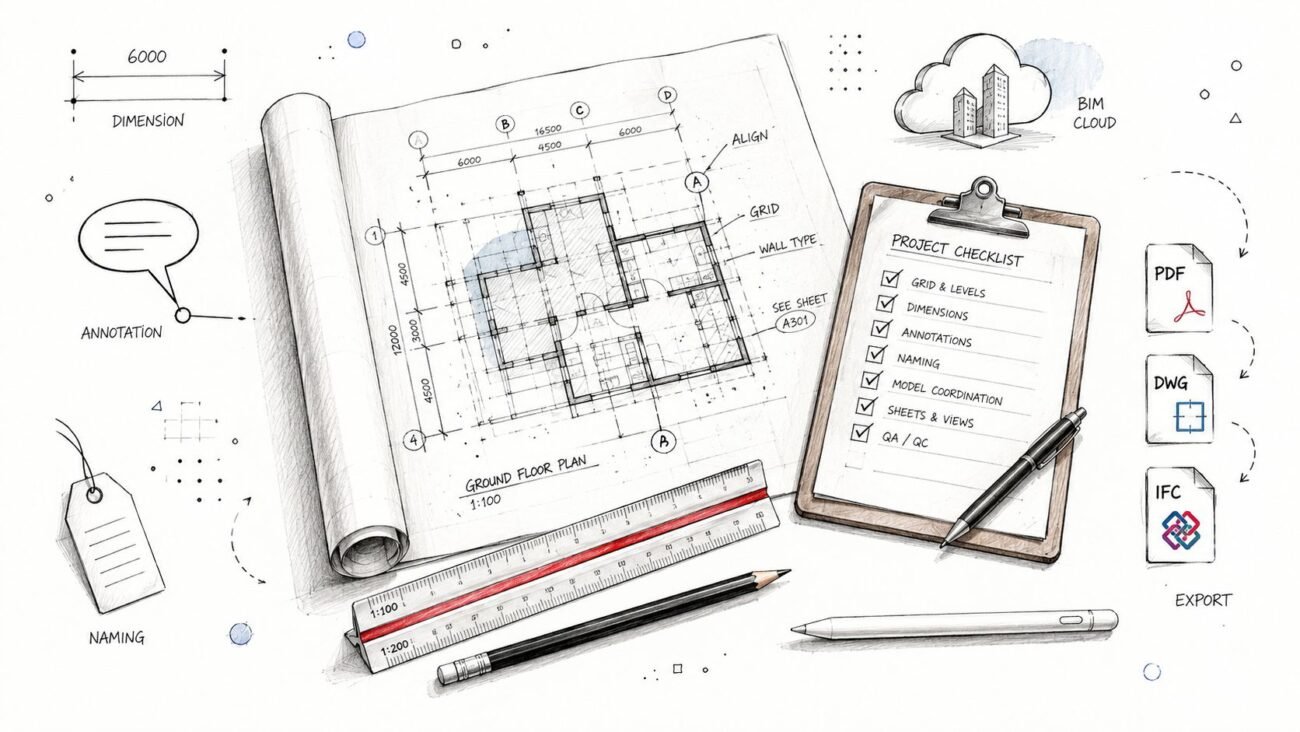
- File naming: Include discipline, zone or building area, revision, and publish status.
- Coordinates: Confirm the shared origin, survey basis, levels, and rotation.
- Worksharing: Define who edits source models and who publishes coordination versions.
- Model content: State the LOD or LDM expected for each milestone.
- Zone boundaries: Divide the project into floors, wings, cores, shafts, corridors, and equipment rooms.
These rules support zone-based reviews rather than a single project-wide clash report. They also give the team a consistent basis for checking whether a model is ready for fabrication, installation, or field release.
Use a repeatable weekly cadence
A practical cycle includes model aggregation, integrity checks, zone-based clash runs, issue assignment, trade revisions, and back-check verification. Keep the meeting focused on decisions. A 60- to 90-minute format can work when the right trade representatives attend, priority issues are reviewed first, and every discussion ends with a named owner and deadline.
Set response windows before an unresolved issue threatens a release. Some projects use 48- or 72-hour windows for trade responses, while the appropriate interval depends on the contract, fabrication lead time, and installation sequence. Record the agreed standard in the coordination rules, then track exceptions instead of allowing them to disappear in meeting notes.
Define the deliverables
A disciplined package includes:
- Federated coordination model, with current source references.
- Clash matrix, including system pairs, tolerances, and priorities.
- Weekly issue log, with owners, due dates, statuses, and resolution notes.
- Updated composite model, issued after revisions and verification.
- Field-ready installation packages, aligned with the coordinated condition.
An outsourced BIM production pod can support this workflow while trade authors retain responsibility for their systems. The in-house BIM manager or GC keeps project authority. The production team can aggregate models, run checks, prepare viewpoints, maintain issue records, and perform back-checks. BIM Heroes is one example of a production partner providing BIM modeling and coordination support across architectural, structural, and MEP systems.
The handoff must assign responsibility for issue progression, review ownership, response expectations, model standards, and zone acceptance. A report alone does not protect the schedule. Verified decisions tied to field release do.
KPIs and Common Pitfalls in Multi-Trade Coordination
Leadership needs more than a statement that coordination is going well. The team should be able to show whether issues are being resolved, whether RFIs are changing, and whether the model is arriving in time to support fabrication and installation.
Track the open versus closed clash count, closure cycle time, RFI volume by trade, rework hours, schedule slip on MEP-intensive activities, and the time between a trade model update and its appearance in the federated model. Secondary signals can reveal process weakness earlier. Meeting overruns, repeated resubmittals, stale model versions, and issues reopened after verification all deserve attention.
What the dashboard should reveal
| KPI | Target Benchmark | Common Pitfall That Causes Failure |
|---|---|---|
| Open versus closed issues | The open list should trend down by zone and release milestone | Teams report total clashes without separating new, assigned, verified, and overdue issues |
| Clash closure cycle time | The project should establish a response and verification standard | No due date leaves trade representatives free to defer decisions |
| RFI volume by trade | Track changes against the project's own baseline and affected zones | The team counts RFIs without identifying whether coordination could have prevented them |
| Rework hours | Record field rework against the approved coordination baseline | Labor and equipment impacts remain buried in general production costs |
| MEP-intensive schedule slip | Compare planned and actual zone release dates | The schedule hides coordination delays inside broad activity durations |
| Model federation latency | Keep the gap between trade publication and coordination review visible | The coordinator reviews outdated files and creates false confidence |
| Resubmittal rate | Monitor repeated submissions after coordination review | Poor source-model QA causes the same issues to return |
The table uses project-specific benchmarks, not invented universal performance targets. A mature team establishes its baseline early, then reports movement to the project manager, operations leader, and executive team. ACC issue records, Navisworks test results, and the project schedule can provide the underlying evidence when naming and status rules remain consistent.
Governance failures that quietly erase value
The most common breakdowns are procedural:
- No clash matrix: The coordinator runs broad tests without agreed priorities or tolerances.
- Orphaned issues: A screenshot exists, but no trade owns the revision.
- Tolerance creep: Teams dismiss conflicts because the list is inconvenient rather than deciding whether the condition is acceptable.
- Early closeout: Coordination ends at issue-for-construction even though fabrication, substitutions, RFIs, and field changes continue.
- Missing architectural or structural review: MEP routes get optimized without checking ceiling, framing, access, or finish implications.
- Outsourced detection without closure: A production partner delivers a report, but nobody binds the team to revision and verification.
QA should also be staged before issuance. A practical BIM production workflow can use five gates: model standard review, LOD compliance assessment, clash detection, issue tracking and resolution, and a pre-issuance QA gate (BIM QA workflow guidance). That sequence gives project leaders checkpoints they can inspect instead of relying on a general promise that the model is coordinated.
For renovation and retrofit work, coordination starts with reliable existing conditions. A point cloud can reveal structural offsets, existing MEP congestion, and clearance constraints that 2D records miss. When that information is converted into a controlled model, scan-to-BIM work becomes part of the same issue-to-resolution workflow rather than a disconnected survey deliverable.
BIM Heroes supports GCs, architects, MEP firms, and scanning companies with managed multi-trade coordination, clash detection, Revit production, and point-cloud-to-model workflows focused on buildable deliverables. If you need a coordination scope for an active project, BIM Heroes can review your models, define the required checks, and help you send the right data for a clear production plan.