"What kind of roof should we do?" It’s one of the first questions a client asks during schematic design, and the answer is more complex than it looks. The choice of roof form is one of the earliest and most consequential decisions in residential architecture. It impacts structural complexity, construction cost, energy performance, drainage, wind resistance, and the entire character of a home.
Two roof types dominate U.S. residential construction: the gable roof and the hip roof. Both are widely used, both have genuine strengths, and both have real limitations. Choosing between them isn't about which is universally "better"—it's about understanding which performs better under your specific conditions and project goals.
This post gives architects and builders the framework to make that call confidently. It's about making a mature decision that balances aesthetics with the hard realities of climate, structure, and budget, ensuring predictability from design through permitting.
Understanding the Two Roof Types
Before diving into a direct comparison, let's establish a clear, technical definition of each roof form. Getting the terminology right is the first step in a disciplined design and documentation process.
Gable Roof
A gable roof has two sloping sides that meet at a central ridge, creating triangular wall sections—the gable ends—at each end of the building.
- It is the simplest and most common roof form in U.S. residential construction.
- Variations include cross gable, Dutch gable, and front-facing gable configurations.
- Characterized by its clean geometry, straightforward framing, and strong visual presence on the street elevation.
Hip Roof
A hip roof is a design where all four sides slope downward to the wall plate, with no vertical gable ends.
- The geometry is more complex, requiring hip rafters at each corner and a more involved framing layout.
- Variations include the pyramid hip, half hip, and the more complex mansard roof.
- Characterized by a lower, more horizontal profile and a uniform appearance from all elevations.
Climate Performance: Where Each Roof Type Excels
The most critical factor in choosing a roof form is often the local climate. A design that works perfectly in one region can be a liability in another. This isn't just about code compliance; it's about building for resilience and protecting the owner's investment.
High Wind and Hurricane Zones
Hip roofs significantly outperform gable roofs in high-wind environments. The aerodynamic geometry distributes wind loads more evenly across all four sloping sides, preventing pressure from building up on any single surface. There are no large, flat gable ends to catch the wind.
Gable ends are a known structural vulnerability. They act like a sail, and the failure of a gable end wall during a hurricane or high-wind event can lead to progressive structural collapse. The International Residential Code (IRC) and state-specific codes like the Florida Building Code mandate additional bracing for gable end walls precisely because of this risk.
For projects in coastal and hurricane-prone markets like Florida, the Gulf Coast, and the Carolinas, a hip roof is the clear choice for margin protection and risk reduction.
Snow and Cold Climates
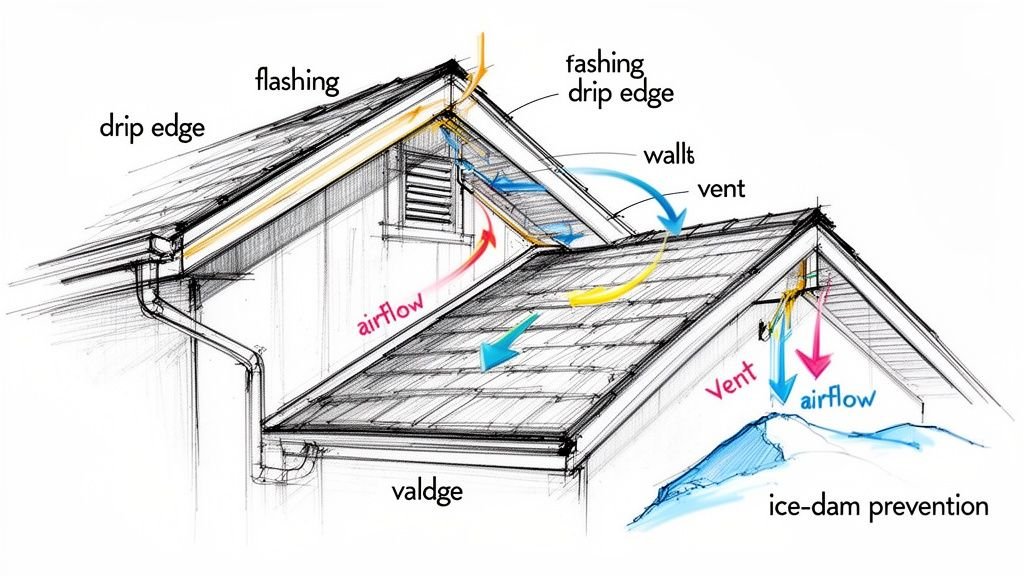
Steeper gable roofs perform exceptionally well in heavy snow regions. The simple, steep pitch sheds snow load efficiently. More importantly, the straightforward geometry is easier to detail correctly for ice dam prevention, a common and costly failure point.
While hip roofs can be designed for cold climates, their complex geometry creates more challenging airflow paths, requiring more careful attic ventilation design to prevent condensation and moisture buildup. For production efficiency and reliability in snowy regions, the gable roof is often the simpler, more predictable solution.
Hot and Dry Climates
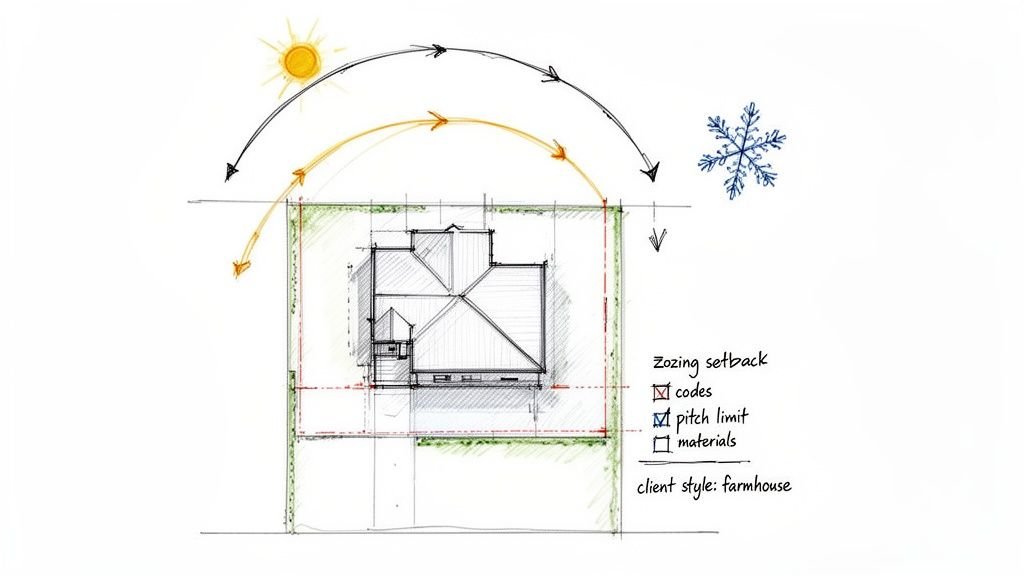
Here, the primary concern is managing solar heat gain. Hip roofs provide more consistent shading on all four elevations due to their built-in overhangs on every side. This can be a significant advantage in hot climates.
Gable roofs with deep overhangs can achieve similar shading on the long elevations but leave the gable ends more exposed to direct sun. Ultimately, in hot climates, building orientation and overhang depth often matter more than the roof form itself.
Rain and Moisture
Hip roofs inherently eliminate a common water infiltration point: the gable end wall. The intersection of the rake board, siding, and soffit on a gable roof is a frequent source of water intrusion if not detailed and executed with precision.
Hip roofs drain to all four sides, which can simplify gutter layout on a simple rectangular plan. By having no exposed vertical end walls, they present fewer opportunities for wind-driven rain to find a path into the building envelope.
Structural Behavior and Framing Complexity
The choice between a gable and hip roof has profound implications for the structural system and framing layout. This directly impacts labor costs, material orders, and the complexity of your construction documents.
Gable Roof Framing
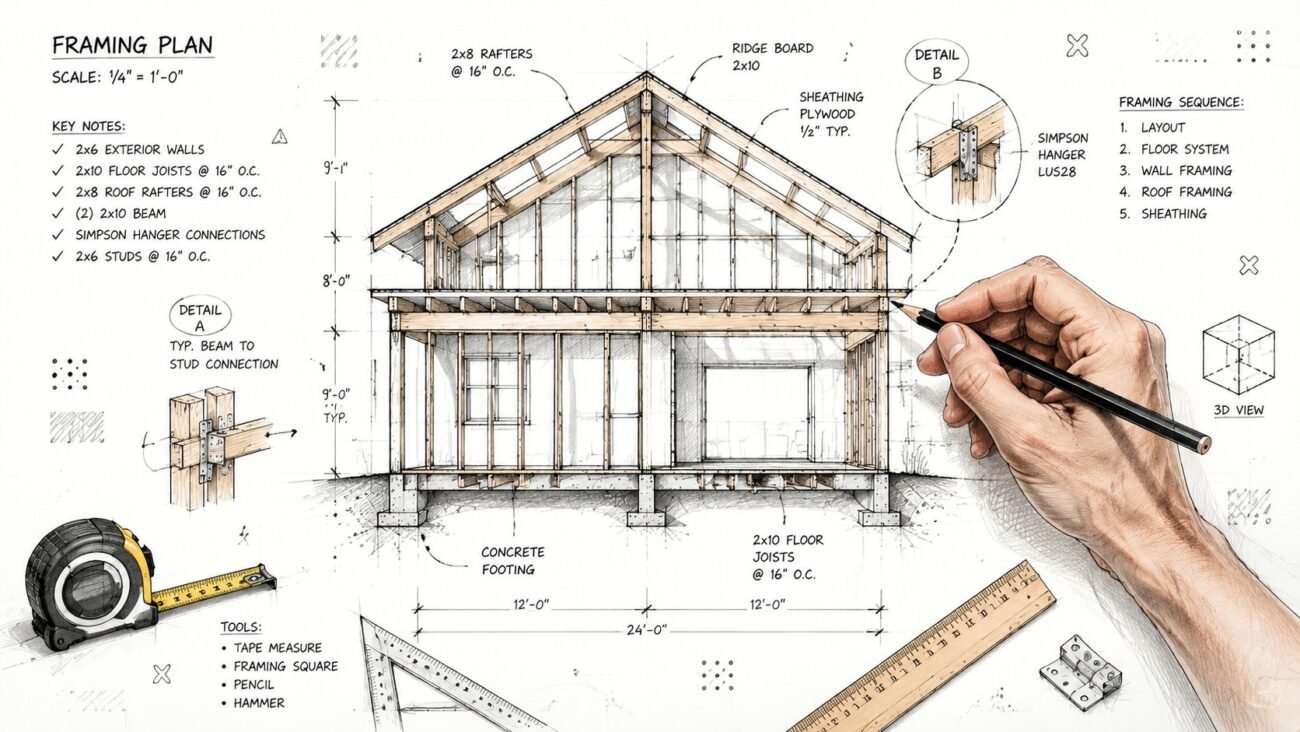
The framing geometry is relatively simple: common rafters, a ridge board or ridge beam, and ceiling joists or collar ties to resist outward thrust. The gable end wall is typically a non-structural infill element that only carries its own weight.
- Simpler to engineer, document, and frame.
- The main structural consideration is the ridge—a non-structural ridge board requires ties to prevent walls from spreading, while a structural ridge beam eliminates thrust but requires posts and a robust load path to the foundation.
- The primary structural vulnerability is bracing the gable end wall against lateral wind loads, a critical detail in high-wind zones that must be clearly documented to prevent RFIs.
Hip Roof Framing
Hip roof framing is significantly more complex. It involves hip rafters at each corner carrying load diagonally, jack rafters filling in the spaces, and valley conditions where roof planes intersect.
- The geometry is inherently self-bracing, providing better resistance to lateral loads without large, unbraced end walls.
- More complex to engineer and document accurately. Framing plans must clearly show hip rafter sizes, jack rafter layouts, and precise ridge length calculations.
- This complexity extends to BIM workflows. Modeling hip roofs in Revit, especially on irregular footprints, requires more experienced modelers and a rigorous QA process to ensure the geometry resolves correctly. This is a classic area where underestimating production time leads to budget overruns.
Cost Implications
For architects advising clients and builders pricing jobs, the cost difference between these two roof types is a major decision driver. The contrast is clear across materials, labor, and long-term maintenance.
Material and Labor Costs
A hip roof consistently costs more than a gable roof.
- Material Costs: Hip roofs require more framing material (hip rafters, more jack rafters) and have a larger surface area for the same building footprint. This translates to more sheathing, underlayment, and roofing material. The premium for a hip roof can be 15% to 30% higher for materials alone.
- Labor Costs: The complex geometry of a hip roof takes more time and requires more skilled labor to lay out and frame accurately. Gable roofs are faster to frame and more forgiving of minor layout errors. This is a direct hit to the labor budget.
Long-Term Maintenance and Usable Space
Hip roofs often have lower long-term maintenance costs. With no exposed gable ends, there are fewer areas prone to water intrusion and less exterior trim to maintain and repaint.
However, this comes at the cost of attic space. Gable roofs provide significantly more usable attic volume due to their continuous triangular cross-section. This is a key consideration if the client wants attic storage or envisions a future attic conversion. The reduced volume in a hip roof makes it less suitable for these purposes.
Aesthetic and Design Considerations
Beyond performance and cost, the roof form is a primary driver of a home's architectural character. The choice often comes down to the desired style and massing.
- Gable roofs create a strong visual presence with their iconic triangular end. This form is a staple of Traditional, Farmhouse, Craftsman, and many Contemporary styles. It also makes incorporating dormers and achieving dramatic vaulted ceilings along the ridge line much simpler.
- Hip roofs present a lower, more horizontal profile. This makes them well-suited for Ranch homes, as well as Mediterranean and Prairie styles where a quieter, less imposing roofline is desired. On buildings with irregular footprints, the consistent slope of a hip roof can tie complex plan shapes together more gracefully.
While cross-gable configurations can add interest to a simple gable form, they also introduce valleys. These add cost and complexity, creating another parallel to hip roof systems where every intersection requires careful detailing in both the BIM model and the final Construction Documents.
Documentation and BIM Modeling Complexity
For a production-focused firm, the documentation effort is a critical factor. The complexity of the roof directly translates to modeling hours, QA time, and potential for errors.
From a production standpoint, gable roofs are significantly simpler to document. The geometry is predictable, the framing plan is straightforward, and the required sections are standard.
Hip roofs demand more from your production team. They require more detailed framing plans, more sections to describe the complex geometry, and more careful coordination at the wall plate. In Revit, errors in a hip roof model tend to compound; a slight mistake in a boundary line or plate height can cause incorrect geometry at multiple intersections.
The implication for production management is clear: hip roof projects require more hours, more experienced modelers, and a more stringent QA process. Teams that budget documentation time based on gable roof assumptions consistently run into trouble, threatening both schedule and margin. This is where template discipline and established workflows for complex geometry become essential for scalable delivery.
How to Choose: A Decision Framework
To help guide the conversation with clients and your internal team, use this decision framework. It's not a set of rigid rules, but a series of checkpoints to ensure you're making a choice that aligns with the project's core priorities.
- If the project is in a high-wind or hurricane zone: A hip roof is strongly preferred and potentially required by code.
- If the budget is the primary constraint: A gable roof delivers comparable performance in most climates at a lower cost and complexity.
- If the architectural style calls for a strong street presence or traditional character: A gable roof is the classic choice.
- If the design requires a lower, quieter roofline or has an irregular plan: A hip roof often provides a more elegant solution.
- If usable attic space and future conversion potential are important: The gable roof is the clear winner.
- If minimizing long-term maintenance is a top priority: A hip roof generally offers better durability.
- If the design involves complex intersections or dormers: Be prepared for the documentation and framing cost premium, regardless of the primary roof form.
How BIM Heroes Supports Residential Roof Documentation
At BIM Heroes, we specialize in creating precise, buildable construction documentation for residential projects of all complexities. Our teams understand the nuances of both gable and hip roof design, from early massing in the BIM model to the final framing callouts.
We act as an embedded production partner for U.S. architects and home builders, producing roof framing plans, sections, and details that are ready for permitting and construction. Our experience with complex Revit roof modeling and deep knowledge of IRC framing requirements means we deliver documentation that prevents RFIs and protects your project's profitability. We don't just model; we deliver clarity and operational consistency. For a closer look at our approach to structural drawings, see our guide on wood framing construction documentation.
The Right Roof for the Right Job
The question is never simply "gable or hip?" The right answer depends on where the project is, what the budget allows, what the design demands, and how the building will be used. Both roof forms have earned their place in American residential architecture for good reasons.
The architect's job is to understand those reasons well enough to recommend the right solution for each unique project—and to document that decision with enough precision that it gets built correctly. That’s where a mature production process and excellent documentation make all the difference, turning a good design into a successfully built reality.
Working on a residential project with complex roof geometry? Learn more about our services and how we can support your roof framing documentation and Revit modeling needs.