Meta title: Preconstruction Planning: Takeoff, VE, and Scheduling
Meta description: How material takeoff, value engineering, and scheduling interact during preconstruction planning, shown through a real feedback-loop example.
Most advice about preconstruction planning still treats it like a neat checklist. Finish the takeoff. Run value engineering. Build the schedule. Move on.
That's not how real projects behave.
On actual jobs, these decisions keep colliding. A quantity change in the takeoff shifts the estimate. That exposes a cost concentration and triggers value engineering. The VE option changes material choice, trade scope, procurement timing, and coordination demands. Then the schedule pushes back and tells you whether that “saving” is useful or whether it just bought delay somewhere else.
That's why the preconstruction phase matters so much. It's where design intent gets pressure-tested against real cost, real constructability, and real time constraints before crews mobilize. It's also a phase that usually costs only 1% to 3% of total project cost, yet it drives outsized value when teams use it to identify savings and improve construction efficiency before work starts, as outlined in ProjectMark's preconstruction checklist overview.
The teams that protect margin don't manage takeoff, VE, and scheduling as separate tasks. They manage them as one operating system.
The Preconstruction Planning Feedback Loop
The biggest mistake in preconstruction planning is assuming information flows one way.
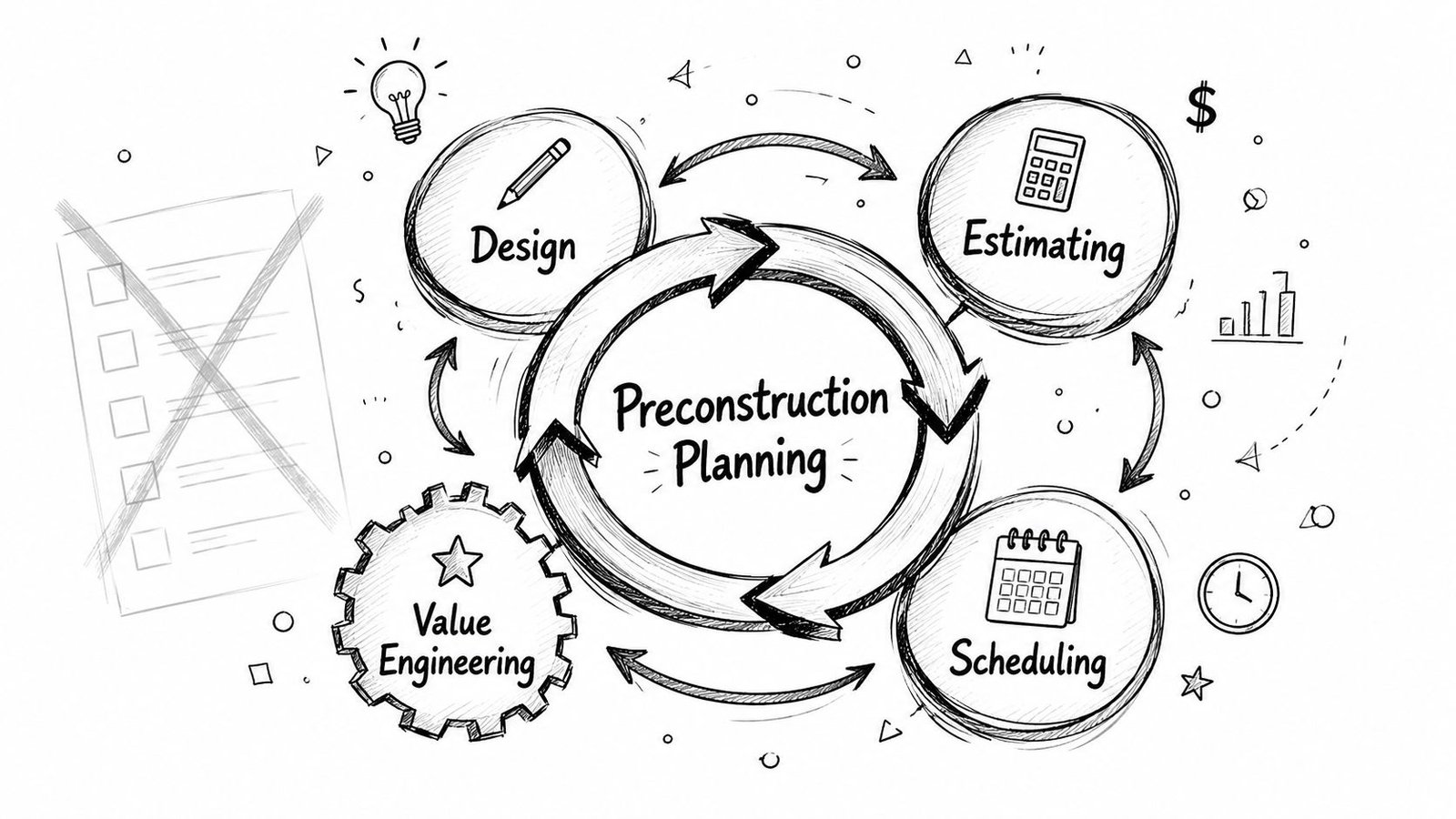
It doesn't. Estimators, VDC leads, project managers, design teams, and trade partners are all working on connected decisions. When one input changes, two others usually need to be checked again. Treating that as a handoff problem instead of a feedback-loop problem is how jobs get approved on numbers that no longer match the scope.
What actually ties these activities together
Material takeoff establishes what the current design is likely to cost.
Value engineering responds to those cost signals and tests alternatives.
Construction scheduling checks whether those alternatives can be delivered in the required sequence and timeframe.
That sounds orderly on paper. In practice, each one keeps revising the others.
Field lesson: A “good” VE option that hasn't been checked against procurement and sequencing isn't a solution yet. It's just a cheaper sketch.
Production maturity becomes evident. Mature teams use model-based quantities, template discipline, decision checkpoints, and QA reviews so the loop runs on current information instead of stale assumptions. Less mature teams keep separate spreadsheets, disconnected model exports, and meeting notes with no closed-loop follow-up. That usually looks fine until procurement, permitting prep, or trade coordination exposes the gap.
Why the loop matters early
Preconstruction planning is where margin is either protected or allowed to slip away. If design assumptions, quantity logic, and schedule logic aren't checked together, the job can look healthy at bid time and underperform later.
The point isn't to create more meetings. The point is to create fewer surprises.
Material Takeoff Establishes the Cost Baseline
A material takeoff converts drawings and models into quantities. Those quantities become pricing inputs, procurement assumptions, crew loading expectations, and budget conversations. If the quantities are wrong, every decision after that inherits the error.
That's why takeoff comes first in the logic of the preconstruction process. You can't engineer value into a design if you don't know where the cost sits. You also can't build a dependable schedule if the quantities behind durations, labor assumptions, and procurement packages are still fuzzy.
Accuracy changes by phase
Early numbers should never pretend to be final numbers. A disciplined estimating workflow tightens accuracy as the design matures. Conceptual estimates are typically developed at ±20% accuracy for feasibility, then refined through schematic design to ±10% accuracy for earlier decisions, as described in this preconstruction planning case-based study.
That progression matters because teams often misuse early quantities. They take a conceptual number and start making downstream commitments as if the scope is locked. It isn't.
What strong takeoff work actually does
Good takeoff work doesn't stop at counting materials. It also surfaces decision risk.
- Scope gaps: Missing assemblies, incomplete system definition, and unclear alternates show up early.
- Cost concentration: Large cost centers become visible before anyone starts “saving money” blindly.
- Model reliability: Quantity confidence tells the team whether the BIM workflow is ready for budget decisions or still needs QA.
For a deeper breakdown of workflows, quantity extraction logic, and common production mistakes, the best next step is this guide to material takeoff workflows.
If your takeoff logic can't survive one design revision without manual cleanup everywhere, the estimate is more fragile than it looks.
The practical rule is simple. Before discussing savings, get the baseline right.
Value Engineering Responds to the Takeoff
Value engineering should be a response to information, not a reflex to pressure.
Once the takeoff shows where cost is concentrated, the team can ask the right questions. Which system is carrying more cost than expected? Which assemblies are overbuilt for the performance target? Which details create fabrication or installation complexity without meaningful project value?
That's real VE. It's function-based, constructability-aware, and grounded in current quantities.
Good VE starts where cost actually sits
A weak VE session starts with broad instructions like “find savings in interiors” or “take cost out of MEP.” A strong one starts with the estimate and the takeoff. It identifies the packages driving variance, then compares alternatives against function, procurement, coordination effort, and installation reality.
That distinction matters because panic-cutting usually creates second-order problems. A cheaper product may drive more RFIs. A different wall build-up may impact detailing, code review, or permit documentation. A system change may reduce first cost but increase coordination complexity across trades.
What productive VE conversations look like
Teams get better results when they test options through a few filters:
- Function stays intact: The option still meets the performance requirement.
- Quantities are traceable: The revised takeoff can be updated cleanly.
- Coordination burden is visible: Architectural, structural, and MEP impacts are known.
- Procurement implications are checked: Lead time and substitution risk are addressed.
For readers who want the deeper decision framework behind this, this article on reducing construction costs through better value engineering covers the mechanics in more detail.
The best VE teams don't ask, “What can we remove?” They ask, “What can we change without breaking cost, schedule, or downstream coordination?”
Scheduling Integrates Cost and Scope Decisions
Scheduling is where preconstruction gets honest.
A construction scheduling exercise isn't just a timeline draft. It's where quantity, sequencing, labor assumptions, procurement timing, permitting prep, and trade coordination have to agree with each other. If they don't, the schedule exposes it.
Integrated preconstruction teams that resolve conflicts before mobilization can achieve up to a 30% reduction in schedule delays and a 7–10% reduction in overall project time, according to FMI's preconstruction article. That benefit doesn't come from software alone. It comes from using schedule logic to test scope decisions before the field pays for them.
The schedule is not the last step
A common mistake is treating the schedule as documentation after takeoff and VE are “finished.” In reality, the schedule should challenge both.
A lower-cost material may have a longer lead time. A system substitution may shift rough-in sequencing. A revised assembly may reduce material cost but increase install duration. Those aren't side notes. They are core planning inputs.
The cheapest option on the estimate sheet can become the most expensive option once trade stacking, access, and lead time hit the sequence.
Where resource planning starts to matter
This is also where labor availability and trade loading become real constraints. If the team doesn't test whether the chosen sequence aligns with actual crew capacity, the schedule turns into wishful thinking. For a broader operational view, this article on mastering resource planning for field services is a useful companion because it frames how allocation discipline affects execution reliability.
Digital workflows help here, especially when 4D logic is connected to scope and model updates instead of living in a separate silo. If you want the scheduling side in more depth, this guide on construction scheduling software and 4D workflows is the right follow-on read.
A Concrete Example of the Feedback Loop in Action
A good way to understand preconstruction planning is to follow one problem all the way around the loop.
Say a design-build team is pricing a mid-sized commercial project. Architectural scope is fairly stable. Structural scope is within expectation. Then the takeoff and estimate review show that the MEP package is materially heavier than the team expected based on the owner's budget and comparable job assumptions.
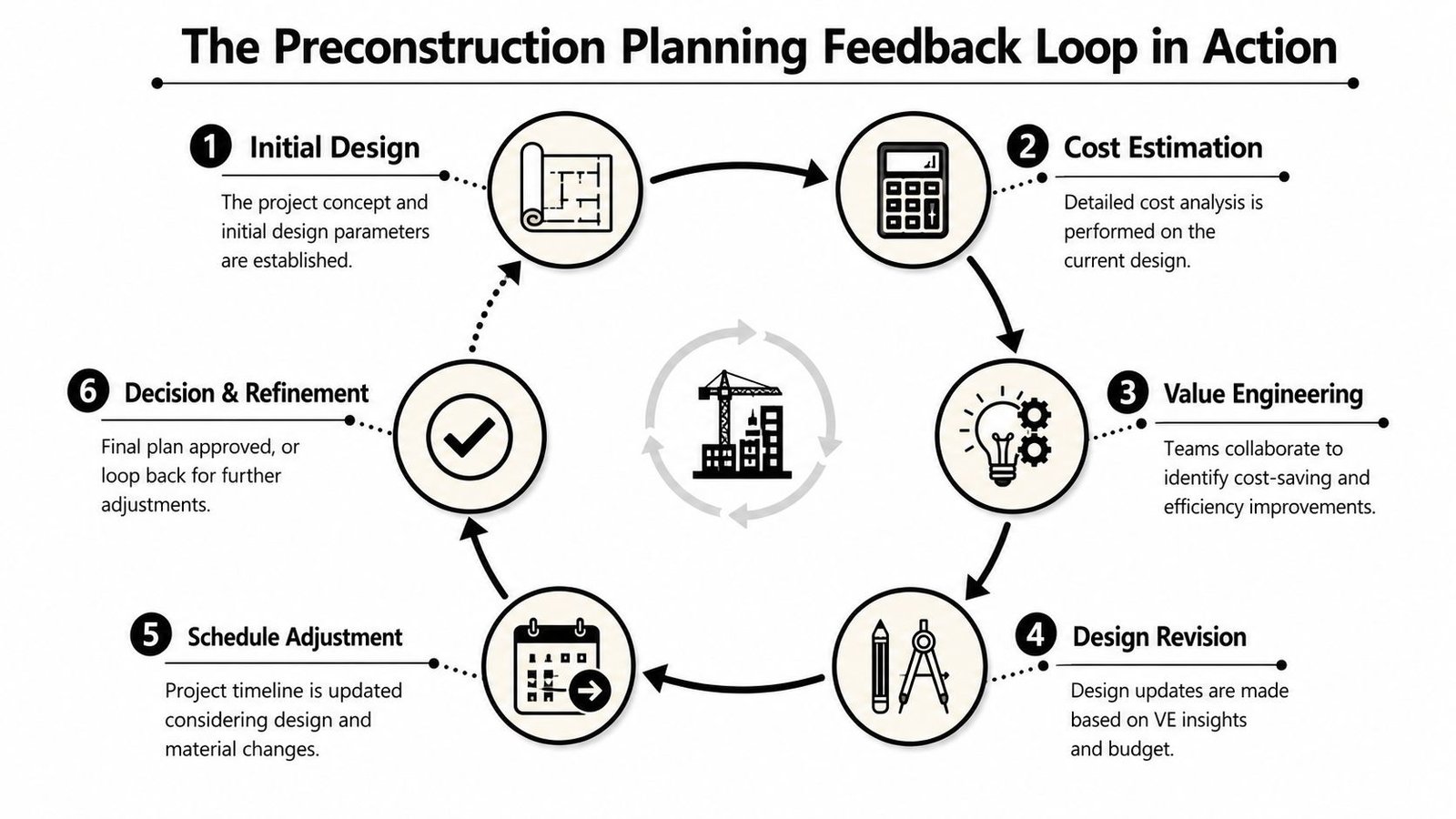
Step one the takeoff finds the pressure point
The issue usually isn't “MEP is expensive.” The useful finding is narrower. The takeoff may show that one portion of the mechanical system, equipment selection, distribution density, or supporting assemblies is pushing cost higher than the rest of the job.
That creates a focused VE target.
At this point, the worst move is to start trimming cost broadly. If the team cuts in the wrong area, they can damage performance and still miss the budget. A better move is to verify the quantities, confirm model coordination quality, and isolate the exact drivers before proposing alternatives.
Step two VE tests alternatives against function
Once the cost concentration is clear, the VE group studies options. On an MEP-heavy job, that might mean revisiting system selection, routing efficiency, equipment strategy, or support detailing. BIM coordination becomes important here because the team needs to know whether the alternative fits the available space and whether it introduces new clashes.
The impact of CAD-to-BIM maturity is evident. If the model is only a visual shell and not dependable for quantity or clash logic, the team is guessing. If the model is coordinated and templated properly, revised quantities and design impacts can be checked quickly and documented cleanly.
Better VE decisions usually come from better model trust, not louder meetings.
The team identifies an alternative system that appears to reduce first cost. On paper, it looks promising. The revised takeoff supports the savings. The owner gets an option worth considering.
Step three the schedule pushes back
Then procurement review and scheduling logic enter the conversation.
The lower-cost option has a longer equipment lead time than the original basis of design. That means the team now has to ask a different question. Can they release procurement earlier? Can other work be resequenced around the delayed equipment? Will finishes, inspections, or commissioning float absorb the shift, or does the whole critical path move?
A mature preconstruction team runs those questions before approving the VE option.
Sometimes the answer is yes. The team can resequence overhead work, lock submittals earlier, and protect downstream milestones. Other times the answer is no. The “savings” disappear because the schedule impact causes acceleration pressure later or creates turnover risk.
Step four the team makes a system decision
This is the point many teams miss. The decision isn't really about takeoff, VE, or scheduling individually. It's about the combined effect.
The best answer might be to keep the original system. It might be to adopt the cheaper alternative with an early release package. It might be to revise only part of the system and leave the most schedule-sensitive components untouched.
That's the feedback loop. One finding changes the next decision, which changes the next constraint, which sends the team back to refine the prior choice.
Why Sequential Handoffs Cause Problems
When teams run takeoff, VE, and scheduling as separate lanes, they create blind spots on purpose.
The estimator finishes a package and hands it off. The VE team marks up savings ideas and passes them along. The scheduler updates durations after the fact. Each group does competent work inside its own box, but the project still underperforms because nobody is managing the interactions.
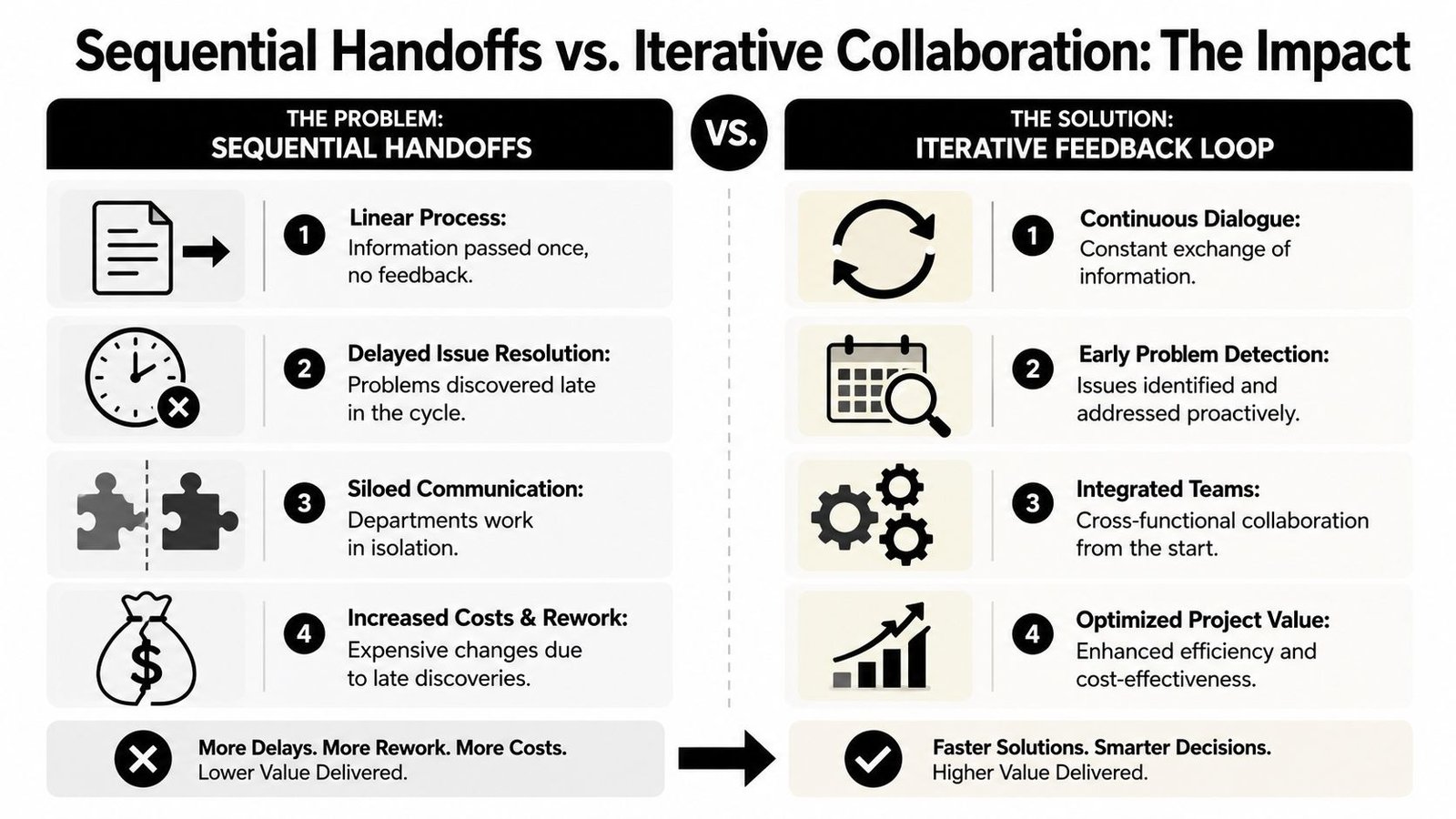
What breaks in a one-way process
Here's how that usually shows up in the field-facing record:
| Sequential handoff problem | What it causes later |
|---|---|
| Takeoff is treated as final before model QA is complete | Cost discussions anchor on bad quantities |
| VE options are approved without coordination review | Scope shifts create RFIs and redesign work |
| Schedule commitments are made before substitutions are settled | Procurement and sequencing conflict later |
| Permit sets move ahead while scope is still moving | Review comments and revisions multiply |
Those issues aren't abstract. Teams without integrated preconstruction processes tend to see higher RFI frequencies tied to design gaps, with a target of keeping RFIs under 1 per $100K of contract value, and they often exceed the target of keeping change order value under 5% of the total contract, as noted qualitatively from the same earlier FMI reference.
The hidden cost of fake savings
A lot of bad VE wins look good for a week.
They reduce a line item in the estimate, but they also create one of these downstream hits:
- More coordination churn: New details, revised families, or fresh clash reviews.
- Permitting friction: Scope changes that don't align cleanly with what's already submitted.
- Trade confusion: Field teams pricing and planning against different assumptions.
- Late procurement stress: A lower-cost item that can't land when the sequence needs it.
A project rarely gets in trouble because one team did nothing. It gets in trouble because each team did its part without closing the loop with the others.
This is also where scalable delivery pods and standardized meeting artifacts matter. Teams need decision checkpoints, issue logs, and ownership trails. Without them, preconstruction becomes a series of partial conclusions.
What Supports an Effective Preconstruction Process
The strongest preconstruction teams don't rely on heroics. They rely on systems.
That starts with dependable data, but it doesn't end there. A coordinated BIM model, clean templates, and consistent QA checks give the team something trustworthy to measure. Then communication routines turn that information into decisions that stick.
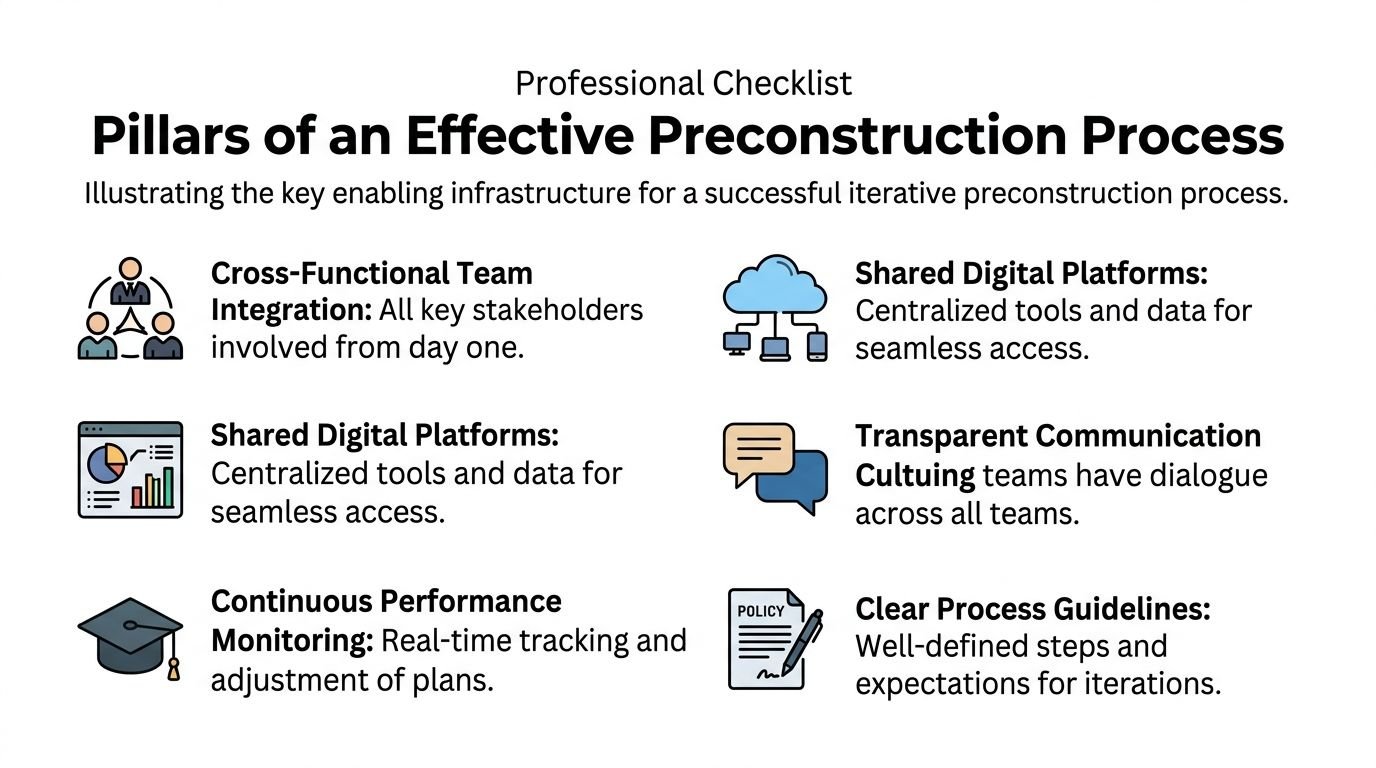
The operating conditions that make the loop work
Disciplined preconstruction teams usually align around measurable targets. A practical benchmark is keeping margin variance under 3% between bid and final margins and targeting a bid-hit ratio of 80% or higher so estimating effort is used efficiently, as outlined by ABC Carolinas on preconstruction planning and margin protection.
Those results are easier to pursue when the process has structure:
- Model quality with purpose: The BIM model isn't just for visuals. It supports quantities, constructability reviews, and revision control.
- Template discipline: Naming, view standards, takeoff logic, and issue tracking stay consistent across teams and projects.
- Decision checkpoints: Major VE options, scope freezes, and schedule impacts are reviewed before they drift downstream.
- QA built into production: Teams verify assumptions before exporting quantities or locking package decisions.
- Permitting prep tied to scope control: Submissions move when the team knows what is stable and what is still open.
- Cross-functional reviews: Estimating, VDC, design, and operations review the same current information.
Technology helps but process carries the result
Software can speed up updates. It can't replace disciplined review.
Navisworks, Revit, model-based takeoff tools, and schedule platforms are useful because they help teams compare options against the same data backbone. But if nobody owns the checkpoints, validates model changes, or tracks unresolved decisions, the tools only make the confusion look more polished.
The practical takeaway is simple. High-quality BIM coordination matters because it supports business decisions, not just drawing output. It's the backbone behind reliable takeoff, useful VE, RFI prevention, and schedule commitments that hold.
Conclusion From Tasks to a System
Preconstruction planning works when teams stop treating material takeoff, value engineering, and scheduling like separate boxes to check.
They're a loop. Takeoff defines the current reality. VE tests smarter options. Scheduling decides whether those options can be delivered without giving the job back in delay, confusion, or rework. That systems view is what protects margin and improves predictability.
If you're tightening your broader preconstruction controls, even adjacent topics like site security planning for active construction environments fit better when they're considered early instead of bolted on later.
For a deeper dive, revisit the linked resources on material takeoff, value engineering, and scheduling. That's where this loop gets sharper.
If your team is working to tighten preconstruction workflows, improve BIM-backed quantity confidence, or build more reliable production systems, BIM Heroes shares practical support across architectural production and BIM consulting. Reach out if you want help with clearer templates, stronger QA routines, or a more dependable preconstruction framework.